
- info@wingeducations.com
- +91 (705) 495-5296
- Mon - Sat : 10.00-18.00
MBA in Product Management is a two-year programme designed to cultivate practical expertise and essential skills in the strategic realm of product development. The MBA Product Management curriculum delves deeply into the strategic aspects of product lifecycle management, market analysis, user-centered design, and innovative problem-solving techniques.
As part of the admission process for MBA in Product Management, eligible applicants are required to hold a Bachelor’s degree from a recognized university with a minimum aggregate score of 50%. A relaxation of 5% is offered to candidates belonging to the SC/ST/PwD category. Universities consider entrance exams such as CAT, MAT, XAT, NMAT, etc. as part of the selection process. MBA in Product Management fees range between INR 15,000 and INR 30 LPA.
Table of Contents
| Degree | Masters |
| Full Form | Master of Business Administration in Product Management |
| Duration | 2 Years |
| Age | No age limit |
| Entrance Exam | CAT, MAT, XAT, NMAT, CMAT |
| Minimum Percentage | A minimum of 50% marks in a Bachelor’s Degree [Relaxations of 5% for reserved category candidates] |
| Average Fees | ₹2 – 15 LPA |
| Average Salary | INR 2 -15 LPA |
| Employment Roles | Consultant, Strategist, Business Development Executive, Administrator, Supply Chain Manager, Product Analyst, Product Marketing Manager |
| Top Recruiters | Amazon, Wipro, TCS, ICICI Bank, Reliance Jio, Flipkart, Bharti Airtel, IBM |
MBA in Product Management equips individuals with essential skills for excelling in the intricate field of product management. Graduates develop business acumen, technical proficiency, strategic thinking, and critical skills like market analysis, prototype creation, and project management upon completion of the course. The course is one of the key specializations under MBA courses. ISBR, Amity University, etc., are some top universities that offer MBA Product Management course.
The job scope for MBA in Product Management in India is broad and students can bag job roles like Product Consultants, Product Managers, Business Development Executives, Purchase Managers, etc., in top companies like Amazon, Wipro, TCS, ICICI Bank, etc.
The general eligibility criteria for MBA in Production Management in most universities and institutions include the following:
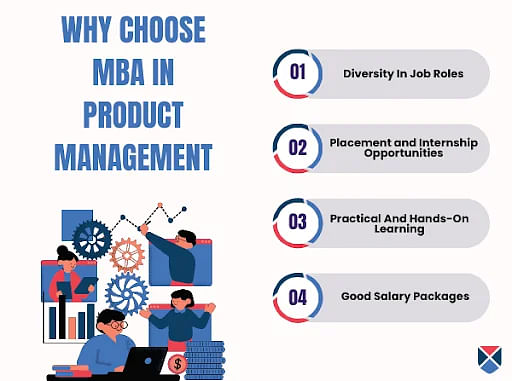
MBA in Product Management equips students not only with a degree but with a potent arsenal of skills that sets them apart as strategic thinkers, innovation drivers, and valuable assets to any organization. Here are some important reasons why students can opt for this program:
Also, Check: Top Reasons to Pursue an MBA
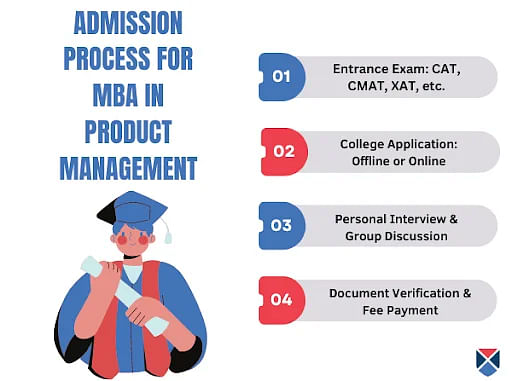
Admission to the MBA in Product Management program is accessible through a combination of entrance examinations and merit-based selection. Numerous universities extend admission options, including direct entry and entrance exam-based routes, for the MBA Product Management course.
Here is an outline of the admission procedure and selection process followed by most universities and institutions:
Application Process:
Selection Process:
The selection process for the MBA in Product Management program is generally consistent across specializations.
Read More on MBA Admission Process
MBA in Product Management course admissions are primarily based on entrance exams conducted at both national and state levels. Various management entrance exams serve as a gateway for admission to reputed institutes offering MBA Product Management programs. Some of the prominent entrance exams for MBA Product Management are detailed in the table below:
MBA Entrance Exam | Registration Date | Accepting Colleges |
Aug 2 – Sep 13, 2023 | ISBR, Amity University | |
Jul 15 – Nov 30, 2023 | ISBR, Amity University | |
Aug 17 – Sep 14, 2023 | ISBR, Amity University | |
February 2024 (Tentative) | ISBR, Amity University | |
Aug 1 – Oct 10, 2023 | ISBR, Amity University | |
Jun 3 – Jul 16, 2023 | ISBR, Amity University |
Some institutions offer an MBA in Product Management, while some institutions offer product management as a specialization in their second-year syllabus. Detailed in the table below is a list of institutions and universities offering this course along with their average fees:
Sl.No. | University | Admission Fee | Miscellaneous Fee | Tuition Fee |
1. | INR 50,000 | INR 1.80 LPA | INR 6.40 LPA | |
| 2. | NICMAR | INR 5,000 | INR 10,000 | INR 5 LPA |
The MBA Product Management syllabus offers a comprehensive and multidisciplinary curriculum, encompassing various management domains to equip students with essential knowledge and specialised skills.
Furthermore, the program emphasizes industry interactions and case-based learning, providing students with valuable insights into contemporary business practices and trends. Like most other specialised MBA programs the curriculum is divided into core and elective courses.
The core courses go beyond imparting practical knowledge; they offer case-based lessons and collaborative learning models, enabling students to develop analytical, decision-making, and leadership skills rather than mere theoretical understanding. Listed below are some core courses in the MBA in Product Management syllabus
Topics Covered | Core Courses |
Foundations of Management | Managerial Concepts, Economy and Policy, Business Ethics, and Methodology. |
Organizational Behaviour | Organizational Behaviour, Organisation Design. |
Product Marketing and Operations Management | Product Market Analysis and Research, Project Management, and Accounting. |
Human Resources Management | Human Resources Management, Managerial Skills for Effectiveness. |
Strategic Product Management | Project Management and Risk, Supply Chain and Logistics, Negotiation and Conflict Resolution, Product Marketing and Branding, Brand Management, Innovation and Design. |
Business Analytics | Business Statistics and Analytics for Decision Making, Data and Analytics, and Advanced Product Marketing. |
Elective subjects in the MBA in Product Management syllabus offer the flexibility to choose courses based on the interest of the student, some of which can be listed as follows
Topics | Subjects Covered |
E-commerce and Digital Marketing | E-commerce Strategy and Implementation, Online Consumer Behavior, Digital Marketing Analytics, Mobile Commerce and Apps, E-commerce Platforms and Technologies |
Technology Trends and Disruption | Emerging Technologies and Business Transformation, Blockchain and Cryptocurrencies, Artificial Intelligence and Machine Learning for Business, Augmented Reality and Virtual Reality in Marketing |
Product Innovation and Design Thinking | Design Thinking and User-Centred Innovation, New Product Development Strategies, Innovation Management and Creativity, Prototyping and Rapid Product Iteration, Managing Innovation Ecosystems |
Digital and Social Media Marketing | Social Media Marketing Strategies, Influencer Marketing and Online Communities, Content Creation and Storytelling, Social Media Analytics and Measurement, Social Media Campaign Management |
Quality Toolkit For Managers | Total Quality Management (TQM), Six Sigma and Lean Management, ISO Standards and Quality Assurance, Quality Control and Process Improvement, Statistical Methods for Quality Management |
Read More: MBA in Product Management Syllabus
To gain a clear understanding of an MBA in Product Management, we can compare it with an MBA in Project Management. These two specialized courses offer unique perspectives within the realm of business management. Given below are the basic differences between the two courses:
Parameters | MBA in Product Management | MBA in Project Management |
Full Form | Masters of Business Administration in Product Management | Master of Business Administration in Project Management |
Overview | MBA in Product Management focuses on creating and managing innovative products and their market success | MBA in Project Management centers around the efficient execution of projects within defined constraints |
Duration | 2 years | 2 years |
Eligibility | 50% in graduation for unreserved category and 45% for SC/ST/PwD students | 50% in graduation for unreserved category and 45% for SC/ST/PwD students |
Job Role | Consultant, Strategist, Business Development Executive, Administrator, Supply Chain Manager, Product Analyst, Product Marketing Manager | Project Manager, Engineering Project Manager, Operations Manager, Senior Test Engineer, Operations Project Manager, Software Development Project Manager |
Average Fee | INR 15,000 – INR 30 LPA | INR 1 LPA – INR 5 LPA |
Average Salary | INR 2 LPA – INR 15 LPA | INR 6 LPA – INR 15 LPA |
Read More: MBA in Project Management
After completing an MBA in Product Management, students can further enhance their expertise and career prospects by considering various courses and paths. Here are some options to consider:
MBA in Product Management graduates can explore a wide range of opportunities in sectors such as finance, consulting, healthcare, technology, hospitality, and more with an average salary range of INR 2–15 LPA. The versatility of the MBA in Product Management program equips graduates with the skills to thrive in diverse roles and industries, making it a stepping stone for a rewarding and successful career.
Positions | Job Description | Average Salary (For Freshers) | Average Salary (5 Years of Work Experience) |
Product Manager | Responsible for overseeing the entire lifecycle of a product, coordinating cross-functional teams, conducting market research, and making strategic decisions to ensure product success | INR 5.1 LPA | INR 15 LPA |
Business Development Executive | Identifying new business opportunities, establishing partnerships, and driving sales growth | INR 1.7 LPA | INR 4 LPA |
Product Consultant | Providing advice to organisations on various challenges and helping them improve their performance | INR 6.5 LPA | INR 20 LPA |
Supply Chain Manager | Manages the end-to-end supply chain process to ensure products are delivered efficiently and meet customer demands | INR 3.6 LPA | INR 6 LPA |
Product Analyst | Analyses market trends, customer feedback, and data to provide insights that guide product development and decision-making | INR 3 LPA | INR 12.5 LPA |
[Source: AmbitionBox]
After graduating with an MBA in Product Management, candidates will be equipped for a variety of exciting and strategic roles in the business world. Here’s a list of potential job roles offered after completing an MBA in Product Management:
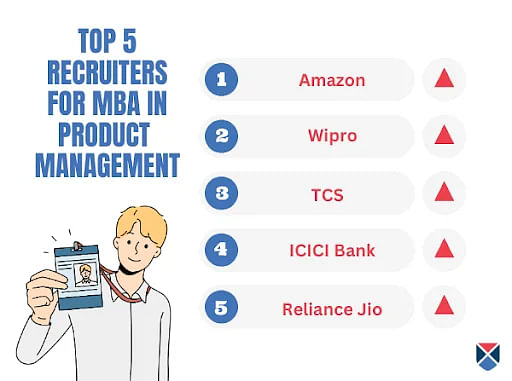
In a landscape of active infrastructural, agricultural, and governmental projects, specialized MBA graduates in Product Management find abundant job prospects. The evolving market dynamics and technological advancements offer diverse roles in both private and public sectors. Below is a list of top recruiters known for their competitive salary range
Top Recruiters | Average Salary |
Amazon | INR 37.7 LPA |
Wipro | INR 18.5 LPA |
TCS | INR 15 LPA |
ICICI Bank | INR 13.5 LPA |
Reliance Jio | INR 18.1 LPA |
Flipkart | INR 32.2 LPA |
Bharti Airtel | INR 22 LPA |
IBM | INR 21 LPA |
Read More: Career Options After MBA in Product Management
Here are some key technical and soft skills that distinguish an exceptional MBA in Product Management graduate:
MBA in Product Management subjects deals with the process involved in managing the entire lifecycle of a product, from ideation to launch and beyond. Listed below is the semester-wise distribution of the MBA in Product Management syllabus.
The MBA Product Management syllabus pdf in the first year provides a basic understanding of planning and formulating ideas for delivering a successful product. Listed below are 1st year MBA in Product Management subjects:
Semester I | Semester II |
Management of Organizations – I | Management of Organizations – II |
Quantitative Techniques and Methods – I | Quantitative Techniques and Methods – II |
Managerial Economics – I | Managerial Economics – II |
Corporate Environment – I | Corporate Environment – II |
Business Skills Development – I | Business Skills Development – II |
Corporate Legal Environment – I | Corporate Legal Environment – II |
Accounting for Managers – I | Accounting for Managers – II |
The second-year MBA Product Management syllabus delves into concepts such as project management, and rural and corporate entrepreneurship. Students will have to complete a research-based project in the final semester of the course. Listed below are 2nd-year MBA in Product Management subjects:
Semester III | Semester IV |
Management of International Business – I | Management of International Business – II |
Business Policy and Strategic Management – I | Business Policy and Strategic Management – II |
Summer Training Project – I | Summer Training Project – II |
Seminar | Seminar |
Also, Check: Top Reasons to Pursue an MBA
The core subjects in the MBA Product Management syllabus cover basic management principles like marketing, accounting and finance. Listed below are some core subjects taught in the course:
The MBA Product Management syllabus offered at ISBR enhances new-age product skills among students in this age of digital transformation. The course is globally validated and industry-oriented. Listed below is the trimester-wise syllabus:
Trimester I | Trimester II |
Managerial Economics | Macroeconomics & Business Environment |
Business Communication | Corporate Finance |
Financial Statements & Analysis | Marketing Management – II |
Marketing Management – I | Organizational Behaviour – II |
Principles of Management | Quantitative Techniques – II |
Organizational Behaviour – I | Advanced Excel |
Quantitative Techniques – I | Digital Business |
Trimester III | Trimester IV |
HRM | UX & Product Design |
Product & Digital Strategy | Market Analysis |
Project Management | Agile Product Management |
New Age Banking & Fintech | Product & Growth Marketing |
Strategic Credit Management/ Econometrics | Leading & Managing Product Teams |
Research Methodology | Innovation Labs 101 |
Disaster Management | – |
Trimester V | Trimester VI |
Product & Digital Strategy | Dissertation |
Product Finance | – |
Digital Product Management | – |
Data Analytics for Product Leaders | – |
Innovation Labs 201 | – |
When pursuing a Master of Business Administration in Product Management course, research projects are an integral part of the studies. These projects are assessed by the professors to judge the student’s understanding of the subjects. Some popular research projects are listed below: