- info@wingeducations.com
- +91 (705) 495-5296
- Mon - Sat : 10.00-18.00
MBA in Technology Management is a two-year postgraduate course study about the impact of technology on business processes and how organizations can use the technology landscape to drive business growth. The course covers subjects like technology strategy and innovation, online brand management, business data analytics, etc.
MBA in Technology Management Admission 2023 requires candidates to clear their bachelor’s degree with a minimum of 60% marks for unreserved and 55% for reserved category from an accredited university. Apart from the merit score, the candidate also needs to qualify for the entrance exams such as CAT, IPSAT, MAT, etc. The average MBA in Technology Management course fee is in the range of INR 50,000 – 6 LPA.
Table of Contents
| Degree | Masters |
| Full Form | Master of Business Administration (Technology Management) |
| Duration | 2 Years |
| Age | There is no specific upper age limit to enroll in the course. |
| Entrance Exam | CAT, MAT, IPSAT, etc. |
| Minimum Percentage | Bachelor’s degree with a minimum of 60% marks for unreserved and 55% for reserved category from an accredited university. |
| Average Fees | ₹50K – 8 LPA |
| Average Salary | INR 4-18 LPA (Source: Payscale) |
| Employment Roles | Data Analyst, Innovation Manager, Product Technology Manager, etc. |
| Top Recruiters | Slide Inc, Aditya Birla Group, Infosys, Amazon, TCS, etc. |
The MBA in Technology Management falls under the umbrella of MBA courses, the course helps graduates understand the importance of innovation in technology as well as how to manage and promote it to optimize its impact. The course is provided by top colleges like Osmania University, Amity University, Institute of Product Leadership, etc.
After completion of the MBA in Technology Management course, graduates can work in top organizations like E&Y, Accenture, Deloitte, Tech Mahindra, etc. The average salary of an MBA in Technology Management graduate is in the range of INR 4-18 LPA (Source: Payscale)
Depending on the college requirements, such as the minimum entrance exam score or the years of work experience needed, there may be different prerequisites for the MBA Technology Management course. The following are the common MBA eligibility requirements for technology management:
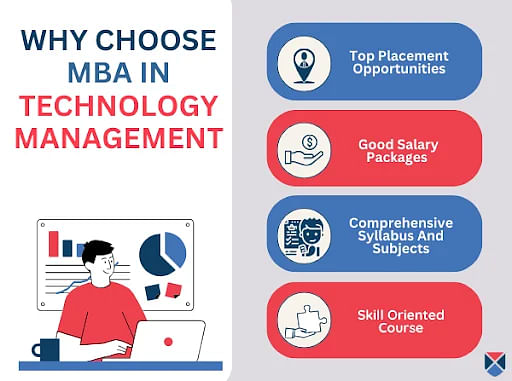
The demand for skilled professionals in the IT and technology domain has always been on the brighter side due to the continuous advancement of technology in different sectors such as healthcare, retail, education, etc. Below mentioned are the reasons why one should choose an MBA Technology Management course.
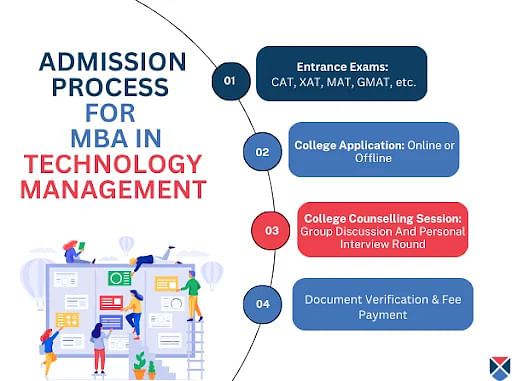
The merit score and cut-off for the entrance exam determine admission to the MBA in Technology Management. Students must complete the standard process listed below in order to enroll in the course:
The admission to MBA Technology Management requires a candidate to qualify for an entrance exam held at the national level such as CAT or institute level such as I-CET. Below listed are the MBA in Technology Management entrance exam details:
MBA Technology Management Entrance Exams | Registration Date | Accepting Colleges |
MAT | Aug 17 – Sep 14, 2023 | Amity University |
CAT | Aug 2- Sep 13, 2023 | Amity University |
CMAT | Aug 10- Dec 11, 2023 | Amity University |
I-CET | April 2024 | Osmania University |
GMAT | Aug 29, 2023 | Institute of Product Leadership, Amity University, etc. |
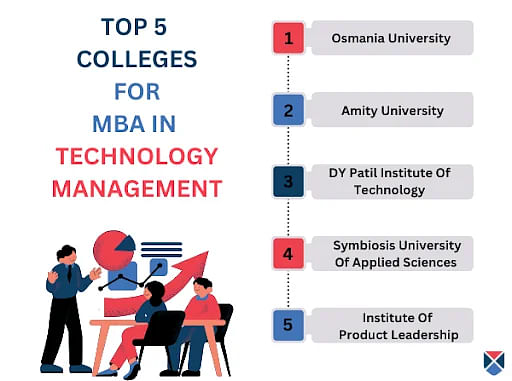
The average MBA Technology Management course fee in India is around INR 50,000 – 6 LPA. Below listed are the top colleges offering MBA Technology Management course and their average fees:
NIRF Management Ranking 2023 | Colleges | Average Fees |
36 | Osmania University | INR 50,000 PA |
35 | Amity University | INR 2.94 LPA |
46 | DY Patil Institute of Technology | INR 5.50 LPA |
55 | Symbiosis University of Applied Sciences | INR 2.75 LPA |
– | Institute of Product Leadership | INR 3.25 LPA |
– | Veda Samhita Educational Services | – |
The MBA in Technology Management course can be pursued in full-time and distance mode. The Executive MBA in Technology Management is also available for aspirants. Below listed are details regarding types of MBA Technology Management courses:
Types | MBA Technology Management Eligibility | Duration |
Full-Time MBA in Technology Management | Bachelor’s degree with a minimum of 60% aggregate for unreserved category students and 55% for reserved category students + Entrance Examination | 2 Years |
Distance MBA in Technology Management | Bachelor’s degree with 50% with a minimum of aggregate for unreserved category students and 45% for reserved category | 2 – 5 Years |
Executive MBA Technology Management | Graduation with a minimum of 60% marks for unreserved category students and 55% for reserved category. A minimum of 2 years of work experience is also required. | 1 – 3 Years |
The distance MBA Technology Management course offers working professionals and individuals a flexible and convenient mode to complete their graduate degrees in technology management without attending on-campus classes. Below listed are important points regarding distance MBA in Technology Management course details:
The EMBA in Technology Management course is ideal for individuals looking to expand their domain knowledge and learn advanced concepts related to technology management. Below listed are important points regarding Executive MBA in Technology Management:
MBA in Technology Management syllabus in the first year focus on understanding an overview of business management and technology management. The second-year MBA Technology Management syllabus delves deeper into advanced topics like technology and innovation strategy, emerging technologies and trends, global technology management, etc.
Below are listed some of the MBA in Technology Management subjects in detail:
MBA in Technology Management Subjects | Topics Covered |
Technology and Innovation Management | Innovation Process and Models, Innovation Metrics, Types of Innovation, Intellectual Property Rights in Innovation, etc. |
Strategic Technology Planning | SWOT Analysis, Risk Management Strategies, Digital Transformation Strategies, etc. |
Technology Ethics and Compliance | Ethical Decision-Making Frameworks, Data Privacy and Protection, Regulatory Compliance, etc. |
Information System Management | Role of Information Systems in Business, IT Governance, Types of Information Systems, IT Sourcing and Vendor Management, etc. |
Read More: MBA in Technology Management Syllabus and Subjects
MBA in Technology Management focuses on a wider variety of tech-related subjects, such as innovation, strategy, and project management. The administration of information technology systems and infrastructure, however, is the focus of an MBA in IT. The table below showcases the differences between the MBA in Technology Management and MBA in IT:
Course | MBA in Technology Management | MBA in Information Technology |
Full-Form | Master of Business Administration in Technology Management | Master of Business Administration in Information Technology |
Stream | Management | Management |
Duration | 2 Years | 2 Years |
Eligibility | Bachelor’s degree with a minimum of 60% marks. | Bachelor’s degree with a minimum of 50% marks. |
Exam | CAT, MAT, CMAT | CAT, XAT, GMAT |
Top Colleges | Osmania University, Amity University | IMT Ghaziabad, MDI Gurgaon |
Average Fees | INR 50,000-6 LPA | INR 2-12 LPA |
Average Salary | INR 4-18 LPA | INR 6 to 20 LPA |
Job Roles | Innovation Manager, Product Technology Manager, etc. | Senior Business Analyst, IT Manager, IT Consultant, etc. |
Knowledge Acquired | Technology Innovation Management, Technology Procurement, Technology Road Mapping, etc. | IT Portfolio Management, IT Governance, Database Management, etc. |
Read More: MBA IT
The graduates after completion of an MBA in Technology Management can do various professional certification courses in their respective domains or enroll in higher degree courses to upskill their domain knowledge. Below listed are courses that can be pursued after the MBA in Technology Management course:
The average MBA in Technology Management salary is in the range of INR 4-18 LPA (Source: Payscale). Salary and annual earnings are determined by the type of practice and performance, expertise, and other factors. Below listed are job opportunities for MBA Technology Management graduates along with their average salary:
Job Role | Average Salary |
Technology Consultant | INR 10.50 LPA |
Junior Digital Transformation Executive | INR 11.34 LPA |
Junior Business Intelligence Analyst | INR 8.55 LPA |
Associate Technology Analyst | INR 7 LPA |
Read More: MBA in Technology Management Salary
MBA in Technology Management graduates can work in private companies such as Deloitte, Infosys, etc., and government departments like E-Governance, Smart City Development, etc. Below listed are a few job roles for MBA Technology Management graduates along with their average salary and top hiring companies:
Job Designations | Job Descriptions | Hiring Companies | Average Salary |
Technology Executive | They support the implementation of technology strategy, and innovation and make sure the goals are as per the business objective. | Slide Inc, Aditya Birla Group, Infosys, etc. | INR 4.67 LPA |
Technology Business Analyst | They help in examining organizational requirements, developing technological specifications, and offering innovative solutions. | Amdocs, Deloitte, TCS, etc. | INR 9.86 LPA |
IT Risk Manager | They develop risk mitigation strategies, cybersecurity protocols, and compliance methods to guarantee data security and legal compliance. | Amazon, KPMG, EY, PayPal, etc. | INR 14.51 LPA |
Junior IT Project Manager | They help define the project’s scope, manage the schedule, and allocate resources to ensure timely and effective project completion. | RWS Group, Wipro, JSW Steel, etc. | INR 6.19 LPA |
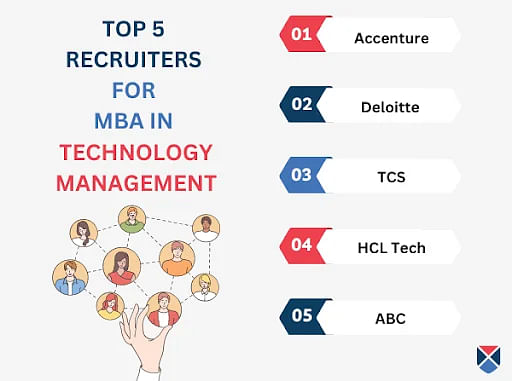
The MBA in Technology Management graduates get opportunities to work in areas like IT Management, Innovation, Research and Development, Technology Strategy, etc. Below listed are top recruiters for MBA Technology Management graduates along with their average salary:
Top Recruiters | Average Salary for Freshers |
Accenture | NR 6-11 LPA |
Deloitte | INR 5-10 LPA |
TCS | INR 6-9.5 LPA |
HCL Tech | INR 5-13 LPA |
ABC | INR 4.5-10 LPA |
[Source: Glassdoor]
The MBA Technology Management course requires graduates to have technical proficiency and business acumen to succeed in their careers. Below listed are a few skills that an MBA in Technology Management graduate needs to excel.
The MBA Technology Management syllabus contains subjects associated with different disciplines including business intelligence and analytics, information technology, user experience design, innovation management, strategic management, etc. The MBA in Technology Management syllabus is divided into 4 semesters.
Students have to do several job-oriented projects and attend workshops and internships as part of the MBA Technology Management course. The problem-solving skills developed during the course help candidates bag job offers in top IT companies, consulting firms, insurance and financial institutions, etc.
Table of Contents
The MBA Technology Management course ensures that the students get expertise in the areas of information management and strategic management in the technology sector. The following is a semester-wise MBA Technology Management course syllabus.
The MBA in Technology Management syllabus in the first year covers concepts on marketing, accounting, finance, and the basics of technology management. Listed below are 1st year MBA Technology Management syllabus:
Semester I | Semester II |
Foundation in Technology Management | Production and Operations Management |
Statistics for Management | Marketing Management |
Economic Analysis for Business | Human Resource Management |
Organizational Behavior and Interpersonal Skills | Business Research Methods |
Legal Aspect of Business | Information Management |
Accounting for Management | Financial Management |
Several topics on technology forecasting and innovations in technology are taught in the second year. Students will also complete research-based projects in the final semester of the course. Listed below is the 2nd-year MBA Technology Management course syllabus:
Semester III | Semester IV |
Applied Operations Research | IPR |
Strategic Management | Managing Technological Innovation |
Technology Forecasting and Assessment | Data Mining and Business Intelligence |
Technology Commercialisation and Transfer | Software Project and Quality Management |
Enterprise Resource Planning | Project Work |
MBA Technology Management subjects are categorized as core and elective subjects. Seminars, research work, lab practicals, and workshops are key parts of the course. Students should select the elective subjects based on their area of interest, ambitions, and career growth.
The fundamental MBA Technology Management core subjects are listed below:
Listed below are some elective subjects included in the MBA in Technology Management course syllabus:
MBA in Technology Management syllabus PDF provides students with a comprehensive understanding of technology and quality management in information systems. Students will develop technical skills in programming languages and technology transfer modes. The topics covered are explained below in detail:
MBA Technology Management Subjects | Topics Covered |
Technology Forecasting and Assessment | channels of technology flow, Internal technology transfer, Technology assessment, Transfer Modes, Technology search strategy, Technology absorption and diffusion, etc |
Technology Transfer Management | Introduction to Cloud Computing, Introduction to AWS Services, Getting Started with Microsoft Azure, Web Apps and Cloud Services, etc |
Database Management Systems | Database Concepts and Data Modeling, Relational Database Design, SQL & Other Relational Languages, Transaction Processing, . Introduction to Special Databases, etc |
Total Quality Management | Core concepts of TQM, Customer Value, Measuring customer value, Technical Tools for Quality, Analytical Methods, Six Sigma, Definition, Competitive advantages, etc |
Strategic Management for Technology | Developing a strategic Vision, Strategy and Competitive advantage, Integrating technology and strategy, Tailoring strategy to fit specific industry and company situations, etc |
The MBA Technology Management course may differ from college to college depending on the curriculum and program objectives. The best colleges’ MBA Technology Management Syllabus is listed below:
The MBA in Technology Management program at Bharathiar University includes a thorough curriculum that covers all aspects of production planning and technology finance. The year-wise list of MBA in Technology Management subjects is provided below.
Year I | Year II |
Basics of Management Principles | Total Quality Management |
Fundamental of Managerial Economics | Production Planning and Control |
Fundamentals of Marketing | Technology Acquisitions & Diffusion |
Financial Management | Technology Finance |
Human Resource Management | Goal Programming in Management |
Accounting for Managers | Technology Forecasting |
Operations Research | R & D Management |
Osmania University offers a comprehensive MBA in Technology Management course covering managerial and technical aspects used in technology management and industrial projects. The list of MBA Technology Management subjects is provided below bifurcated into four semesters:
Semester I | Semester II |
Foundation in Technology Management | Technology Forecasting and Assessment |
Technology, Creativity and Innovation | Technology Transfer Management |
Information Technology for Business | Technology Projects, Appraisal, and Evaluation |
Organizational Behavior and Interpersonal Skills | Business Research Methods |
Principles of Marketing | Economic and Legal Environment |
Accounting for Management | Financial Management |
Semester III | Semester IV |
Production and Operations Management | Strategic Management of Technology |
International Business and Strategic Alliances | Supply Chain Management |
Organizational Development and Team Building | Performance Appraisal and Counseling |
Leadership and Change Management | Industrial Relations and Labor Laws |
– | Project Report |
Projects are given to college students to recognize their standards and train them according to the needs of the industry standards. Some popular MBA projects in Technology Management are:
The MBA Technology Management course is curated for 2 years and divided into 4 semesters. The course includes core and elective subjects along with projects in the final semester. Listed below is the course curriculum.
MBA Technology Management adopts innovative coaching techniques to foster collaborative learning and make stronger student-instructor relationships. Listed below are the coaching methods and techniques in general:
MBA Technology Management books are accessible both online and offline by many authors and publications. Reference books are meant for gaining knowledge of the current trends in the technology sector. Some of the MBA Technology Management books are:
Name of the Books | Authors | Topics Covered |
Handbook of Technology Management | Gerard H. Gaynor | Assimilation Supply Chain Strategies, Benchmarking Tools and Techniques, optimize investments in technology, etc |
A Textbook of Technology Management | U. Ravi Kiran | Cardinal Principles of Technology Management, Research and Innovation, Technology Planning, Technology Strategy, Technology Life Cycles |
Management of Technology and Innovation: Competing Through Technological Excellence | P.N. Rastogi | The Axes and Atlas of Technology, Strategic Management of Technology, Productivity and Incremental Innovation, Technology Absorption |
Technology, Management, and Society | Peter Drucker | Information, Communications and Understanding; Management’s New Role; Work and Tools; Technological Trends in the Twentieth Century |