
- info@wingeducations.com
- +91 (705) 495-5296
- Mon - Sat : 10.00-18.00
The University of Cambridge is a member of the Russell Group, a group of reputed research-focused universities in the UK. It was founded in 1209 making it one of the oldest universities in the world. The University consistently ranks among the top 10 universities globally. As per 2026 it is ranked #6 in the QS World University Rankings and #3 by Times Higher Education. Some of the most popular field of study at the university are computer science, engineering, medicine, and business.
Cambridge has no single campus. Instead, it operates through 31 independent colleges spread across a small. Each college provides housing and student support, while teaching, exams, and degrees are shared across the entire university.
| Category | Key Details |
|---|---|
| Global Rankings | QS World University Rankings 2026: #6 Times Higher Education (THE): #3 |
| Acceptance Rate | Official acceptance rate 21% (2025) |
| Popular Courses | MBBS, MBA, BA Computer Science, BA Law, BA Engineering |
| Application Portals | Undergraduate: UCAS + My Cambridge Application Postgraduate: Cambridge Graduate Application Portal |
| Key Deadlines | UG 2027 Programs (UCAS): 15 Oct 2026 My Cambridge Application: ~22 Oct 2026 Master’s: Course-specific (Feb–Oct 2026) PhD: 14 May 2026 |
| Eligibility (Indian Students) | UG: Class XII scores + extra qualifications. CBSE: 5 or more A1 grades. PG: UK 2:1 equivalent. Usually 70–75%+ CGPA. Competitive courses can expect higher. |
| English Language Test | IELTS: 7.5 overall, no band below 7.0 TOEFL: 110 overall, 25+ in each section TOEFL after 21 Jan 2026 may need extra assessment |
*INR values use a conversion rate of 1 GBP = ₹121.
Table of Contents
The University of Cambridge offers 100+ Master’s courses, 90+ PhDs, and around 30 undergraduate programs. Popular and competitive subjects include Medicine, Computer Science, Law, Engineering, Natural Sciences, Mathematics, Economics, and English.
For undergraduates, Cambridge uses a special system called the Tripos. Students start by studying a broad range in their subject in the first years and then specialize in later years. Weekly supervisions allow 1–3 students to meet a teacher and get personalized guidance, making learning intensive and highly focused.
Some of the popular UG and PG courses among international students are:
| Course Name | Duration | Application Fees | Annual Tuition Fees (GBP) | Annual Tuition Fees (INR) | Tips for International Applicants |
|---|---|---|---|---|---|
| MBA (1.1K Views) | 1 Year | £165 (₹19,965) | £80,000 | ₹96.8 Lakhs | • GMAT 700+ / GRE 320+ • 4–6+ years leadership experience • Impact-driven essays • Behavioral interview preparation |
| MFin (558 Views) | 1 Year | £120 (₹14,520) | £60,000 | ₹72.6 Lakhs | • GMAT Quant 700+ / GRE Quant 165+ • Finance internships/projects • Valuation & analytics focus in SOP |
| PhD Computer Science (440 Views) | 3 Years | £20 (₹2,420) | £41,304 | ₹49.98 Lakhs | • Research alignment with 2–3 faculty • Publications/thesis preferred • Clear research proposal |
| MPhil Advanced Computer Science (438 Views) | 9 Months | £20 (₹2,420) | £48,192 | ₹58.31 Lakhs | • Advanced CS background • Research-oriented SOP • Strong programming/open-source work • Clear PhD pathway |
| PhD Medicine (375 Views) | 3 Years | £20 (₹2,420) | £39,336 | ₹47.6 Lakhs | • Deep lab/clinical research experience preferred • Detailed research proposal |
| MBBS (MB BChir) (1.1K Views) | 6 Years | £29 (₹3,509) | £70,554 | ₹85.37 Lakhs | • Strong hospital exposure • Ethical personal statement • Medicine-focused interview prep • 95%+ in PCB |
| BA Mathematics (275 Views) | 3 Years | £60 (₹7,260) | £32,406 | ₹39.21 Lakhs | • Strong problem-solving skills • Unseen-question interview readiness |
| BA Law (193 Views) | 3 Years | £60 (₹7,260) | £29,052 | ₹35.15 Lakhs | • Clear legal reasoning in SOP |
| BA Architecture (188 Views) | 3 Years | £29 (₹3,509) | £38,010 | ₹45.99 Lakhs | • Strong design portfolio • Technical & creative drawings • Portfolio-based interview |
| BA Economics (180 Views) | 3 Years | £29 (₹3,509) | £29,052 | ₹35.15 Lakhs | • Excellent Maths background • Awareness of Global Economic Conditions |
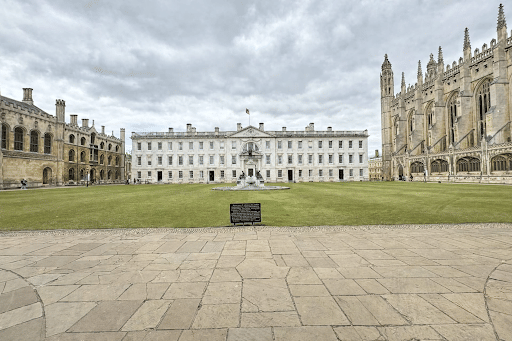
Founded in 1209, the University of Cambridge does not have one main campus. Instead, it works through 31 independent colleges spread across the city. These colleges are part of everyday Cambridge, not separate from it. Each college gives students housing, meals, and academic support. While you belong to one college, lectures, exams, and departments are shared across the whole university.
Note:
At Cambridge, Trinity College is often the first choice students Prefer. It is the largest college, has over £2 billion in funds, and its former students include 34 Nobel Prize winners. While Trinity stands out, other colleges like King’s, St John’s, and Christ’s share the same city campus and offer strong study life in their own way.
Cambridge is often called the UK’s cycling city, and it shows in daily life. A large share of residents use bikes every week due to the city’s flat roads, short distances, and student-friendly layout. Air quality is usually clean and healthy, staying in the “good” range most of the year. The city offers plenty of green spaces and has very little heavy industry. It is small, safe, and has low crime, making daily travel much less stressful than in bigger cities.
The University of Cambridge was founded in 1209. It is the second-oldest university in any English-speaking country, after Oxford. With 100+ libraries in its colleges and departments, learning is part of life all over the city. The city is just under an hour from London by the train, making it well-connected. Furthermore, Sundays in Cambridge feel quiet and traditional, with many small shops closed and big stores open for only a few hours. Students wear gowns for formal dinners. Cosy pubs, a safe city, and lively bars make it easy to mix study, social life, and culture.
The application portal and fees at University of Cambridge for Indian students are provided below:
| Levels of Study | Application Portal | Application Fees |
|---|---|---|
| Undergraduate Programs | UCAS or My Cambridge Application | £60 (~INR 6,756) |
| Graduate Programs | Graduate Application Portal | Master’s: £85 (₹10,285) per application Doctoral (PhD): £20 (₹2,420) for up to 7 applications |
The University of Cambridge follows a tri-term academic system rooted in historical traditions, with each term lasting around 8 weeks. The academic year runs from 1 October to 30 September. The three terms are Michaelmas (October to December), Lent (January to March), and Easter (April to June), with breaks between each term when regular teaching pauses.
| Term | Start | Teaching Period | End | Notes |
|---|---|---|---|---|
| Michaelmas | Early Oct (~1 Oct) | Early Oct – Early Dec (~8 weeks) | Mid-Dec (~19 Dec) | Autumn term; start of academic year; freshers arrive; core foundational teaching. |
| Lent | Early Jan (~5 Jan) | Mid-Jan – Mid/Late Mar (~8 weeks) | Late Mar (~25 Mar) | Winter term; builds on Michaelmas; includes reading or revision weeks. |
| Easter | Mid-April (~17 Apr) | Late Apr – Mid/Late Jun (~8 weeks) | Late Jun (~25 Jun) | Summer term; major exams (Tripos); focus on finals and research; lighter teaching. |
Note: The admission deadlines for international students at the University of Cambridge vary by program. Master’s courses have different deadlines depending on the course. Most PhD courses follow common deadlines for Michaelmas, Lent, or Easter terms, though a few offer only two intakes. Undergraduate applications go through UCAS and the university portal, each with a separate deadline. International students should follow these dates carefully to apply on time.
Postgraduate (Master’s / MPhil / MS / MFin)
Deadlines vary by course. Popular courses:
| Course | Deadline |
|---|---|
| MFin | May 31, 2026 |
| MPhil Advanced Computer Science | Feb 26, 2026 |
| MS Physics | May 14, 2026 |
| MPhil Economics | Oct 1, 2026 |
| MPhil Management | Feb 26, 2026 |
| MPhil Biotechnology | May 14, 2026 |
PhD / Doctoral
Undergraduate (BA / MBBS / BS)
At the University of Cambridge, entry to Master’s-level programs for Indian students is assessed against official UK Bachelor’s Honours equivalence. Minimum grades differ by course, with more competitive programs often expecting High 2:1 or First-class standards, even when the basic requirement is a standard 2:1.
Academic Requirements for Indian Students
| Degree Type / Duration | Examples |
|---|---|
| 3-year degrees | BBA/BBM/BBS, BCA, Statistics, Fine Arts, Law (if 3-year postgraduate) |
| 4-year degrees | BEng/Tech, Optometry, BPharm, Physiotherapy, BSc Agriculture, BSc Nursing/Nursing, Technology-related |
| 5-year degrees | Architecture, BAMS/BHMS/BSMS/BUMS* (Ayurvedic/Homoeopathic/Siddha/Unani Medicine & Surgery), 5-year integrated/first Law |
| 3–4 year degrees | BA/BSc/BCom from well-ranked institutions |
Minimum Academic Scores for Indian Applicants (Master’s at Cambridge)
| UK Honours Level | General Indian Requirement | Ashoka (4-point CGPA) | NLSIU (7-point CGPA) | O.P. Jindal (8-point CGPA) |
|---|---|---|---|---|
| UK 2:1 | 70% or CGPA 7.3–7.4 /10 | 3.7 / 4 | 5 / 7 | 6 / 8 |
| High 2:1 | 73% or CGPA 7.7 /10 | 3.8 / 4 | 5.5 / 7 | 6.5 / 8 |
| First Class | 75% or CGPA 8.0 /10 | 3.9 / 4 | 6 / 7 | 7 / 8 |
Note*:
Note: Cambridge sets separate grade rules for Ashoka, NLSIU, and O.P. Jindal because they use different grading scales.These universities are well-regarded and academically strong, so Cambridge matches their scores directly to UK grades instead of using the usual Indian percentage system.
Equivalent to UK Master’s Degree
These qualifications are primarily required for PhD entry, as Cambridge expects a Master’s-level equivalent for doctoral study.
The University of Cambridge offers its MBA program through Cambridge Judge Business School, one of the top business schools globally. It is ranked #7 as per the QS global mba ranking and #35 as per the Global MBA Ranking. The University offers full time, part time and executive mba for international students.
| Requirement | Details |
|---|---|
| Admission Portal | Judge Business School Portal |
| Educational Qualification | Bachelor’s degree or equivalent from a recognized university |
| Work Experience | Minimum 3 years most candidates have 4–6 years (as per 2025 data) |
| GMAT/GRE Scores | GMAT (average GMAT ~625-700) or GRE (Verbal 76% Quant 60%) required |
| English Language Proficiency | IELTS: 7.5 overall, with minimum 7.0 in each component TOEFL: 110 overall, with minimum 25 in each section |
| Application Components | Online application form, essays, references (2), CV/Resume, interview |
| Key Dates | Applications year-round Round 1 – 26.Sep.2026 (Closed) Round 2 – 6.Oct.2025 (Closed) Round 3 – 5.Jan.2026 (Closed) Round 4 – 30.Mar.2026 Round 5 – 5.May.2026 |
In September 2025, Cambridge Judge Business School welcomed a new batch of students to its one-year MBA programme. The Class of 2025 has 217 students from 43 different countries, showing strong global diversity. The average student is 29 years old, the average GMAT score is 700, and 47% of the class are women.
| Category | Details |
|---|---|
| Class Size | 217 students |
| Average Age | 29 years |
| Gender Split | 47% women |
| Nationalities | 43 nationalities |
| Average Work Experience | 6 years |
| Average GMAT | 700 |
| Student Backgrounds | Consulting, finance, tech, entrepreneurship |
| Class Profile | Highly international, leadership-focused |
Note: Some students may be invited for an online interview. If shortlisted, the admissions team will email you and schedule it during a fixed two-week interview period for that round.
At Cambridge, all undergraduate applications go through UCAS, and most courses also need a short extra form called My Cambridge Application. First, submit your UCAS application by mid-October 2026 (6 pm UK time for 2027 entry). Within 48 hours, you’ll get a link to complete My Cambridge Application by late October (usually 22 October). This two-step process collects extra details like transcripts, optional personal statements, and course-specific info.
Academic Requirements
Cambridge expects top grades, but Class XII alone is usually not enough.
Key point: Indian Class XII results do not qualify on their own for competitive entry.
Extra qualifications usually required
The English proficiency requirements apply to both undergraduate and postgraduate courses at the University of Cambridge are:
English Language Test – Minimum Scores
TOEFL after 21 Jan 2026 may not be accepted; extra assessment may apply.
Note: Due to changes in the test format, TOEFL taken after 21 January 2026 may require an additional assessment at the University of Cambridge Language Centre.
Also Check:
The University of Cambridge consistently ranks among the world’s top universities. Over the past five years, it has maintained a strong and stable global position. QS rankings ranged from #2 to #6, THE from #3 to #5, Guardian around #2–3, US News between #5–8, and CWUR from #1–4. The table below shows these trends in detail:
| Ranking Body | 2026 Rank | 2025 Rank | 2024 Rank | 2023 Rank | 2022 Rank |
|---|---|---|---|---|---|
| QS World University Rankings | #6 | #5 | #2 | #2 | #3 |
| THE World University Rankings | #3 | #5 | #5 | #3 | #5 |
| The Guardian World University Rankings | #3 | #3 | #3 | #3 | #2 |
| US News & World Report Best Global Universities | #5 | #6 | #6 | #8 | #8 |
| CWUR (Center for World University Rankings) | – | #1 | #4 | #4 | #4 |
University of Cambridge ranks at #3 in The best UK universities 2026 by The Guardian rankings. Here are some subject-specific rankings of University of Cambridge according to The Guardian:
For detailed subject-wise and overall rankings, explore the University of Cambridge ranking page.
Students looking for financial support can explore the key scholarships offered by the University of Cambridge and external options. These awards cover undergraduate, postgraduate, and PhD levels, with options for full or partial funding depending on the course and profile.
| Scholarship | Level | Amount (GBP / INR) | Eligibility | Coverage |
|---|---|---|---|---|
| Gates Cambridge Scholarship | Postgraduate (Master’s, PhD) | Full cost: £30k–£50k + £21k maintenance (~INR 25.4L) | Outstanding non-UK applicants, any subject, leadership potential | Full fees, living expenses, travel; PhD up to 4 yrs |
| Cambridge International Scholarship | Postgraduate (PhD) | Tuition £30k–£40k + £18k–£21k maintenance (~INR 21.8–25.4L) | Highly ranked non-UK/Ireland applicants, any subject | Tuition, living allowance, health surcharge |
| GREAT Scholarships (India) | Postgraduate (1-year Master’s) | £10k (~INR 12.1L) | Indian citizens, motivated in subject, UG degree | Tuition contribution |
| Prathiba M Singh Cambridge Scholarship | Postgraduate (LLM) | Not specified | Indian citizens, IP law interest, return to India | Tuition / partial costs |
| Pemanda Monappa Scholarship | Postgraduate (Master’s) | Not specified | Indian applicants, Biological Sciences (excl. Medicine/Vet) | Part-cost for fees/living |
| OCSI Scholarships | Undergraduate / Graduate / Research | INR 4,00,000 (~£3,306), 3 awards | Indian citizens admitted to Cambridge | Part-cost for study expenses |
| Chevening/Cambridge Scholarship | Postgraduate (Master’s) | Full cost: tuition + stipend + travel (~INR varies) | Indian / eligible applicants; 2+ yrs work experience; UK Master’s | Full tuition, monthly stipend, airfare, visa |
| Cambridge Trust Scholarship (Postgraduate) | Postgraduate (Master’s, PhD) | Part-cost ~£10k–£20k (~INR 12.1–24.2L) | International students incl. Indians, academic merit + financial need | Partial tuition / maintenance |
| Cambridge Trust Scholarship (Undergraduate) | Undergraduate | £10k–£15k (~INR 12.1–18.1L) or full tuition | International students incl. Indians, merit + financial need | Partial / full tuition / college fees |
The University of Cambridge is part of the UK’s top Russell Group and is often ranked among the best universities in the world, alongside Oxford and Harvard. It sits in a small, safe, student-friendly city with a strong academic and cultural vibe. Students can join 500+ societies, many low-cost or free, including Indian cultural and music groups. Life here can be budget-friendly too—cycling, free university events, and smart spending apps help many students save £50–£100 a month while enjoying city life.