- info@wingeducations.com
- +91 (705) 495-5296
- Mon - Sat : 10.00-18.00
| Degree | Masters |
| Full Form | Master of Business Administration in Aviation Management |
| Duration | 2 Years |
| Age | No age Limit |
| Entrance Exam | CAT, MAT, XAT, NMAT, CMAT, etc |
| Minimum Percentage | 50% in graduation for unreserved category and 45% for SC/ST/PwD students |
| Average Fees | ₹5 LPA |
| Similar Options of Study | MBA in Airport Management |
| Average Salary | INR 3 to 15 LPA |
| Employment Roles | Cargo Supervisors, Management Trainee, Flight Dispatcher, Station Attendant, Information Representative, Crew Schedule Coordinator, Airline Station Agent, Airport Operation Supervisor, Cabin Crew |
| Top Recruiters | Air India, Jet Airways, Thomas Cook, Indigo, ITC, Qatar Airways, etc |
MBA in Aviation Management course is one of the highly demanding specializations under MBA courses. The course builds leadership qualities among students and covers important subject areas on finance, general management, international business, marketing, aviation management, etc.
MBA in Aviation Management has a broader job scope with different job designations, including aviation manager, airport operation manager, airport planner, airport director, etc. The average MBA Aviation Management salary in India is in the range of INR 3-15 LPA (Source: Ambition Box).
The MBA in Aviation eligibility consists of parameters like educational background, entrance exam score, and prior experience in aviation or related industry. Below listed is the common eligibility criteria for the MBA in Aviation Management course:
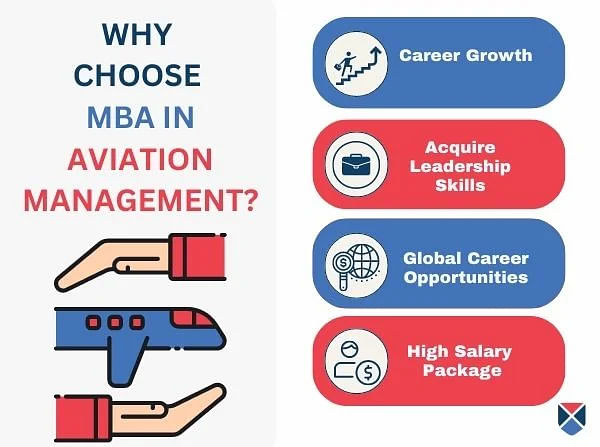
MBA in Aviation Management course helps students gain adequate technical knowledge on the functioning of the aviation sector and airport management. Below are some points on why a student should pursue an MBA in Aviation Management in India:
Admission for the MBA in Aviation Management in India is based on entrance exams, group discussions, and personal interviews. There is no direct admission or management quota available for the course. Explained below is the admission process for the best colleges for an MBA in Aviation Management in India:
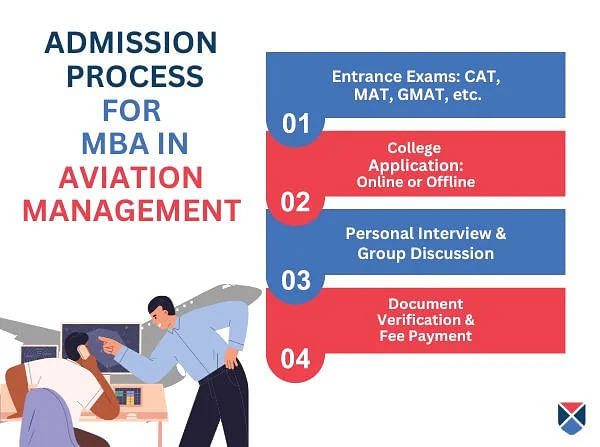
The students have to appear for various entrance exams conducted at the national level such as CAT, MAT, CMAT, etc. UPES College also conducts its own entrance exam known as UPESMET for students who haven’t taken national or state-level entrance exams. Listed below are some important entrance exams for MBA Aviation Management:
MBA Aviation Management Entrance Exams | Exam Date | Accepting Colleges |
| Nov 24, 2024 | DYPSUM, Jain University, Srinivas University | |
| Feb 25- Dec 17, 2023 | Silver Oak University, UPES | |
| Jan 7, 2024 | UPES, Assam Don Bosco University, DYPUSM | |
| Oct 10- Dec 19, 2023 | Jain University | |
| February 2024 (tentatively) | Silver Oak University | |
| – | Assam Don Bosco University | |
KEA-PGCET | September 2024 (tentatively) | Srinivas University |
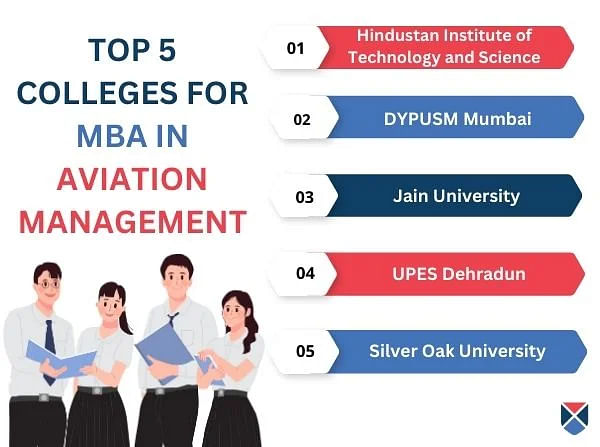
The MBA in Aviation Management course is offered by top B-Schools and universities in India such as UPES, Jain University, Hindustan University, etc., with average fees ranging between INR 1-8 LPA. Given below is a list of some of the best MBA in Aviation Management colleges in India along with the fee breakdown:
| College Name | Tuition Fees (INR) | Admission Fees (INR) | Miscellaneous Fees (INR) |
| Hindustan Institute of Technology and Science | 2.29 LPA | 50,000 | – |
| DYPUSM Mumbai | 7.5 LPA | 1,000 | – |
| Jain University | 5.75 LPA | – | – |
| UPES Dehradun | 5.72 LPA | – | 1.9 LPA |
| IGNOU | 2.12 LPA | – | – |
| Srinivas University | 2.25 LPA | – | – |
| Assam Don Bosco University | 1.9 LPA | – | – |
| Silver Oak University | 90,000-1 LPA | – | – |
| Top Cities | Average Fees |
| MBA Aviation Management Colleges in Bangalore | INR 4.3 LPA |
| MBA Aviation Management Colleges in Dehradun | INR 6 LPA |
| MBA Aviation Management Colleges in Ahamedbad | INR 5 LPA |
| MBA Aviation Management Colleges in Delhi | INR 5.5 LPA |
| MBA Aviation Management Colleges in Jaipur | INR 1.5 LPA |
| MBA Aviation Management Colleges in Pune | INR 5 LPA |
Students can complete an MBA in Aviation Management in India through full-time, part-time, and distance modes. Many colleges offer this course according to students’ requirements and working professionals. MBA in Aviation Management course details are given below:
Type | MBA in Aviation Management Eligibility | Top Colleges | Course Duration |
Full Time MBA in Aviation Management | Bachelor’s degree with a minimum of 50% marks + Entrance Exam Score+ Qualifying GD and PI rounds | UPES, Hindustan University, Jain University, etc. | 2 Years |
Distance MBA in Aviation Management | Bachelor’s degree with a minimum of 50% marks for unreserved category and 45% for reserved category students. | IGNOU, IMTS Institute, etc. | 2-4 Years |
Online MBA in Aviation Management | Students must have a minimum average grade point of 55 percent and have graduated from an academically recognized university. | Jain Online University, Amity Online University, etc. | 1-2 Years |
The MBA in Aviation Management syllabus will touch upon subjects like Airline Marketing, Airline Safety, Airline Strategic Planning, etc. Students can gain expertise in airport quality management through DGCA regulations and aircraft maintenance techniques. Some of the MBA in Aviation Management core subjects are explained below:
| MBA in Aviation Management Subjects | Topics Covered |
| Management Information System | Foundations of Information Systems, IS for operations and decision making, DSS and AI: DSS models and software, Security and Ethical Challenges, etc |
| Strategic Airport Planning and Marketing | Growth of air transport, Airport characteristics related to airport design, Airport planning and surveys, The role and scope of activity of the Airport Enterprise, etc |
| Air Traffic Control | Human factors in Air traffic Control, Information processing – Sensation and sensory memory, Communication distortion, expectancy, Human-machine systems, Stress – causes of stress – noise and vibration, etc |
| Aircraft Maintenance Management | Maintenance: Role of the Engineer & Mechanic, Documentation for Maintenance, Production Planning and Control, Line Maintenance, Quality Assurance, etc |
| Aviation Legal Environment | DGCA-Introduction to Directorate General of Civil Aviation, REGULATIONS-Aircraft Act 1934- The Aircraft Rules 1937, NATIONAL LEGISLATION -The Air Corporations Act, etc |
Read More: MBA in Aviation Management Subjects and Syllabus
MBA in Aviation Management deals with airline operations and the study of the airline industry while MBA in Airport Management course focuses on airport control and operations. Given below are some major differences between the two courses.
| Parameter | MBA in Aviation Management | MBA in Airport Management |
| Type | Masters degree | Masters degree |
| Duration | 2 years | 2 years |
| Entrance Exam | CAT, MAT, etc | CAT, MAT, etc |
| Average Fees | INR 1 to 8 LPA | INR 50,000-4 LPA |
| Focus Area | The course involves an in-depth study of the airline industry, airport development planning, and airline operations. | The course provides details about essential control standards carried out in aviation operations, airport control, and air transportation |
| Job Opportunities | Aviation Managers, Aviation Operations Specialists, etc | Airport Representatives, Airport Managers, etc |
| Average Salary | INR 3 -15 LPA | INR 2-14 LPA |
Also, Check: MBA in Airport Management
Students can take up jobs or opt for higher studies after an MBA in Aviation Management. The graduates can also choose to pursue research in aviation management. Students can also take certification courses related to aerospace and aviation. Some of the courses are:
The average MBA in Aviation Management salary in India is approximately INR 3 to 15 LPA. The freshers can earn in the range of INR 3-8 LPA, depending on their skills and knowledge. The professionals after 3 years of work experience can earn up to INR 15 LPA. Students can get hired on job profiles like Aviation Managers, Airline Quality Specialists, etc.
Below listed are the top job designations for the MBA in Aviation Management course along with their average entry-level salaries:
| MBA in Aviation Management Jobs | Job Description | Average Entry-Level Salary |
| Aviation Manager | Overseas flight plans, aircraft schedules, equipment maintenance, and flight crew management | INR 4-6 LPA |
| Airport Manager | Implements the protocols and guidelines issued by AAI regarding airports and airspace | INR 6-7 LPA |
| Air Traffic Controller | Responsible for the safety of aircraft at higher altitudes and in the en-route phase of the flight surrounding busier airports and airspace | INR 3-6 LPA |
| Airport Operation Manager | Responsible for regulating all the functions of an airport according to the prescribed rules and regulations | INR 5-8 LPA |
| Customer Relationship Manager | In-charge of customer relationships after the sale or service process is complete | INR 3-5 LPA |
[Sources: Ambition Box, Payscale & Glassdoor]
Read More: MBA in Aviation Management Jobs Salary
MBA in Aviation Management graduates can work in various job sectors Aerospace Regulatory Authorities, National and International Airlines, Aviation Fuel Companies, Air Cargo Operators, etc. Some of the MBA in Aviation Management jobs are listed below:
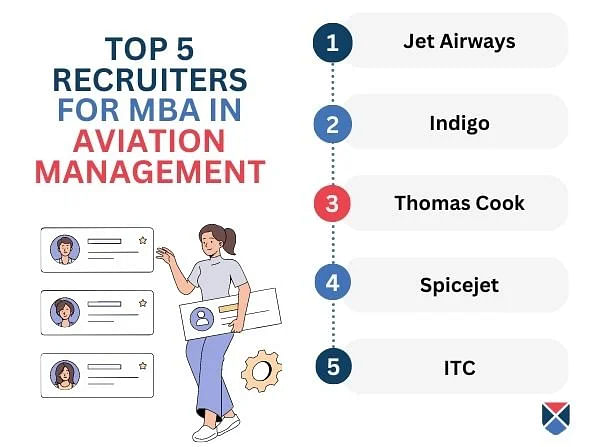
The MBA in Aviation Management graduates are hired by top private and government organizations like Indigo, Emirates, Air India, etc. Listed below are some of the top private companies along with salaries that offer jobs for MBA in Aviation Management graduates:
| Company | Average Salary (INR) |
| Jet Airways | 16 LPA |
| Indigo | 14.4 LPA |
| Thomas Cook | 2.75 LPA |
| Spicejet | 7.6 LPA |
| ITC | 13 LPA |
| Kempegowda International Airport, Bengaluru | 9 LPA |
| Emirates | 40 LPA |
| Bharat Petroleum | 4 LPA |
[Source: Ambition Box]
Students pursuing MBA courses can apply for various scholarships to help them at the time of admission. Listed below are some MBA in Aviation Management scholarships offered by government and private institutions:
MBA in Aviation Management graduates should have both technical skills and managerial skills to excel in their professional careers. Listed below are some essential skills:
MBA in Aviation Management course provides insights into important topics like airport management and aviation safety. Listed below is the semester-wise distribution of the MBA in Aviation Management syllabus.
The MBA Aviation Management syllabus PDF in the first year provides basic management principles related to the aviation business and security. Listed below are first year MBA in Aviation Management syllabus:
Semester I | Semester II |
Business Economics | Operations Research |
Business Communication | Managerial Economics |
Principles of Management | Aviation and Aerospace Business Models |
Airline and Airport Management | Aviation Safety and Security Management |
Human Resource Management | Airline Operation and Scheduling |
Airline Marketing Management | Management Information System |
Organisational Behaviour | Aviation Project Management |
MBA in Aviation Management First-year Practical Subjects
Listed below are some practical subjects taught in the first-year syllabus of MBA in Aviation Management:
The second-year MBA Aviation Management syllabus throws light on concepts of aviation law and airport operations. Students will complete a dissertation in the final semester of the course. Listed below are second-year MBA in Aviation Management subjects:
Semester III | Semester IV |
Customer Relationship Management | Airport Ramp Operations |
Aviation Law and Insurance | International Business |
Airline Economics | Maintenance, Repair and Overhaul in Aviation |
Management of Airline Operations | Air Traffic Management and Navigation |
Disaster Management in Aviation | Aviation Revenue Management |
Operations Management | Seminar |
Electives | Dissertation |
Also Check: Top Reasons to Pursue an MBA in 2023
MBA in Aviation Management syllabus concentrates on subjects related to aviation and aerospace business and maintenance. Internships and projects form an essential part of the course. Listed below are the core and elective subjects taught in the course:
Listed below are the core MBA in Aviation Management subjects that candidates study in the course:
Given below are the elective MBA in Aviation Management subjects that students study in the second year of the course:
The topics covered in the subjects of MBA Aviation Management syllabus PDF are explained in-depth below:
MBA Project Management Subjects | Topics Covered |
Airport and Airline Management | History of Aviation, Aircraft Infrastructure and Management, Air Transport Services, Role of DGCA, Role of Air Traffic Control, etc |
Airline Marketing Management | Marketing of Air Transport Services, Product Analysis in Airline Marketing, Applications of Marketing Research, Web-based marketing programmes, etc |
Airline Operation and Scheduling | Transportation and Assignment Models, Critical Path Method, Scope and Definition of Network Models, Overview of Operation Control Centre, etc |
Airline Finance | Finance Management, World Airline Financial Results, Sources of Internal Finance, Budget Preparation and Control, Exchange Rate Volatility, etc |
Aviation Safety Management System | Theory of Risk, Aviation Safety, Internal Reporting Systems, Aircraft Discrepancies, Airport Certification Manual, etc |
MBA in Aviation Management syllabus varies according to the type of university and the course structure. The MBA Aviation Management syllabus subjects covered in some top colleges are mentioned below:
Hindustan University offers expertise in aviation operations and air transportation in the MBA Aviation Management course. The third semester has mostly elective subjects and the fourth semester is dedicated to project work. Given below is the semester-wise Hindustan University MBA Aviation Management syllabus:
Semester I | Semester II |
Airline and Airport Management | Airline Operating and Scheduling |
Data Analysis for Business Decisions | Airline Finance |
Accounting for Management | Airline Law |
Airline Marketing Management
Human Resource Management | Aviation Safety Management
Strategic Management |
Organisational Behaviour | Total Quality Management |
Economics Analysis for Business Decisions | Research Methods in Business |
Bharathiar University is one of the pioneering universities that provide MBA in Aviation Management.Topics on Aircraft Maintenance, Air Traffic Control, etc are covered in detail in the course. Given below is the year-wise syllabus for MBA in Aviation Management:
Year I | Year II |
Principles of Management and Organisational Behaviour | Management Information Systems |
Managerial Economics | Airline and Airport Operations |
Accounting and Finance for Managers | Strategic Airport Planning and Marketing |
Marketing Management
Human Resource Management | Air Traffic Control
Aircraft Maintenance Management |
Research Methods for Management | Airline Marketing and Strategic Airline Alliances |
Operations Management | Aviation Legal Environment |
MBA in Aviation Management projects can be taken up on different topics like aviation marketing and airport operations. The project motivates the aspirants to develop research and leadership skills. Popular MBA in Aviation Management projects are:
Also Check: MBA Project Topics
MBA in Aviation Management syllabus is divided into core and elective subjects. The aspirants/students work on case studies and undergo an internship at the end of the course. The MBA Aviation Management syllabus is structured as:
Teaching methodology and technique used at MBA in Aviation Management postgraduate level can be very different. Students largely depend on the course content and are required to undertake independent research. Students can work in organisations/companies as they have to submit the final year internship report. Basic teaching methodologies and techniques are:
Listed below are some of the best MBA in Aviation Management reference books on aviation management for students.
| Books | Authors | Topics Covered |
| Liberalization in Aviation: Competition, Cooperation, and Public Policy | Hartmut Wolf, Hans-Martin Niemeier, Peter Forsyth, Kai Hüschelrath | Aspects of competition in various liberalized markets, the emergence and growth of low-cost carriers, horizontal mergers and alliances, |
| Strategic Management in the Aviation Industry | Werner Delfmann, Sascha Albers, Herbert Baum, Stefan Auerbach | Strategic issues for air freight carriers and airport companies |
| Airline Business in the 21st Century | Rigas Doganis | Major issues that will affect the airline industry in this new millennium |
| Introduction to Aviation Management | Andreas Wald, Christoph Fay, Ronald Gleich | History of civil aviation, global aviation operations, civil aviation landscape in india |
| Straight and Level: Practical Airline Economics | Stephen Holloway | Relationships between unit revenue, unit cost, yield, and load factor |