- info@wingeducations.com
- +91 (705) 495-5296
- Mon - Sat : 10.00-18.00
| Degree | Bachelors |
| Full Form | Bachelor of Science in Aviation |
| Duration | 3 Years |
| Age | The minimum age limit to enroll in the course is 17 years. |
| Subjects Required | Physics, Mathematics and English in 10+2 from a recognized board |
| Minimum Percentage | 50-50% aggregate in 10+2 examination for general category students and 5% relaxation for reserved category students. |
| Average Fees | INR 17,000-3 LPA |
| Average Salary | INR 2-5 LPA (Source: Ambition Box and Glassdoor) |
| Employment Roles | Aviation Analyst, Flight Operation Coordinator, Air Traffic Controller, etc. |
| Top Recruiters | SpiceJet, Go Airways, Air Indigo, IndiGo, etc. |
The BSc Aviation course aims to teach students about knowledge and information about aircraft production and its maintenance, design, engine functionality, and aviation management. Top colleges like Vels University, Institute of Aviation and Aviation Safety, Mumbai University, etc., offer a BSc in Aviation course. The courses fall under the umbrella of BSc courses.
B.Sc Aviation curriculum helps students to gain an understanding of aircraft maintenance, flight planning, and other multiple facets of the aviation industry so they can work as Flight Dispatcher, Commercial Pilot, Safety Inspector, Cargo Operations Manager, etc. The average salary of a BSc Aviation graduate is INR 2-5 LPA ( Source: Ambition Box & Glassdoor).
The admission procedure for BSc in Aviation requires candidates to fulfill a certain set of basic eligibility criteria including merit marks, subject requirements, etc. Below listed is the common BSc in Aviation eligibility criteria:
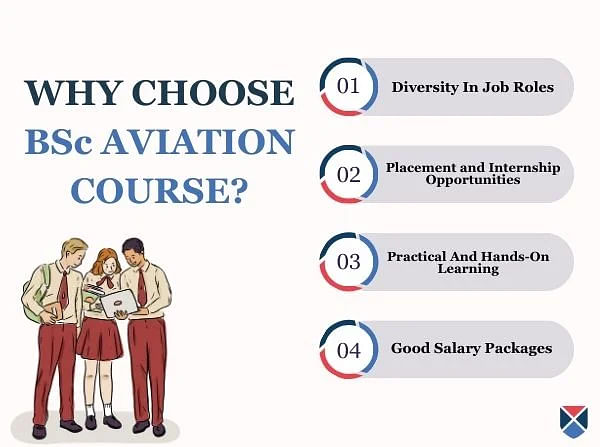
BSc Aviation course is one of the dynamic courses, as there is a consistent demand for trained professionals in various roles, from pilots and air traffic controllers to aviation managers and safety experts. Below listed are reasons why one should choose BSc in Aviation course:
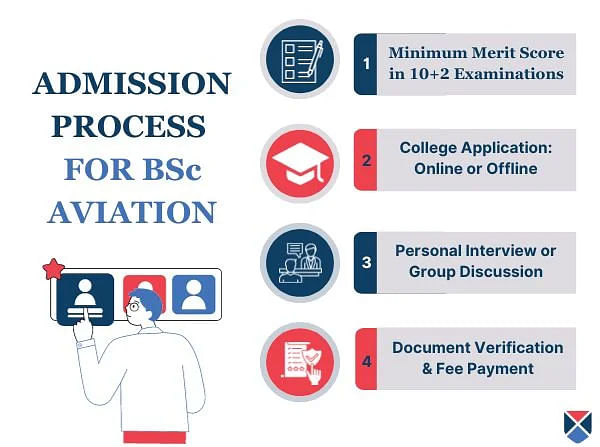
The BSc Aviation admission is done based on merit scores obtained by the students in colleges like Sathyabama Institute of Science and Technology, Hindustan University, etc. Below listed is the general B.Sc Aviation admission process:
The average B.Sc Aviation fees in India is in the range of INR 17,000-3 LPA. Top colleges like VELS University, Hindustan University, ASET College, etc., offer BSc in Aviation courses. Below listed are the best colleges for BSc in Aviation course with their average fees:
Name of the College | Average BSc in Aviation Fees |
INR 17,000 PA | |
INR 57,500 PA | |
INR 1.34 LPA | |
INR 25,000 PA | |
INR 20,000 PA | |
INR 2.36 LPA | |
– | |
– | |
Boston College, Madurai | – |
ASET College | – |
Institute of Aviation and Aviation Safety | INR 66,000 PA |
The BSc Aviation course can be pursued in full-time and distance mode in India. Below listed are BSc Aviation course details:
Types | BSc in Aviation Eligibility | BSc Aviation Duration |
Full-Time BSc in Aviation | 10+2 (High School Degree) with a minimum of 50-60% marks for the general category and 45% marks for the reserved category students. | 3 Years |
BSc Aviation Distance Education | 10+2 (High School Degree) with a minimum of 45-50% marks for the general category and 45-40% marks for the reserved category | 3-5 Years |
The distance BSc Aviation in India is recognized by UGC which offers students an understanding of the aviation industry with flexible learning and a cost-effective mode of study. A few crucial pointers for the distance learning BSc Aviation course are listed below:
Also, Check: Aviation Courses after 12th
The first-year BSc Aviation syllabus gives an introduction to aviation, including its background, laws, and fundamental ideas. The second-year syllabus covers advanced topics like aircraft operations, aviation law and regulation, advanced aviation safety, etc. The third-year syllabus focuses on specializations like aviation management, aviation technology, aviation safety, aviation research, etc.
Below listed are a few important BSc Aviation subjects along with topics covered:
BSc Aviation Subjects | Topics Covered |
Aircraft System | Aircraft Structure and Materials, Electrical Systems, Fuel Systems, Landing Gear Systems, Aircraft Performance System, etc. |
Aerodynamics | Airfoil Theory, Aerodynamic Control Surfaces, Wind Tunnel Testing, Compressibility and High-Speed Flight, etc. |
Aviation Safety | Overview of Aviation Safety Principles, Safety Management Systems, Accident Investigation, Safety Audits and Inspection, etc. |
Flight Planning and Operations | Flight Planning Process, Navigation and Airway Systems, Altitude and Airspeed Selection, Flight Monitoring, etc. |
Read More: B.Sc Aviation Syllabus and Subjects
The technical aspects of aviation are the main focus of the BSc Aviation course, which gives students a thorough understanding of the design, maintenance, and operation of aircraft. The BBA Aviation Management program integrates business and aviation studies, including finance, marketing, etc.
The table below showcases the differences between a B.Sc in Aviation and BBA in Aviation Management:
Course | BSc in Aviation | BBA in Aviation Management |
Full Form | Bachelor of Science in Aviation | Bachelor of Business Administration in Aviation |
Course Overview | The course curriculum focuses on topics like aviation technology, aircraft systems, and aviation safety. | The course curriculum focuses on airline management, airport management, aviation marketing, or aviation finance |
Stream | Science | Management/Commerce |
Duration | 3 Years | 3 Years |
Eligibility | 10+2 (High School Degree) with a minimum of 50-55% marks. | 10+2 (High School Degree) with a minimum of 50% marks. |
Entrance Exams | On Basis of Merit Score | CUET-UG, UPESET, SUAT, etc. |
Top Colleges | ASET College, Hindustan University, Vels University, etc. | UPES, Silver Oak University, NIILM University, etc. |
Fees | INR 17,000-3 LPA | INR 20,000-2 LPA |
Average Salary | INR 2-5 LPA | INR 2.50-4 LPA |
Job Role | Aviation Analyst, Aerospace Researcher, Aviation Consultant, etc. | Airline Manager, Airline Operations Coordinator, Aviation Marketing Manager, etc. |
The BSc Aviation salary in India on average is between INR 2-5 LPA (Source: Ambition Box & Glassdoor). Graduates after having three-plus years of experience can earn more than INR 7 LPA. Below listed are job roles for BSc in Aviation graduates along with their average entry-level salaries:
BSc Aviation Jobs | Entry Level Average Salary | Salary After 3 Years of Experience |
Aircraft Maintenance Engineer | INR 3.20 LPA | INR 4-8 LPA |
Cabin Crew | INR 3 LPA | INR 6.20-7 LPA |
Airport Security Officer | INR 4.40 LPA | INR 6-9 LPA |
Flight Training Instructor | INR 3-4 LPA | INR 6-8.40 LPA |
Read More: BSc Aviation Salary in India
Graduates with a BSc in Aviation can continue their education by enrolling in additional certification courses or higher education programs, which will further develop their subject knowledge and skills. A few courses that a graduate of the B.Sc. Aviation programs can pursue further are listed below:
The career options after BSc in Aviation are vast, graduates can work in top airlines including Vistara, Air India, TruJet, GoAir, Air Asia India, etc. Below listed are a few BSc Aviation job roles offered to graduates along with their job designation, top companies, and average starting salaries:
Job Designations | Hiring Companies | Average Salary |
Aviation Analyst | SpiceJet, Jet Airways, IndiGo, RDM India, etc. | INR 4.10 LPA |
Air Traffic Controller | TCS, Collabera, Magicbricks, SpiceJet, AAI, etc. | INR 4.82 LPA |
Aircraft Dispatcher | Jet Airways, IndiGo, Air India, Air Asia, Global Vectra HeliCorp, etc. | INR 5.52 LPA |
Airline Customer Service Representative | IndiGo, AirBus, AISATS, Air India, Alliance Air, etc. | INR 2.48 LPA |
Aviation Consultant | ICF, Air India, CAPA India, Laminaar Aviation Infotech, etc. | INR 3.5-5 LPA |
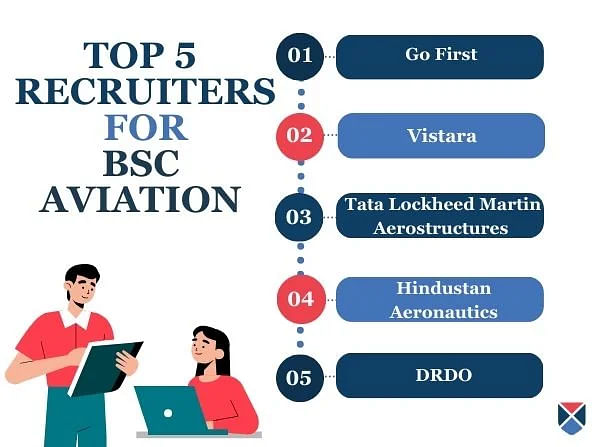
The B.Sc Aviation graduates are hired by various private and government airlines, aviation training and education institutes, aviation consulting firms, aviation research and development departments, etc. Below listed are a few top recruiters for graduates:
Top Recruiter | BSc Aviation Monthly Salary (Average) |
Go First | INR 30,833 |
Vistara | INR 40,000 |
Tata Lockheed Martin Aerostructures | INR 30,000 |
Hindustan Aeronautics | INR 27,000-INR 45,000 |
DRDO | INR 26,000 |
[Source: Glassdoor & Ambition Box]
To excel as a BSc Aviation graduate a combination of domain knowledge, technical knowledge, and practical skills are required. Below listed are a few skills required by the graduate:
The BSc Aviation syllabus is divided into six semesters consisting of both core and elective subjects. The course focuses on enabling students with the required knowledge in the core BSc Aviation subjects such as Air Navigation, Air Regulations, Meteorology, Aircraft and Engine, Aviation Mathematics, Aviation Physics, etc.
In addition to the core subjects, students can choose the elective subjects based on their preference such as Environmental Science, Personality Development, Indian Heritage and Culture, English Language and Communication Skills Practical, Computer Labs, etc.
BSc Aviation course equips students with the required skills and knowledge in designing and maintaining aircraft, helicopters, airline management, and air traffic control to ensure the aircraft works efficiently. The teaching methodologies involve seminars, workshops, hands-on practice, simulation training, etc.
Table of Contents
The BSc in Aviation syllabus focuses on understanding the concepts of production and maintenance of aircraft, aircraft engines, aircraft science, etc. The course focuses on both fundamentals and skill-based subjects. The semester-wise breakdown of the BSc Aviation syllabus is given below:
The BSc Aviation 1st year syllabus focuses on the foundation subjects such as Aviation Physics, Aviation Mathematics, Aviation Science, Aircraft Awareness, etc. Given below is the semester-wise list of First Year BSc Aviation Syllabus:
Semester-I | Semester-II |
Air Navigation-I | Air Navigation-II |
Air Regulation-I | Air Regulation-II |
Meteorology-I | Meteorology-II |
Aircraft and Engine -I | Aircraft and Engine -II |
The BSc Aviation 2nd Year syllabus focuses on advanced topics in aircraft maintenance and air regulations such as Vertical distribution of Temperature, Development of Inversions, Pressure Variation with height, Altimeter Settings, etc. Given below is the semester-wise list of second-year BSc Aviation Syllabus:
Semester-III | Semester-IV |
Air Navigation-III | Air Navigation-IV |
Air Regulation-III | Air Regulation-IV |
Meteorology-III | Meteorology-IV |
Aircraft and Engine -III | Aircraft and Engine -IV |
The BSc Aviation 3rd year syllabus focuses on subjects such as Mercator Chart, Airspeed Indicators, Radio Wave Propagation, Navigation using Computers, etc. Listed below is the semester-wise breakdown of third year BSc Aviation syllabus:
Semester-V | Semester-VI |
Air Navigation-V | Air Navigation-VI |
Air Regulation-V | Air Regulation-VI |
Meteorology-V | Meteorology-VI |
Aircraft and Engine -V | Aircraft and Engine – VI |
Computer Application in the Aviation Industry | Aircraft Inspection Procedures |
Aviation English Computer Practicals | Aircraft Awareness and Simulator Practicals |
Aircraft Ground Handling and Safety Practicals | English Language and Communication Skills Practical |
B.Sc Aviation subjects aim at enabling students with a strong domain knowledge and skill set on the performance, designing, manufacturing, and maintenance of the aircraft along with the basic skills required for the operation of the aircraft. The BSc in Aviation subjects are divided into core and elective subjects, the details of which are given below:
The core subjects in BSc Aviation course focus on the foundation of designing and manufacturing aircraft to help them understand the theoretical and practical aspects of aircraft maintenance. Listed below are the BSc Aviation core subjects:
BSc Aviation elective subjects can be chosen by the students based on their areas of interest, scope for higher education, career opportunities, future potential of growth, etc. Listed below are the BSc Aviation elective subjects:
The BSc Aviation course covers both basic and advanced topics such as aircraft maintenance, aircraft regulation, meteorology, aircraft awareness, safety regulations, etc. Listed below are the few important B.Sc Aviation subject list along with their details:
BSc Aviation Subjects | Topics Covered |
Air Navigation-I | Earth Magnetism, Mercator Chart, Air Speed Indicator, Radio Wave Propagation, Altimeters |
Air Regulation-I | Indian Aircraft Act 1934. Indian Aircraft Act 1937, Radio Telegraphic Apparatus, Private Pilots Licence, Validity, Renewal & Privileges, Rules of the Air |
Meteorology-I | Solar and Terrestrial Radiation, Lapse rate, Stability and Instability, Barometric Pressure, Reduction of Pressure to mean sea level |
Aircraft and Engines-I | Types of drag, drag-speed relation, Flight controls: Axes of rotation, six-degree freedom, Hydraulic system, Reservoir, EDP, ADP, RAT, PTU, Electric pumps, |
The BSc in Aviation Syllabus varies from one college to another but the course structure remains the same covering all the major subjects and concepts. To learn more about the program and syllabus in detail, students can download the BSc Aviation syllabus 2023 PDF from the university’s official website. The best colleges’ BSc Aviation syllabus are listed below
The Vels University BSC Aviation syllabus focuses on both practical and theoretical aspects of aircraft manufacturing and maintenance with various teaching methodologies. The detailed BSc Aviation Syllabus PDF of Vels University can be downloaded from the college official website. Given below is the semester-wise breakdown of BSc in Aviation Syllabus:
Semester-I | Semester-II |
Tamil-I / Hindi/ French | Tamil-II / Hindi/ French |
English Paper-I | English Paper-II |
Familiarisation of Airport | Theory of Flight |
Aviation Calculation and Numerical | Familiarisation of Aircraft |
Radio Telephony | Basic Electricity and Aircraft Maintenance System |
– | Aviation History, Indian and World History |
– | Practical- Radio Telephony Workshop |
Semester-III | Semester-IV |
Air Navigation-I | Air Regulation-II |
Air Regulation-I | Radio Aids |
Meteorology-I | Aero Engines |
Pistol Engines and Propellers | Practicals-Hanger Workshop I |
Human Factors | Environmental Studies |
Practicals -ATC Communication and its Units | Quantitative Aptitude, Logical Reasoning and Data Interpretation |
Semester-V | Semester-VI |
Aircraft Instruments | Practical – Flight Planning |
Meteorology-II | Practical-Flight Operations |
Aircraft Systems | Practical – Maintenance Workshop |
Civil Aviation Requirements and Safety Management Systems | Practical- Flying Synthetic |
Flight Performance and Planning | Project and Viva Voce |
Practical-Hangar Workshop-II | – |
The Centurion University of Technology & Management B.Sc Aviation syllabus focuses on practical and theoretical concepts related to the aviation industry right from the foundation such as Applied Physics and Applied Science, etc to advanced subjects such as Air Regulations, Aircraft Maintenance, etc.
Listed below is the semester-wise BSc Aviation syllabus of the Centurion University of Technology & Management
Semester-I | Semester-II |
Human Factor | English |
Air Regulation-I | Environmental Science |
Air Navigation-I | Air Regulation-II |
Meteorology-I | Air Navigation-II |
Aircraft & Engines -I | Meteorology-II |
Flying Experience-I | Aircraft & Engines-II |
Flying Experience-II |
Semester-III | Semester-IV |
English Language | Principles of Management |
Air Regulation-III | Air Regulation-IV |
Air Navigation-III | Air Navigation-IV |
Meteorology-III | Meteorology-IV |
Aircraft & Engines-III | Aircraft & Engines-IV |
Elective-I | Elective-II |
Semester-V | Semester-VI |
Air Regulation-V | Air Regulation-VI |
Air Navigation-V | Air Navigation-VI |
Meteorology-V | Meteorology-VI |
Aircraft & Engines -V | Aircraft & Engines-VI |
Elective-III | Elective-IV |
To equip students with a practical understanding of the course, the college curriculum includes dissertation/project work in the final year. Below listed are a few trending project topics for the BSc Aviation course:
The BSc in Aviation course structure is a blend of theoretical concepts and industry-driven applications which includes an understanding of aircraft engines, designing and manufacturing aircraft systems, aircraft regulations, meteorology, pressure points, etc. Given below is the BSc Aviation course structure:
The BSc Aviation syllabus includes both traditional and modern teaching methodologies such as traditional classroom teaching, simulation training, hands-on practicals, workshops, internships, etc. Listed below are the BSc Aviation Teaching Methodologies and Techniques
The BSc Aviation syllabus is vast and to gain a deeper insight into the topics discussed in the subjects, candidates can refer to the books by experts and famous authors in the field of aviation. Listed below are some of the reference books for B.Sc Aviation graduates:
BSc Aviation Reference Books | Author | Topics Covered |
Flight Without Formula | Kermode | Rocket Propulsion, Balance of Aeroplane, The Tail Plane, Stability of Aeroplane |
Flight Performance & Planning | Nordian AS | Take off performance calculations, Approach and Landing, Minimum and Maximum Operation Speed |
Climatology | Satvindra Singh | Meteorology and climatology, Earth’s Atmosphere, Insolation and temperature, Atmospheric Pressure |
Indian Aircraft Rules | Ministry of Civil Aviation | Definition and Interpretation, Nationality of the Aircraft, Delegation of Power, Licenses and Appeal, Use and Operation of Aircraft |