
- info@wingeducations.com
- +91 (705) 495-5296
- Mon - Sat : 10.00-18.00
| Degree | Bachelors |
| Full Form | Bachelor of Science in Physics |
| Duration | 3 Years |
| Age | Minimum age limit is 17 years. |
| Minimum Percentage | 50% for general category and 45% marks for reserved category in 10+2. |
| Average Fees | INR 5,000-2,00,000 per year |
| Similar Options of Study | B.Sc (Applied Physics), B.Sc (Mathematics), B.Tech (Physics) etc. |
| Average Salary | INR 2 – 7 LPA |
| Employment Roles | Physicist, Research Associate, Research Scientists, Radiology Technician, etc. |
| Top Recruiters | ISRO, DRDO, Bhabha Atomic Research Centre (BARC), TCS, Infosys, Wipro, etc. |
BSc Physics full form is Bachelor of Science in Physics. The BSc Physics course duration is three years and focuses on the fundamentals of physics such as Sound waves, Applied acoustic, Ultrasonic Power supply, Electromagnetic waves, etc. BSc Physics course falls under the umbrella of BSc Courses.
B.Sc Physics graduates can opt for job roles such as Physicist, Research Associate, Lab Assistant, Subject Matter Expert, Academic Counsellor, Physics Lecturer, etc in various industries such as Research and Development, Healthcare, Logistics, Education Technology, automobiles, information technology, etc. The average BSc Physics salary is in the range of INR 2-7 LPA.
The eligibility for BSc in Physics is that the candidate must meet certain requirements such as merit score, age limit, subject requirements, etc. Listed below is the B.Sc Physics requirements for admission:
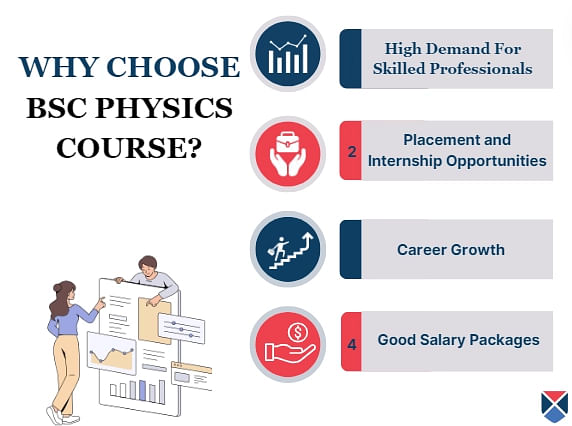
BSc in Physics course has a good scope in the global market with the increasing demand for skilled graduates in various fields such as electronics, automobile, logistics, etc. Listed below are the important facts on why choosing a BSc Physics course can be the right choice:
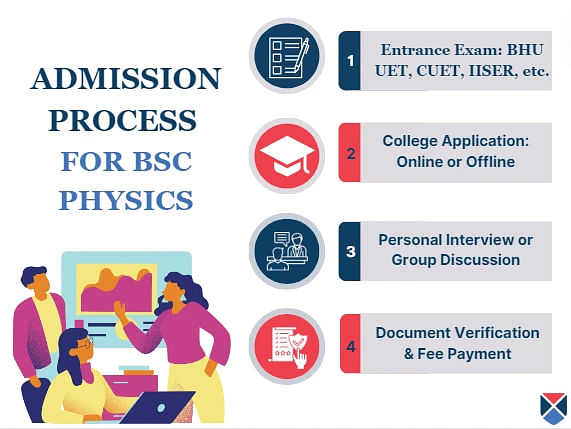
The BSc Physics admission process is done either through the merit score of the previous qualifying examination or based on the entrance examination score as per the college admission criteria. Listed below is the step-by-step BSc in Physics admission process:
In a few colleges such as the Indian Institute of Science Education and Research, and Banaras Hindu University, etc conduct entrance examinations such as IISER, BHU UET, CUET, etc for admissions into BSc Physics courses. Listed below are the entrance exam for BSc in Physics and their registration details:
BSc Physics Entrance Exam | Registration Date | Accepting Colleges |
27 Dec 2023 – 10 Feb 2024 | Banaras Hindu University | |
19 Feb 2024 | Christ University, Amity University, Hindu College | |
April 2024 | Indian Institute of Science Education and Research | |
31 Dec 2023 | Alagappa University, Amity University, Central University of Rajasthan |
The average B.Sc Physics fees in India is INR 5,000 – 2,00,000 per year based on the infrastructure, location, lab facilities, placement opportunities, etc. Private colleges such as Amity University, Lovely Professional University, Madras Christian College, etc, and government colleges such as Jamia Millia Islamia, Indian Institute of Science Education and Research, Delhi University, etc. offer BSc in Physics courses.
Listed below are the top colleges in India offering BSc Physics courses and their fee details:
NIRF Ranking 2023 | Name of the College | Admission Fees | BSc Physics Tuition Fees (Per Year) | Miscellaneous Fees |
1 | INR 500 | INR 19,200 | INR 17,500 | |
2 | INR 25,000 | INR 67,000 | – | |
7 | INR 1,000 | INR 13,300 | INR 5,000 | |
11 | INR 10,000 | INR 22,500 | INR 1,00,000 | |
37 | INR 1,000 | INR 6,350 | INR 8,000 | |
67 | – | INR 19,000 | INR 5,000 | |
79 | INR 2,090 | INR 33,000 | INR 2,500 | |
– | INR 1,200 | INR 1,00,000 | INR 3,700 | |
– | INR 10,000 | INR 40,000 | INR 20,000 |
Listed below are city-wise BSc in Physics colleges in India and their average fee details:
Location | BSc Physics Fees Per Year |
INR 5,000 – 60,000 | |
INR 10,000 – 42,000 | |
INR 5,000 – 35,000 | |
INR 5,000 – 1,40,000 | |
INR 4,000 – 22,000 | |
INR 9,000 – 33,000 | |
INR 20,000 – 1,50,000 | |
INR 6,000 – 90,000 | |
INR 5,000 – 60,000 |
BSc Physics syllabus is designed to impart a practical and theoretical understanding of the fundamental concepts of Physics through various subjects and topics such as electromagnetism, Quantum Mechanics, Electromagnetic theory, Atomic and Molecular Physics, etc.
Listed below is the semester-wise BSc Physics syllabus:
Semester-I | Semester-II |
| Mechanics-I | Allied Mathematics – II |
| Electricity and Magnetism | Mechanics-II |
| Allied Mathematics-I | Environmental Science |
| Properties of Matter and Acoustics | Thermal Physics and Oscillations |
| – | Optics |
| – | Electro-Magnetic Induction and Electronic Devices |
Semester-III | Semester-IV |
| Allied Chemistry-I | Allied Chemistry-II |
| Mathematical Physics-II | Mathematical Physics-III |
| Thermal and Statistical Physics | Digital Systems and Applications |
| Sound Waves, Applied Acoustic, Ultrasonic and Power Supply | Physical Optics-II |
| Analog Systems and Application | Modern Physics Elements |
| Practicals | Practicals |
Semester-V | Semester-VI |
Mathematical Physics | Statistical Mechanics |
Classical Mechanics | Solid State Physics |
Quantum Mechanics | Elements of Nuclear Physics |
Electronic Devices and Circuits | Atomic Physics and Laser |
Electromagnetic Theory | Topics in Modern Physics |
Practicals | Practicals |
The BSc Physics course is designed to equip the students with knowledge and skills related to electromagnetism, thermodynamics elements of nuclear physics, etc. whereas the BSc Chemistry is a three-year undergraduate course that focuses on the fundamental concepts of chemistry such as Inorganic Chemistry, thermodynamics, organic chemistry, etc.
Listed below is the comparison between B Sc Physics and BSc Chemistry based on various parameters:
Course | BSc Physics | BSc Chemistry |
Full Form | Bachelor of Science in Physics | Bachelor of Science in Chemistry |
Course Duration | 3 Years | 3 Years |
Course Overview | B.Sc in Physics focuses on subjects such as electromagnetism, atomic energy, statistical mechanism, mechanics and relativity, etc. | BSc in Chemistry focuses on topics such as Enzymes and Lipids, Inorganic Chemistry, Qualitative Analysis, Physical Chemistry, etc |
Eligibility Criteria | 50% in 10+2, with Physics, Chemistry and Mathematics as compulsory subjects | 50% in 10+2, with Physics, Chemistry and Mathematics as compulsory subjects |
Course Fees Per Year | INR 5,000 – 2,00,000 | INR 8,000 – 3,00,000 |
Entrance Exam | CUET, IISAR, GSAT | CUET, BHU UET, IPU CET |
Top Colleges | Fergusson College, IISC, Ramjas College | Hindu College, Miranda House, Loyola College |
Job Roles | Research Associate, Laboratory Assistant, Physicist, Subject Matter Expert | Chemist, Pharma Assist, Clinical Research Specialist, Academic Counsellor |
Average Salary | INR 2-7 LPA | INR 3 – 7 LPA |
After completing the BSc in Physics course, students can opt for higher education in the field of Physics to enhance their knowledge and skills further. Pursuing higher studies will also help the candidates in getting better job opportunities. Listed below are some of the courses students can opt for after BSc Physics:
BSc Physics scope is enormous in various fields such as Research and Development, Automobile, Electronics, Healthcare, etc. The graduates are hired by both private and public sector companies in India in job roles such as Academic Counsellor, Research Associate, Lab technician, etc.
Listed below are the BSc Physics job roles along with their job descriptions and hiring companies:
BSc Physics Job Roles | Job Description | Hiring Companies |
Subject Matter Expert | Responsible for fact-checking and proofreading the details of the document as per the client’s requirements, legislation and law. | TCS, Amazon, Concentrix |
Academic Counselor | Provides counselling to parents and students to assess and diagnose any mental health issues and create awareness of mental health well-being. | Vendantu, UpGrad, CollegeDekho |
Physicist | Studies and research on the interaction of matter and energy through various tests and experiments | TCS, KPMG, SRM Institute of Science and Technology |
Research Associate | Researches new designs, materials and instruments for their quality, feasibility, and benefits and approves them for development. | Accenture, Crisil, Microsoft |
Lab Assistant | Responsible for withdrawing the samples, and performing diagnostic tests and documentation in a laboratory setting. | Manipal Hospitals, Dr. Lal PathLabs, Apollo Hospitals |
Statistician | Generally work with a large set of data and numbers to analyse and interpret the trends to make business decisions. | Epsilon, Novartis, Chegg |
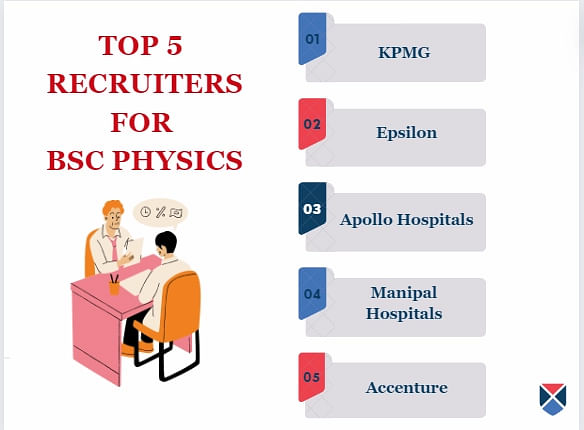
Tabulated below are the top recruiters for BSc Physics graduates in India:
Accenture | Microsoft | TATA Motors |
Tata Consultancy Services | Epsilon | Chegg |
Novartis | Apollo Hospitals | Manipal Hospitals |
KPMG | Vedantu | Amazon |
Concentrix | Wipro | Dr. Lal PathLabs |
The average B.Sc Physics salary ranges from INR 2-7 LPA based on domain expertise and experience. The salary range can go up to INR 12 LPA with 3+ years of working experience in the relevant field. Listed below is the BSc Physics salary for various job roles based on the experience:
B.Sc Physics Job Role | Average Entry-Level Salary | Salary After 3+ Years of Experience |
Subject Matter Expert | INR 5.3 LPA | INR 8.5 LPA |
Research Associate | INR 4.5 LPA | INR 7.7 LPA |
Physicist | INR 4.8 LPA | INR 6.3 LPA |
Laboratory Technician | INR 3.1 LPA | INR 4.5 LPA |
Statistician | INR 5.8 LPA | INR 9.5 LPA |
Academic Counselor | INR 4.2 LPA | INR 6.5 LPA |
High School Teacher | INR 2.3 LPA | INR 4.2 LPA |
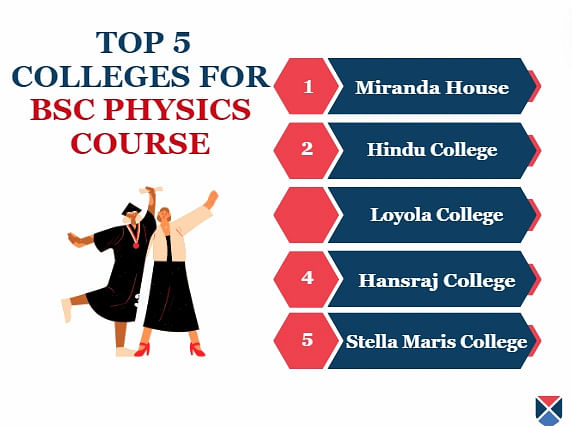
Candidates can choose to pursue BSc Physics courses in top cities such as Chennai, Bangalore, Mumbai, Delhi, etc in prestigious universities such as Fergusson College, Ramjas College, Loyola College, etc. for better placement opportunities.
Listed below are the top 5 cities in India to pursue a BSc Physics course based on the cost of living, average fees, infrastructure, exposure, etc.
Cities | Top Colleges Offering B.Sc Physics. Course | Average Living Expense | Average Starting Salary | Top Recruiters |
Chennai | Loyola College | INR 15,00-25,000 Per Month | INR 14,000 – 35,000 Per Month | Apollo Hospitals, Tata Capital, Sutherland |
Delhi | Hindu College | INR 12,000-15,000 Per Month | INR 15,000 – 30,000 Per Month | Accenture, Metlife, Genpact |
Bangalore | Christ University | INR 10,000-20,000 Per Month | INR 20,000 – 50,000 Per Month | IBM, Tata Motors, Infosys |
Mumbai | St.Xavier’s College | Up to INR 30,000 Per Month | INR 15,000 – 33,000 Per Month | Randstad, Abbott, IBM |
Pune | Fergusson College | INR 15,000-30,000 Per Month | INR 22,000 – 40,000 Per Month | Deutsche Bank, BNY Mellon, Accenture |
Many educational institutions, NGOs and government offer scholarships to BSc Physics students based on certain criteria such as annual income, quota, merit score, etc, Listed below are some of the BSc Physics Scholarships and their benefits:
BSc Physics Scholarship | Eligibility Criteria | Amount |
The Tata Capital Pankh Scholarship Programme 2024 | Must be an Indian Citizen | Full Tuition Fee Waiver |
Narotam Sekhsaria Scholarship Programme | Must be an Indian citizen under the age of 30 pursuing an undergraduate degree | Maximum of 20 Lakhs |
Indira Gandhi Scholarship for Single Girl Child | Must be a single girl child in the family pursuing an undergraduate program from any recognised university | INR 36,200 |
Candidates need to develop certain soft skills and hard skills to excel in their career after BSc Physics graduation. Listed below are some of the important skills that the student must possess:
The BSc Physics syllabus consists of a systematic and multidisciplinary curriculum that involves both theoretical and practical study of physics. B.Sc physics syllabus for each semester contains theory, lab, and practical examinations. The following is a tabulated breakdown of the general BSc Physics syllabus semester-wise:
BSc Physics syllabus 1st year is diverse and includes a wide range of scientific studies on optics, particle & nuclear physics, quantum mechanics, electromagnetism, etc. The table below represents the first-year BSc Physics subjects:
Semester I | Semester II |
Properties of Matter and Acoustics | Mechanics-II |
Allied Mathematics – I | Allied Mathematics – II |
Mechanics-I | Environmental Studies |
Electricity and Magnetism | Optics |
– | Thermal Physics and Oscillations |
– | Electro-Magnetic Induction and Electronic Devices |
Practical topics in First Year BSc Physics Subjects
Some of the practical topics in the first-year BSc physics syllabus are given below:
Read More: BSc Physics 1st Year Syllabus
BSc Physics 2nd year syllabus covers topics like electric and magnetic fields, geometric and wave optics, interference, laws of thermodynamics, applications to gasses, etc. Some of the BSc Physics subjects in the second-year are given below:
Semester III | Semester IV |
Mathematical Physics-II | Mathematical Physics-III |
Analog Systems and Application | Allied Chemistry-II |
Thermal and Statistical Physics | Physical Optics-II |
Allied Chemistry-I | Digital Systems and Applications |
Sound Waves, Applied Acoustic, Ultrasonic and Power Supply | Modern Physics Elements |
Practicals/Lab Work | Practicals/Lab Work |
Practical Topics in Second Year BSc Physics Subjects
The practical topics in the 2nd-year BSc physics syllabus are given below:
Read More: BSc Physics 2nd Year Syllabus
The 3rd year BSc Physics syllabus covers advanced topics like advanced quantum mechanics, electromagnetism, nuclear physics, etc. The third-year BSc Physics subjects are given below:
Semester V | Semester VI |
Solid State Physics-I | Nuclear Physics-II |
Electricity and Magnetism | Applied Mechanics |
Electrodynamics -II and Electronics- II | Electives |
Nuclear Physics-I | Quantum Mechanics and Relativity |
Quantum Mechanics Advanced | Solid State Physics-II |
Practicals/Lab Work | Advanced Thermal and Statistical Physics |
Minor Project | Practicals/Lab Work |
– | Dissertation/Project Report |
Practical Topics in Third Year BSc Physics Subjects
Some of the practical topics in the 3rd-year BSc physics syllabus are given below:
Read More: BSc Physics 3rd Year Syllabus
BSc Physics subjects include the scientific study of composition, makeup, and characteristics of matter and energy. The subjects in BSc physics cover several areas of modern and classical physics. The following is a list of the topics covered under the B.Sc Physics syllabus.
Listed below are some of the core BSc Physics subjects:
BSc Physics Core Subjects | Topics Covered |
Properties Of Matter And Mechanics | Elasticity, Viscosity, Surface tension, Mechanics, Waves And Oscillations, Acoustics, Ultrasonics |
Allied Mathematics | Integral Calculus, Curvilinear Coordinates, Derivatives and Integrals |
Environmental Studies | Environmental Awareness, Conservation Topics |
Mechanics | Newtonian Mechanics, Motion in a Central Field, Rigid Body Dynamics |
Thermal Physics and Oscillation | Laws of Thermodynamics, Clausius Theorem, Entropy, Nernst Heat Theorem, Low-temperature Physics |
Mathematical Physics | Mathematical Methods in Physics, Differential Equations, Complex Analysis |
Allied Chemistry | Chemical Bonding, Periodic Table Trends, Coordination Compounds, Organic Compound Fundamentals |
Analog System and Application | Introduction to Analog Systems, Applications of Analog Systems |
Modern Physics Elements | Introduction to Modern Physics, Special Relativity, Photoelectric Effect |
Nuclear Physics | Nuclear Structure, Radioactivity, Nuclear Reactions, Fission and Fusion |
Electricity And Magnetism | Electrostatics and Magnetostatics, Motion of Charged Particles in Uniform Electric & Magnetic Fields, Integral Calculus, Curvilinear Coordinates |
Thermodynamics | Conversion of heat, Laws of Thermodynamics, Clausius theorem, Entropy, Nernst heat theorem, Low temp physics |
Physical Optics | Fresnel’s & Fraunhofer diffraction, Michelson Interferometer, Fabry-Perot interferometer and etalon, Polarization |
Solid State Physics | Introduction to Crystal structure, Introduction to discrete and continuous X-ray spectra, Introduction to LASER, Reciprocal lattice |
Quantum Mechanics | Planck’s radiation law, Compton Effect, Wave particle duality, Schrodinger’s equation, Introduction to Nanoscience and Nanotechnology |
Listed below are some of the elective BSc Physics subjects along with topics covered in each subject:
Elective Subjects | Topics Covered |
Astro-Physics | Celestial mechanics, Stellar structure and evolution, Galactic dynamics, Cosmology, Observational techniques, Exoplanets, Black holes |
Energy Physics | Thermodynamics, Heat transfer, Fluid dynamics, Nuclear energy, Energy conversion, Power systems, Alternative energy sources |
Materials Science | Crystal structure, Mechanical properties, Electrical properties, Magnetic properties, Nanomaterials, Polymers, Semiconductors |
Renewable Energy and Energy Harvesting | Solar energy, Wind energy, Biomass energy, Geothermal energy, Energy storage technologies, Energy harvesting devices |
Computational Physics Skills | Numerical methods, Monte Carlo simulations, Data analysis, Programming languages (e.g., Python, MATLAB), Parallel computing, Machine learning basics |
Earth Science | Geology, Geophysics, Plate tectonics, Seismology, Mineralogy, Petrology, Earth’s interior structure, Earth’s magnetic field |
Atmospheric Physics | Atmospheric composition, Climate dynamics, Meteorology, Atmospheric optics, Weather phenomena, Climate change, Atmospheric modeling |
Medical Physics | Radiation therapy, Medical imaging techniques (X-rays, MRI, CT scans), Nuclear medicine, Dosimetry, Radiobiology |
Classical Dynamics | Newtonian mechanics, Lagrangian mechanics, Hamiltonian mechanics, Central force motion, Rigid body dynamics, Celestial mechanics, Chaos theory |
The BSc in Physics syllabus differs depending on the structure and aim of the program across institutions. Students can get the B.Sc Physics syllabus pdf from the university website to grasp a better understanding of the BSc Physics subjects offered by specific institutions. The following are the BSc Physics disciplines offered at leading universities:
Sharda University BSc Physics syllabus focuses on making students understand topics like quantum mechanics, nuclear physics, fluid mechanics, thermal physics, etc. Below listed is the BSc Physics syllabus semester wise at Sharda University:
Semester 1 | Semester 2 |
Mathematical Physics-I | Optics Fundamentals |
Communicative English-I | Communicative English-II |
Understanding Properties of Matter | Fundamentals of Thermal Physics |
Concept of Ecology and Ecosystem | Yoga (Holistic Health) |
Practical/Laboratory Work | Probability Distribution |
– | Practical/Laboratory Work |
Semester 3 | Semester 4 |
Understanding Solid State Physics | Quantum Mechanics |
Mathematical Physics-II | Concept of Electromagnetic Theory |
Magnetism and Electricity Concept | Air Pollution and Related Technologies |
Logical Skill Development | Concept of Analog Electronic Device |
Concept of Descriptive Statistics | Research Based Learning-II |
Research Based Learning-I | Discipline Specific Elective-I |
Subject Specific Elective-I | Campus to Corporate |
Practical/Laboratory Work | Practical/Laboratory Work |
Semester 5 | Semester 6 |
Concept of Numerical Analysis | Nuclear Physics |
Waves and Oscillation | Molecular Physics |
Instrumentation Concept | Understanding Statistical Mechanics |
Relativity and Classical Mechanics | Practical/Laboratory Work |
Practical/Laboratory Work | Research Based Learning-Iv |
Industry Connect | Minor Subject |
Research Based Learning-III | Project Work |
BSc in Physics subjects in IOS, Nagpur focuses on understanding of classical mechanics, electromagnetism, quantum mechanics, and statistical mechanics. Below listed is the BSc Physics syllabus at the Institute of Science, Nagpur:
Semester 1 | Semester 2 |
Matter and Mechanics Properties | Gravitation, Astrophysics, Magnetism and Magnetostatics Concepts |
Electrostatics, Time varying fields & Electric Currents | Oscillations, Kinetic theory of gasses and Thermodynamics |
Practical/Laboratory Work | Practical/Laboratory Work |
Semester 3 | Semester 4 |
Fundamentals of Physical Optics and Electromagnetic Waves | Solid State Electronics, and Molecular Physics Fundamentals |
Sound Waves, Applied Acoustic, Ultrasonic and Power Supply Concepts | Solid State Physics, X-Ray and Laser |
Practical/Laboratory Work | Practical/Laboratory Work |
Semester 5 | Semester 6 |
Quantum Mechanics, Nanomaterials and Nanotechnology Concept | Electronics, Communication and Digital Electronics and Fibre Optics |
Atomic Physics and Statistical Physics | Concept of Relativity, Nuclear Physics and BioPhysics |
Practical/Laboratory Work | Practical/Laboratory Work |
B.Sc in Physics syllabus is a three-year undergraduate program divided into six semesters that provide in-depth knowledge of scientific and technical aspects of physics through problem-solving & hands-on exercises, study visits, and projects, and other activities. The general course structure is given below:
B.Sc Physics course curriculum includes various techniques used in laboratories to aid learning. Forensic science laboratories, community ventures, and other action-based learning approaches are used in addition to conventional lecture-based instruction. These techniques include inductive, discovery, scientific method skills, technical skills, and deductive methods. Some effective learning techniques are given below:
B.Sc Physics syllabus includes several projects to provide a holistic idea of the several practical implementations of the course outcome. These projects expose students to undertake industry-relevant measures and knowledge. Popular B.Sc Physics projects are given below:
Reference books in BSc Physics syllabus help students to gain in-depth knowledge and score well in the exam. The following is a list of the most recommended books for a B.Sc Physics course:
BSc Physics Books | Topics Covered | Author |
Optics | Geometrical optics, Physical optics, Wave optics, Polarization, Interference, Diffraction | G. Kaur and G.R. Pickrell |
Modern Physics | Special relativity, Quantum mechanics, Atomic physics, Nuclear physics, Particle physics, Quantum information theory | John R. Taylor, Chris D. Zafiratos |
Quantum Physics | Quantum mechanics principles, Wave-particle duality, Schrödinger’s equation, Quantum states and operators | E.H. Wichman |
Waves and Oscillations | Wave equation, Superposition, Resonance, Simple Harmonic Motion, Doppler effect, Forced oscillations | N K Bajaj |
Concepts of Modern Physics | Relativity, Quantum mechanics, Statistical mechanics, Solid-state physics, Nuclear physics, Elementary particles | Arthur Beiser |