
- info@wingeducations.com
- +91 (705) 495-5296
- Mon - Sat : 10.00-18.00
| Degree | Bachelors |
| Full Form | Bachelor of Science |
| Duration | 3 Years |
| Age | No age limit |
| Minimum Percentage | 50% in 10+2 from a recognized board. |
| Average Fees | INR 1,500 to 4,40,000 per year. |
| Average Salary | INR 3–7 LPA |
| Employment Roles | Business Analyst, Scientist, Lecturer, Pharmacist, Plant Biochemist, etc. |
BSc full form is Bachelor of Science. The course aims to develop a creative and critical understanding of a range of fields, including engineering, finance, and technology, as well as healthcare. The BSc course offers various specializations that students can select in their final years such as applied mathematics, information technology, chemistry, zoology, nursing, agriculture, etc.
The B.Sc job scope is vast, as a graduate can find employment opportunities in core science industries and other research-based industries. B.Sc graduates primarily work as Scientists, Research Scholars, Specialists, and R&D Industry Experts. The average BSc graduate salary in India is in the range of INR 3-7 LPA.
BSc admission requires a candidate to fulfil a certain set of eligibility criteria such as education qualifications, subject requirements, entrance exam score, etc. Below are the BSc courses eligibility criteria:
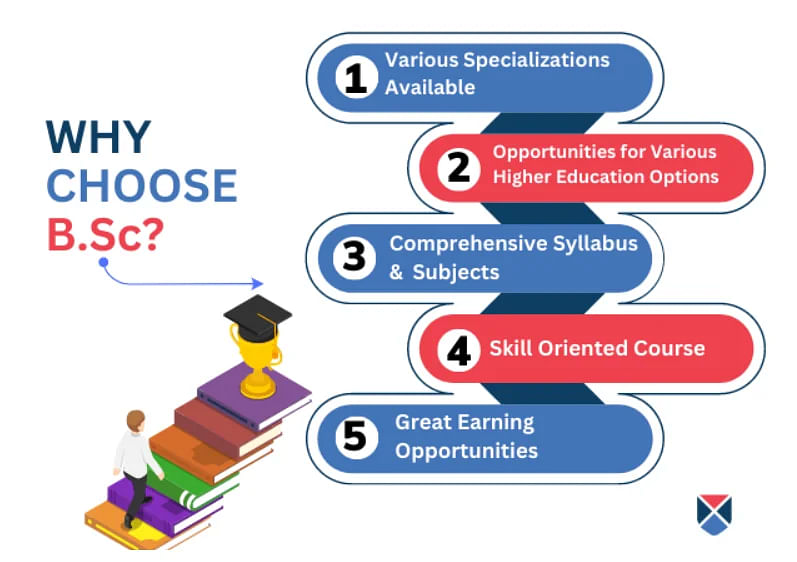
BSc is one of the most prestigious undergraduate science degrees in India. The course offers extensive support for research-based study in various fields of science and technology. Below mentioned is a detailed insight regarding why to choose a BSc course:
Read More: Advantages and Disadvantages of BSc Degree
BSc admission is done based on both merit basis in colleges like IES University and on the basis of entrance exam scores in colleges like LPU, BITS Pilani, etc. Listed below are the steps for the admission process for BSc courses in general:
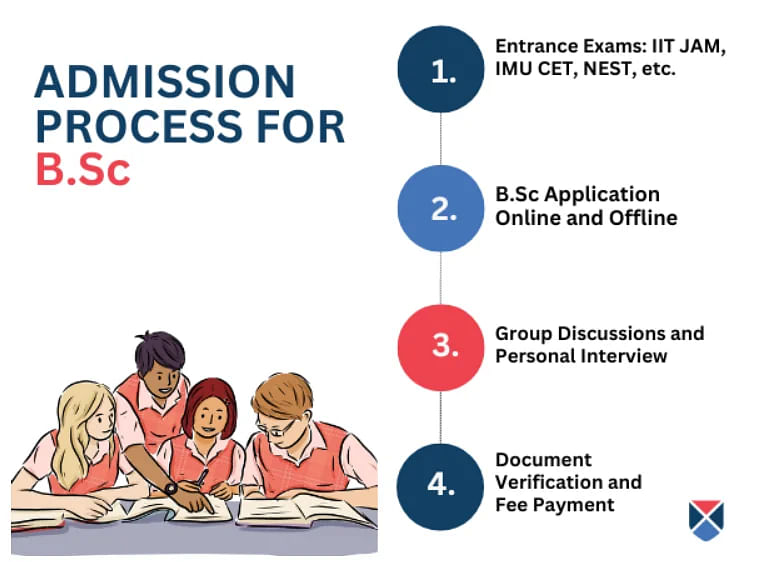
The BSc entrance exam is conducted in the form of an online written test. There are several national and state-level entrance examinations affiliated with several universities. Apart from that, selected universities conduct a university-level exam for the admission process, apart from national-level examinations.
Some of the popular BSc entrance exams are listed below:
| BSc Entrance Exams | Registration Dates (Tentative) |
| CUET-UG | February 2024-April 2024 |
| NPAT | December 2023- May 2024 |
| CUCET | February 2024-April 2024 |
| TS EAMCET | March 2024- April 2024 |
| KCET | February 2024-April 2024 |
| Pune University OEE | April 2024 |
| WBJEE JENPAS | January 2024 |
There are several pure science and research technology applications, and each of them is pursued as a separate specialized domain. The diverse fields of research require specialized personnel to spearhead the research work and establish a concrete theorem.
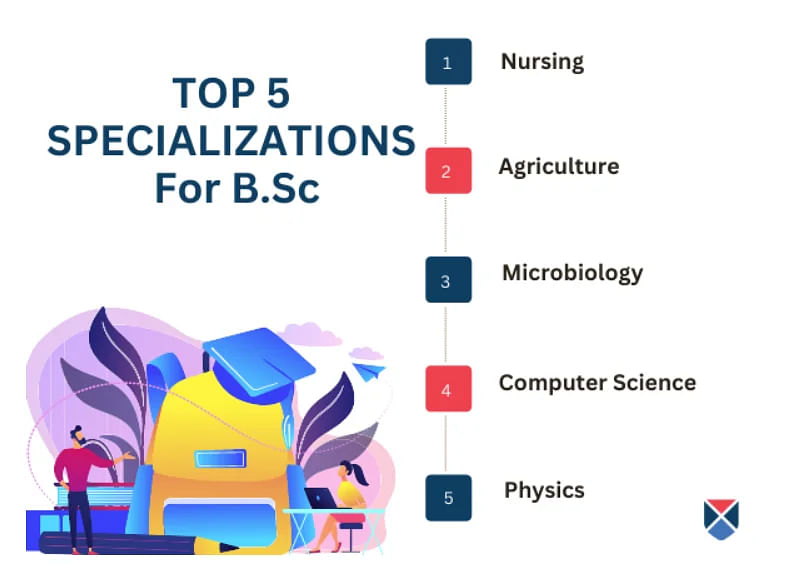
Listed below are the top BSc branches or specializations in India:
Other BSc degree courses include:
Read More: List of all BSc Specializations
The Bachelor of Science Lateral Entry course is designed for students who have completed a diploma in engineering or technology and wish to pursue a degree in science. BSc Lateral Entry admission is an entrance-based admission process. These entrance tests are known as LEET and are conducted by state-level education authorities every year.
B.Sc Lateral Entry eligibility criteria include that the aspirant must complete their diploma degree in science with a minimum of 45% aggregate. Candidates who fall into the reserved category will receive a 5% exemption.
The BSc courses in India are provided by top private colleges in India like UPES, Sharda University, LPU, whereas, the top government colleges like Mumbai University, IITs offer BSc degree in various specializations from chemistry to information technology. IITs offer BS degree also known as a bachelor of science degree in research and other related field with a 3-4 year of duration.
Below listed are the top colleges offering BSc along with the fee breakdown:
College Name | B.Sc Tuition Fee Per Year | Admission Fees | Miscellaneous Fees Per Year |
| IIT Kanpur | INR 1,00,000 | INR 19,950 | INR 17,530 |
| UPES | INR 94,000 – 1,52,000 | INR 29,500 | INR 2,50,000 |
| Sharda University | INR 96,000 | – | INR 1,65,000 |
| Amity University | INR 84,000 – 4,40,000 | INR 20,000 | INR 1,05,000 – 1,83,000 |
| Siksha `O` Anusandhan | INR 1,00,000 – 1,80,000 | INR 10,000 | INR 95,000 – 1,65,000 |
| NMIMS | INR 3,50,000 | INR 10,000 | INR 1,80,000 |
| Indian Institute of Science | INR 10,000 | INR 15,000 (refundable) | INR 5,200 |
| BITS, Pilani | INR 1,78,000 | INR 39,800 | INR 25,000 |
| LPU | INR 1,00,000 – 2,40,000 | – | INR 9,000 |
| Bharati Vidyapeeth | INR 1,20,000 | INR 10,000 | – |
| JMI, Delhi | INR 7,800 | INR 5,000 | – |
| Silver Oak University | INR 42,000 | INR 10,000 | – |
| Assam Don Bosco University | INR 60,000 | – | INR 32,000 |
| VIT | INR 55,000 – 1,25,000 | INR 2,000 – 3,000 | – |
| Mumbai University | INR 16,940 | INR 380 | – |
| Indus University | INR 85,000 | – | INR 58,500 |
| Monark University | INR 74,000 | – | INR 4,500 |
Below listed are location-wise BSc colleges in India with the annual fees:
| Location | Tuition Fees Per Year |
| INR 10,000-1,50,000 | |
| INR 50,000-3,00,000 | |
| INR 10,000-2,00,000 | |
| INR 17,100-50,500 | |
| INR 12,000-1,56,000 | |
| INR 40,000-2,00,000 | |
| BSc Colleges in Hyderabad | INR 1,00,000-2,00,000 |
| INR 6,500-47,000 | |
| INR 10,750-85,500 | |
| INR 50,000-3,00,000 |
Read More: BSc Fees in India
In India, BSc courses are in high demand. A variety of courses are designed for students. Full-time BSc courses, integrated B.Sc courses, and distance BSc courses are among them. Listed below are the types of BSc courses details:
Type | Basic Eligibility | BSc Duration |
Full-Time BTech | Should have passed 10+2 with PCM/PCB with a minimum of 50% marks for the general category and 45% for the reserved category + Entrance Exam Score | 3 Years |
Integrated BSc Course | Should have passed 10+2 with PCM/PCB with a minimum of 50% marks for the general category and 45% for the reserved category | 5 Years |
Distance BSc Education | Should have passed 10+2 with PCM/PCB with a minimum of 45-50% marks for the general category and 45-40% for the reserved category | 3-6 Years |
Distance BSc courses in India are recognized by UGC-DEB making them highly credible and valuable. Below mentioned are the distance BSc course details:
Distance BSc courses in India are recognized by UGC-DEB making them highly credible and valuable. Below mentioned are the distance BSc course details:
Read More: BSc+MSc
The BSc 1st year syllabus offers in-depth knowledge of a basic overview of the course and builds a strong foundation. The BSc second-year syllabus focuses on providing students with a deeper understanding of their chosen field of study through a combination of theoretical and practical coursework.
The BSc 3rd year syllabus focuses on attaining the practical experience required for the industry through projects and internships. Some of the subjects that are included in the BSc syllabus are:
| BSc Subjects | Topics Covered |
| Biology | Biology Basics, Genetics, Evolutionary Biology, Ecology, etc. |
| Chemistry | Inorganic Chemistry, Organic Chemistry, Physical Chemistry, Analytical Chemistry, etc. |
| Microbiology | Microbial Genetics, Virology, Immunology, Medical Microbiology, Microbial Ecology, etc. |
| Biotechnology | Cell Biology, Molecular Biology, Genetic Engineering, Bioprocess Engineering, etc. |
Read More: B.Sc Syllabus and Subjects
BTech programs are more practical and application-oriented, with a strong emphasis on engineering and technology subjects. BSc is more theoretical and research-oriented. The table below showcases the differences between BA and BSc:
Course | BTech | BSc |
Full Form | Bachelor of Technology | Bachelor of Science |
Stream | Science | Science |
Course Overview | The course syllabus cover topics like computer science, electrical engineering, mechanical engineering, civil engineering, etc. | The course cover topics like physics, chemistry, biology, and mathematics. |
Course Duration | 4 Years | 3 years |
Eligibility | High Degree (10+2) from a recognized Board with 60% in Physics, Chemistry, and Maths. | 50% in 10+2 from a recognized board |
Entrance Exams | JEE Main, BITSAT, JEE Advanced, etc. | NEST, NPAT, BHU UET, etc. |
Top Colleges | NIT Jalandhar, LPU, IIT Bombay, IIT Delhi, etc. | Miranda House, Presidency College, Wilson College, etc. |
Tuition Fees Per Year | INR 55,000 – 4,90,000 | INR 1,500- 4,40,000 |
Average Salary | INR 2.5 – 6 LPA | INR 3–7 LPA |
Job Roles | IIT Madras, IIT Delhi, IIT Bombay, etc. | Software Developer, Web Developer, Database Administrator, Network Administrator, etc. |
Read More: BSc vs B.Tech
The BSc salary in India on average is between INR 3-7 LPA [Sources: Ambition Box & Payscale]. Graduates after having three-plus years of experience can earn more than INR 7-8 LPA. Below listed are job roles for BSc graduates along with their average entry-level salaries:
BSc Jobs | Entry Level Average Salary | Salary After 3 Years of Experience |
| Medical Representative | INR 3.10 LPA | INR 4-5 LPA |
| Food Technologist | INR 3-4 LPA | INR 5-7 LPA |
| Technical Writer | INR 3-3.50 LPA | INR 4-6 LPA |
| GIS Specialist | INR 3-4.5 LPA | INR 5-8 LPA |
Read More: BSc Salary in India
BSc courses are diverse in nature and have scope both in India and abroad. Graduates who are willing to enhance their research further can opt for an M.Sc degree in India. BSc graduates, who have a knack for management studies, can opt for an MBA in any domain, which helps them gain interdisciplinary knowledge.
Some of the higher education courses include :
Read More: Courses After BSc
There are plenty of job opportunities available for BSc graduates in both the public and private sectors. The job roles offered will differ according to the industry they work in, and the technical knowledge candidates possess. Below listed are top career positions for BSc graduates with top hiring companies and average salaries:
BSc Job Designations | Hiring Companies | Average Salary |
| Research Scientist | Lupin, Dr.Reddy’s, Sun Pharmaceutical Industries, etc. | INR 5.30 LPA |
| Data Analyst | TCS, Cognizant, Wipro, Accenture, S&P Global, etc. | INR 5.70 LPA |
| Biotechnologist | RG Technosolutions, Dr. Lal Path Labs, Green Pro Biotech, SGS, etc. | INR 4 LPA |
| Lab Technician | SRL Diagnostics, Lab Tech, Apollo Hospitals, AIIMS, etc. | INR 3-4 LPA |
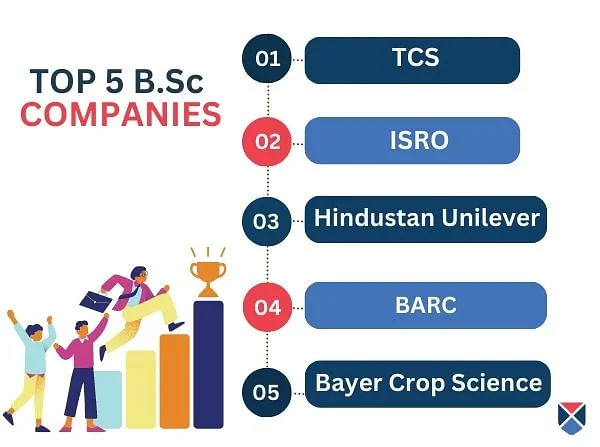
The BSc scope is vast as graduates are hired by various industries such as healthcare and pharmaceuticals, biotechnology and life science, IT, oil and gas, education and research, etc. Below listed are a few top recruiters for graduates:
Top Recruiter | Average BSc Entry-Level Salary |
| TCS | INR 3-4.50 LPA |
| ISRO | INR 4-6 LPA |
| HUL | INR 4.50-5 LPA |
| BARC | INR 3-5 LPA |
| Bayer Crop Science | INR 3.70-4.50 LPA |
[Sources: Payscale & Ambition Box]
Read More: Career Options After BSc
There are various government schemes, private initiatives, and individual college scholarships that students can get depending on their merit performance. Below mentioned are some BSc scholarships for graduates:
Scholarship | Eligibility Criteria | Amount |
| Post-Matric Scholarship for Students with Disabilities |
| Upto INR 4,000 |
| POSE (Promotion of Science Education) Scholarship | The candidate should have secured 60% marks in 10+2 (High School Degree) and the candidate should not be more than 30 years. | Upto INR 22,000 |
HDFC Bank Parivartan’s ECS Scholarship |
| Upto INR 75,000 |
Merck India Charitable Trust (MICT) scholarship |
| Upto INR 35,000 |
Read More: BSc Scholarship
BSc graduates are required to possess skills that will help them succeed in their professional careers. These skill sets will not only help them in terms of academics but will also help them to thrive as a working professional.
The BSc syllabus followed in most institutions in India is based on the recommendations made by the UGC. The syllabus of BSc is designed to provide students with a comprehensive knowledge in science and related subjects while providing avenues for specialization in various fields of science.
The BSc syllabus is divided into majors and minors through a blend of core and elective courses. The BSc curriculum includes practical learning experiences including laboratory work, research projects, and internships.
The BSc subjects differ based on the field of study selected by the students. Some of the common BSc course specializations include BSc Mathematics, BSc Computer Science, BSc Physics, BSc Chemistry, BSc Zoology, and more.
Below listed are the BSc syllabus for some of the popular areas of specialization.
The BSc Mathematics syllabus covers important topics such as Algebra, Calculus, Trigonometry, and more. Below listed is the semester wise BSc Mathematics syllabus followed by the institutions in India.
| Semester I | Semester II |
| English- I | English- II |
| Calculus | Analytical Geometry of Three Dimension |
| Algebra-I | Geometry & Vector Calculus |
| Trigonometry | Calculus- II |
| Semester III | Semester IV |
| Algebra-II | Mathematical Analysis |
| Calculus-II | Static & Dynamic |
| Set Theory and Theory of Equations | Vector Analysis |
| Differential Equations | Riemann Integration and Series ofFunctions |
| Computer Graphic (Elective) | Ring Theory and Linear Algebra I |
| Semester V | Semester VI |
| Real Analysis | Complex Analysis and Ring Theory |
| Elementary Number Theory & Advanced Algebra | Advanced Calculus |
| Complex Analysis | Complex Analysis-II |
| Numerical Methods Practical using C | Programming in C Language |
| Human Rights and Mathematics for Environmental Studies (Elective) | Graph Theory and Metric Spaces |
| Partial Differential Equations andApplications | Project Work |
Read more: BSc Mathematics Syllabus
The BSc syllabus for Computer Science deals with topics such as Statistics, Programming, Data Analysis, etc. The B.Sc Computer Science syllabus is detailed in the table below.
| Semester I | Semester II |
| Introduction to Digital Electronics | Front Office Management |
| Basics of Computer Science | Discrete Mathematics |
| Environmental Sciences | Computer Organization |
| Foundation course in Mathematics | Fundamental of Open Source Software-LINUX |
| English | Value and Ethics |
| Semester III | Semester IV |
| Object-Oriented Programming using C++ | Database Management Systems |
| Operating Systems Concepts | Introduction to Computer Network |
| Introduction to Data Structures | Numerical Analysis |
| System Analysis and Design | System Programming |
| Technical Writing | Report Writing(Yantra) |
| Analytical Skill Development-I | Analytical Skill Development-II |
| Semester V | Semester VI |
| Python Programming | Introduction to Web Technology |
| Introduction to Software Engineering | Project Work |
| Mobile Application Development | – |
| Personality Development Program | – |
| Minor Project-I | – |
Read more: BSc Computer Science
The BSc Physics syllabus covers important topics such as Waves, Optics, Kinetic Theory, Thermodynamics, and more. Below listed is the semester wise BSc syllabus for Physics.
| Semester I | Semester II |
| Properties of Matter and Acoustics | Mechanics-II |
| Allied Mathematics – I | Allied Mathematics – II |
| Mechanics-I | Environmental Studies |
| Electricity and Magnetism | Optics |
| Electro-Magnetic Induction and Electronic Devices | Thermal Physics and Oscillations |
| Semester III | Semester IV |
| Mathematics-I | Mathematics-III |
| Analog Systems and Application | Allied Chemistry-II |
| Thermal and Statistical Physics | Physical Optics-II |
| Allied Chemistry-I | Digital Systems and Applications |
| Sound Waves, Applied Acoustic, Ultrasonic and Power Supply | Modern Physics Elements |
| Practicals/Lab Work | Practicals/Lab Work |
| Semester V | Semester VI |
| Solid State Physics-I | Nuclear Physics-II |
| Electricity & Magnetism | Applied Mechanics |
| Electrodynamics and Electronics-II | Quantum Mechanics and Relativity |
| Nuclear Physics-I | Solid State Physics-II |
| Quantum Mechanics Advanced | Advanced Thermal and Statistical Physics |
| Practical/Lab Work | Practical/Lab Work |
| Minor Project | Project |
Read more: BSc Physics Syllabus
The BSc syllabus for Chemistry focuses on topics such as Organic and Inorganic Chemistry, Physical Chemistry, Materials Concepts, and more. Below listed is the semester wise BSc Chemistry syllabus.
| Semester I | Semester II |
| Chemistry Fundamentals | Medicinal Chemistry Fundamentals |
| Physical Chemistry Principles | Concept of Biochemical Analysis |
| Quantitative Analysis | Qualitative Analysis |
| Practical/Laboratory Work | Practical/Laboratory Work |
| Semester III | Semester IV |
| Understanding Instrumental Analysis | Physical Chemistry-II |
| Inorganic Chemistry-I | Organic Chemistry-II |
| Organic Chemistry-I | Advanced Materials Concept |
| Biostatistics | Quantum Mechanics and Analytical Techniques |
| Physical Analysis Concepts | Environmental Studies |
| Practical/Laboratory Work | Practical/Laboratory Work |
| Semester V | Semester VI |
| Organic Chemistry-III | Physical Chemistry-IV |
| Physical Chemistry-III | Spectroscopic Methods |
| Analytical Chemistry Concept-I | Analytical Chemistry Concept-II |
| Elective-I | Elective-III |
| Elective-II | Elective-IIV |
| Understanding Organic Synthesis-A | Understanding Organic Synthesis-B |
| Practical/Laboratory Work | Practical/Laboratory Work |
Read more: BSc Chemistry Syllabus
The BSc Zoology syllabus deals with important topics such as Anatomy, Genetics, Cell Biology, and more. The BSc syllabus for Zoology is detailed in the table below.
| Semester I | Semester II |
| Life and Diversity of Animals-Nonchordates(Protozoa to Annelida) | Life and Diversity of Animals- Nonchordates(Arthropoda to Hemichordata) |
| Invertebrate Zoology-I | Invertebrate Zoology-II |
| Animal Discovery | Comparative Anatomy and Development Biology ofVertebrates |
| Semester III | Semester IV |
| Life and Diversity of Animals-Chordates(Protochordata to Amphibia) | Life and Diversity of Animals-Chordates (Reptilia,Aves and Mammals) |
| Vertebrate Zoology –I | Vertebrate Zoology –II |
| Physiology, Biochemistry and History | Genetics and Evolutionary Biology |
| Semester V | Semester VI |
| General Mammalian Physiology I | Reproductive Biology |
| Cell Biology | General Mammalian Physiology II |
| Applied Zoology and Ethology | Research/Project |
| Elective-I | Elective-II |
| Value Education | Practical/ Laboratory Work |
| Practical/ Laboratory Work | – |
Read more: BSc Zoology Syllabus
Other Important B.Sc Specializations Syllabus:
Read more: List of all BSc Specializations
The BSc subjects usually include Mathematics, Physics, Chemistry, Biology, Computer Science, Environmental Science, Zoology, Botany, etc. However, these subjects may vary depending on the specialization and university offering the BSc course.
Below listed are the core BSc subjects and the topics covered under popular BSc specializations such as BSc Physics, BSc Chemistry, BSc Maths, BSc Zoology, and more.
| Specialization | Core Subjects | Topics Covered |
| Physics |
| Wave & Optics, Newton Mechanics, Laws of Thermodynamics, Special Relativity, Nuclear Structure, Entropy, Polarization, Wave Particle Duality |
| Chemistry |
| Atomic Structure, Molecular Geometry, Spectroscopy, Chemical Kinetics, Surface Chemistry, Drug Development, Bioorganic Chemistry, Biomolecules, Nanomaterials, Organic Synthesis Methods |
| Mathematics |
| Limit and Continuity, Leibnitz’s Theorem, Rolle’s Theorem, Finite and Infinite Set, Continuous Functions, Integration, Differential and Partial Differentiation, Boolean Algebra, Random Variables |
| Zoology |
| Animal Diversity, Animal Physiology, Animal Behaviour, Animal Ecology, Developmental Biology, Evolutionary Biology, Genetics and Evolutionary Biology, Reproductive Endocrinology, Reproductive Biology |
| Botany |
| Plant Anatomy, Gymnosperms, Pollination, Plant Physiology, Biometrics, Taxonomy, Cell Biology, Gene Mutations, Microorganisms, Plant Disease Epidemiology, Quantitative Inheritance |
| Computer Science |
| OOP, Data Structures, GUI Programming, Set Theory, Graph Theory, 2D and 3D Transformations, STL, Exception Handling, Java Syntax, Data Types, SQL Programming |
| Biotechnology |
| Biomolecules Structures, Enzyme Kinetics, Microbial Morphology, Homeostasis, DNA Isolation, Recombinant Protein Production, DNA Fingerprinting Techniques, Genomic and Proteomic Techniques, Bioinformatics |
| Microbiology |
| Metabolic Processes and Functions of Microorganisms, Microbial Growth, Microbial Genetics, Genetic Variation, Immune System, Immunopathology, Genetic Engineering in Microbiology, Microbial Cultivation |
The BSc course offers specialization in various disciplines offering a range of elective subjects in addition to core BSc subjects listed above. The BSc elective subjects covered are listed in the table below.
| Specialization | Elective Subjects | Topics Covered |
| Physics |
| Celestial Mechanics, Fluid Dynamics, Nanomaterials, Semiconductors, Solar Energy, Numerical Methods, Atmospheric Modeling, Radiation Therapy, Newtonian Mechanics, Central Force Motion |
| Chemistry |
| Crop Protection Chemicals, Agrochemical Analysis, Forensic Toxicology, Enzyme Kinetics, Quantum Chemical Calculations, Fuel Cell Technology, Chromatographic Techniques, Green Nanotechnology |
| Mathematics |
| De Morgan’s Law, Equivalence Relations, Synthetic Division, Ordinary Derivatives of Vectors, Cross Product and Triples Product of Vectors |
| Zoology |
| Biological Systems, Role of Animals in Agriculture, Industry, Aquatic Organisms, Lab Tests, Imaging Technologies, Medicine, Conservation Strategies |
| Botany |
| Seed Development, Seed Dispersal Mechanisms, Fruit Anatomy, Fruit Breeding, Medicinal Plants, Ethnobotanical Knowledge, Genomic and Proteomic Databases, Biofertilizers, Plant Breeding, Postharvest Physiology |
| Computer Science |
| CPU Scheduling Algorithms, File System Organization and Optimization, E-Commerce Business Models, Cloud Service Models, Virtualization Technologies, Intrusion Detection, LAN and WAN Technologies, Testing Methodologies |
| Biotechnology |
| Nanoscience, Nanomaterials Synthesis, Immobilization Techniques for Enzyme Stabilization, DNA Profiling Techniques, Biofertilizer Evaluation, Population Ecology, Biological Data Analysis |
| Microbiology |
| Microbial Cell Structure, Biomolecules, Clinical Chemistry, Biochemical Markers of Diseases, Blood Chemistry Analysis, Microorganisms in Food and Dairy Products, Fermentation Process, Foodborne Pathogens |
The BSc Distance Education program is an undergraduate degree that spans a period of 3 – 6 years. The program offers flexibility for students who cannot attend regular classes. Some of the popular BSc Distance Education courses include BSc IT, BSc Mathematics, BSc Psychology, etc.
The Bachelor of Science Distance Education syllabus followed by most colleges in India is given below.
| Semester I | Semester II |
| English | English |
| Physics I | Physics II |
| Mathematics I | Mathematics III |
| Mathematics II | Mathematics IV |
| Computer Science I | Computer Science II |
| – | Skill Enhancement Course |
| Semester III | Semester IV |
| Physics III | Physics IV |
| Mathematics V | Mathematics VII |
| Mathematics VI | Mathematics VIII |
| Computer Science III | Computer Science IV |
| Ability Enhancement Compulsory Course I | Ability Enhancement Compulsory Course II |
| Semester V | Semester VI |
| Elements of Chemistry | Physics VI |
| Human Resource Management & Organizational Behaviour | Mathematics IX |
| Statistics | Computer Science VI |
| Skill Enhancement Course III | Inference Theory |
| Skill Enhancement Course IV | Physics / Computer Science / Mathematics X |
The B.Sc syllabus is focused on providing students with specialized knowledge and hands-on training in a variety of fields. The BSc subjects 1st year provide a fundamental review of 10+2 fundamentals and introduce some cutting-edge ideas in the field.
Along with the required dissertation submission and viva voce, the programme also includes CBCS electives, which provide possibilities for students to choose subjects often in the third year. The BSc course outline consists of:
The Bachelor of Science teaching methods encompass a range of strategies such as traditional lectures, case studies, experimental learning, and more aimed at providing an extensive understanding of the syllabus. Below listed are the BSc teaching methodologies and techniques used in the curriculum.