B.Lib.I.Sc [Bachelor of Library and Information Science] Admission 2026-2027
B.Lib.I.Sc [Bachelor of Library and Information Science] Admission 2026-2027
B.Lib.I.Sc Admission 2026: Course Overview
Bachelor of Library and Information Science (B.Lib.I.Sc / B.Lib) is a 1-year professional degree program designed to train students in library management, digital cataloging, archive preservation, and information management systems.
Key Program Highlights
Eligibility: Bachelor’s degree (BA, BSc, BCom) from a recognized university with minimum 50% aggregate marks. Course Duration: 1 Year (2 Semesters). Average Course Fees:Distance / Open Universities: ₹4,000 – ₹9,000 Regular Universities: ₹10,000 – ₹35,000 Job Roles: Assistant Librarian, Information Analyst, Archivist, Library Documentation Officer in government schools, colleges, and public libraries. BLIS is a one-year undergraduate course that deals with the principles of information science and management of libraries with an emphasis on the use of technology in libraries and information centers. Graduates get the opportunity to work in various roles such as Library Information assistants, Project Trainees, Library, Professional Assist, etc.
Librarian, Assistant Librarian, Technical Writer, Library Assistant, etc.
Top Recruiters
Private Libraries, Public Libraries, Libraries in Schools and Colleges.
About BLIS Course
The BLIS full form is Bachelor of Library and Information Sciences, an undergraduate course meant to impart skills and training necessary for the effective management and organization of libraries and provides varieties of library and information services. The BLIS course duration is one year. BLIS Admission 2024 requires students to have a minimum of 50% in bachelor’s degree and qualify with the required cut-off marks in B.Lib.I.Sc entrance exams such as CUET, JMI EE, etc., based on the college requirements. B. Lib.I.Sc syllabus cover topics like cataloging and classification theory, information sources and services, etc. After completion of the BLIS degree, graduates can pursue careers in public libraries, archiving centers, cataloging departments, etc. The average salary of a B.Lib.I.Sc graduate is in the range of INR 2-5 LPA
Ignite Your Future With BLIS
Seize the opportunity to know more about BLIS for smarter educational choices. Book a free counseling session now!
Why Choose BLIS Course?
The Bachelor of Library and Information Science (BLIS) course is an excellent choice for those interested in the field of library science and wants to excel in library management. Below are a few points that give us in-depth insight into why to choose the BLIS course:
There are many options for students after a B.Lib.I.Sc degree with various job types available such as Archivist, Cataloguer, Researcher, Abstractor, etc.
One of the biggest advantages of pursuing the BLib course is the immense diversity of options that opens up after completing the course. There are also options for one delving into information science and becoming an Indexer or an Information Architect.
According to a report by the Indian Library Association, there has been an 8% increase in demand for librarians due to the increasing importance of information management and digital resources.
The government initiative of the National Mission on Libraries, which began in 2012, intends to modernize and digitize libraries, leading to higher work prospects for librarians in both the public and private sectors.
Who Should Pursue a BLIS Course?
Before enrolling in any course it is important to understand the knowledge and future opportunities one can get from the course. Below are the points regarding who should pursue the BLIS course:
The B.Lib.I.Sc course is for those aspirants that want to set up a career in library and information science.
Aspirants can set up their careers in various roles of their preference, such as library trainee, archivist, storage specialist, etc.
Individuals aspiring to pursue a career in library science should be passionate about reading, researching, and having good communication skills.
For admission to the BLIS course candidate is required to meet standard eligibility criteria. Below mentioned is the eligibility criteria for the BLIS course:
Candidate must hold a relevant Bachelor’s degree from any recognized college or university with a minimum of 50% marks.
Students must pass an additional entrance exam for B.Lib.I.Sc admission at certain institutions, such as the AMU BLIS entrance exam and the University of Calcutta B.Lib.I.Sc entrance exam.
There is no upper age limit to enroll in the course.
BLIS Admission 2024
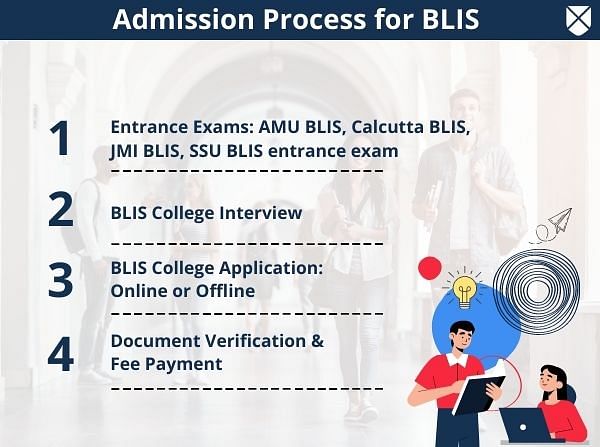
The admission procedure for the BLIS course is done on a merit or entrance basis. Listed below is the procedure to get admission for the B.Lib.I.Sc course:
Step 1: The candidate should meet the eligibility criteria including a bachelor’s degree from a recognized university and a minimum percentage of marks.
Step 2: The applications for B.Lib.I.Sc admissions are available through both online and offline procedures
Step 3: The candidate also needs to clear the entrance exam cut-off as per the college requirements.
Step 4:The final selection is based on the candidate’s performance in the interview and their academic record.
Step 5: The candidate needs to submit the necessary document and pay the library science course fees.
BLIS Entrance Exams
BLIS entrance exams are conducted at the national and institute levels. The popular BLIS entrance exams are listed below, along with application details:
B.Lib.I.Sc Entrance Exam
Registration Details
CUET
CUET Application Form
AMU BLIS Entrance Exam
AMU EE Application Form
JMI BLIS Entrance Exam
JMI EE Application Form
Calcutta University BLIS Entrance Exam
Application Form
BLIS Fees Structure
The average B.Lib.I.Sc course fee is in the range of INR 5,000- 1 Lakh. Librarian course fees differ amongst colleges and universities depending on amenities, location, infrastructure, and other factors. Below is a list of the best BLIS colleges along with a breakdown of their fees:
S.No
College Name
Tuition Fees
Admission Fees
Miscellaneous Fees
1
Parul University
INR 20,000
–
INR 66,000
2
Dibrugarh University
INR 13,800
INR 1050
INR 2,608
3
Jiwaji University
INR 13,320
–
INR 7,400
4
Tilak Maharashtra Vidyapeeth
INR 11,000
INR 2,000
INR 9,500
Types of B.Lib.I.Sc Courses
The course has full-time, part-time, and distance learning options available to students. The following BLIS course details are provided below:
Type
BLIS Eligibility
BLIS Duration
BLIS Full Time
Should have passed bachelor’s degree with a minimum of 50% + Entrance Examinations
1 Year
BLIS Part-Time
Should have passed bachelor’s degree with a minimum of 50%
1 Year
Distance BLIS
Should have passed bachelor’s degree with a minimum of 50%
1-2 Year
Distance B.Lib.I.Sc Course
BLib course or BLIS through distance mode is a one-year program that can be extended to a maximum of two years based on student course completion. This program is intended for students who are unable to attend typical on-campus classes due to a variety of factors like a job or personal obligations. The average distance library science course fees is INR 7,900.
Top BLIS Distance Colleges in India
Below is a list of top colleges offering distance BLIS course in India:
S.NO
College Name
1
IGNOU
2
Acharaya Nagarjuna University
3
Kurukshetra University
4
Tamil Nadu Open University
Top B.Lib.I.Sc Colleges in India
B.Lib.I.Sc scope in India is wide because libraries are a vital part of educational institutions, government organizations, and commercial businesses. Graduates of this course can work in various sectors such as education, research, publishing, and media. The B.Lib.I.Sc course is offered by various prominent colleges in India and admission is based on merit or entrance exam scores.
Top BLIS Government Colleges in India
There are various government colleges in India that offer a B.Lib.I.Sc degree. The top government colleges in India offering a BLIS course are listed below:
S.No
College Name
Average Total Fees
1
Aligarh Muslim University
INR 10,000
2
Panjab University
INR 17,885
3
Arunachal University
INR 29,000
4
University of Calcutta
INR 2,644
Top BLIS Private Colleges in India
BLib course is offered by various private institutes in India with practical exposure to students in terms of projects, group discussions, etc. Below listed are private colleges offering BLIS course:
S.No
College Name
Average Total Fees
1
LPU
INR 1 Lakh
2
ITM University
INR 20,000
3
Oriental University
INR 22,500
4
Doon University
INR 62,150
Top BLIS Colleges by City
BLIS Colleges in Mumbai
BLIS Colleges in Ahmedabad
BLIS Colleges in Pune
BLIS Colleges in Chennai
BLIS Colleges in Jaipur
BLIS Colleges in Bangalore
BLIS Colleges in Kolkata
BLIS Colleges in Lucknow
BLIS Colleges in Noida
BLIS Colleges in Bhopal
Top BLIS Colleges by State
BLIS Colleges in Maharashtra
BLIS Colleges in Delhi
BLIS Colleges in Karnataka
BLIS Colleges in UP
BLIS Colleges in Kerala
BLIS Colleges in West Bengal
BLIS Colleges in Tamil Nadu
BLIS Colleges in Madhya Pradesh
B.Lib.I.Sc Syllabus and Subjects
The BLIS course syllabus includes subjects that encompass two semesters. The current B.Lib.I.Sc syllabus includes a way to store library data or even other things such as newsletters, books, and e-books.The librarian course syllabus taught in some of the best colleges in India is listed below:
Integrated BLIS can be pursued by students after completion of a Bachelor’s Degree (Honours) in any stream from a recognized university. The integrated BIS course durationis two years. A candidate can pursue B.Lib.I.Sc + M.Lib.I.Sc. integrated course from universities like Calcutta University.
BLIS Course Comparison
The Bachelor of Library and Information Science (B.Lib.I.Sc.) degree program provides a thorough understanding of library science, information science, and the management and organization of information resources. Below mentioned are similar library course details:
B. Lib.I.Sc vs D.Lib.I.Sc
Below is the difference between the B.Lib.I.Sc. and D.Lib.I.Sc. course:
Full-Form
Bachelor of Library and Information Science
Diploma in Library and Information Science
Course Duration
1 Year
1 year
Eligibility
Passed Bachelor’s degree with 50% marks
Passed 10+2 with 50% marks
Average Fees
INR 5,000 – 1 Lakh.
INR 5,000-50,000.
Entrance Exam
DUET, CUET, IPU CET
ACET, LPUNEST
Top Colleges
Chandigarh University, Jadavpur University, Punjab University, Department of Library and Information Science, etc.
Kishori Raman PG College, Vardhaman Mahaveer Open University, Krishna Kanta Handique State Open University, Adesh University, etc.
There are ample career alternatives available to graduates after the B.Lib.I.Sc. course. Candidates can pursue higher education, which ensures a higher starting salary due to an increased knowledge and skill set. Some of the higher education options after B.Lib.I.Sc. for students are:
Career options for B.Lib.I.Sc. graduates are vast in public, private libraries, colleges, universities, archiving centers, research centers, etc. Following are the various job profiles of B.Lib.I.Sc. graduates.
Library Information Assistant
Library Trainee
Deputy Librarian
Storage Specialist
Cataloguer
Archivist
Information Architect
Read More: Best Career Options after BLIS
B. Lib.I.Sc Salary in India
B.Lib.I.Sc. graduates’ average salary in India is in the range of INR 2-5 LPA. The salary is determined by factors such as industry outlook, experience, job role, etc. The scope for a higher salary also increases with higher studies after B.Lib.I.Sc. graduation. As candidates get more practical exposure and experience, the salary gradually increases. Read More:B.Lib.I.Sc Salary
B. Lib.I.Sc Scholarships
Students pursuing a library science degree can apply for various scholarships provided by public and private institutions. A list of scholarships provided to students pursuing BLib course are listed below:
Maulana Azad National Scholarship
National Scholarship Scheme for Post-Matric Studies
The course demands a detailed study of the course, but aspiring students should also possess a certain set ofhard and soft skills to get prolific outcomes from the BLIS course duration. Some of these skills are listed below:
Critical Thinking
Ability to organize job duties
Knowledge of library resources
Execute independent judgment
Leadership skills
Time Management skills
Semester Wise BLIS Syllabus
The Bachelor of Library and Information Science Syllabus focuses on studying the concepts of Library and Information science. The B.Lib course syllabus introduces aspirants to a broad range of library science subjects that focuses primarily on bibliographic control, indexing, classification of documents, cataloguing, researching, and archiving. The one-year librarian course syllabus and its B.Lib subjects are listed below:
Semester I
Semester II
Library Catalogue: Nature and Functions
Documentation of Techniques and Services
Information Technology in Daily Life
Classification of Documents by CC
Society and Library- Kinds of Libraries, Five Laws of Library Science
Bibliographies and Bibliographic Control
Classification of Documents by DDC
Theory of Classification: Growth and Structure of Knowledge
BLIS Subjects
The BLIS course syllabus provides students with an in-depth knowledge of Library and Information Science. Students study various aspects of BLIS subjects to make the syllabus of library science more flexible. The subject list for the B.Lib course syllabus is mentioned below:
Basics of Information Technology
Library Cataloguing Theory
Library Classification Theory
Library Classification Practical
Library Cataloguing Practical
Foundations of Library and Library Management
Information Sources and Services
BLIS Course Structure
Throughout its 1-year duration, the BLIS course syllabus is fragmented into various BLIS course subjects. The Bachelor of Library Science Syllabus is structured to provide students with a critical understanding of the B.Lib syllabus concepts keeping in mind the scope of the relevant job. The course structure for the Library and Information Science Syllabus is listed below:
One year duration
Core subjects
Practical submissions
Institutional training
Research Methodology
Bibliographic control
BLIS Teaching Methodology and Techniques
The BLIS course syllabus includes practical submissions, institutional training, instructional designing, fieldwork, and traditional lecture-based pedagogy. Information science training, bibliographic control training, archiving, and classification training are some of the few skills that the students inhibit during the library course syllabus. Some of the general teaching methods in the library science syllabus are listed below:
Academic lectures
Individual Projects
Group Projects
Practical Submissions
Cataloguing
Archiving
Fieldwork
Bibliographic control
×
Wing Educations AssistantOnline now
Student Support
Hello, how can we guide you today?
Ask about admissions, courses, colleges, exams, study abroad, contact details, or counselling support.
Swipe left or right to jump between messages on touch devices.