
- info@wingeducations.com
- +91 (705) 495-5296
- Mon - Sat : 10.00-18.00
B.Pharma or Bachelor of Pharmacy course is a four-year professional undergraduate degree in pharmacy that focuses on the formulation, production, and distribution of medicines and pharmaceutical products. The B.Pharmacy syllabus includes core subjects such as Pharmaceutical Chemistry, Pharmacology, Pharmaceutics, Pharmacognosy, and other related topics to provide students with a comprehensive understanding of the pharmaceutical sciences.
To be eligible for B.Pharmacy Admission, students must complete 10+2 with science subjects such as Physics, Chemistry, Biology, or Mathematics with a minimum of 50% marks. The students also need to qualify entrance exams such as MHT-CET, KEAM, BITSAT, etc., depending on the college requirement.
The B.Pharma fees are in the range of INR 15,000–3.0 lakh per year, depending on the type of institute, facilities and location. The B.Pharma fees in private colleges are in the range of INR 70,000–3.0 lakh per year, whereas B.Pharma government college fees are between INR 15,000 –1.35 lakh per year
Table of Contents
| Degree | Bachelors |
| Full Form | Bachelor of Pharmacy |
| Duration | 4 Years |
| Age | Minimum age limit is 17 years. |
| Minimum Percentage | 50% marks in 10+2 for general category and 45% marks for reserved category students. |
| Average Fees | INR 15,000-3,00,000 Per Year |
| Average Salary | INR 2 – 5 LPA (Source: Ambition Box) |
| Employment Roles | Pharmacist, Pharmacy Technician, Retail Pharmacist, etc. |
| Top Recruiters | Novartis, Dr. Reddy’s Laboratories Ltd, Syngene, Sun Pharmaceuticals, etc. |
B.Pharma full form is Bachelor of Pharmacy, is a course designed to give students strong theoretical foundations and high levels of technical skill in pharmaceutical sciences and technology.
Pharmacists are in high demand in fields including research and development, regulatory affairs, and pharmaceutical manufacturing due to the expansion of the biotechnology and pharmaceutical sectors. India’s biotechnology market is expected to grow to $150 billion by 2025.
Graduates can also opt for jobs like Pharmacy Technician, Retail Pharmacist, health inspector, research & development executive, etc., in private and public companies. The average salary of a B.Pharmacy graduate is in the range of INR 2-5 LPA (Source: Ambition Box)
Read More: How to Become a Pharmacist?
The B.Pharmacy eligibility criteria are standard for most colleges but may vary from institution to institution. The basic B.Pharma eligibility criteria are discussed below:
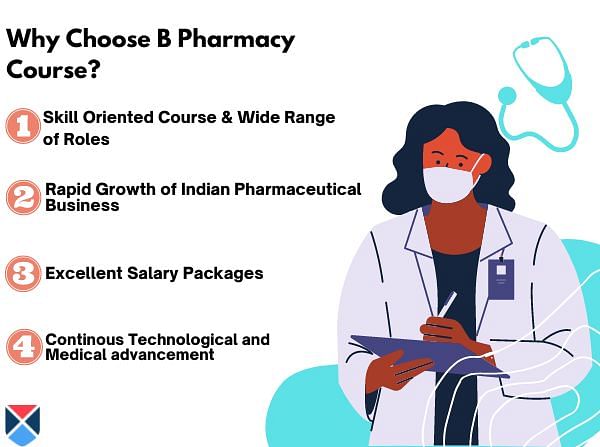
B.Pharmacy course helps students to get job opportunities in diverse roles like community pharmacist, health policy analyst, pharmaceutical marketing manager, etc. Below are a few highlighted points as to why you should choose B.Pharmacy course.
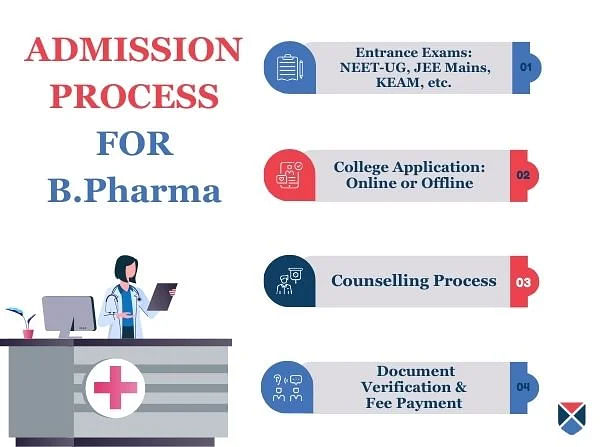
B.Pharmacy admission is done on merit in colleges like SRM University, Diburrah University, etc. Whereas, colleges like BITS Pilani, Manipal College of Pharmaceutical Science, etc., conduct entrance exams for B Pharmacy course. Listed below is the B.Pharma admission process in general:
Read More: B.Pharmacy Admission 2024
B.Pharmacy entrance exams are held at the national, state level, and institute levels. Colleges like UPES accept NEET scores and also conduct UPESPAT for students who have not taken the NEET exam. Below listed are a few entrance exam details for the B.Pharm course.
| B.Pharma Entrance Exams | Registration Dates | Accepting Colleges |
| MHT CET | Jan 10-Mar 1, 2024 (Closed) | Bombay College of Pharmacy, Bharati Vidyapeeth College of Pharmacy |
| NEET-UG | January 2024-February 2024 (Closed) | UPES, ICT Mumbai – Institute of Chemical Technology, Jamia Hamdard University, etc. |
| JEE Mains | Feb 2, 2024-Mar 2, 2024 (Closed) | PES University, BIT Mesra, etc. |
| KCET | 10 Feb, 2024 (Closed) | Rajiv Gandhi University of Health Sciences, PES University |
| TS EAMCET | February 2024- April 2024 (Closed) | St. Paul College of Pharmacy, G. Pulla Reddy College of Pharmacy, etc. |
| KEAM | March 2024- April 2024 (Closed) | Lisie College of Pharmacy, Al Shifa College of Pharmacy, etc. |
| BITSAT | January 2024- April 2024 (Closed) | Birla Institute of Technology and Science |
| GLAET | January 2024- May 2024 (Closed) | GLA University |
| MAHE Entrance Exam | Mar 15, 2024 (Closed) | Manipal College of Pharmaceutical Science |
| GUJCET | January 2024 (Closed) | Nirma University |
| UPSEE | February 2024 (Closed) | Dr. APJ Abdul Kalam Technical University |
Read More: B.Pharma Entrance Exam 2024
Several specializations and in-depth courses in a range of pharmacy-related topics are offered by the B Pharmacy course. Aspirant students may opt to concentrate on certain specialties in specific disciplines of pharmacy. A list of B.Pharma specializations is shown below:
Read More: B.Sc Nursing vs B.Pharmacy vs BPT – Which is Better?
There are various government and private colleges in India offering B.Pharm courses. Top private colleges offering B.Pharmacy such as BITS Pilani, JSS College of Pharmacy, NMIMS Mumbai, etc. Government colleges like MDU Rohtak, Jamia Hamdard University, etc., also offer B Pharmacy courses. The B.Pharmacy fees per year is in the range of INR 15,000-3,00,000.
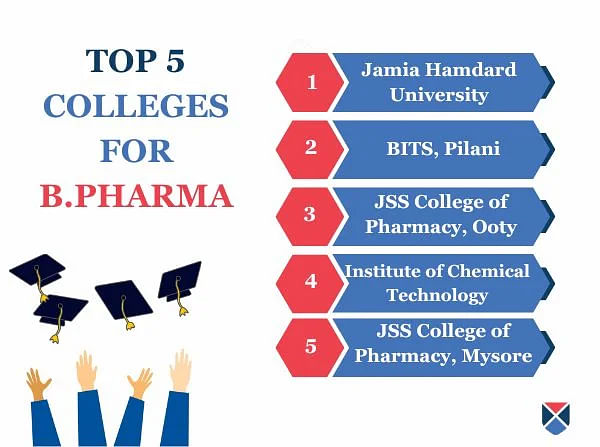
Given below is the list of best B.Pharmacy colleges in India as per NIRF ranking 2024 along with their annual fees detail:
| NIRF Ranking 2024 | Name of the College | B.Pharma Tuition Fees (Per Year) | Miscellaneous Fees Per Year |
| 1 | Jamia Hamdard University | INR 1.35 lakh | INR 1,500 |
| 3 | BITS, Pilani | INR 1.99 lakh | INR 70,000 |
| 4 | JSS College of Pharmacy, Ooty | INR 80,000 | – |
| 5 | Institute of Chemical Technology, Mumbai | INR 85,350 | INR 17,000 |
| 6 | JSS College of Pharmacy,Mysore | INR 77,500 | INR 30,000 |
| 7 | Panjab University | INR 17,000 | INR 8,950 |
| 8 | Manipal College of Pharmaceutical Sciences | INR 2.10 lakh | INR 65,000 |
| 10 | NMIMS, Mumbai | INR 2.75 lakh | INR 1.00 lakh |
| 11 | SRM Institute of Science and Technology | INR 2.25 lakh | INR 39,000 |
| 13 | Amrita Vishwa Vidyapeetham | INR 1.25 lakh | INR 1.17 lakh |
| 16 | Lovely Professional University | INR 2.30 lakh | INR 53,000 |
| 19 | Chitkara University | INR 1.72 lakh | – |
| 20 | Chandigarh University | INR 2.66 lakh | – |
| 22 | Amity Institute of Pharmacy, Noida | INR 1.65 lakh | INR 45,000 |
| 25 | I. S. F. College of Pharmacy | INR 90,000 | INR 60,000-90,000 |
| 26 | Maharishi Markandeshwar (Deemed to be University) | INR 96,500 | INR 19,500 |
| 27 | Annamalai University | INR 5,170 | – |
| 28 | Banasthali Vidyapith | INR 1.54 lakh | – |
Read More: B.Pharma Fees in India
Below listed are location-wise B.Pharmacy colleges in India with the annual fees:
| Location | B.Pharma Fees Per Year |
| B.Pharmacy Colleges in Mumbai | INR 40,000 – 2.75 lakh |
| B.Pharmacy College in Pune | INR 60,000-1.70 lakh |
| B.Pharmacy College in Hyderabad | INR 85,000-2.50 lakh |
| B.Pharmacy Colleges in Kolkata | INR 1.20-2.0 lakh |
| B.Pharmacy College in Bangalore | INR 60,000-2.0 lakh |
| B.Pharmacy College in Lucknow | INR 30,000-1.50 lakh |
| B.Pharmacy College in Delhi | INR 20,000-2.10 lakh |
| B.Pharmacy College in Patna | INR 40,000-1.00 lakh |
| B.Pharmacy Colleges in Nagpur | INR 35,000-1.50 lakh |
| B.Pharmacy Colleges in Chennai | INR 60,000-2.25 lakh |
| B.Pharmacy College in Indore | INR 40,000-1.50 lakh |
| B.Pharmacy Colleges in Jaipur | INR 50,000-1.00 lakh |
B.Pharm course duration for Lateral Entry three-year undergraduate program. A Lateral Entry to a course is granted when a student has previously studied a diploma or course related to the subject, they will be eligible to attend directly from 2nd year, i.e. third semester onwards.
Admission to the B.Pharmacy Lateral Entry Program is intended for students who have completed a diploma (pharmacy) (10 + 2 to 2 years later) or an equivalent degree (PCI must recognize diploma).
The entrance exam for B.Pharmacy lateral entry and B Pharmacy course is similar. Examinations such as UPSEE, GUJCET, and MHT-CET are some popular examinations candidates wishing to pursue a B.Pharmacy can apply to get into the university of their choice.
Read More: B.Pharmacy Lateral Entry
The B.Pharmacy syllabus is designed to provide students with a strong foundation in the science of pharmacy, microbiology, clinical and healthcare sciences, and pharmacy technology, as well as the practical skills they need to work in a pharmacy setting. The following is the B.Pharmacy course syllabus:
| Semester I | Semester II |
Human Anatomy and Physiology | Communication Skills |
Pharmaceutical Inorganic Chemistry | Biochemistry-I |
Pharmacognosy | Pathophysiology |
Remedial Mathematical Biology | Computer Applications in Pharmacy |
Pharmaceutical Analysis | Environmental Sciences |
Practical /Laboratory Work | Practical /Laboratory Work |
| Semester III | Semester IV |
| Pharmaceutical Microbiology | Phytochemistry |
Pharmaceutical Engineering | Medicinal Chemistry |
Physical Pharmaceutics | Industrial Pharmacy |
APHE I | APHE II |
Practical /Laboratory Work | Practical /Laboratory Work |
| Semester V | Semester VI |
| Biochemistry-II | Pharmaceutical Jurisprudence & Ethics |
Pharmaceutical Technology | Biopharmaceutics & Pharmacokinetics |
Hospital Pharmacy | Chemistry of Natural Products |
Elective | Elective |
Practical /Laboratory Work | Practical /Laboratory Work |
| Semester VII | Semester VIII |
| Pharmaceutical Biotechnology | Herbal Drug Technology |
Pharmaceutical Industrial Management | Electives |
Instrumental Methods of Analysis | Research Methodology and Biostatistics |
Quality Assurance | Preventive and Social Pharmacy |
Electives | Research Project |
Practical /Laboratory Work | Practical /Laboratory Work |
Check Detailed Year Wise Syllabus:
B Pharmacy course is an undergraduate degree program that offers a more in-depth study of pharmacy, while D.Pharma is a diploma program that provides a basic understanding of the field. The table below shows the difference between B.Pharmacy and D.Pharmacy:
| Course | B.Pharmacy | D.Pharma |
| Full-Form | Bachelor of Pharmacy | Diploma in Pharmacy |
| Course Duration | 4 years | 2 years |
| Course Overview | The B.Pharma includes subjects such as pharmaceutical chemistry, pharmacology, pharmaceutics, pharmacognosy, pharmaceutical analysis, etc. | The course curriculum covers subjects like pharmaceutical chemistry, pharmacology, pharmaceutical jurisprudence, hospital pharmacy, etc. |
| Eligibility | 50% in 10+2, with Science as a compulsory subject | 50% in 10+2, with Physics, Chemistry, and Mathematics as compulsory subjects |
| Course Fees Per Year | INR 15,000 – 3.0 lakh | INR 10,000 – 1.00 lakh |
| Entrance Exam | WBJEE, MAH CET, OJEE | GPAT, UPSEE, AU AMIEE |
| Top Colleges | LPU, SRM University, VGU, Amity University | Chitkara University, Integral University, MCOPS |
| Job Roles | Pharmacist, Pharmacy Technician, Retail Pharmacist, etc. | Clinical Pharmacist, Pharmacologist, Clinical Research Associate, etc. |
| Average Salary | INR 2-5 LPA | INR 2-4 LPA |
Read More: B.Pharma vs D Pharma
There is a lot of scope and opportunity for graduates of Bachelor of Pharmacy to pursue higher studies in India and abroad. By gaining higher education, students can increase their chances of getting a gratifying career and help them get into the field of research.
Below mentioned are some of the popular master’s courses that students pursue after a B.Pharmacy:
Read More: Courses after B.Pharm
A graduate in B.Pharma has a broad spectrum of lucrative employability opportunities in various industries and areas of employment, such as the pharmaceutical industry, clinical research, medical writing, health and wellness industry, etc.
Below is a list of top job designations along with hiring companies and their average salaries:
Job Designations | Job Description | Hiring Companies |
| Pharmacist |
| Apollo Hospitals, Fortis Healthcare, Medlife, etc. |
| Clinical Research Associate |
| Veeda Clinical Research, IQVIA, Axis Clinicals, etc. |
| Medical Writer |
| Cactus Communications, Indegene, Trilogy Writing & Consultancy, etc. |
| Regulatory Affairs Officer |
| Tata Elxis, Dr. Reddy’s, Novartis, etc. |
| Community Health Worker |
| HLL Lifecare, Paras Hospital, Care Hospital, etc. |
| Pharmaceutical Marketing Executive/Manager |
| Lupin, Abbott Healthcare, Bayer, etc. |
| Biopharmaceutical Researcher and Development Scientist |
| Sun Pharmaceutical Industries, Biocon, Cadila Healthcare, etc. |
| Medical Representative |
| Sun Pharma, Cipla, Dr. Reddy’s Laboratories, etc. |
| Pharmacovigilance Officer |
| Novartis, GlaxoSmithKline (GSK), etc. |
| Drug Inspector |
| Central Drugs Standard Control Organization (CDSCO), State FDA, etc. |
According to Payscale, the average B.Pharm salary in India is in the range of INR 2–5 LPA for graduates. Graduates with 0-1 years of experience can earn in the range of INR 2-4 LPA, whereas, after 3+ years of experience, the salary can range between INR 4-7 LPA or higher.
The salary for Bachelor of Pharmacy graduates is competitive depending on skills, job roles & responsibilities, experience, etc. that exist. Below listed are a few B.Pharmacy jobs along with the entry-level and experienced salary range:
| B.Pharmacy Jobs | Entry Level Average Salary (INR) | Salary After 3 Years of Experience (INR) |
| Pharmacist | 3-3.50 LPA | 4-6 LPA |
| Clinical Research Associate | 3.10 LPA | 4-4.50 LPA |
| Medical Writer | 3.50 LPA | 4-5.30 LPA |
| Biopharmaceutical Researcher and Development Scientist | 3-4 LPA | 5-7 LPA |
| Pharmaceutical Analyst | 3.10 LPA | 4-5.80 LPA |
| Regulatory Affairs Officer | 2.40 LPA | 3.40-4.50 LPA |
| Medical Representative | 2.50-3 LPA | 4-6 LPA |
| Pharmaceutical Marketing Executive | 3.50-3.80 LPA | 4-6 LPA |
| Pharmacovigilance Officer | 2.60-3 LPA | 4-6.75 LPA |
| Community Health Worker | 2-3.50 LPA | 4-6 LPA |
| Drug Inspector | 3-3.50 LPA | 5-6 LPA |
Read More: B.Pharmacy Salary in India
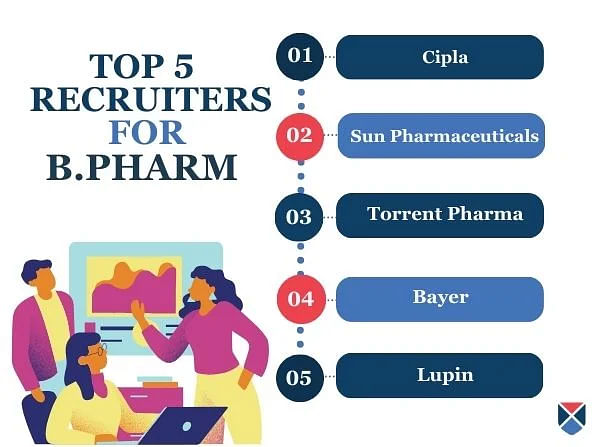
Below listed are a few top recruiters for B.Pharmacy graduates:
| Cipla | Biocon | MedPlus |
| Sun Pharmaceuticals | Apollo Hospitals | Siemens Healthineers |
| Torrent Pharma | Dr Reddy’s Laboratories Ltd | Medtronic |
| Bayer | Syngene International | Food and Drug Administration (FDA) |
| Lupin Limited | Emcure Pharmaceuticals | Cadila Healthcare |
| Serum Institute of India | Dr. Lal PathLabs | Parexel |
| Roche | Johnson & Johnson | Fortis Healthcare |
Read More: Career Options After B.Pharmacy
Students can pursue a B.Pharma course from top cities like Mumbai, Hyderabad, Bangalore, etc., as these cities have prestigious colleges like Bombay College of Pharmacy, Nizam’s Institute of Medical Sciences (NIMS), National Institute of Pharmaceutical Education and Research (NIPER) and many more.
Below listed are the top 5 cities to pursue a B.Pharmacy course based on industry exposure, reputable institutes, infrastructure, academic environment, affordability, etc.
| City | Top Colleges Offering B.Pharm Course | Average Starting Salary (INR) | Top Recruiters |
Mumbai | Bombay College of Pharmacy, Institute of Chemical Technology, etc. | 20,000-35,000 Per Month | Wellness Forever, Lupin, Sun Pharma, etc. |
Hyderabad | Nizam’s Institute of Medical Sciences, Institute of Pharmaceutical Technology, etc. | 15,000-27,000 Per Month | Dr. Reddy’s Laboratories, Aurobindo Pharma, etc. |
Bangalore | M.S. Ramiah University of Applied Sciences | 16,000-25,000 Per Month | Biocon, Syngene International, Strides Pharma, etc. |
Pune | Poona College of Pharmacy, Sinhgad College of Pharmacy, etc. | 17,000- 21,000 Per Month | Emcure Pharmaceuticals, Serum Institute of India, etc. |
Delhi | Jamia Hamdard University | 20,000-22,000 Per Month | Ranbaxy Laboratories, Dr. Lal PathLabs, etc. |
The government of India offers various scholarships to candidates who wish to pursue pharmacy courses but are unable to due to unsound financial background. Students can also avail scholarships from private universities based on merit criteria, quota, etc. Below is a list of some of the B.Pharma Scholarship:
| B.Pharmacy Scholarship | Eligibility Criteria | Amount |
| Swarnajayanti Fellowship | Students who want to pursue research in science and technology like pharmacy, medicines, engineering, etc. | Upto INR 25,000 |
| Prime Minister’s Scholarship Scheme | Students who want to pursue MBBS, B.Tech, BE, BDS, B.Ed, MCA, BBS, BCA and B. Pharma courses | INR 2,250 |
| Nationwide Education and Scholarship Test | Students who want to pursue undergraduate degree in science engineering and pharmacy with a minimum of 75% marks. | Upto INR 50,000 |
Read More: Pharmacy Courses After 12th
There are various technical, professional, and interpersonal skills required by B.Pharma students to succeed in their professional careers. Some of these skills include
B Pharma syllabus covers a wide range of core topics related to pharmacy, including Pharmaceutical Chemistry, Pharmacology, Pharmaceutics, Pharmaceutical Analysis, Human Anatomy, and Clinical Pharmacy. The B.Pharma subjects may vary as per institution; however, the core knowledge and skills that are essential for pharmacists are included in the common curriculum.
In addition to these core subjects, students may also be required to take elective courses in their fourth year with topics such as Hospital Pharmacy, Community Pharmacy, Pharmaceutical Marketing, Pharmaceutical Management, etc. B.Pharmacy course allows students to get hands-on training and gain industry-relevant expertise to work as pharmacists and in different job roles in hospitals, community pharmacies, and pharmaceutical companies.
Check Detailed Year Wise Syllabus:
Table Of Contents
B.Pharma syllabus aims to introduce students to all the essential aspects of medical care along with preparing and dispensing medical drugs. The syllabus is also designed to provide students with a strong foundation in the science of pharmacy, as well as the practical skills they need to become registered pharmacists.
The semester-wise B.Pharm syllabus is given below:
B Pharm subjects in the first year cover fundamental concepts related to biomolecules, metabolism, enzymology, structure and function of the human body, use of computers in pharmacy, etc. The table below shows the B Pharm subjects in first year:
| Semester 1 | Semester 2 |
Human Anatomy and Physiology | Communication Skills |
Pharmaceutical Inorganic Chemistry | Biochemistry-I |
Pharmacognosy | Pathophysiology |
Remedial Mathematical Biology | Computer Applications in Pharmacy |
Pharmaceutical Analysis | Environmental Sciences |
Practical /Laboratory Work | Practical /Laboratory Work |
Practical Topics in the 1st year B.Pharm Syllabus
Some of the practical topics under the first-year B.Pharmacy syllabus are given below:
Read More: B.Pharm 1st Year Syllabus
B.Pharmacy 2nd year syllabus focuses on understanding pharmaceutical disciplines that cover topics like drug quality assessment techniques, pharmaceutical manufacturing processes, process validation, etc. The table below shows the second year B.Pharm syllabus:
| Semester 3 | Semester 4 |
Pharmaceutical Microbiology | Phytochemistry |
Pharmaceutical Engineering | Medicinal Chemistry |
Physical Pharmaceutics | Industrial Pharmacy |
APHE I | APHE II |
Practical /Laboratory Work | Practical /Laboratory Work |
Practical Topics in the 2nd year B.Pharmacy Syllabus
Some of the practical topics under the second-year B.Pharmacy subjects are given below:
Read More: B.Pharm 2nd Year Syllabus
B.Pharmacy 3rd year syllabus covers topics like drug design, organic synthesis, characterization of bioactive compounds from medicinal plants, drug formulation, technologies, etc. The table below shows B Pharmacy subjects semester wise for third year:
| Semester 5 | Semester 6 |
Biochemistry-II | Pharmaceutical Jurisprudence & Ethics |
Pharmaceutical Technology | Biopharmaceutics & Pharmacokinetics |
Hospital Pharmacy | Chemistry of Natural Products |
Elective | Elective |
Practical /Laboratory Work | Practical /Laboratory Work |
Practical Topics in the 3rd year B.Pharmacy Syllabus
Some of the practical topics under the third-year B.Pharm syllabus are given below:
Read More: B.Pharm 3rd Year Syllabus
B Pharm 4th year syllabus focuses on specialized topics like cosmetic pharmacy, regulatory science pharmacy, advanced instrumentation methods, etc., along with practical training, research projects, and clinical rotation The table below shows fourth year syllabus of B.Pharm:
| Semester 7 | Semester 8 |
Pharmaceutical Biotechnology | Herbal Drug Technology |
Pharmaceutical Industrial Management | Electives |
Instrumental Methods of Analysis | Research Methodology and Biostatistics |
Quality Assurance | Preventive and Social Pharmacy |
Electives | Research Project |
Practical /Laboratory Work | Practical /Laboratory Work |
Practical Topics in the 4th year B.Pharmacy Syllabus
Some of the practical topics under the fourth-year B.Pharm syllabus are given below:
Read More: B.Pharm 4th Year Syllabus
The B.Pharmacy subjects cover a theoretical and practical insight into the core functionalities of Pharmaceutics, Pharmacognosy, and Pharmaceutical Analysis along with pharmaceutical biology, chemistry, and mathematics. Below is a list of some core & elective subjects in the B.Pharm syllabus:
The B.Pharmacy syllabus consists of core subjects that are considered essential for the foundation learning of pharmacy. Some of the core subjects in B Pharmacy are given below:
| B.Pharmacy Subjects | Topics Covered |
Human Anatomy and Physiology | The cellular level of organization, Integumentary system, Body fluids and blood, Peripheral nervous system, Cardiovascular system |
Biochemistry | Biomolecules, Carbohydrate metabolism, Lipid metabolism, Amino acid metabolism, Enzymes |
Pharmaceutical Organic Chemistry | Classification, nomenclature and isomerism, Alkyl halides, Carbonyl compounds, Carboxylic acids |
Pharmacognosy and Phytochemistry | Introduction to Pharmacognosy, Conservation of medicinal plants, Plant tissue Culture, Introduction to secondary metabolites |
Pharmacology | General Pharmacology, Pharmacology of drugs acting on the peripheral nervous system, Drugs used in myasthenia gravis and glaucoma |
Biopharmaceutics and Pharmacokinetics | Introduction Biopharmaceutics, Bioavailability, and Bioequivalence, Pharmacokinetics, Nonlinear Pharmacokinetics |
Pharmaceutical Engineering | Pharmaceutical unit operations, Process validation, Pharmaceutical plant layout, GMP (Good Manufacturing Practices) |
Pharmaceutical Jurisprudence & Ethics | Pharmaceutical laws and regulations, Code of ethics for pharmacists, Intellectual Property Rights (IPR) in Pharmacy |
Pharmaceutical Technology | Dosage form design and evaluation, Parenteral preparations, Novel drug delivery systems, Nanotechnology in Pharmacy |
Pharmaceutical Inorganic Chemistry | Inorganic pharmaceuticals, Complexation reactions in pharmacy, Radioactive pharmaceuticals |
Environmental Sciences | Environmental pollution, Waste management in the pharmaceutical industry, Green chemistry in the pharmacy |
Communication Skills | Verbal and written communication skills, Interpersonal communication, Presentation skills |
Computer Applications in Pharmacy | Basics of computer hardware and software, Pharmacy information system, Drug information databases |
Research Methodology and Biostatistics | Research design and methodology, Data analysis techniques, Biostatistics in clinical trials |
Industrial Pharmacy | Pharmaceutical manufacturing processes, Quality control in the pharmaceutical industry, Good Manufacturing Practices (GMP) |
Medicinal Chemistry | Structure-activity relationship (SAR), Drug design and synthesis, Antimicrobial agents, Anticancer drugs |
Elective subjects are optional for the students making the course very flexible and diverse, especially from the B.Pharmacy 4th sem syllabus. Some of the elective subjects under the syllabus of B.Pharm are given below:
| B Pharma Elective Subjects | Topics Covered |
Advanced Instrumental Techniques | Spectroscopy techniques, Chromatographic methods, Mass spectrometry, Nuclear magnetic resonance (NMR), Electrophoresis techniques, etc. |
Computer-Aided Drug Design | Molecular modeling, Structure-based drug design, Ligand-based drug design, Pharmacophore mapping, QSAR (Quantitative Structure-Activity Relationship), etc. |
Experimental Pharmacology | Animal models in pharmacology, In vitro pharmacological assays, Evaluation of drug efficacy, Toxicology studies, etc. |
Pharmaceutical Regulatory Science | Drug approval processes and regulations, Regulatory compliance in drug development, Post-marketing surveillance, Good Manufacturing Practices (GMP), etc. |
Pharma Marketing Management | Marketing strategies, Brand management, Pharmaceutical advertising, Market segmentation, etc. |
Standardization of Herbals and Quality Control | Techniques for herbal extraction and purification, Quality control tests for herbal formulations, Identification and authentication of herbal raw materials, etc. |
Cosmetic Science | Formulation of cosmetics, Skin physiology, Cosmetic ingredients, Safety assessment, Regulatory requirements, etc. |
Novel Drug Delivery System | Types of drug delivery systems, Nanotechnology in drug delivery, Controlled release systems, Targeted drug delivery, Implantable drug delivery, etc. |
As one of the most important aspects of the course, the B.Pharmacy syllabus focuses primarily on practical labs. Practical lab courses are offered every semester. The lab courses are listed below along with topics covered in each:
| B Pharm Subjects (Laboratory) | Topics Covered |
Laboratory of Pharmaceutics I | General techniques in pharmaceutical labs, Dispensing practices, Pharmaceutical formulations, Dosage form preparation, etc. |
Laboratory Remedial Biology | Remedial exercises in biology techniques |
Laboratory Organic Chemistry | Organic synthesis techniques, Separation and purification methods, Identification of organic compounds, Spectroscopic analysis, etc. |
Laboratory Biochemistry | Protein purification, Metabolic pathway studies, Molecular biology techniques, Clinical biochemistry analyses, etc. |
Laboratory Microbiology and Immunology | Sterilization methods, Identification of microorganisms, Serological tests, etc. |
Laboratory Medicinal Chemistry | Synthesis of medicinal compounds, Isolation techniques for natural products, Drug design and development, etc. |
There are numerous specializations and specific courses offered by B.Pharmacy in various fields of pharmacy. These specializations are in specific areas of pharmacy where an aspirant would like to further their studies and research. Some of the top B.Pharmacy specializations are given below, along with subjects covered in the specialization:
| B Pharma Specialization | Subjects Covered |
Pharmaceutical Chemistry |
|
| Pharmaceutics |
|
| Pharmacology |
|
| Ayurveda |
|
| Pharmaceutical Marketing Management |
|
| Quality Assurance |
|
| Industrial Pharmacy |
|
The B Pharm syllabus differs depending on the structure and aim of the program across institutions. Students can get the B.Pharmacy syllabus pdf from the university website to grasp a better understanding of the B.Pharma subjects offered by specific institutions. The following is the B.Pharmacy syllabus of top colleges offering the course:
Amity University B.Pharma syllabus is divided into core, remedial, allied, and elective courses. Listed below is the first year B.Pharmacy syllabus and second year offered by Amity University:
| Semester Ⅰ | Semester Ⅱ |
Concept of Remedial Biology | Understanding Biochemistry |
Understanding Remedial Mathematics | Pharmaceutical Organic Chemistry-I |
Pharmaceutical Analysis-I | Pharmacy Computer Application |
Pharmaceutics-I | Environmental Science Concepts |
Communication Skills-I | Communication Skills-II |
Human Physiology and Anatomy Concepts-I | Human Physiology and Anatomy Concepts-II |
Inorganic Chemistry | Pathophysiology |
Practicals | Practicals |
Outdoor Based Activity Course | Outdoor Based Activity Course |
Semester Ⅲ | Semester Ⅳ |
Fundamentals of Pharmaceutical Microbiology | Pharmaceutical Organic Chemistry-III |
Pharmaceutical Engineering | Pharmacology-I |
Pharmaceutical Organic Chemistry-II | Concept of Medicinal Chemistry-I |
Understanding Physical Pharmaceutics-I | Fundamentals of Pharmacognosy and Phytochemistry- I |
Behavioral Science-I | Understanding Physical Pharmaceutics-II |
Open Elective Course | Open Elective Course |
Foreign Language Based Course | Foreign Language Based Course |
Outdoor-Based Activity Course | Outdoor-Based Activity Course |
– | Behavioral Science-II |
Semester V | Semester VI |
Concept of Medicinal Chemistry-II | Concept of Medicinal Chemistry-III |
Industrial Pharmacy-I | Pharmacology-III |
Pharmacology-II | Quality Assurance |
Fundamentals of Pharmacognosy and Phytochemistry- II | Understanding Herbal Drug Technology |
Pharmaceutical Jurisprudence | Pharmacokinetics Concepts |
Open Elective Course | Open Elective Course |
Foreign Language Based Course | Foreign Language Based Course |
Outdoor-Based Activity Course | Outdoor-Based Activity Course |
Semester VII | Semester VIII |
Industrial Pharmacy-II | Advanced Instrumental Techniques (Specialization Elective Course) |
Instrumental Method of Analysis | Project Work |
Pharmaceutical Marketing-I | Research Methodology and Biostatistics |
Pharmacy Practice | Preventive and Social Pharmacy |
Practice School | Pharmaceutical Marketing-II |
Open Elective Course | Computer Aided Drug Design (Specialization Elective Course) |
Foreign Language Based Course | Experimental Pharmacology (Specialization Elective Course) |
Outdoor Based Activity Course | Pharma Marketing Management(Specialization Elective Course) |
– | Cosmetic Science (Specialization Elective Course) |
– | Pharmaceutical Regulatory Science (Specialization Elective Course) |
– | Standardization of Herbals and Quality Control (Specialization Elective Course) |
– | Open Elective Course |
– | Foreign Language Based Course |
– | Outdoor-Based Activity Course |
Read More: Amity University B.Pharma
Jamia Hamdard University BPharm syllabus focuses on pharmaceutical sciences, pharmaceutical chemistry, pharmacology, pharmaceutics, and regulatory affairs. Listed below is a semester-wise B.Pharmacy syllabus offered by Jamia Hamdard University:
| B Pharmacy 1st Year Syllabus | |
Pharmaceutics-I | Human Anatomy and Physiology |
Pharmaceutics-II | Pharmacognosy – I |
Pharmaceutics-III | Unani Pharmacy |
Pharmaceutical Chemistry-I & II | – |
B.Pharmacy 2nd Year Syllabus | |
Pharmaceutics-IV | Pharmacology-I |
Biostatistics and Research Methodology | Pharmacognosy – II |
Pharmaceutics-V | Pathophysiology and Health Education |
Pharmaceutical Chemistry-III | Unani Pharmacy |
Pharmaceutical Analysis-I | Computer Application |
Pharmaceutical Chemistry-IV | – |
B.Pharmacy 3rd Year Syllabus | |
Clinical and Hospital Pharmacy | Pharmaceutical Formulations and Cosmetology |
Ethics and Forensic Pharmacy | Medicinal Chemistry-I |
Pharmaceutical Analysis-II | Pharmacognosy – III |
Pharmaceutical Chemistry-V | Pharmacology-II |
Natural Products Chemistry | Concept of Biochemistry |
Pharmacognosy Report | Unani Pharmacy |
B.Pharmacy 4th Year Syllabus | |
Pharmaceutical Management | Medicinal Chemistry-II |
Understanding Pharmaceutical Biotechnology | Pharmacognosy – IV |
Biopharmaceutics and Pharmacokinetics | Pharmacology-III |
Pharmaceutical Analysis-III | Pharmaceutics Project |
Technology in Pharmacy | Unani Pharmacy |
Read More: Hamdard University B.Pharmacy
B.Pharma syllabus focuses on the theory and practice of medicine and drug use during the four years. The course focuses on assessing students based on their theoretical and practical knowledge.
The students are generally evaluated on the following components:
The general course structure is as follows:
The Pharmacy syllabus consists of both theory and practical teaching methods. The theoretical traditional-based classroom teaching introduces the aspirants to all the essential aspects of the syllabus of BPharmacy. Whereas the practical teaching method helps the students acquire industry-oriented skills.
Some of the standard learning methods for BPharmacy course are given below:
Aside from theory and lab practicals, B.Pharmacy courses strongly emphasize workshops. Workshops provide students with an insider’s view of how pharmaceutical companies operate and knowledge about various aspects of the pharmaceutical industry.
Here are some of the workshops under B.Pharmacy course:
B.Pharmacy course includes research projects that students need to complete in their final year depending on their specializations like Pharmaceutical Chemistry, Pharmaceutics, Pharmaceutical Analysis, etc. The projects help students comprehend the fundamental concepts of pharmacy to a practical level.
The following is a list of some of the most well-liked research project topics:
B Pharm subjects books help students understand concepts related to Phytochemistry, Herbal Drugs, Physical Pharmacy, Dosage Form Design, Patient Counseling, etc.
There are many B.Pharmacy books available in the market for students to obtain the essential knowledge they need to acquire holistic insight into the course in a comprehensive manner. Some of the B.Pharmacy reference books are mentioned below:
| B.Pharm Books | Topics Covered | Author Name |
Textbook of Forensic Pharmacy | Forensic analysis in pharmacy, Legal aspects of pharmacy, Drug regulations and laws, Poisoning investigations, etc. | M. Mithal |
Pharmaceutical Analysis | Analytical techniques in pharmaceuticals, Quality control, Spectroscopy, Chromatography, Drug formulation, etc. | David G. Watson |
Applied Biopharmaceutics and Pharmacokinetics | Pharmacokinetic principles, Drug absorption, Distribution, Metabolism, Elimination, etc. | Leon Shargel |
Basic and Clinical Pharmacology | Basic pharmacological concepts, Drug classification, Clinical application of drugs, Drug interactions, etc. | Anthony J. Trevor and Bertram G. Katzung |