- info@wingeducations.com
- +91 (705) 495-5296
- Mon - Sat : 10.00-18.00
The University of Siegen is a research-focused institution located in North Rhine-Westphalia, Germany, ranked between 1001-1200 globally in the QS World Rankings 2025. It offers a variety of programs, with popular choices including M.S. Computer Science, M.S. Electronics Design, and M.S. Nanoscience. The university has a low tuition fee of around €652/year for most programs, with the cost of living estimated at €950/month. Special features include its strong local industry connections and a supportive environment for international students, making it a great choice for those looking to study in a smaller, yet research-driven university in Germany.
The University of Siegen has an average acceptance rate of 50% for Bachelor’s programs, making it one of the easier German universities to get into. The university is well-regarded for its international orientation and welcomes a significant number of international students.
Also Check: Admissions at University of Siegen
Table of Contents
The University of Siegen’s QS World University Rankings 2025 place it at 1001-1200 globally. In the Times Higher Education (THE) World University Rankings, it is ranked 601-800 overall and 192nd among young universities. Here’s a short breakdown of the rankings:
| Ranked by | 2023 | 2024 | 2025 |
|---|---|---|---|
| QS | #1001 | #1001-1200 | #1001-1200 |
| THE | #801 | #601-800 | #501-600 |
| US News | #984 | #1210 | #1210 |
Additionally, THE Young University Ranked University of Siegen 192nd among young universities & National Ranking (Germany) ranked 46-48 in THE World University Rankings.
The University of Siegen offers over a hundred courses in undergraduate and postgraduate programs via its affiliated five schools. Here’s a breakdown of some of the popular programs along with deadlines:
| Program | Important Dates | Fees |
|---|---|---|
| M.S Mechatronics 2 years | Application Deadline For Winter Intake (30th Apr 2025) | INR 63,831/Yr EUR 652 /Yr |
| M.S Electrical Engineering 2 years | Application Deadline For Winter Intake (30th Apr 2025) | INR 63,831/Yr EUR 652 /Yr |
| M.S Nanoscience and Nanotechnology 2 years | Application Deadline For Winter Intake (30th Apr 2025) | INR 63,243/Yr EUR 646 /Yr |
| M.S Human-Computer Interaction 2 years | Application Deadline For Winter Intake (1st Jun 2025) Application Deadline For Summer Intake (1st Dec 2025) | INR 63,831/Yr EUR 652 /Yr |
| M.S Economic Policy 2 years | Application Deadline For Winter Intake (15th Jul 2025) | INR 63,831/Yr EUR 652 /Yr |
| M.A Media Culture 2 years | Application Deadline For Summer Intake (1st Jan 2025) Application Deadline For Winter Intake (15th Jul 2025) | INR 63,831/Yr EUR 652 /Yr |
| M.S Chemistry 2 years | Application Deadline For Winter Intake (30th Apr 2025) | INR 63,831/Yr EUR 652 /Yr |
| M.S Physics 2 years | Application Deadline For Winter Intake (31st May 2025) | INR 63,243/Yr EUR 646 /Yr |
| M.A Roads to Democracies 2 years | Application Deadline For Winter Intake (15th Jul 2025) | INR 63,831/Yr EUR 652 /Yr |
| B.A Social sciences in Europe 4 years | Application Deadline For Winter Intake (15th Jul 2025) | INR 63,831/Yr EUR 652 /Yr |
For the Winter Semester (starting October) at the University of Siegen generally need to apply by May 15th and for the Summer Semester (starting March/April), deadlines are generally around January 15th.
Here’s a more detailed breakdown:
To apply to the University of Siegen as an Indian student, you’ll need to demonstrate your academic qualifications, language proficiency, and potentially obtain an APS certificate. You’ll also need to apply through the university’s online portal and pay the application fee. Here’s a breakdown of the same:
| Category | Details |
|---|---|
| Eligibility | Secondary school certificate, university entrance exam, or sufficient years of study from home country. |
| Application Portal | Universal online portal of the Institute | Submit online via MoveOn portal |
| Supporting Documents | Academic Transcripts: Official records of previous studies. |
| Language Proficiency: | |
| German: DSH, Goethe-Zertifikat, TestDaF (depending on program). | |
| English: TOEFL iBT, IELTS (for English-taught programs). | |
| CV: Detailed curriculum vitae. | |
| Passport Copy: Valid passport or ID card. | |
| Passport-sized Photo: Recent photo. | |
| Study Plan: Outline of intended courses. | |
| Financial Guarantee: Proof of sufficient funds for living expenses. | |
| Additional Documents | Cover Letter: 500 words detailing field of specialization. |
| GRE (Optional): For certain programs (e.g., physics), a GRE certificate may be required. | |
| Clearance Certificate: From previous university. | |
| Confirmation of Acceptance: Statement from the university. |
University of Siegen offers 17 courses across various disciplines for international students. The PG tuition fees for Indian students range from EUR 646 (₹63243) to EUR 652 (₹63830).
The tuition fee 2024 for M.S Nanoscience and Nanotechnology at University of Siegen was EUR 646 (₹63243). In 2023, the fee was EUR 652 (₹63831). The fee has decreased by EUR 6 (₹588).
Similarly, tuition fee for M.S Electrical Engineering in 2023 was EUR 652 (₹63831). The 2023 fee for M.S Mechatronics at University of Siegen was EUR 652 (₹63831).
The University of Siegen campus in 2025 offers a variety of academic and extracurricular activities, with a focus on international exchange and research. The University of Siegen host events like the RESAW conference, SIGOPT conference, and the PenteQost Spring School on Quantum Science. The university also has orientation programs for incoming students and various courses, including those offered in English.
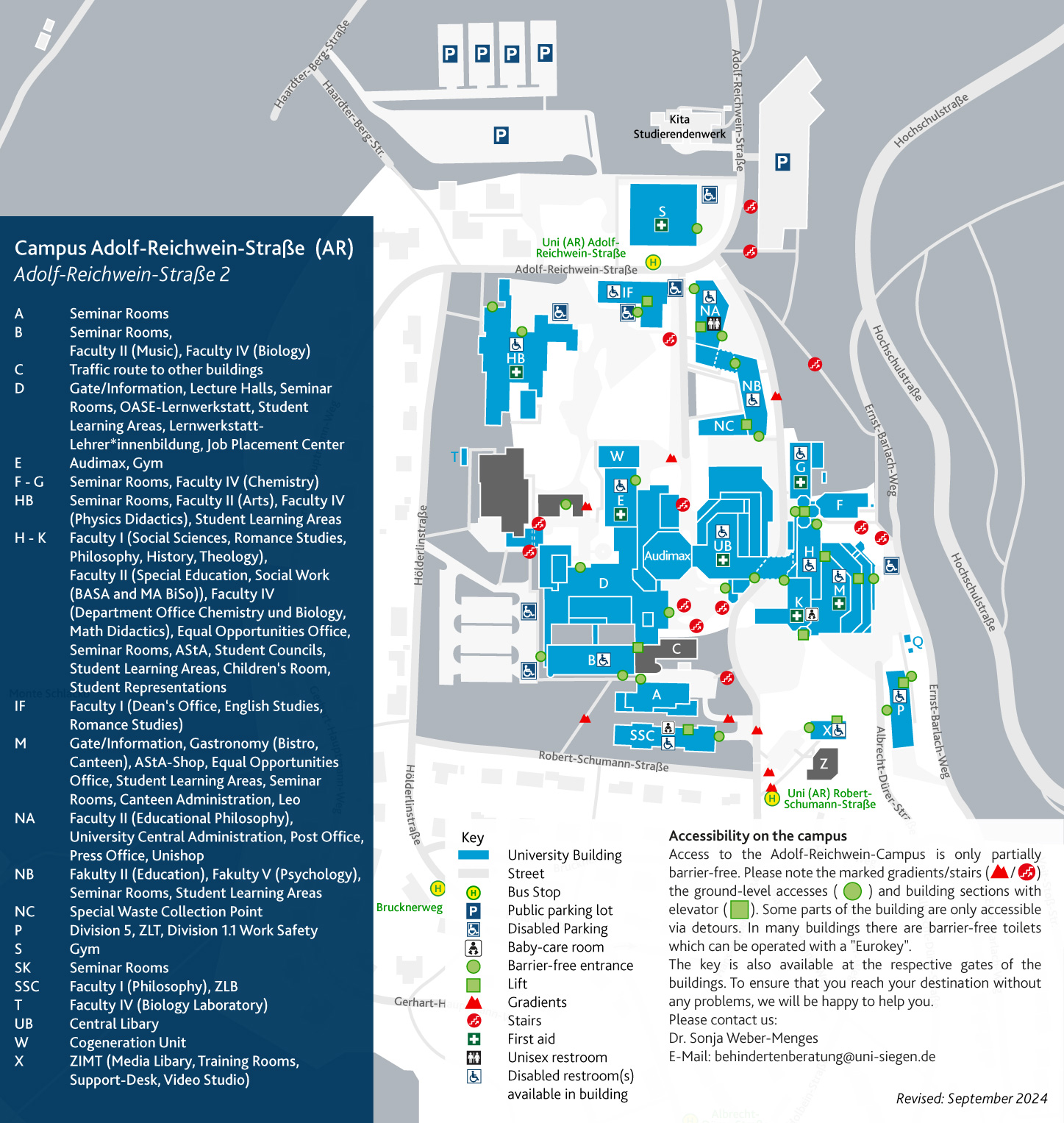
To know more about campus, refer: https://www.uni-siegen.de/start/kontakt/anfahrt_und_lageplaene/reichwein.html.en?lang=e
Usually, there are no tuition fees required for study at the University of Siegen and the cost for living is also reasonable. Hence, there’s not much help available for international students. However some scholarships are awarded by political or religious groups to the students.
There are many different scholarships with very different criteria. Therefore, the easiest way is to use the search engines and filter your own criteria through them.
Here are some external scholarships besides the above ones available for all Indian students:
| Konrad-Adenauer-Stiftung Scholarship | Scholarship per student – Variable Amount | Level Of Study – Doctorate | Type – Merit-Based | View Details |
| Heinrich Boll Scholarships | Scholarship per student – Variable Amount | Level Of Study – Doctorate | Type – Company-Sponsored | View Details |
| Paul Foundation scholarships | Scholarship per student – ₹17.4 L/Yr or $20,174 | Level Of Study – Diploma | Type – Merit-Based | View Details |
| Deutschland Stipendium Program | Scholarship per student – ₹25,845/Yr or $300 | Level Of Study – Bachelor | Type – College-Specific | View Details |
| Axol Science Scholarship | Scholarship per student – ₹1.7 L/Yr or $2,000 | Level Of Study – Bachelor | Type – Company-Sponsored | View Details |
| DAAD Scholarships | Scholarship per student – ₹80,464/Yr or $934 | Level Of Study – Doctorate | Type – Merit-Based | View Details |
The estimated cost of living in Siegen, Germany for an international student is around €950 per month. This includes rent, food, health insurance, and other expenses. Annual expenses are estimated at around €11,904. Tuition fees are not charged at public universities in Germany, but there is a semester fee of ~€322.
Here’s a more detailed breakdown:
Also Check: Cost of Living in Germany for Indian Students
The University of Siegen generally has strong placement rates and is considered one of the top 10 universities in Germany. The average salary offered to graduates is around 48,000 USD (3,819,705.60 INR) per year, with some companies offering salaries between 50,000-70,000 USD (3,978,860 INR – 5,570,404 INR) per year.
The University of Siegen in Germany generally boasts strong job outcomes for its graduates, with a high percentage finding employment in their field of choice. The university provides career services, internships, and connections with companies, supporting students in their job search and career development. While specific 2025 data is not readily available, the university’s reputation for quality education and its focus on practical skills suggest a positive outlook for graduates in the job market.
Ques. What is the University of Siegen like? Is it worth studying there?
Ans. The University of Siegen is a modern, research-oriented institution in North Rhine-Westphalia, Germany, with a strong international focus. It offers a supportive environment for international students, including a Buddy Program to assist with cultural integration and academic guidance. The city of Siegen, known as Germany’s greenest large city, provides a peaceful setting with various student activities and modern amenities.
Ques. How good is the University of Siegen for an MS in Computer Science?
Ans. The MS in Computer Science at Siegen is research-driven, offering specializations like Visual Computing and Embedded Systems. The program emphasizes practical experience through research projects and close collaboration between computer science and electrical engineering departments. However, in national rankings, the university is positioned lower compared to top-tier German institutions.
Ques. How good is the University of Siegen for an MS in Electronics Design?
Ans. Siegen’s MS in Electronics Design and Technology is a specialized program focusing on areas like semiconductor design, optoelectronics, and embedded systems. It combines theoretical coursework with practical research projects, preparing graduates for roles in industry or academia. The program is well-regarded within Germany, though it may not have the same international recognition as offerings from more prominent institutions.
Ques. How does the MS in Visual Computing at Siegen compare to other public universities in Germany in terms of job prospects?
Ans. The Visual Computing specialization at Siegen covers computer vision, graphics, and machine learning, aligning with current industry trends. While the program offers solid academic training, its lower national ranking may impact immediate job prospects compared to graduates from higher-ranked universities. However, Germany’s strong tech industry provides opportunities for skilled graduates across various institutions.