
- info@wingeducations.com
- +91 (705) 495-5296
- Mon - Sat : 10.00-18.00
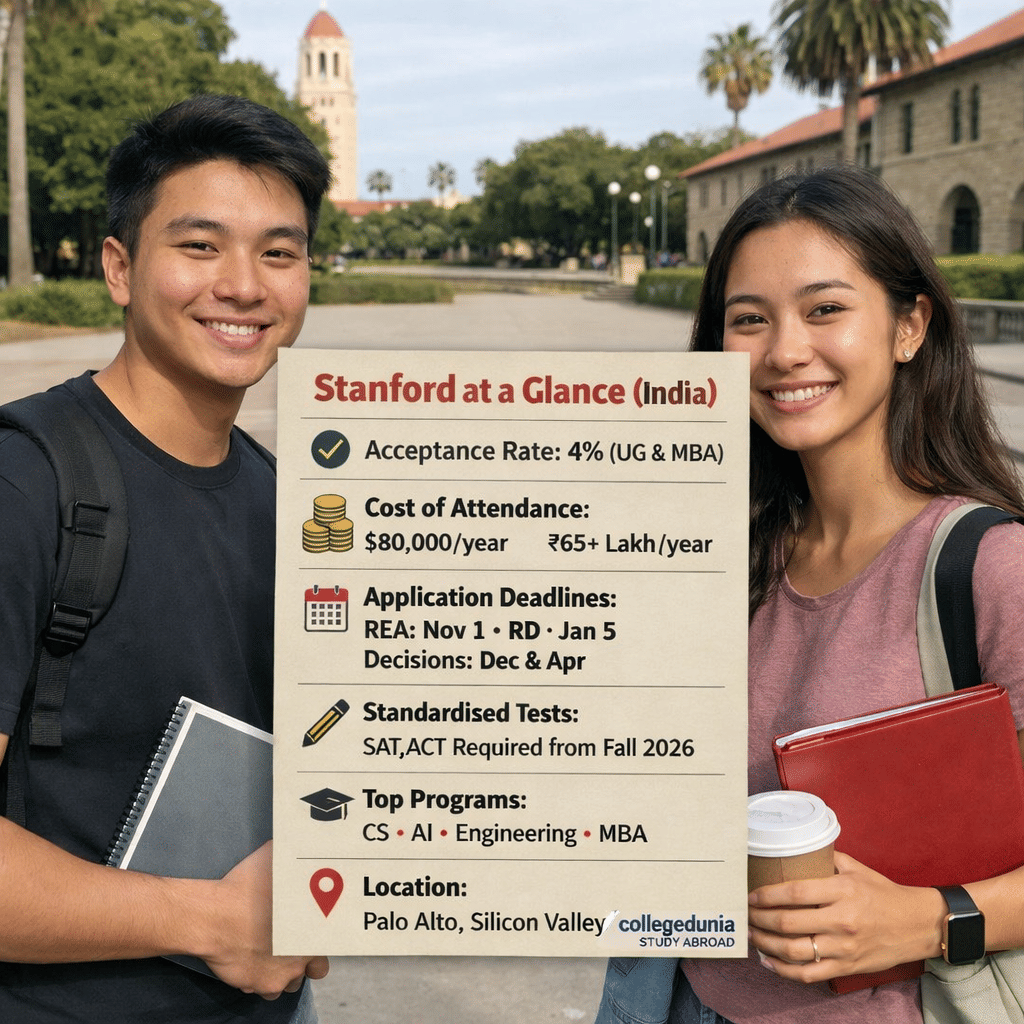
Stanford University is a top-ranked private research university in California, USA, located in the Silicon Valley region near Palo Alto. It is one of the most selective universities in the world and is highly popular among Indian students for Computer Science, Artificial Intelligence, Engineering, and MBA (Stanford GSB).
Stanford’s acceptance rate has been around 3.6%–3.9% in recent cycles (UG), and remains among the lowest in the US. Stanford follows a quarter system, and its annual cost of attendance for international students is among the highest in the US, crossing ₹85–90 Lakhs per year, including tuition and living expenses.
This guide covers Stanford University fees in INR, acceptance rate, rankings, SAT/ACT requirements, popular courses, scholarships, deadlines, and admission requirements for Indian applicants.
INR conversion used in this page: ₹90.78 per $1 (planning rate).
Table of Contents
| Key Parameter | Stanford University Details |
|---|---|
| Location | Stanford, California (Silicon Valley, near Palo Alto) |
| Type | Private Research University |
| Acceptance Rate (UG) | ~3.6%–3.9% |
| Acceptance Rate (MBA) | ~6%–8% |
| QS Ranking 2026 | #3 globally |
| THE Ranking 2026 | #5 globally |
| Annual UG Tuition (3 quarters) | $67,731 (≈ ₹61.5 Lakhs) |
| Total UG Cost of Attendance | $96,513 (≈ ₹87–90 Lakhs/year) |
| SAT/ACT Requirement | Required for UG (2026 onwards) |
| UG Deadlines (Fall 2027) | REA: Nov 1, 2026 | RD: Jan 5, 2027 |
| Decisions (UG) | REA: mid-Dec | RD: early April |
| Popular Programs | MS CS, Engineering, AI, MBA, Economics |
Stanford University is one of the most expensive universities in the US. For Indian students, the realistic annual budget is not just tuition—it also includes housing, insurance, meals, and personal expenses. Click here to check Estimated total cost of studying at Stanford (UG)
Important: Stanford bills tuition quarterly, so Indian students should plan cash flow for 3 major payments per year.
Stanford graduate tuition is billed per quarter, and most full-time programs run for 3 quarters per academic year (Autumn, Winter, Spring). Tuition-only typically ranges from ~₹60–80 Lakhs/year depending on program (MS vs MBA), excluding living expenses.
| Programs | Annual Tuition (USD) | Approx. Fees (INR) |
|---|---|---|
| MBA (GSB) / MBA Finance | $85,755 | ₹77.67 Lakh |
| LLM (Law School) | $77,454 | ₹70.15 Lakh |
| MS Computer Science | $67,686 | ₹61.30 Lakh |
| MS Electrical Engineering | $67,686 | ₹61.30 Lakh |
| MS Management Science & Engineering | $67,686 | ₹61.30 Lakh |
| MS Mechanical Engineering | $67,686 | ₹61.30 Lakh |
| MS Bioengineering | $67,686 | ₹61.30 Lakh |
| MS Aeronautics & Astronautics | $67,686 | ₹61.30 Lakh |
Living expenses (UG/PG): Most Indian students should budget an additional $45,000–$50,000/year (₹40–45 Lakhs) for housing, food, and insurance in the Bay Area.
Check: Stanford University Fees for Indian Students 2026-27
Stanford undergraduate tuition is published on Stanford Student Services, and the actual billed total depends on housing, meal plan, insurance, and personal expenses. Start with tuition as the “fixed” anchor.
| Popular UG academic directions (examples) | Tuition basis | 2025–26 tuition (official) |
|---|---|---|
| Engineering, Computer Science, Economics, Biological Sciences, Mathematics (apply to the university, choose a major later) | Full-time per quarter | $22,577 per quarter (INR 20.44 Lakhs) |
UG annual tuition estimate (3 quarters): $22,577 × 3 = $67,731
Some of the most popular Stanford University undergraduate courses for Indian students are listed below:
| Programs | Total Annual Fees (INR) | Total Annual Fees (USD) |
|---|---|---|
| BS Computer Science | ₹61.34 Lakh | $67,731 |
| BS Management Science and Engineering | ₹61.34 Lakh | $67,731 |
| BS Mechanical Engineering | ₹61.34 Lakh | $67,731 |
| BS Sustainable Architecture & Engineering | ₹61.34 Lakh | $67,731 |
| BS Computer Science – Artificial Intelligence | ₹61.34 Lakh | $67,731 |
Also Check: Top Engineering Universities in USA
Stanford University is among the most selective universities globally. Stanford’s undergraduate acceptance rate has been around 3.6%–3.9% in recent cycles. For Indian students, competition is especially intense due to high application volume in STEM programs like Computer Science and Engineering. Graduate acceptance rates differ by department, and Stanford MBA admissions are also highly selective.
| Program | Estimated Acceptance Rate |
|---|---|
| Undergraduate (UG) | 3.6%–3.9% |
| MBA (Stanford GSB) | 6%–8% |
| MS Computer Science | Highly selective (varies by department) |
| MS Engineering | Varies by department |
Stanford University has officially reinstated the SAT/ACT requirement for first-year and transfer undergraduate applicants starting Fall 2026, ending its previous test-optional policy. Applicants may self-report scores during application review, with official reports required upon enrollment.
Getting into Stanford requires far more than high marks. Indian applicants who get shortlisted typically have:
Tip: Stanford values “Intellectual Vitality” heavily, meaning your projects, reading, curiosity, and initiative matter as much as grades.
Stanford University deadlines depend on the program level. Undergraduate deadlines are fixed university-wide, but MS and MBA deadlines vary by department. Indian applicants should shortlist their programs first and then track deadlines carefully. To apply for Fall 2027, you should ideally complete SAT/ACT, SOP, and LOR preparation by June–August 2026.
Stanford Deadlines Snapshot
As of February 2026, the primary application window for Stanford’s Fall 2026 undergraduate and most graduate programs has closed. Current applicants are now in the “review phase,” with decision notifications scheduled for release in early April 2026. For those still looking to apply this year, a few specific windows remain open:
If you missed the 2026 window, your preparation for the Fall 2027 cycle should begin now. The application portals typically open in August/September 2026.
| Program Level | Application Opens | Early Deadline (REA/R1) | Regular Deadline (RD/R2) |
|---|---|---|---|
| Undergraduate | August 2026 | Nov 1, 2026 | Jan 5, 2027 |
| Stanford GSB (MBA) | September 2026 | Sept 9, 2026 | Jan 6, 2027 |
| MS (Engineering) | September 2026 | – | Dec 1–15, 2026 |
Stanford UG has fixed university-wide dates. Stanford PG deadlines must be tracked department-by-department. Shortlist 3–5 target programs first, then build a deadline tracker..
Stanford University is consistently ranked among the Top 5 universities in the USA and globally, especially for Computer Science, Engineering, and Business programs.
| Ranking Agency | 2024 Rank | 2025 Rank | 2026 Rank | Trend Status |
|---|---|---|---|---|
| QS World University Rankings | #5 | #6 | #3 | Significant Rise |
| Times Higher Education (THE) | #2 | #6 | #5 | Stable Top 5 |
| U.S. News & World Report (Global) | #3 | #3 | #3 | Consistent Elite |
Stanford’s global reputation is strongest in Computer Science/AI, Engineering, Business, and interdisciplinary tech-management areas.
Check the detailed rankings of Stanford University and ranking trends
Stanford University’s admission process is defined by its extreme selectivity and a holistic review system that looks beyond “perfect” numbers to find students with exceptional “Intellectual Vitality.” Check Stanford University Admission Process
Unlike undergraduate admissions, Stanford graduate entry is managed by individual departments (e.g., Engineering, GSB, Law). Each has unique prerequisites and timelines.
| Category | Admission Requirements |
|---|---|
| Application Form | https://gradadmissions.stanford.edu/apply/apply-now |
| Application Fee | $125 USD (~₹10,400 INR). Note: MBA is $275. |
| Academic Score | 3.5/4.0 GPA is the “competitive” baseline, no hard minimum. Successful Indian applicants typically have 85–90%. |
| TOEFL Score | MS Engineering: 89+ | Humanities/Social Science/Education: 100+ |
| Admission Requirement | A 4-year Bachelor’s is mandatory for most. 3-year degrees from India (B.Com/B.Sc) usually require a completed 2-year Master’s to qualify. |
| Standardized Testing | GRE Quant: 165+ (Engineering prefers higher Quant scores, often 168+) | Verbal: 160+ GMAT: 650+ (720+ – competitive average) |
| Required Documents | Transcripts, LOR – 3 mandatory, Resume/CV: 1–2 pages maximum, SOP |
Historically, Stanford Graduate Admissions only accepted the TOEFL. However, for the Autumn 2026–27 entry, IELTS Academic is now officially listed as an option for graduate programs.
Also Read: Stanford University MS in Computer Science: Fees, Requirements & Deadlines
Stanford uses the Common Application and follows a “holistic” review process. There is no minimum GPA requirement, but admitted students typically have an average unweighted GPA of 3.94–3.96. Stanford’s official first-year page lists these required components for UG applications:
Testing detail: Stanford states ACT/SAT scores are required for first-year and transfer applicants, and applicants can self-report scores for application review.
| Category | Admission Requirements |
|---|---|
| Application Form | Common Application (https://www.commonapp.org/) |
| Application Fee | $100 USD (approx. ₹8,400 INR) |
| Academic Score | No minimum GPA; however, the average unweighted GPA of admitted students is 3.94–3.96. |
| TOEFL Score | 100+ |
| Admission Requirement | LOR (2 Teacher + 1 Counselor), 1 Main Personal Statement + Stanford-specific Short Questions |
| Standardized Testing | SAT: Middle 50% range is 1510–1570 | ACT: 34–35 |
| Deadlines | Nov 1 (Restrictive Early Action) | Jan 5 (Regular Decision) |
The Stanford Graduate School of Business (GSB) MBA is one of the most selective programs globally. If you missed the January deadline, there is one remaining window for the 2026 intake:
Admit Status: Round 3 is the most competitive and does not include an “Admit Weekend.” International students are generally encouraged to apply in Rounds 1 or 2 to allow ample time for visa processing.
| Category | Requirement / 2026 Profile |
|---|---|
| Application Fee | $275 (approx. ₹22,800 INR) |
| Average GMAT (Legacy) | 738 (Range: 560–790) |
| Average GMAT (Focus) | ~695 (Projected equivalent) |
| Average GPA | 3.77 (U.S. 4.0 scale) |
| Work Experience | Average 5.1 years (No minimum required) |
| English Proficiency | TOEFL (100+), IELTS (7.0+), or PTE (68+) |
| Acceptance Rate | ~6% to 8% |
The cost of a Stanford MBA is high, but the ROI is typically strong, with graduates commonly entering high-paying roles in consulting, tech, and finance.
Stanford publishes a standard undergraduate budget for 2025–26 with item-level numbers.
| Cost item (UG standard budget) | 2025–26 amount |
|---|---|
| Tuition | $67,731 |
| Housing and food | $22,167 |
| Student fees allowance | $2,475 |
| Books and supplies allowance | $840 |
| Personal expenses allowance | $3,300 |
| Total (excluding travel variability) | $96,513 |
| One-time fees for new students | Orientation fee $525; Document fee $250 |
Using ₹90.78 per $1 (planning rate):
Most cost pressure is not tuition alone. The Stanford budget already shows housing/food as a major component, and Bay Area prices make cash-flow planning important (rent deposits, quarter billing, health insurance decisions).
Stanford University’s campus, affectionately known as “The Farm”, is one of the largest and most architecturally distinct university campuses in the world. Spanning 8,180 acres in the heart of Silicon Valley, it blends 19th-century Spanish-Colonial heritage with ultra-modern research facilities.
The flip side—often echoed by students online—is that Palo Alto/Stanford can feel expensive and “bubble-like,” so students who want a dense city life sometimes prefer Berkeley or NYC/Boston schools.
Stanford funding is a mix of need-based aid (especially UG) and competitive fellowships (especially graduate).
| Scholarship | Who it’s for | Typical Value | Notes |
|---|---|---|---|
| Knight-Hennessy Scholars | Graduate applicants | Full/near-full funding (varies) | Extremely competitive; leadership-heavy |
| Stanford need-based (UG) | Undergrad | Varies by family income | Policy-led support; check official calculator/policy pages |
Some Stanford funding processes may require an ITIN or SSN at later stages; requirements vary by scholarship type.
Also Check: Stanford University Scholarships for International Students
Stanford has a strong reputation for employability and entrepreneurship. Graduates commonly enter top roles in technology, consulting, finance, research, and startups. Indian students at Stanford typically focus on STEM-designated programs (like MS CS or Engineering) to utilize the 3-year OPT (Optional Practical Training) extension, which significantly improves the chances of H-1B sponsorship.
Ques. How does Stanford University’s quarter system work?
Ques. What is Stanford University fees for Indian students in INR?
Ques. Is Stanford University SAT required for 2026?
Ques. What is the Stanford University MBA fees?
Ques. What is the Stanford University MS Computer Science fees?
Ques. Is Stanford University public or private?
Ques. Where is Stanford University located?
Ques. What is Stanford University undergraduate tuition per year?
Ques. What is Stanford University total cost of attendance?