
- info@wingeducations.com
- +91 (705) 495-5296
- Mon - Sat : 10.00-18.00
Pharm.D is a six-year PhD postgraduate degree programme that deals with the study of analytical chemistry, monographs of inorganic chemicals and clinical study of drugs and experiments. The course duration includes 5 years of academic studies and one year of internship for students. Pharm.D course offers various opportunities in employment roles such as Drug Advisor, Clinical Pharmacist, Lecturer, Medical Writer, etc.
Table of Contents
| Degree | Doctorate |
| Full Form | Doctor of Pharmacy |
| Duration | 6 Years |
| Age | Minimum 17 years of age |
| Minimum Percentage | 50% |
| Average Fees | ₹50K – 2 LPA |
| Average Salary | INR 3.5 LPA [Source: PayScale] |
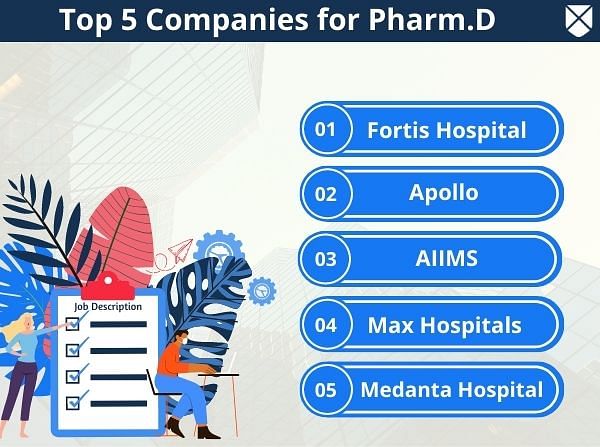
| Employment Roles | Clinical Pharmacist, Pharmacologist, Clinical Research Associate (CRA), Junior Clinical Research Associate (CRA), Data Analyst, Business Development Manager, Research Scientist etc |
| Top Recruiters | Quintiles, Inc., Syngene, Sun Pharmaceuticals, Glenmark Pharma, Zydus Cadila, Biocon, GlaxoSmithKline, Cipla Inc., Apollo Hospitals, BioClinica, Fortis Hospitals, Glenmark Pharma, Fortis etc |
Pharm.D duration is a six-year doctorate program under the science stream, with aim of teaching the principles of analytical chemistry, as well as the study of specific inorganic substances’ monographs. Pharm.D full form is Doctorate of Pharmacy. The Pharm.D syllabus and subject are structured in a way that gives graduates a wide range of employment options.
The Pharm.D job scope is extensive, ranging from Clinical Pharmacist, Data Analyst to Pharmaceutical Advisor in both private and government sectors.
Students must clear the 10+2 examination from any recognized board or school. The basic Pharm.D eligibility criteria include securing 50% aggregate marks in the 10+2 exam and sound performance in the Pharm.D entrance exams for respective colleges. The minimum age for Pharm.D eligibility is 17 years.
Students should note that the eligibility criteria for the 6 years Pharm.D course and the 3-year Pharm.D are different.
Below are the eligibility criteria for the 6-year Pharm.D Course:
Below are the eligibility criteria for the 3-year Pharm.D Course:
The admissions to the Pharm.D course can be done through both online and offline methods. Pharm.D admissions are also available from the website or by directly visiting the college’s admissions office. Listed below are the details of the Pharm.D admission process in general:
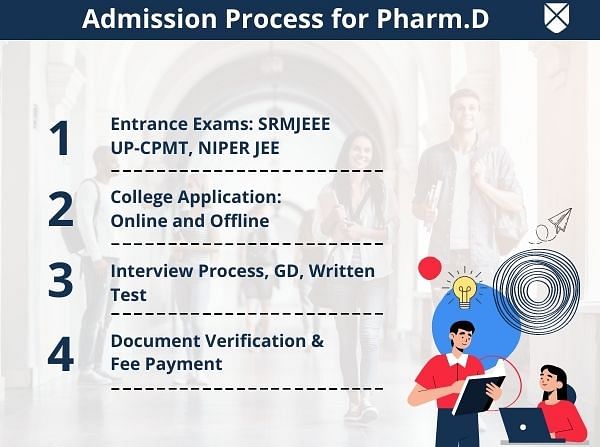
Pharm.D course information is available on the Pharm.D colleges in India through which the aspirants begin their application process. The Pharm.D course applications in India are available to students through both online and offline modes.
Pharm.D course duration includes 5 years of academic studies and one year of internship for students of doctorate level. Job opportunities are available in various fields after a long duration of enmeshing skills and aptitude in pharmaceutical science training.
Students can follow these guidelines to enrol in a good university:
The selection process for Pharm.D admissions is usually based on the candidate’s performance in the 10+2 examinations. In some Pharm.D colleges, admissions are strictly offered to only those candidates who pass a Pharm.D entrance exam of the respective colleges such as GPAT, UP-CPMT, and UPSEE.
Pharm.D Lateral Entry admissions are available to candidates who have completed their Diploma in Pharmacy or B.Pharmacy course. Lateral Entry for Pharm.D is done for the 6-year-long Pharm.D (Pre Baccalaureate) course. Pharm.D Lateral Entry candidates can join the course from the 4th year onwards.
Pharm.D is a six-year pre-PhD postgraduate program that deals with the clinical study of drugs and experiments, which further helps treat patients in Pharmaceutical Science. The Pharm.D scope is very high for the aspirants owing to the relevance of the education that the students recieve.
Aspirants can take up the Pharm.D course immediately after completing their 10+2 from a recognized board. For the 3-year Pharm.D course, aspirants can apply for the course after completing their Bachelor of Pharmacy or B.Pharm degree.
The Pharm.D degree is apt for students interested in the healthcare industry. The duration of the course is 6 years. There are 2 types of Pharm.D courses that students can opt to pursue, as follows:
Pharm.D (Pre Baccalaureate) is a 6-year doctoral degree program where students will have to complete 5 years of academic study and a 1-year internship at a hospital. Students who have completed their 10+2 can apply for this course.
Pharm.D (Post Baccalaureate) is a 3-year doctoral degree program that sees students complete 2 years of academic study and a 1-year internship at a hospital. B.Pharmacy and Diploma in Pharmacy graduates are eligible for this course.
Students enrolled in the Pharm.D program must complete the standard curriculum set by the Indian Pharmacy Council. The Doctor of Pharmacy focuses on pharmacies, pharmaceutical chemistry, pharmaceutical microbiology, etc.
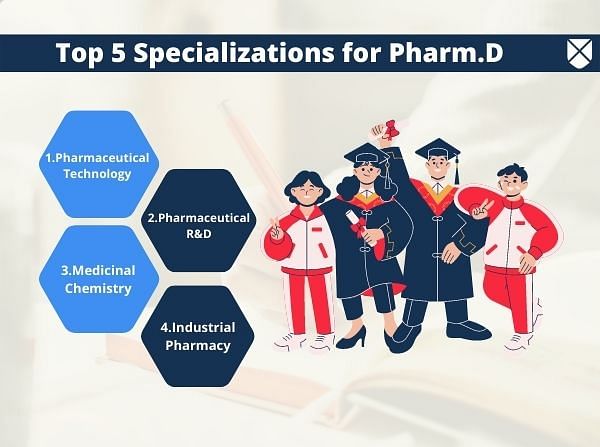
Pharmaceutical Technology: Pharmaceutical technology involves implementing scientific knowledge to develop new methods for the manufacture of drugs and processes.
Pharmaceutical R&D: In pharmaceutical R & D, new drugs are discovered by recognizing the active ingredients in traditional medicine and treatments, or discoveries such as penicillin.
Medicinal Chemistry: Medicinal Chemistry deals with the research and development of pharmaceuticals. Drug discovery, delivery, human consumption, and metabolic responses form part of this area. Biomedical analysis, pharmacology, pharmacokinetics, and pharmacodynamics form part of medicinal chemistry.
Industrial Pharmacies: Industrial pharmacies handle the manufacture, development, promotion, and distribution of medicines to end-users.
For the Pharm.D admission process, the selection of candidates is either based on merit or through an entrance exam conducted by the institution. Pharm.D colleges or universities ensure they select the best student with the desired knowledge and skill set with the entrance exam process. Listed below are some of the popular entrance exams for the 6 years Pharm.D course duration:
Students, who wish to appear for the Pharm.D entrance exam should ask, ‘What is Pharm.D?’ They should adequately study the exam pattern and the syllabus beforehand. Listed below are the detailed pattern of the Pharm.D entrance exam:
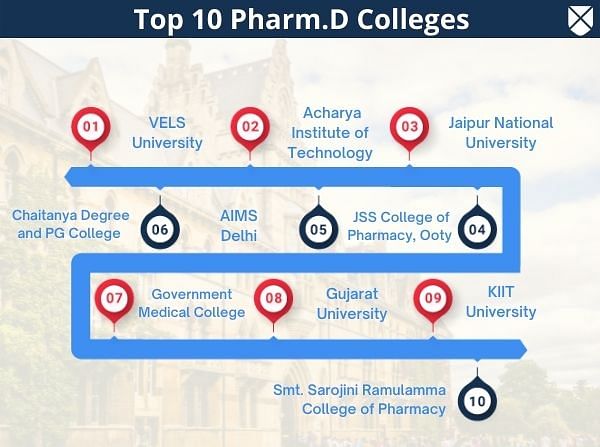
Even though Pharm.D was introduced in 2008, it has come a long way to be recognized as a top-tier career prospect for many students. Many top institutions in India have included the Pharm.D course in their curriculum. Listed below are the top Pharm.D colleges in India:
| Sl.No. | Name of the Institute | Average Fees |
| 1. | Poona College of Pharmacy | INR 1.75 LPA |
| 2. | Chandigarh University | INR 2 LPA |
| 3. | Jaipur National University | INR 1.1 LPA |
| 4. | Chaitanya Degree and PG College | INR 1 LPA |
| 5. | Smt. Sarojini Ramulamma College of Pharmacy | INR 80,000 PA |
| 6. | JSS College of Pharmacy, Ooty | INR 2.8 LPA |
| 7. | SRM University Kattankulathur Campus | INR 1.66 LPA |
| 8. | MS Ramaiah University of Applied Sciences | INR 2.3 LPA |
| 9. | Sri Ramachandra University | INR 1.75 LPA |
| 10. | Goa College of Pharmacy | INR 2.9 LPA |
Below is a list of the top Pharm.D colleges in Bangalore with average fees:
| Name of the College | Average Fees |
| Dayananda Sagar University | INR 3.7 LPA |
| MS Ramaiah University | INR 2 LPA |
| Krupanidhi College of Pharmacy | INR 17.5 LPA |
| Karnataka College of Pharmacy | INR 1 LPA |
| T John College of Pharmacy | INR 1.3 LPA |
Read More: Top Pharm.D Colleges in Bangalore
Below is a list of the top Pharm.D colleges in Hyderabad with an average fee:
| Name of the College | Average Fees |
| Sultan Ul Uloom College of Pharmacy | INR 4.8 LPA |
| Sri Venkateshwara College of Pharmacy | INR 4.1 LPA |
| Anurag Group of Institutions | INR 6.2 LPA |
| RBVRR Women’s College of Pharmacy | INR 4.2 LPA |
| Malla Reddy College of Pharmacy | INR 5.4 LPA |
Read More: Top Pharm.D Colleges in Hyderabad
Below is a list of the top Pharm.D colleges in Coimbatore with an average fee:
| Name of the College | Average Fees |
| Sri Ramakrishna Institute of Paramedical Sciences, Coimbatore | INR 9.6 LPA |
| Karpagam University | INR 15 LPA |
| RVS College of Pharmaceutical Science, Coimbatore | INR 4.0 LPA |
| Karpagam College of Pharmacy | INR 18 LPA |
Read More: Top Pharm.D Colleges in Coimbatore
Below is a list of the top Pharm.D colleges in Chennai with average fees:
| Name of the College | Average Fees |
| SRUSRMCRI | INR 7.5 LPA |
| Vels University | INR 2 LPA |
| Jaya College of Paramedical Sciences College of Pharmacy | INR 2.7 LPA |
Read More: Top Pharm.D Colleges in Chennai
Below is a list of the top Pharm.D colleges in Pune with average fees:
| Name of College | Average Fees |
| Poona College of Pharmacy | INR 5 LPA |
| Indira College of Pharmacy | INR 7 LPA |
| College of Pharmacy | INR 7 LPA |
Read More: Top Pharm.D Colleges in Pune
Below is a list of the top Government Pharm.D colleges:
| SI.No. | Name of College |
| 1 | Andhra University |
| 2 | Annamalai University |
| 3 | Andhra University College of Pharmaceutical Sciences |
| 4 | L M College Of Pharmacy |
| 5 | Government Pharmacy College |
Below is a list of the top Private Pharm.D colleges:
| SI.No | Name of College |
| 1 | Manipal University |
| 2 | Sri Ramachandra Institute of Higher Education and Research |
| 3 | Birla Institute of Technology |
| 4 | PES University |
| 5 | Jaipur National University |
The average Pharm.D course fee in India is INR 50K-2LPA. The Pharm.D fees per year may vary on various factors such as Infrastructure, teaching facilities, institutional facilities, faculty, etc. Below is the list of the Pharm.D fee structure for various colleges in India:
| Sl.No. | Name of the Institute | Total Fee Structure |
| 1. | JSS College of Pharmacy, Mysore | INR 15.1 LPA |
| 2. | Sri Ramachandra University, Chennai | INR 7.5 LPA |
| 3. | Dayanand Sagar University, Bengaluru | INR 3.7 LPA |
| 4. | Poona College of Pharmacy, Pune | INR 10.5 LPA |
| 5. | Jaipur National University, Jaipur | INR 6.6 LPA |
| 6. | SRM University, Chennai | INR 15 LPA |
| 7. | Annamalai University | INR 10 LPA |
| 8 | DY Patil | INR 10 LPA |
Pharm.D course duration is usually divided into five years of academic training having 10 semesters and one year for internship. Below is the subject list of the Pharm.D offered by various colleges in the country:
Read More: Pharm.D Syllabus and Subjects
Below is a comparison of PharmD and B.Pharmacy course through multiple parameters:
| Parameters | Doctor of Pharmacy | Bachelor of Pharmacy |
| Overview | Doctor of Pharmacy is a combination of science and art of dispensing medicines. Students are acknowledged as practical in clinical pharmacy and medical pharmacy. | This course aims at the candidates who want to open their pharmacy store or join the research industry. Also, it teaches about medicines, drugs, formulations, etc. |
| Duration | 6 years | 4 years |
| Eligibility | 10+2 with a minimum of 60% marks in the science stream | 10+2 with a minimum of 50% marks in the science stream |
| Admission Process | Merit-Based | Entrance Exam Based |
| Top Colleges | Chandigarh University, NIMS University, Manipal college of pharmaceutical sciences, Etc. | Jamia Hamdard, Panjab University, BITS Pilani, etc. |
| Job Roles | Pharmacists, Drug experts, Retail Pharmacists, Hospital Pharmacy directors, Hospital Staff Pharmacists, Clinical Pharmacists, etc. | Drug inspector, medical writer, pharmaceutical scientist, pharmacy business, etc. |
| Average Fees | INR 6– 20 LPA | INR 4 – 5 LPA |
| Average Salary | INR 3 – 10 LPA (Source- Glassdoor) | INR 2.5 – 6 LPA(Source- Glassdoor) |
| Top Recruiting Organization | Home Health Care, Community pharmacy, clinical pharmacy, geriatric pharmacy, managed care, governmental agencies, etc. | Hospitals, Government Drug Research Institutes, Medical Clinics, etc. |
Read More: B.Pharmacy
Given below is a college comparison of two colleges that provide the PharmD course in India:
| Parameters | Chandigarh University | NIMS University |
| Overview | Chandigarh University is situated in Chandigarh. It is a private university with an A+ grade by NAAC. | NIMS University is situated in Jaipur. According to ASSOCHAM, It is the best private university in 2018. |
| Location | Chandigarh | Jaipur |
| Eligibility | 10+2 with a minimum of 50% marks | 10+2 with a minimum of 50% marks |
| Admission process | Entrance exam | Entrance exam |
| Average fees | INR 2 LPA | INR 1.5 LPA |
| Top recruiting organizations | Microsoft, Samsung, Google, Amazon, Dell, IBM, Sapient, Oracle, Flipkart, etc. | Dell, Cisco, CNBC, IBM, Adobe, Cairn, Wipro, VIVO, Intex, HDFC Bank, etc. |
| Average salary | INR 7 LPA (Source- Glassdoor) | INR 4 LPA (Source- Glassdoor) |
With newer discoveries and infrastructure development being a continuous course of action, courses such as Pharm.D have gained a lot of importance in the last decade. Although a newer course, Pharm.D has managed to become an essential part of the college curriculum all around the globe. To understand ‘Why to choose Pharm.D?’, and “What is Pharm.D course?” we make it simpler by breaking it down into the following three questions:
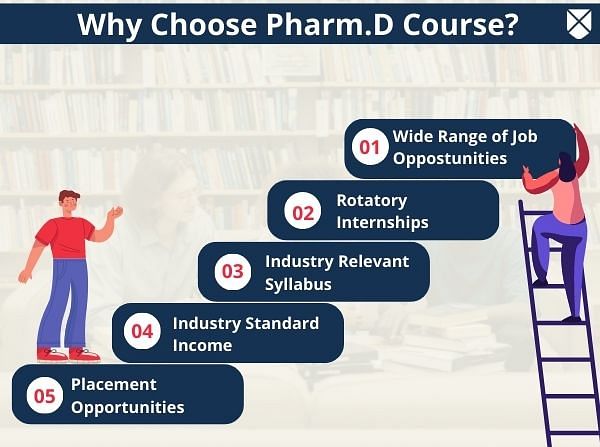
The Pharm.D course duration is six years that focuses on imparting various critical skills to students such as medical writing, therapeutic skills, counselling skills, persuasive skills, technical skills, and business skills. The Pharm.D course’s full form is Doctor of Pharmacy. The Pharm.D course aims to sculpt the graduates into individuals with pharmaceutical skills to face the industry challenges and provide adequate solutions.
Pharm.D jobs can be a rich and fulfilling experience for aspirants who want to explore and contribute to the world of pharmaceutics and healthcare. There are various Pharm.D benefits available to graduates, including job postings such as Nutritionist, Medical Writer, Drug Advisor or work as a community practitioner for prescribing medications for chronic diseases.
Medical Writer: Medical writer works on creating scientific documents by associating closely with doctors, scientists, and other subject experts to elaborate vividly on the research results and the product’s usage. Medical Writers have become very reputable in the past few years with the industry demands concise writers that can put medical details clearly on a document.
Pharm.D has today become a lucrative career not only because of the advancement in technology and medical research but also because healthcare has become one of the essential and dire human services.
Community Involvement: The need for Pharmacists is growing in the country as they provide legitimacy with their advice and prescriptions. Pharmacists spend years of study and training in understanding the world of Pharm.D courses and their uses.
Read More: Pharm.D Job Opportunities and Scope
Students should be well prepared following the various aspects of the Pharm.D entrance exam. Some preparation tips for the Pharm.D entrance exam are listed below:
Ample educational opportunities are available to Pharm.D degree holders who do not want to take up jobs immediately after graduation. Research skills become more polished with higher education experience, thus becoming an individual of high demand in various positions. Some of the higher education opportunities available for Pharm.D graduates are listed below:
According to payscale, the average Pharm.D salary offered in India is INR 3.5 LPA. The pay range goes higher as the graduate gains experience over time. Higher Studies after Pharm.D course duration also ensures a higher pay scale when entering a workforce.
Read More: Pharm.D Salary and Placements
While researching the Pharm.D course details in India, one should look into the career options that Pharm.D fetches for its graduates. Options vary for students who want to immediately enter the workforce compared to those who want to pursue higher studies. Graduates of Pharm.D interested in teaching can apply for the NET exam. Some of the popular roles available to Pharm.D graduates are:
Management and interpersonal skills play a massive role in ensuring the student becomes a top-tier graduate as Pharm.D is not only about knowing the subject but also about providing community service and building relationships. Some of the skills are listed below:
The Pharm D syllabus gives exposure to students in various industry-specified functions such as those in the areas of healthcare services, research, BPOs, etc. Pharm.D job scope is extensive and all the subjects aligned with the course aim to help train the students for roles such as clinical pharmacist, research associate, data analyst, etc.
Table of Contents
The semester-wise Pharm.D syllabus focuses on studying the subjects of medicinal biochemistry, clinical research, pharmaceutical microbiology, pharmaceutics, pharmaceutical analysis, pharmacognosy & phytopharmaceuticals, etc. The Detailed Pharm D syllabus is given below:
The semester-wise Pharm.D first-year syllabus is listed below:
| Semester I | Semester II |
| Human Anatomy and Physiology | Pharmaceutics |
| Medicinal Biochemistry | Pharmaceutical Organic Chemistry |
| Pharmaceutical Inorganic Chemistry | Remedial Mathematics/Biology |
The semester-wise Pharm.D second-year syllabus is listed below:
| Semester III | Semester IV |
| Pathophysiology | Pharmaceutical Microbiology |
| Pharmacognosy & Phytopharmaceuticals | Pharmacology- I |
| Community Pharmacy | Pharmacotherapeutics – I |
The semester-wise Pharm.D third-year syllabus is listed below:
| Semester V | Semester VI |
| Pharmacology – II | Pharmaceutical Analysis |
| Pharmacotherapeutics – II | Pharmaceutical Jurisprudence |
| Medicinal Chemistry | Pharmaceutical Formulations |
The semester-wise Pharm.D fourth-year syllabus is listed below:
| Semester VII | Semester VIII |
| Pharmacotherapeutics – III | Hospital Pharmacy |
| Clinical Pharmacy | Biostatistics and Research Methodology |
| Biopharmaceutics and Pharmacokinetics | Clinical Toxicology |
The semester-wise Pharm.D fifth-year syllabus is listed below:
| Semester IX | Semester X |
| Clinical Research | Pharmacoepidemiology & Pharmacoeconomics |
| Clinical Pharmacokinetics | Pharmacotherapeutic Drug Monitoring |
| Clerkship | Project Work (Six months) |
The syllabus of Pharm.D provides the students with an in-depth knowledge of the world of pharmaceutical science and its various prospects. Pharm. D syllabus focuses on core subjects throughout its five-year academic duration with an internship training of one year. Students study the subjects in Pharm.D throughout a 10-semester break up to make the syllabus more flexible.
The core Pharm.D subjects list contains essential subjects that all Pharm.D students study, which are as follows:
The elective Pharm.D subjects list contains subjects that Pharm.D students can take, which are as follows:
Some of the Pharm.D subjects are given in a greater detail:
Pharm D subjects | Topics Covered |
Pharmaceutics | Concept of health, Nutrition and health, First aid, Environment and health |
Pharmaceutical Chemistry | Acids, bases and buffer, Antimicrobials and Astringent, Expectorants and Emetic, Quality control of Drugs |
Pharmacognosy | Pharmaceutical aids, Carbohydrates, Vitamins, Therapeutics |
Pharmacology & Toxicology | Routes of administration of drugs, General mechanism of drugs action, Drugs acting on the respiratory system |
The candidate must complete a one-year internship to complete the course. When candidates are in the internship stage, they experience how things work in their field. You will also learn how to maintain interpersonal relationships with your patients. This internship will focus on the experience.
Students independently provide clinical pharmacy services to their allotted wards during the internship. The training period includes six months in general medicine with specialty training of two months each in specialty departments.
| Specialty | Duration |
| Surgery | 3 Months |
| Pediatrics | 1 Month |
| OB &G | 1 Month |
| Psychiatry | 3 Months |
| Skin and VD | 1 Month |
| Orthopedics | 2 Months |
| Total | 12 Months |
The Pharm.D syllabus is designed in a core subject pattern throughout the 10-semester duration. The Doctor of Pharmacy syllabus gives students a critical approach to pharmaceutical science research and industry requirements. The institutional training in the 6th year also forms a core component of the PharmD syllabus that prepares students adequately for the industry demands. The Pharm.D syllabus course structure is listed below:
The Pharm.D syllabus is a long course that includes various on-field training and internship periods to mitigate the students into the field of pharmaceutical science appropriately. For example, the 3rd year Pharm.D syllabus focuses on the analysis and formulations of pharmaceutical concepts and a course in Pharmacotherapeutics. The Pharm.D Subjects introduce the students to various concepts each semester. Some of the teaching methods appropriate in the Pharm.D syllabus are listed below:
Healthcare has become a global need, with people requiring medical assistance in one way or another. Fatalities and injuries are inevitable to the human condition, and therefore, careers like Pharm.D play a considerable role in providing those essential services. Some of the Pharm.D project areas popular among students are listed below:
Pharm.D reference books are available to students through online and offline modes. The students can also download some of the Pharm.D syllabus books online to reduce the cost of buying further. Some of the popular Pharm.D reference books are listed below:
| Name of the Books | Authors |
| Applied Therapeutics (10th Edition) | Kimble & Young |
| Concepts in Sterile Preparations and Aseptic Technique | Ochoa & Vega |
| Drug Information | Malone, Kier, and Stanovich |
| Pharmacy Practice and the Law | Richard R Abood |
| Medical Microbiology | Murray, Rosenthal, and Pfaller |
| Mosby’s Drug Reference for Health Professionals (6th edition) | Mosby |