
- info@wingeducations.com
- +91 (705) 495-5296
- Mon - Sat : 10.00-18.00
PGDM in Business Analytics is a two-year PG management program designed to equip individuals with the skills to leverage data and technology for strategic decision-making. PGDM Business Analytics requires prospective candidates to have a minimum of 55% in the bachelor’s degree with a relaxation of 5% for candidates from SC/ST/PwD categories.
PGDM Business Analytics delves into data analysis, offering insights into financial accounting, managerial economics, optimization analytics, and statistical analysis. The average costs for the PGDM Business Analytics program range from INR 1 LPA – INR 15 LPA
Students after graduation can get career opportunities as a Data Scientist, IT analyst, Quantitative Analyst, and Market Research Analyst with an average salary between INR 3 LPA – 12 LPA.
Table of Contents
| Degree | Postgraduate Diploma |
| Full Form | Post Graduate Diploma in Management Business Analytics |
| Duration | 2 Years |
| Age | No age restriction |
| Entrance Exam | CAT, MAT, XAT, ATMA |
| Minimum Percentage | 55% marks in Bachelor’s Degree from a recognized university. [5% Relaxations for the Reserved Category] |
| Average Fees | ₹3 LPA |
| Similar Options of Study | MBA in Business Analytics |
| Average Salary | INR 3 – 12 LPA |
| Employment Roles | Data Analyst, Business Analyst, Data Scientist, Business Intelligence Analyst, Analytics Consultant, Market Research Analyst |
| Top Recruiters | TCS, Cognizant, Accenture, Wipro, Infosys, Amazon, Ernst & Young |
PGDM in Business Analytics is a postgraduate diploma program that encompasses a diverse range of subjects, including management foundations like financial accounting managerial economics, and business analytics.
PGDM Business Analytics consists of four semesters and the course falls under the umbrella of the PGDM course. The development of business analytical skills is an important component of the program. Case studies, faculty lectures, and group discussions all contribute to the development of skilled problem solvers.
To apply for a PGDM course, candidates must meet varying eligibility criteria set by different universities. Here’s a general outline of common requirements:
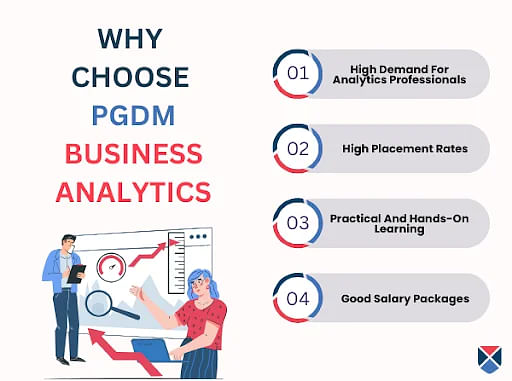
Pursuing a PGDM in Business Analytics positions you at the forefront of a booming industry, offering ample growth prospects, and lucrative salaries. Listed below are some valuable insights to consider when opting for a PGDM Business Analytics course
Admission to the PGDM Business Analytics course is based on merit or entrance exams depending on the institution. Listed below is a step-by-step outline of the admission procedure for the PGDM in Business Analytics program at leading colleges:
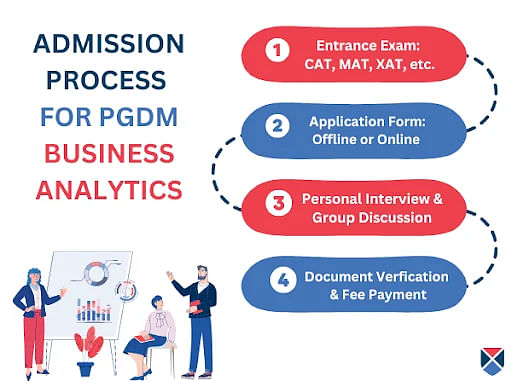
Entrance exams serve as a prevalent method of evaluation for colleges, aiding in the selection of students. Among the prominent entrance exams for PGDM in Business Analytics are CAT, CMAT, SNAP, and NMAT. The entrance exams encompass English, Logical Reasoning, Analytical Thinking, and subject-specific questions following an objective and MCQ-based format. Variations in syllabus, examination methodology, and question patterns are contingent on the university or conducting body.
Listed in the table below are some of the common entrance exams for PGDM in Business Analytics:
Entrance Exam | Registration Date | Registration Details | Accepting Colleges |
CAT | Aug 2 – Sep 13, 2023 | XIME, ISBM, ISBR, N.L. Dalmia IMS, GIBS | |
MAT | Aug 17 – Sep 14, 2023 | XIME, ISBM, N.L. Dalmia IMS, GIBS | |
CMAT | February 2024 | XIME, ISBM, N.L. Dalmia IMS, GIBS | |
NMAT | Aug 1 – Oct 10, 2023 | XIME, ISBM |
Renowned institutes across India offer PGDM in Business Analytics, focusing on a comprehensive curriculum encompassing management principles, data analytics, statistics, machine learning, and data visualization. The fee structure for the program may vary based on factors like location, faculty expertise, and additional facilities.
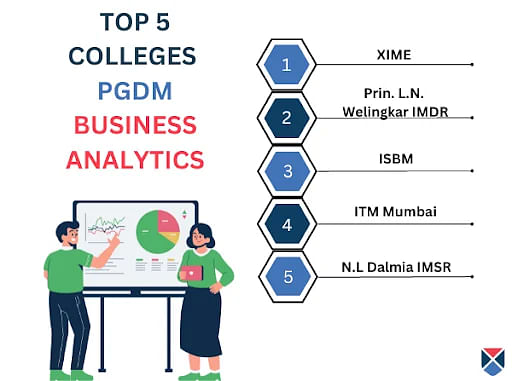
Listed in the table below are some of the best universities offering PGDM in Business Analytics, along with their indicative fee structure.
| Sl No. | College Name | Average Fee |
| 1 | XIME | INR 6 LPA |
| 2 | Prin. L.N. Welingkar IMDR | INR 7 LPA |
| 3 | ISBM | INR 5.5 LPA |
| 4 | ITM, Mumbai | INR 5.2 LPA |
| 5 | N.L Dalmia, IMSR | INR 7.3 LPA |
| 6 | Lal Bahadur Shastri Institute of Management | INR 7.7 LPA |
| 7 | ISBR | INR 5 LPA |
| 8 | St. Teresa’s College Autonomous, Ernakulam | INR 68,687 PA |
| 9 | GIBS | INR 4 LPA |
Note: These figures are approximate values and subject to change at the institution’s discretion
Due to the rising demand for PGDM programs, different ways for students to enroll have emerged substantially, based on their background, goals, and qualifications. Below are the different types of PGDM in Business Analytics courses along with their details:
Type | Eligibility for PGDM in Business Analytics Courses | PGDM Duration |
PGDM in Business Analytics Full Time | Candidate should have completed a bachelor’s degree with a minimum of 50% marks | 2 Years |
Distance PGDM in Business Analytics | Candidate should have completed a bachelor’s degree with a minimum of 45-50% marks | 1-2 Years |
Students who want to study remotely can pursue distance mode for PGDM in Business Analytics. Students will be supplemented with E-Learning materials, case studies, online projects, and assignments, helping them with in-depth learning of core areas of business analytics. Some key information regarding Distance PGDM in Business Analytics is given below:
The PGDM Business Analytics program presents a comprehensive syllabus meticulously designed to equip students with a profound understanding of the dynamic world of data analytics. Spanning four semesters, this curriculum bridges the gap between foundational knowledge and specialised expertise.
The table below contains an overview of the topics covered in PGDM Business Analytics syllabus:
Subjects | Topics Covered |
Financial Analytics | Financial Risk Models, Analytical Models in Finance, Pricing & Revenue Analytics, Time Series Forecasting. |
Analytics Fundamentals | Programming for Analytics, DBMS and Data Warehousing, Multivariate Data Analysis. |
Predictive Modeling | Predictive Modeling using SAS, Big Data Analytics, Data Mining for Business Analytics, Time Series Econometrics |
Applied Analytics | Applied Business Intelligence, Financial Analytics, Risk Modeling |
Consumer Insights | Consumer Analytics, Pricing & Revenue Analytics, Web & Social Media Analytics |
Strategic Decision Making | Project Management Analytics for HR, Models in Marketing, Supply Chain Analytics |
Market and Industry Focus | Analytics for Marketing, Analytics for Retail Industry, Operations Research Models, Analytics for Investment Banking |
PGDM Business Analytics Offers a specialized curriculum tailored to the intricacies of data analytics, emphasizing hands-on skills and practical applications whereas MBA in Business Analytics Combines business administration fundamentals with specialized training in data analytics, catering to individuals seeking a broader managerial skill set. The following table represents the major differences between the two courses.
Parameters | PGDM Business Analytics | MBA Business Analytics |
Full Form | Post Graduate Diploma in Business Analytics | Master of Business Administration in Business Analytics |
Duration | 2 Years | 2 Years |
Eligibility | 50% in graduation for general category and 45% for reserved categories | 50% in graduation for general category and 45% for reserved categories |
Average Fee | INR 1 – 15 LPA | INR 5 – 15 LPA |
Job Role | Data Analyst, Business Analyst, Data Scientist, Business Intelligence Analyst, Analytics Consultant, Market Research Analyst | Analytics Manager, Data Analytics Manager, Business Analytics Strategist, Project Manager (Analytics), Analytics Solutions Architect. |
Average Salary | INR 3 – 12 LPA | INR 3 – 20 LPA |
Graduates of a PGDM in Business Analytics can pursue a variety of advanced educational and career paths. These post-PGDM options allow for further specialisation and career advancement. These alternatives cater to a wide range of goals, including advanced research, industry-specific specialisation, and honing leadership and managerial skills in the field of data analytics. Here are a few notable courses and opportunities:
Having completed a specialised PGDM in Business Analytics, professionals attain a blend of management insights and advanced analytical skills. Detailed in the table below is a breakdown of salaries for PGDM Business Analytics job roles, including average starting salaries for freshers and average salary of those with 5 years of experience.
Jobs | Description | Average Salary for Freshers | Average Salary After 5 Years |
Data Analyst | Analyses data to discover insights that drive business decisions. | INR 3 LPA | INR 7 LPA |
Data Scientist | Develops advanced models to predict outcomes and extract insights from complex data. | INR 3 LPA | INR 9 LPA |
Analytics Manager | Oversees a team of analysts, ensuring data-driven strategies are implemented effectively. | INR 4 LPA | INR 12 LPA |
Market Research Analyst | Studies consumer behavior and market trends to inform marketing strategies. | INR 3 LPA | INR 7 LPA |
Risk Analyst | Assesses potential risks and opportunities by analysing data to support informed decision-making. | INR 3 LPA | INR 7 LPA |
With a PGDM in Business Analytics, graduates possess a strong foundation in management concepts alongside a specialised analytical skill set. This unique blend prepares them for a range of impactful careers where data-driven insights fuel strategic decisions. Below is a selection of promising career paths, underlining the program’s ability to bridge the gap between management principles and modern data science
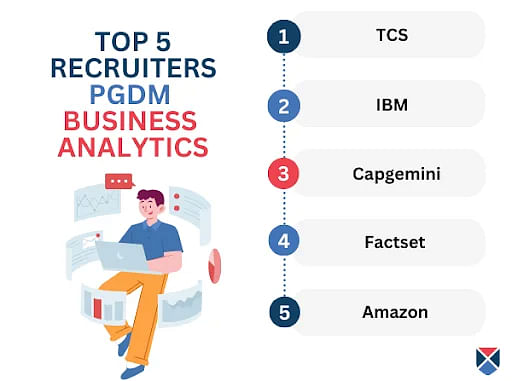
PGDM Business Analytics graduates are highly sought after by a wide range of industries. Top-tier companies across various sectors actively recruit individuals who possess expertise in Business Analytics. Listed below are some top recruiters along with their average salary
Jobs | Top Recruiters | Average Salary |
Data Analyst | TCS, Cognizant, Accenture, Wipro, Infosys | INR 7 LPA |
Data Scientist | IBM, Capgemini, Tech Mahindra | INR 9 LPA |
Data Analytics Manager | Publicis Sapient, EXL, Capgemini, S&P Global | INR 12 LPA |
Market Research Analyst | Factset, ArcGate, Markets And Markets | INR 6 LPA |
Risk Analyst | Amazon, Ernst & Young, Wipro, Accenture | INR 6 LPA |
To thrive in their professional roles, graduates of the PGDM in Business Analytics program need a blend of intricate technical skills and soft abilities. These proficiencies often extend beyond classroom teachings, necessitating hands-on practice and real-world exposure.
Listed below are some key skills required for excelling in this field:
The syllabus for PGDM in Business Analytics has been meticulously structured to provide knowledge as to the need for data analytics, its usage in businesses, and relevant tools for data analysis. The PGDM in Business Analytics syllabus showcases the various research methods and tools used to produce numbers for projections, future trends, contingency planning, resource allocations, etc. within a business.
Here are the semester-wise syllabus details for PGDM in Business Analytics:
The first-year PGDM in Business Analytics syllabus focuses on core fundamental aspects of the need for and components of Business Analytics like quantitative techniques, reporting tools, and analysis methods. The PGDM in Business Analytics syllabus for 1st year contains the following subjects:
Semester I | Semester II |
Organizational Behaviour | Financial Markets & Instruments |
Accounting for Management | Quantitative Techniques II |
Management Principles | Contemporary Business Environment |
Quantitative Techniques I | Blockchain Fundamentals |
Financial Analysis & Reporting | Human Resource Management |
Business Economics | Communication Skills & Business Correspondence |
Intro to Management Systems | Financial & Risk Analysis |
IoT (Internet of Things) | Cloud Computing Fundamentals (Elective I) |
High-Frequency Finance and News Analytics (Elective II) |
PGDM in Business Analytics Practical Subjects for 1st Year
The focus for PGDM in Business Analytics subjects in the 2nd year is primarily on specific models, techniques, and AI tools used for Data Business Analytics. The PGDM in Business Analytics syllabus for the second year is listed below:
Semester III | Semester IV |
Software Project Management | Business of Artificial Intelligence |
Advanced Programming in R | Supply Chain Analytics |
Intro to Big Data | Strategic Management |
Data Mining | Artificial Intelligence in Business |
SAS Modeling | Research Project |
Advanced Cyber Security(Elective I) | – |
Advanced Machine Learning (Elective II) | – |
PGDM in Business Analytics Practical Subjects for 2nd Year
PGDM in Business Analytics subjects provide analytical tools and research methodologies for students in different sectors and fields. PGDM in Business Analytics Syllabus has core subjects as well as elective subjects such as Quantitative Data, Data Mining, Organisational Behaviour, Intro to IT Systems, Business Statistics, Intro to Big Data, Strategic Management, Supply Chain Analytics, Advances Programming in R, etc.
Showcased below are the various elective and core subjects taught to students as a part of PGDM in Business Analytics course:
The following subjects build the key foundation for why PGDM in Business Analytics is needed. Listed below are some foundational aspects of business analytics and data research methodologies: