- info@wingeducations.com
- +91 (705) 495-5296
- Mon - Sat : 10.00-18.00
The M.Com course is a two-year postgraduate degree programme that deals with a detailed study of subjects, including accounting, commerce, economics and the advancement of finance-related matters. The course goal is to train individuals for effective management in finance and commerce. The graduates can find work as Mutual Fund Brokers, Finance Bookkeepers, Budget Analysts, or Business Consultants.
Table of Contents
| Degree | Masters |
| Full Form | Master of Commerce |
| Duration | 2 Years |
| Age | The minimum age limit is 20-21 years. |
| Minimum Percentage | A minimum of 50% in bachelor’s degree from a recognized institution. |
| Average Fees | ₹5K – 2 LPA |
| Similar Options of Study | M.Phil (Commerce), MBA, CA |
| Average Salary | INR 4 – 10 LPA |
| Employment Roles | Accountant, Finance Manager, Cost Accountant, Accounting Manager, etc. |
| Top Recruiters | EY (Ernst & Young), Genpact, Accenture, WNS Global Services, HDFC Bank Pvt Ltd, etc. |
MCom full form stands for Master of Commerce. It is a postgraduate Master’s degree program focusing on Commerce, Accounting, Management, and Economics-related subjects. The MCom course duration is 2 years.
MCom admission 2024 requires candidates to have 50% or above in the bachelor’s degree of Commerce from any recognized university. The student must pass the entrance exam such as CUET, BHU PET, etc., with the required cut-off marks. The MCom syllabus covers topics like Economic Analysis, International Business, Corporate Tax Planning, etc.
The MCom degree provides good employment opportunities for students looking for exposure in the field of commerce with various job roles such as Business Analyst, Stock Broker, Finance Bookkeeper, Finance Consultant, etc. The average salary of MCom graduates is in the range of INR 4-10 LPA.
MCom program helps students to study subjects related to commerce such as accounting for managerial decisions, computer applications in business, and so on. It is ideal that the candidates check out the worthiness of the M.Com course. The following pointers can help students to understand the M.Com benefits.
Read More: M.Com Job Opportunities and Scope
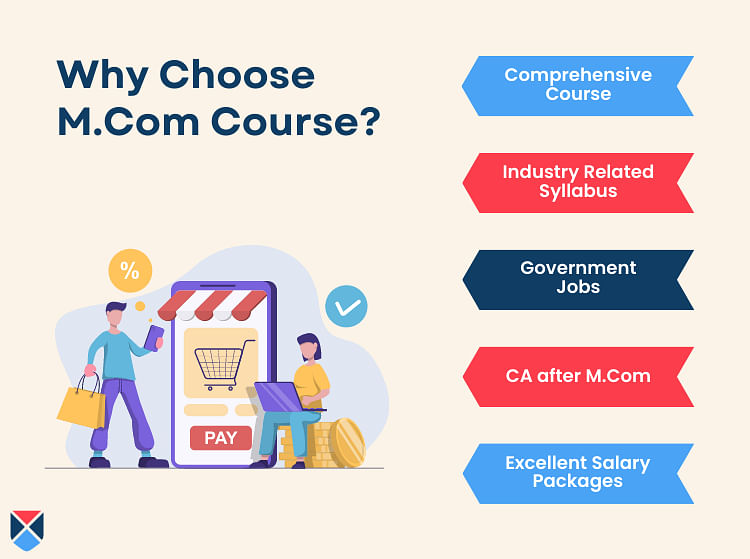
Below mentioned are points regarding who should pursue an MCom course:
The MCom qualification in India differs according to the university. For admission, the aspirants are required to meet the eligibility criteria. The basic eligibility criteria for the course are listed below:
For M.Com registration, the candidates must meet the eligibility criteria set by the universities which may vary when applying for the course. Mentioned below are the general guidelines for admission to the course:
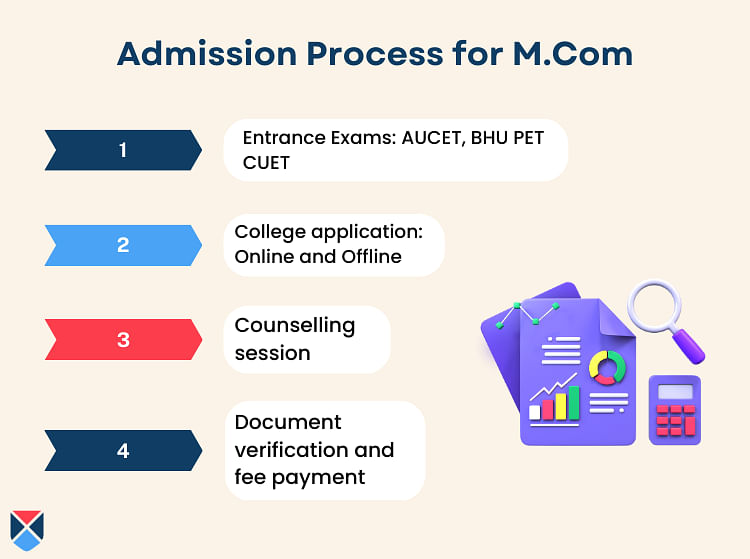
There are various entrance exams conducted at national, state, and institute levels for MCom course. Here is a list of some of the popular entrance exams along with the application form details:
M.Com Entrance Exam | Registration Details |
| PU CET | Application Form |
JMI EE | Application Form |
Application Form | |
| BHU PET | Application Form |
Application Form | |
Application Form |
The MCom fees in India range between INR 5,000-2 LPA on average. The course fees can differ for different colleges and universities around the country based on the infrastructure and faculty they provide.
Below is the list of some of the top colleges and information regarding fee structure:
SI.NO | Name of College | Tuition Fees | MCom Admission Fees | Miscellaneous Fees |
1. | INR 20,000 | INR 2,000 | INR 8,000 | |
2. | INR 12,000 | INR 1,500 | INR 5,000 | |
3. | INR 15,000 | INR 2,000 | INR 8,000 | |
4. | INR 50,000 | INR 5,000 | INR 20,000 |
The course has full-time, part-time, and distance learning options available to students. The following MCom course details are provided below:
Type | Basic Eligibility | MCom Duration |
MCom Full Time | Should have completed bachelor’s degree with a minimum of 50% + Entrance Exams | 2 Years |
MCom Part-Time | Should have completed bachelor’s degree with a minimum of 50% | 2 Years |
Distance MCom | Should have completed bachelor’s degree with a minimum of 50% | 2-5 Years |
MCom distance education is one of the most lucrative courses that are available to aspirants who are unable to pursue the degree in regular mode. Given below are some of the popular pointers regarding the distance M Com course:
Integrated MCom can be pursued by students after 10+2 (high school degree) completion. The integrated M.Com course duration is five years. The course can be pursued in a combination of BCom+MCom from colleges like Gauhati University, Guru Nanak Dev University, etc.
Given below are some of the popular pointers regarding the M.Com course from IGNOU:
Given below are some of the popular pointers regarding the MCom course details from Annamalai University:
Given below are some of the popular pointers regarding the M.Com course from LPU Distance Education:
Some of the top MCom distance education universities/colleges are:
Name | Average Fees |
INR 11,000 PA | |
INR 16,000 PA | |
INR 12,000 PA | |
INR 10,000 PA | |
INR 44,000 PA | |
INR 5,000 PA | |
INR 7,000 PA | |
INR 13,500 PA |
Students can pursue MCom specialization based on their interests and previous academic stream. The course list of different specializations has been given below.
MCom’s scope in India is vast as the demand for graduates who wish to pursue a career in finance, accounting, or business has increased. The MCom courses are offered by various prominent colleges in India and the candidate can get admission based on merit or entrance exam scores.
The average MCom fees in government colleges range between INR 5,000-50,000 PA. The top government colleges in India offering an M Com course are shown in the table below:
Sl.No | College Name | Average Fees |
1 | Delhi University | INR 8,000 PA |
2 | Mumbai University | INR 6,025 PA |
3 | Kalinga University | INR 25,000 PA |
4 | University of Mysore | INR 9,680 PA |
5 | Sydenham College of Commerce and Economics | INR 6,265 PA |
There are various private colleges for MCom degree in India providing good learning exposure in terms of research projects, internships, site visits, etc. Below is a list of private MCom colleges in India:
Sl.No | College Name | Average Fees |
1 | Parul University | INR 40,000 PA |
2 | Arunachal University of Studies | INR 35,000 PA |
3 | Sister Nivedita University | INR 1.53 LPA |
4 | St Josephs College | INR 39,250 PA |
5 | Jain University | INR 62,500 PA |
Top Master of Commerce Colleges by City
MCom Colleges in Mumbai | MCom Colleges in Ahmedabad |
MCom Colleges in Pune | MCom Colleges in Chennai |
MCom Colleges in Indore | MCom Colleges in Surat |
MCom Colleges in Jaipur | MCom Colleges in Bangalore |
MCom Colleges in Kolkata | MCom Colleges in Lucknow |
MCom Colleges in Coimbatore | MCom Colleges in Kottayam |
Top MCom Colleges by State
MCom Colleges in Hyderabad | MCom Colleges in Gujarat |
MCom Colleges in Delhi | MCom Colleges in Kerala |
MCom Colleges in Karnataka | MCom Colleges in Tamil Nadu |
MCom Colleges in Rajasthan | MCom Colleges in Uttar Pradesh |
MCom Colleges in Chandigarh | MCom Colleges in Punjab |
MCom Colleges in Maharashtra | MCom Colleges in Bihar |
Listed below are the top colleges with the highest MCom placements.
| Names | Top Recruiters | Placement Package |
| SRCC, New Delhi | Wipro, Samsung, KPMG, EY, etc | INR 15 LPA |
| Christ University, Bangalore | Deloitte, EY, KPMG, TCS, etc | INR 13 LPA |
| Hansraj College, New Delhi | Capgemini, P&G, OYO, KPMG etc | INR 31 LPA |
| NMIMS, Mumbai | Reliance, Citi Bank, Infosys, Deloitte, etc | INR 8 LPA |
| Loyola College, Chennai | IBM, Dell, TATA Motors, Flipkart etc | INR 5.5 LPA |
Listed below are some of the most common pointers for the MCom Mumbai University:
| M Com Eligibility | 50% in Bachelor’s Degree with Commerce |
| MCom Course Duration | 2 years |
| M Com specialization | E-Commerce, Advanced Accounting & Auditing, Financial Markets, Agribusiness Management, Accountancy, E-Commerce, Business Management, Banking, and Finance |
| Average MCom Fees | INR 10,000 – INR 1 lakh |
Some of the most common pointers for the Calcutta University MCom are listed below: Calcutta University also provides full-time and part-time MCom courses.
| M Com Eligibility | 50% in Bachelor’s Degree with Commerce |
| MCom Course Duration | 2 years |
| Average M Com Fees | INR 2,400 |
The table below shows a significant comparison of some of the best colleges considered for the M.Com course:
| Parameters | Hindu College, New Delhi | Presidency College, Chennai | Loyola College, Chennai |
| NIRF- Ranking | 2 | 3 | 6 |
| Average Fee | INR 44,000 | INR 1,700 PA | INR 20,000 PA |
| Average Placement Package | INR 5 LPA | INR 3.5 LPA | INR 5 LPA |
| ROI Rank | 3 | 1 | 2 |
| Top companies participate in placement drives | KPMG, DE Shaw, Maruti, Jaypee, Deloitte, and Google. | HDFC Bank, TATA AIG, Federal Bank. Mind tree, reliance, etc. | E&Y, Zoho Corps, well Fargo, Wipro, TCS, IBM, Amazon, and others. |
Master of Commerce course in India aims at making students familiar with commerce, accounting, finance, and banking. Below mentioned is the M.Com subjects list:
Read More: M.Com Syllabus and Subjects
The MCom course offers diverse career options to students in terms of employment roles and higher education options. There are also other courses that offer the same career prospects to students such as:
M.Com (Master of Commerce) and MBA (Master of Business Administration) are two separate courses that have their own benefits. It depends on your qualification background and area of interest to select one of these courses.
Some of the key differences between these courses are mentioned below:
| Parameters | MCom | MBA |
| Full-Form | Master of Commerce | Master of Business Administration |
| Course Duration | 2 Years | 2 Years |
| Eligibility | 50% in Bachelor’s Degree with Commerce | 50% in Bachelor’s Degree |
| Average Fees | INR 5,000-2 LPA | INR 3-15 LPA |
| Entrance Exam | BHU PET, PU CET, AU CET | CAT, MAT, XAT |
| Top Colleges | SRCC, Hindu College, Loyola College | IIMs, XMRI, FMS |
Read More: MBA
Some of the key differences between M.Com and LLB are mentioned below:
| Parameters | MCom | LLB |
| Full-Form | Master of Commerce | Bachelor of Laws |
| Course Duration | 2 Years | 2 Years |
| Eligibility | 50% in Bachelor’s Degree with Commerce | 45% in Bachelors Degree |
| Average Fees | INR 5,000-2 LPA | INR 10,000 – 3.5 LPA |
| Entrance Exam | BHU PET, PU CET, AU CET | CLAT, LSAT, CUET |
| Top Colleges | SRCC, Hindu College, Loyola College | NLSIU, NLU, Nalsar University of Law |
Read More: LLB
The key differences between M.Com and MA Economics are mentioned below:
| Parameters | M.Com | MA Economics |
| Full-Form | Master of Commerce | Master of Arts in Economics |
| Course Duration | 2 Years | 2 Years |
| Eligibility | 50% in Bachelor’s Degree with Commerce | 50% in Bachelor’s Degree |
| Average Fees | INR 5,000-2 LPA | INR 50,000 – 2 LPA |
| Entrance Exam | BHU PET, PU CET, AU CET | BHU PET, JNUEE, CUEE, AUCET |
| Top Colleges | SRCC, Hindu College, Loyola College | JNU, SXC, Presidency College Kolkata |
Read More: MA Economics
Some of the key differences between M.Com and CA are mentioned below:
| Parameters | M.Com | CA |
| Full-Form | Master of Commerce | Chartered Accountancy |
| Course Duration | 2 Years | 5 Years |
| Eligibility | 50% in Bachelor’s Degree with Commerce | 55% aggregate in 10+2 examination |
| Average Fees | INR 5,000-2 LPA | INR 2-2.5 Laks. |
| Entrance Exam | BHU PET, PU CET, AU CET | CA Foundation, CA Intermediate, CA Final Exam |
| Top Colleges | SRCC, Hindu College, Loyola College | ICAI, Academy of Commerce, CHAMPS |
Read More: CA
After graduating from the course, the aspirant can choose to pursue higher courses in Commerce. The aim of the program is to develop scholars into researchers who can make substantial contributions to the field of commerce and finance. Here is the list of Higher Education after post-graduation:
There are a plethora of career options for an M.Com graduate. India has multi-national companies which hire M.Com graduates for various positions. Here is the list of some of the top recruits:
The average M.Com salary in India is in the range of INR 4-10 LPA for freshers. The salaries and annual earnings depend on the specific kind of practice and performance, expertise, and other related aspects.
Read More: M.Com Salary
The Indian government offers several scholarships to economically disadvantaged, minority, and physically challenged students who wish to pursue a Master of commerce degree. There are many private and public scholarships available to qualified applicants for an M Com degree.
The several MCom Scholarships are listed below:
An aspirant wishing to pursue M.Com must have the necessary skills to develop in the course. The course is a theory-based course where knowledge skills are required. Here is a list of a few skills an applicant should have:
The MCom syllabus is divided into four semesters over the course duration of two years. M.Com subjects mainly include contemporary theories such as modern portfolio theory, resource-based view theory, game theory, etc., associated with the commerce field. The core MCom subjects consist of Organisation Theory and Behaviour, Economic Analysis, Strategic Management, Accounting Theory, International Business, etc. Students can also choose elective subjects like International Finance, Banking and Finance, Financial Markets, etc.
Aspirants studying for the M.Com course will learn about a variety of tools/software including risk management software, GST filing tools, accounting software like Tally ERP, financial analysis software, etc. M.Com syllabus provides students with in-depth knowledge needed in the business world. The graduates are qualified to hold positions as Bank Managers, Business Analysts, Investment Bankers, Tax Analysts, etc.
Table of Contents
M.Com subjects are emphasized giving students technical expertise on the main topics of financial and business fundamentals. MCom subjects 1st year include topics such as Organisation Theory and Behaviour, Statistical Analysis, Economic Analysis, etc whereas MCom 2nd year subjects include topics such as Strategic Management, Accounting Theory, International Business, etc.
Below is the list of MCom subjects:
Given below is the core MCom subjects list along with topics covered in each subject:
| Core Subjects | Topics Covered |
| Managerial Economics | Nature and Scope of Managerial Economics, Economics and Managerial Theory, Theory of Consumer Choice, Production Theory, and Demand Analysis. |
| Organizational Behaviour and Human Resource Management | The Concepts of Organization, Groups in Organization, Preparation and Selection, Development and Evaluation, Compensation and Protection. |
| Accounting Theory | The Nature of Accounting Theory, Capital, Value and Profit, Accounting Information and the Capital Market, Globalisation of Accounting Standards. |
| Financial Management and Business Valuation | Functions of Financial Management, System and Role of Finance Manager, Sources of Capital and Cost of Capital, Analysis of Leverages. |
| Corporate Laws | Doctrine of Indoor Management, Liability of Misstatement – Mergers and Acquisitions, Intellectual Property Rights, Patents Act. |
| Quantitative Techniques for Business Decision | Linear Programming and Network Analysis, PERT and CPM, Formulation and Solution of Transportation Models, Simplex and Hungarian Method. |
| Advanced Accounting | Accounting for Issues, Accounting Issues relative to Amalgamation, Accounting for Holding and Subsidiary Companies, and Accounts relating to the Liquidation of Companies. |
| Tax Planning and Management | Return of Income, Expert and Emergency Assessment, Concept of Tax Planning, Tax Avoidance and Tax Evasions, and Tax Planning with reference to location. |
The optional MCom subjects are given below along with the topics covered in each subject:
| Elective Subjects | Topics Covered |
| Financial Markets | Stock Markets, Bond Markets, Derivatives, Forex Markets, Capital Market Efficiency, Asset Pricing, Financial Instruments, Regulatory Framework, Risk Management, Investment Banking, Financial Modeling, Global Financial Markets, etc. |
| Banking and Finance | Banking Operations, Retail Banking, Corporate Banking, Monetary Policy, Financial Regulation, Credit Risk Management, Basel Norms, Treasury Management, Mergers and Acquisitions in Banking, Asset-Liability Management (ALM), etc. |
| International Finance | Foreign Exchange Markets, Exchange Rate Mechanisms, International Trade Finance, Trade Policies, Global Investments, Cross-Border Mergers and Acquisitions, International Financial Institutions, Balance of Payments, etc. |
| Entrepreneurial Management | Product Development, Funding Strategies, Venture Capital, Business Models, Lean Startup Methodology, Entrepreneurial Finance, Crowdfunding, etc. |
| Information Systems and Technology in Business | Digital Business, Data Management, Information Security, Cybersecurity, IT Governance, Risk Management in IT, Cloud Computing, Mobile Technologies, Emerging Technologies, etc. |
| Environmental Economics | Cost-Benefit Analysis, Sustainable Development, Environmental Policy and Regulation, Environmental Impact Assessment,, Market-Based Instruments, Carbon Trading, Biodiversity Conservation, etc. |
| Strategic Cost Management | Value Chain Analysis, Process Costing, Cost-Volume-Profit (CVP) Analysis, Cost Estimation Techniques, Costing for Decision Making, Budgeting, Cost Allocation Methods, Performance Measurement and Evaluation, etc. |
The M.Com syllabus and subjects mainly include thesis-based components and some research-based elements. The course deals with Accounting, Financial Banking Services, the Functioning of the Economy, Management and subjects related to Economics. The final year subjects include compulsory internships, project submission and placement drives.
The following is a detailed M.Com general subjects list according to the semester. However, the subjects vary from university to university.
MCom 1st sem subjects include Managerial Economics, Income Tax Law and Accounts, Management Process, etc. MCom 2nd semester syllabus covers subjects such as Business Environment, Quantitative Techniques for Business Decisions, etc. Given below are the semester-wise M.Com subjects 1st year:
Semester I | Semester II |
| Organizational Behavior and Management Process | Corporate Laws |
| Managerial Economics | Financial Management |
| Computer Applications in Commerce | Indian Financial System |
| Income Tax Law and Accounts | Management of Nonprofit Organizations |
| Business Environment | Tax Planning and Management |
| Marketing Management | Monetary Systems |
M.Com 3rd sem subjects include topics such as Diversity at Work, Compensation Management, Human Resource information system, Financial Instruments, etc. MCom 4th sem subjects are Quantitative Techniques, International Business, Sales Management, etc. Given below are the semester-wise M.Com 2nd year subjects:
Semester III | Semester IV |
| General Service Tax (GST) | Quantitiative Techniques |
| Management of Financial Services | International Business |
| Auditing and Assurance Service | Advertising & Sales Management |
| International Trade – Theory & Practice | Research and Internships |
Also, Check: Scope of M.Com in India
The M.Com degree provides candidates with a variety of specialization options in both core and elective subjects. Each specialty focuses on a distinct area of M.Com subjects while giving each person a different set of skills. The list of top M.Com specializations along with subjects and topics covered in a table given below:
| MCom Specializations | Subjects |
| MCom in Finance |
|
| M.Com Computer Application & IT |
|
| MCom in Business Management |
|
| M.Com Marketing |
|
| M.Com Human Resource Management |
|
Also, Check the Scope of M.Com in India
MCom syllabus varies from one college to another but the structure and the concepts remain the same focusing on equipping the students with relevant skills and knowledge related to statistics, finance, business management, etc. Here is the college-wise MCom syllabus from top colleges in India:
DU M.Com syllabus focuses on imparting knowledge related to Statistical Decision Theory, Hypothesis Testing, Regression Analysis, Cost function, etc. Listed below is the Delhi University M.Com syllabus:
| DU MCom 1st Semester Subjects | DU MCom 2nd Semester Subjects |
| Organisation Theory and Behaviour | Managerial Accounting |
| Statistical Analysis | Quantitative Techniques for Business Decisions |
| Economical Analysis | Business Environment |
| Financial Management and Policy | Marketing Management |
| DU MCom 3rd Semester Subjects | DU MCom 4th Semester Subjects |
| Strategic Management | International Business |
| Accounting Theory and Practice | Human Resource Management |
| Elective I | Elective I |
| Elective II | Elective II |
Osmania University MCom syllabus focuses on equipping students with knowledge related to Finance, Accounting, Taxation, Resource Management, etc. Listed below is the semester-wise Osmania University MCom syllabus:
| MCom 1st Sem Subjects | MCom 2nd Sem Subjects |
| Managerial Economics | International Business and Business Environment |
| Principles of Marketing | Marketing Management |
| OT & OB | Human Resource Management |
| Elective-I | Elective-IV |
| Elective-II | Elective-V |
| MCom 3rd Sem Subjects | MCom 4th Sem Subjects |
| Research Methodology & Statistical Analysis | Quantitative Techniques for Business Decisions |
| E-Commerce | Business and Corporate Taxation |
| Cost Accounting and Control | Strategic Management |
| Elective-IV | Elective-VI |
| Elective-V | Elective-VII |
Also, Check: IGNOU M.Com Syllabus: Download PDF
The core MCom subjects vary depending on the specialisation chosen by the candidate and also the university offering the course. Some of the specialisation courses are taught during the first year of the M.Com syllabus. There are seminars, placement drives and business events hosted by colleges as part of their course structure. In short, the course structure for the M.Com subject is as follows:
M.Com trains students in hands-on experience and solves real-world projects. The students are taught about commerce and banking. Finance, Business Laws and Theories are given special attention. Many real-world projects and action-based teaching methods with traditional teaching methods are a part of the course. In a nutshell, the teaching structure includes:
The M.Com projects motivate students to solve real-life scenarios using suitable techniques. The topics are selected based on the workshops conducted by the universities in collaboration with businesses. Given below are some of the projects.
Some of the M.Com projects are listed below:
MCom books help students with in-depth concepts related to business innovation, startup management, financial reporting, auditing standards, risk management, working capital management, etc. Students can download the MCom syllabus PDF from their respective university websites for a better understanding of the curriculum. Listed below are some M.Com books for reference:
Name of Book | Topics Covered | Author |
| Organizational Behaviour | Employee Motivation, Team Dynamics, Leadership Styles, etc. | S.P Robbins |
| Business Taxation | Tax Planning, Corporate Taxation, GST Compliance, etc. | Radhakrishnan P |
| Cost Accounting | Cost Concepts, Cost-Volume-Profit Analysis, Budgeting, etc. | M.P Gupta |
| Financial Management | Capital Budgeting, Risk Analysis, Working Capital Management, etc. | I.M Pandey |
| Principles of Accounting | Financial Statements, Accounting Principles, GAAP rules, etc. | Dixon Cooper, Mitchell Franklin and Patty Graybeal |