- info@wingeducations.com
- +91 (705) 495-5296
- Mon - Sat : 10.00-18.00
MCA or Master of Computer Applications is a 3-year professional postgraduate degree in computer science that studies various traditional and modern aspects of Software Engineering, Data Structures and Algorithms, Computer Graphics, and Artificial Intelligence. The core MCA subjects include Fundamentals of Computer, Computer Design and Architecture, Data & File Structures, Discrete Mathematics and Combinatorics, Artificial Intelligence and Expert Theory, etc.
To be eligible for MCA Admissions, candidates must have a bachelor’s degree in computer science or computer application with a 50% aggregate mark or an equal CGPA from a recognized university. Candidates are also required to qualify for entrance exams, such as UPSEE, OJEE, TANCET, etc. The average MCA fees ranges from INR 30,000 – 2 Lakhs Per Annum.
An MCA course is a great option for anyone who is interested in pursuing a career in computer science. After completion of the MCA degree, candidates can find job opportunities in IT, software companies, international conglomerates, and MNCs. The average salary of MCA graduate ranges between INR 3 – 10 LPA.
Table of Contents
| Degree | Masters |
| Full Form | Master of Computer Application |
| Duration | 3 Years |
| Age | No Age Limit |
| Minimum Percentage | 50% in UG |
| Average Fees | ₹30K – 2 LPA |
| Similar Options of Study | MCM, M.Sc Computer Science, B.Tech Computer Science and Engineering, MCS |
| Average Salary | INR 3-10 LPA |
| Employment Roles | Senior Software Engineer, Software Developer, Team Leader (IT), Project Manager (IT) |
| Top Recruiters | HCL Technologies Ltd., TCS, Accenture, Cognizant, Capgemini, Tech Mahindra Ltd |
MCA full form stands for Master of Computer Applications, a skill-oriented program structured with an insightful and comprehensive understanding of computer applications, software programming, operating systems, and web technology.
The MCA course duration is three years and introduces students to the advanced concepts of computer applications through a theoretical and practical understanding of modern computer technologies, software & app development, UX design, and programming languages.
For admission, candidates are required to meet the minimum MCA eligibility which can differ based on several factors, such as course availability, performance in the entrance exam, and a candidate’s merit. MCA course eligibility criteria require:
Also, Check: MCA After BSc
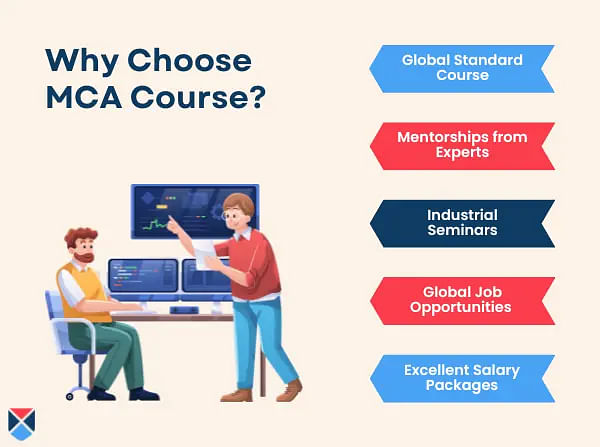
MCA course delves deep into the field of computer science and applications. Below are the detailed viewpoints regarding why one should choose the MCA course:
Read More: Top 10 Benefits of Pursuing MCA Course
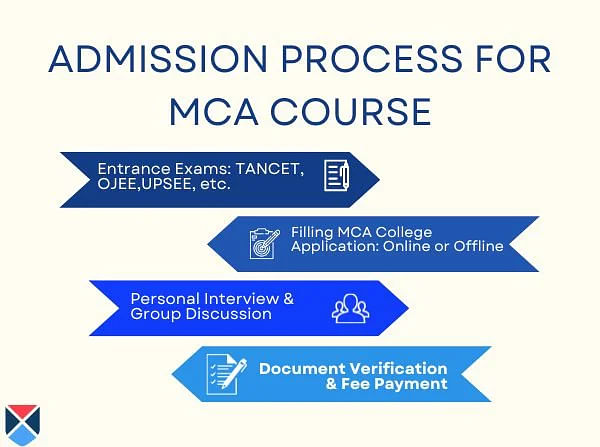
The admission procedure for the MCA degree is done on a merit or entrance basis. Listed below are some of the admission process details for the MCA course in general:
Also, Check: MCA Lateral Entry
The MCA course admission process is based on entrance exam such as ATMA, PUCET, LPUNEST, SUAT, SAAT, etc in a few colleges. Listed below are some of the popular college-based MCA entrance exams conducted in India:
| MCA Entrance Exams | Registration Details | Accepting Colleges |
| ATMA | Nov 29, 2023- Feb 11, 2024 | Institute of Business Management (PG), GLA University, IILM University, Christ University |
| PUCET | February 2024 (Tentative) | Aligarh Muslim University, Assam University, Banaras Hindu University |
| BIT MCA | March 2024 (Tentative) | NIT Trichy, NIT Durgapur, University of Durgapur |
| VITMEE | March-April 2024 (Tentative) | VIT Bhopal University, VIT Chennai, VIT AP University |
| NIMCET | March 2024 (Tentative) | MNNIT Allahabad, NIT Kurukshetra, NIT Warangal |
| GVSAT | March-April 2024 (Tentative) | S P Jain Institute of Management & Research, BITS Pilani, Great Lakes Institute of Management |
| SUAT | January 2024 (Tentative) | Sharda University |
| LPUNEST | Oct 16, 2023 -Jan 15, 2024 | Lovely Professional University |
| JUET | February 2024 (Tentative) | Babasaheb Bhimrao Ambedkar University, Central University of Andhra Pradesh, Banaras Hindu University |
| KIITEE | Nov 10, 2023 – Mar 10, 2024 | KIIT Bhubaneswar, KSOL Bhubaneswar, KIIT School of Computer Application |
Read More: MCA Entrance Exams
MCA course fees range between INR 30,000 PA – 2 LPA. Various factors come into play when deciding upon the MCA fees charged by the colleges. The MCA fee structure in Indian colleges is reasonable compared to other computer science degrees.
Listed below is the MCA fee structure for top colleges in India:
| Name of the Institute | Total Fee Structure | Admission Fees | Miscellaneous Fees |
| Chandigarh University | INR 1.4 LPA | – | INR 21,500 PA |
| Jain University | INR 2 LPA | INR 1,000 | INR 32,000 PA |
| Christ University | INR 1.8 LPA | INR 5,000 | INR 43,394 PA |
| Amity University | INR 50,000 PA | INR 20,000 | – |
| SRM Institute of Science and Technology | INR 1 LPA | – | INR 1.02 LPA |
| JNU, Delhi | INR 371 PA | INR 1,000 | INR 2500 |
| University of Hyderabad | INR 37,630 PA | INR 3,000 | INR 8,775 |
| Jamia Millia Islamia, Delhi | INR 8,500 PA | INR 500 | INR 4,500 |
| NIT, Trichy | INR 70,000 PA | INR 5,000 | INR 12,000 |
| NIT, Warangal | INR 62,500 PA | INR 1,000 | INR 8,000 |
| Sharda University | INR 1.54 LPA | INR 5,000 | INR 6,000 |
| UPES | INR 1.10 LPA | INR 1,000 | INR 3,500 |
| VIT Vellore | INR 1.4 LPA | INR 3,000 | INR 1,000 |
| SRM Institute of Science and Technology | INR 1 LPA | INR 10,000 | INR 8,000 |
| GLA University | INR 1.38 LPA | INR 1,000 | – |
Read More: Top MCA Colleges Without Entrance Exams
Below listed is the location-wise MCA colleges in India with the average annual fees:
| Cities | Average Fees |
| MCA Colleges in Bangalore | INR 58,000 PA |
| MCA Colleges in Pune | INR 65,000 PA |
| MCA Colleges in Chennai | INR 45,000 PA |
| MCA Colleges in Coimbatore | INR 61,000 PA |
| MCA Colleges in Hyderabad | INR 1,50,000 PA |
| MCA Colleges in Delhi | INR 1,44,000 PA |
| MCA Colleges in Jaipur | INR 30,000 PA |
MCA specializations offer candidates to pursue a career in software development, web development, or data analytics with knowledge of software development, database management, and computer networks. Some of the MCA course specializations that are available across Indian universities are:
The course has full-time, part-time, and distance learning options available to students. The following MCA course details are provided below:
Type | MCA Course Eligibility | MCA Course Duration |
Full-Time | Should have passed bachelor’s degree with a minimum of 50%+ Entrance Examination | 3 Years |
Part-Time | Should have passed bachelor’s degree with a minimum of 50% | 3 Years |
Distance | Should have passed bachelor’s degree with a minimum of 50% | 3-5 Years |
Below listed are the MCA distance education course details:
The MCA course in India is divided into 6 semesters and includes core & elective subjects with classroom projects, seminars, and several other assessments. Listed below are some of the MCA subjects in the course:
| MCA Subjects | Topics Covered |
| Probability and Statistics | Sample space and events, Random Variables, Sampling distribution, test of Hypothesis, Curvilinear regression |
| Mathematical Foundations of Computer Science | Mathematical Logic, Relations, Elementary Combinatorics, Recurrence Relations, Graph Theory |
| Programming with C | Introduction to Programming, C Languages, Arrays, Functions, Structures, Basics of Files, Pointers |
| E-Commerce Syllabus | Introduction to Electronic Commerce, Electronic Payment Systems, Electronic Data Interchange, Corporate Digital Library, Consumer Search and Research Discovery |
| Computer System Architecture | Digital logic circuits, Register Transfer and Micro operations, Programming the basic Computer, Central Processing Unit, Program Control |
| Object Oriented Programming using C++ | Principles of OOP, Functions Prototyping, Constructors, Inheritance, Exception Handling |
Read More: MCA Subjects and Syllabus
Integrated MCA can be pursued by students after 10+2 (high school degree) completion. The course aims to provide students with the knowledge and skills needed to create, manage, and maintain software applications and systems. The integrated MCA course duration is five years. The Integrated MCA courses can be in the following combinations:
MCA course is one of the most preferred postgraduate courses offered in India. However, there are some similar courses in the same area of study. The course comparison between the Master of Computer Applications and other programs has been discussed below.
The differences between MCA course and M.Sc in Computer Science (M.Sc CS) are given below:
| Parameters | MCA | M.Sc in Computer Science |
| Full Form | Master of Computer Applications | Master of Science in Computer Science |
| Duration | 3 years | 2 years |
| Eligibility | BCA or related field with 50% marks | B.Sc Computer science or related field |
| Average Fees | INR 30,000 PA – 2 LPA | INR 1 – 3 LPA |
| Top Colleges | NIT, JMI, JNU, MNNIT, BHU, LPU | SXC, IISc, JNTU, UoH, SJC |
Read More: MCA vs MSC CS
The scope for higher education after the MCA course increases the credibility of the individual’s professional growth. Lucrative careers are one of the main reasons why many join the MCA course. However, if they feel the need to go for higher studies, they can opt for the same as well.
Some of the higher educational options after the MCA course duration are listed below:
The average MCA salary offered in India is INR 3-10 LPA (Source: Payscale). The scope of salary is even higher as the individual applies for higher educational options after MCA. The scope for growth and development is immense in the IT industry, thereby ensuring individuals with certain key skills see a hike in their pay range. Listed below is the average MCA salary for different job roles:
| MCA Job Role | Average Salary |
| Hardware Engineer | INR 6.9 LPA |
| Technical Writer | INR 6.2 LPA |
| Data Scientist | INR 10.2 LPA |
| Junior Cloud Architect | INR 9.7 LPA |
| Database Engineer | INR 7.1 LPA |
Read More: MCA Salary in India
While conducting research into the MCA degree, one should look into the various career options the course offers. Listed below are some of the job roles that an MCA course graduate can join as a fresher:
Read More: Career Options After MCA Course
There are various scholarships available to computer science graduates in India offered by government and private organisations. The scholarships benefit students pursuing MCA course, BCA, or any computer science degree. Below is a list of scholarships available to students:
The 3-year MCA course demands a lot of tedious effort to understand the theoretical tenets of the course. Along with the theoretical aspects, a practical approach is also necessary for an MCA course aspirant to be a well-wrought graduate.
Some of the skills that make one a reliable MCA course professional are listed below:
Also, Check: Complete List of MCA Government Jobs
The MCA syllabus provides a deeper understanding of the core functionalities of computer applications and programming. The MCA subjects include a wide range of topics such as Networking, Systems Management, Application Software, AI, Business Programming, etc. The Master of Computer Applications (MCA) syllabus is divided into 6 semesters consisting of core and elective subjects. Colleges like IGNOU offer 2 year MCA course divided into 4 semesters.
MCA core subjects consist of Computer Programming with C, Mathematical Structures, Database Management Systems, Computer Organization and Architecture, Operating Systems, Data Structures and Algorithms, etc. Students can also choose various elective subjects like Data Science, Cloud Computing, Cybersecurity, Web-Based Processing, Internet of Things, etc.
MCA course syllabus also offers students to learn about the practical application of database systems like MySQL, Oracle, Microsoft SQL Server, etc., and BI tools like Tableau or Power BI. The technical knowledge helps them to work in various job roles including Database Administrator, IT Consultant, Business Intelligence Analyst, etc.
Table of Contents
The Master of Computer Applications syllabus and subjects are covered in six semesters and the course duration is 2 years. The MCA semester-wise syllabus focuses on learning Computer Programming, Software Development, Database Management, C++, etc. However, the subjects for MCA vary slightly from college to college. The following is the MCA syllabus semester wise:
MCA first year syllabus mainly covers the fundamental aspects of computer application and programming along with mathematical concepts and basics of functions, arrays, pointers, etc. The table below contains the MCA subjects in 1st year:
| Semester I | Semester II |
| Fundamentals of Computer | Operating System Concepts |
| Computer Design and Architecture | Theory of Computations |
| Programming with C & Python | Programming in C++ |
| Object Oriented Programming | Data Structure & Algorithm |
| Discrete Mathematics and Combinatorics | Oral and Wireless Communication (Elective) |
| Business Communications | System Analysis and Design |
| – | Networking and TCP Suite |
MCA First-Year Practicals
Apart from theoretical concepts, the following are the practical subjects available under the MCA program for the first year:
Syllabus of MCA in second year focuses on advanced programming, software development methodologies, database management, graphic algorithms and techniques, etc. The table below contains the MCA course subjects for second-year:
| Semester III | Semester IV |
| Java Programming | Web Development and Technologies |
| DBMS | Prolog Programming |
| Software Engineering | Network Programming |
| Design Analysis | Electives I & II (Computer Science/IT) |
| Computer Network | – |
| System Administrations | – |
MCA Second-Year Practicals
Apart from theoretical concepts, the following are the practical subjects available under the MCA program for the second year:
MCA course syllabus in third year delves into advanced topics like machine learning algorithms, neural networks, cloud service models, data cleaning and preprocessing, among practical learning through dissertation projects and internships. The table below contains the MCA subjects semester-wise for the third year:
| Semester V | Semester VI |
| Data Mining and Data Warehousing | Project Report |
| Machine Learning | |
| Artificial Intelligence | |
| Internship | Seminar |
| Artificial Intelligence (Practical) | |
| Elective III (Computer Science/IT) | |
| Elective IV (Computer Science/IT) | Practical |
| Minor Project |
Also, Check: Why MCA? Top 10 Benefits of MCA
MCA course subjects provide students with modern knowledge of computer application concepts. Subjects in MCA are usually taught through classroom lectures with seminars, projects, and lab practices. Some of the core & elective topics from the MCA subjects list are given below:
The syllabus of MCA course consists of core subjects that focus on understanding concepts related to programming languages, database management, software engineering, and computer networks. Below are the core MCA subjects in detail:
| MCA Core Subjects | Topics Covered |
| Fundamentals of Computer | Computer Organization, Number Systems, Logic Circuits, Basics of Operating Systems, Basics of Computer Networks, Introduction to Programming, etc. |
| Computer Design and Architecture | Processor Architecture, Memory Hierarchy, Instruction Set Architecture, Pipelining, Caching, Parallel Processing, GPU Architecture, etc. |
| Discrete Mathematics | Set Theory, Logic and Propositional Calculus, Combinatorics, Graph Theory, Relations and Functions, Boolean Algebra, Tree and Graph Traversals, etc. |
| Database Management System | Relational Database Concepts, SQL, Normalization, Indexing, Transaction Management, Database Security, NoSQL Databases, Distributed Databases, etc. |
| Software Engineering | Software Development Life Cycle (SDLC), Requirement Engineering, Software Design Patterns, Testing Strategies, Software Maintenance, Agile Methodologies, etc. |
| Data Structure & Algorithm | Arrays, Linked Lists, Trees, Graphs, Sorting Algorithms, Searching Algorithms, Dynamic Programming, Hashing, Big-O Notation, etc. |
| Java Programming | Java Basics, Object-Oriented Programming in Java, Exception Handling, Multithreading, Java Swing, JavaFX, JDBC, Java Collections Framework, etc. |
| Object Oriented Programming | Object-Oriented Concepts, Inheritance, Polymorphism, Encapsulation, Abstraction, Interfaces, Design Principles (SOLID), Design Patterns, etc. |
| Web Development & Technologies | HTML, CSS, JavaScript, Server-side Scripting (e.g., PHP, ASP.NET), Web Frameworks (e.g., Django, Flask), RESTful APIs, Front-end Frameworks (e.g., React, Angular), etc. |
| Operating System | Process Management, Memory Management, File Systems, Scheduling Algorithms, Deadlocks, Virtual Memory, Device Management, Operating System Security, etc. |
| Networking and TCP Suite | OSI Model, TCP/IP Protocol Suite, Subnetting, Routing, Switching, DNS, DHCP, HTTP/HTTPS, Network Security, Wireless Networks, IPv6, etc. |
| Computer Network | Network Topologies, Network Protocols, Network Devices, LANs and WANs, Network Security, Wireless Networking, Network Troubleshooting, VPN, etc. |
| Machine Learning | Supervised Learning, Unsupervised Learning, Feature Engineering, Neural Networks, Decision Trees, Clustering Algorithms, Regression Analysis, Natural Language Processing, etc. |
The Master of Computer Applications course syllabus provides a variety of electives in different domains of computer application & programming. Elective subjects from the syllabus of MCA can be chosen based on the field of interest. Below are the elective MCA subjects:
| MCA Elective Subjects | Topics Covered |
| loud Computing | Cloud Architecture, Cloud Security, IaaS, PaaS, SaaS, Cloud Deployment Models, Serverless Computing, Cloud Services Management, etc. |
| Internet of Things (IoT) | IoT Architecture, IoT Protocols, Sensor Networks, IoT Security, Edge Computing, IoT Applications, IoT Standards, etc. |
| Oral and Wireless Communication | Wireless Communication Basics, Mobile Communication Systems, Wireless Networks, Signal Processing for Communication, Satellite Communication, etc. |
| Parallel and Distributed Systems | Parallel Computing Models, Distributed Systems, Cluster Computing, Grid Computing, Multicore Architectures, Load Balancing, etc. |
| Mobile Computing | Mobile App Development, Mobile Operating Systems, Mobile Security, Cross-platform Development, Mobile Databases, Mobile UI/UX Design, etc. |
| Computer Graphics | 2D and 3D Graphics, Rendering Techniques, Computer Animation, GPU Programming, Virtual Reality (VR), Augmented Reality (AR), etc. |
| Big Data Analytics | Hadoop, Spark, Data Mining, Data Warehousing, Predictive Analytics, Machine Learning for Big Data, Real-time Big Data Processing, etc. |
| Web-Based Processing | Web Application Development, Web Services, RESTful APIs, Front-end Frameworks (e.g., React, Angular), Server-Side Scripting, etc. |
| Advanced Operating Systems | Real-time Operating Systems, Distributed Operating Systems, Fault Tolerance, File Systems, etc. |
| Quantum Computing | Quantum Mechanics, Quantum Algorithms, Quantum Information Processing, Quantum Cryptography, Quantum Programming, etc. |
MCA course offers various specializations to students in various domains like cloud computing, data analytics, mobile computing, etc., with a focus on understanding the basics of computer science and advanced knowledge in the respective area selected by the student.
Below are the various specializations offered in MCA along with the subjects covered:
| MCA Specialization List | Subjects Covered |
| Cloud Computing |
|
| Cyber Security |
|
| Data Analytics |
|
| Mobile Computing |
|
| Internet of Things |
|
| Management Information System |
|
The 2-year Master of Computer Applications course syllabus at IGNOU mostly covers the theoretical & practical aspects of computer science and programming. The MCA course syllabus for IGNOU is given below:
| MCA 1st Sem Subjects | MCA 2nd Sem Subjects |
| Design and Analysis of Algorithms | Data Communication and Computer Networks |
| Discrete Mathematics | Object-Oriented Analysis and Design |
| Software Engineering | Web Technologies |
| Professional Skills and Ethics | Data Warehousing and Data Mining |
| Security and Cyber Laws | OOAD and Web Technologies Lab |
| DAA and Web Design Lab | Computer Network and Data Mining Lab |
| Software Engineering Lab | – |
| MCA 3rd Sem Subjects | MCA 4th Sem Subjects |
| AI and Machine Learning | Digital Image Processing and Computer Vision |
| Accountancy and Financial Management | Mobile Computing |
| Data Science and Big Data | Project |
| Cloud Computing and IoT | |
| AI and Machine Learning Lab | |
| Cloud and Data Science Lab |
Read More: IGNOU MCA Syllabus
An introduction to computer organization is given in the National Institute of Technology MCA course. Graduates can obtain a comprehensive understanding of several core functionalities in computer applications and architecture. The Master of Computer Applications course syllabus for National Institute of Technology is given below:
Semester I | Semester II |
| Problem Solving and Programming | Data Structures and Applications |
| Mathematical Foundations of Computer Applications | Database Management Systems |
| Computer Organization and Architecture | Operating Systems |
| Accounting and Financial Management | Object-Oriented Programming |
| Probability and Statistical Methods | Resource Management Techniques |
| Programming in C Laboratory | DBMS Laboratory |
| Business Communication | Data Structures Laboratory |
Semester III | Semester IV |
| Data Mining Techniques | Organizational Behaviour |
| Graphics and Multimedia | Information Security |
| Software Engineering | Distributed Technology |
| Computer Networks | Object – Oriented Analysis and Design |
| Design and Analysis of Algorithms | Elective I (from List A) |
| OS and Networks Laboratory | Distributed Technology Laboratory |
| Graphics and Multimedia Laboratory | Information Security Laboratory |
Semester V | Semester VI |
| Web Technology | Project Work |
| Cloud Computing | |
| Elective II (From Lists B and C) | |
| Elective III (From Lists B and C) | |
| Elective IV (From Lists B and C) | |
| Web Technology Laboratory | |
| Mini Project Work |
Also, Check:
The 3-year MCA course syllabus is pragmatic and includes several theoretical and practical learning approaches that help students to get effective training. Listed below is the MCA course structure:
MCA syllabus is quite dynamic with industry-oriented coursework and includes projects, seminars, and certifications for effective learning. Listed below are some of the teaching methodologies and techniques in the MCA course syllabus:
Students are required to produce projects during the 3-year tenure of the MCA course syllabus. Students must present an application-based project after the fifth and sixth semesters. These MCA projects perform like a starting step for the aspirants of the IT industry. Listed below are some of the MCA project topics:
MCA reference books help students by providing a solid foundation in programming, different types of data structures, software development methodologies, database concepts, design principles, etc. Students can download the MCA syllabus PDF from their respective college or university website to get a more detailed overview.
Listed below are some of the popular reference books for the syllabus of MCA:
MCA Books | Topics Covered | Authors |
C Programming | Programming Basics, Control Structures, Functions, Arrays, Pointers, etc. | Balaguruswamy |
Fundamentals of Data Structures | Data Structures Introduction, Algorithms, Linked Lists, Trees, Graphs, etc. | Horowitz and Sahani |
Object-Oriented Programming in C++ | C++ Basics, Object-Oriented Concepts, Inheritance, Polymorphism, Templates, etc. | Nabajyoti Barkakati |
Fundamentals of Computers | Computer Fundamentals, History of Computers, Computer Architecture, Memory Systems, Input/Output Devices, etc. | V Rajaraman |
Computers and C Programming | Computer Basics, C Programming Concepts, File Handling, Software Development, Networking, etc. | Bajpai, Kushwaha, Yadav |
Computer Database Organization | Database Concepts, Database Design, Data Models, Query Languages, Database Management Systems, etc. | James Martin |