
- info@wingeducations.com
- +91 (705) 495-5296
- Mon - Sat : 10.00-18.00
The MBA in Finance and Marketing is a postgraduate course that deals with the in-depth study of financial management and strategic marketing concepts used to effectively manage financial resources and improve brand positioning. The course also equips students with knowledge of technical tools and software like Google Analytics, data visualization software like Power BI, market research software like SPSS, etc.
To be eligible candidates must hold a bachelor’s degree with a minimum aggregate of 50%, relaxations of 5% are offered for the reserved category candidates. Along with qualifying for entrance examinations like the CAT, GMAT, MAT, etc. The average MBA in Marketing and Finance fees range from INR 45,000 to INR 3 LPA. Graduates may pursue positions such as Financial Analyst, Marketing Manager, Product Strategist, etc., with average salary ranging between INR 3 -17 LPA (Source: Payscale).
Table of Contents
| Degree | Masters |
| Full Form | Master of Business Administration in Finance and Marketing |
| Duration | 2 Years |
| Age | No age limit |
| Entrance Exam | CAT, MAT, XAT, NMAT |
| Subjects Required | Bachelor’s Degree |
| Minimum Percentage | 50% in graduation for unreserved category and 45% for SC/ST/PwD students |
| Average Fees | ₹12K – 12 LPA |
| Similar Options of Study | MBA in Accounting, MBA Banking and Finance, MBA in Marketing |
| Average Salary | INR 3 – 17 LPA (Source: Payscale) |
| Employment Roles | Marketing Manager, Financial Analyst, Product Manager, Investment Banking Analyst, Business Development Manager, Sales Manager |
| Top Recruiters | Wipro, HSBC Group, Reliance, Flipkart, Accenture, Capgemini |
MBA in Finance and Marketing is a two-year course that falls under the umbrella of MBA courses. Under the MBA Finance and Marketing syllabus, students delve into core subjects like Financial Management, Marketing Principles, and Business Communication. Progressing through areas such as Investment Analysis, Brand Management, and Strategic Marketing amplify their expertise.
The MBA in Marketing and Finance program bridges the gap between fundamental financial understanding and specialized marketing management expertise. Students develop a broad skill set that includes financial analysis, marketing strategy, leadership, effective communication, and a global business perspective.
The eligibility criteria for MBA in Finance and Marketing programs vary per institution, however, they generally include the following important features that candidates must achieve:
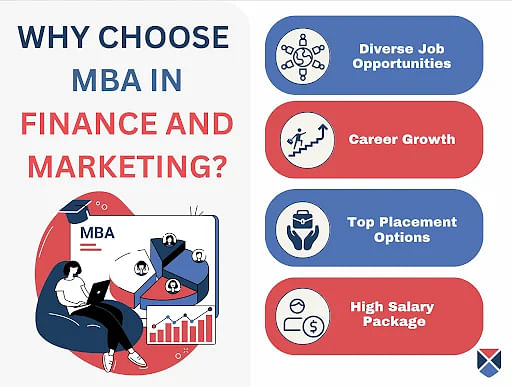
An MBA in Finance and Marketing not only positions students for success but empowers them to contribute significantly to dynamic industries and secure a future brimming with growth and opportunities. Listed below are some reasons why you should choose an MBA in Finance and Marketing program:
Also, Check: Top Reasons to Pursue an MBA
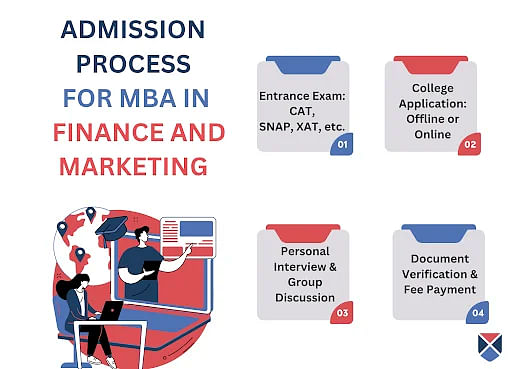
Admission to MBA programs in Finance and Marketing can be obtained through both online and offline processes. The usual step-by-step admission approach and selection structure used by colleges and institutions for MBA in Marketing and Finance admissions is outlined below:
Following the completion of the selection process, institutes compile a merit list based on numerous criteria. Successful candidates will then be admitted to the MBA in Marketing and Finance course. Candidates who receive admission offers must accept them within the timeframe specified. They must pay the required course fees in order to be admitted.
Read More on MBA Admission Process
Depending on the institution, MBA in Finance and Marketing admission may be merit-based or entrance-based. Certain institutes hold their own entrance tests for MBA admissions evaluating students based on their ability and topic knowledge. Several universities accept nationally recognized entrance exams like the CAT, MAT, XAT, or CMAT, as well as entrance exams geared to certain MBA subjects like finance and marketing.
The table below shows some common entrance exams for MBA in Finance and Marketing courses:
Entrance Exam | Registration Date | Accepting Colleges |
Aug 2 – Sep 13, 2023 | Poornima University, Jain University, Jaipur National University, BITM | |
Jul 11 – Sep 12, 2023 | Jain University, Jaipur National University, BITM | |
Feb 13 – Mar 13, 2023 | Poornima University, Jain University, Jaipur National University, BITM | |
Aug 1 – Oct 10, 2023 | Jain University | |
Jun 3 – Jul 16, 2023 | Jain University | |
To be announced | Symbiosis Institute of Digital & Telecom Management |
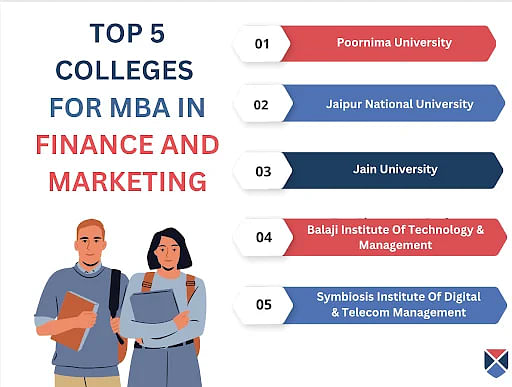
There are various private and government colleges offering MBA in Finance and Marketing course such as Jain University, SIDTM, Poornima University, etc., with an average fees ranging between INR 45,000 – 3 LPA. The table below presents a compilation of top universities in India that offer MBA in Marketing and Finance degree:
Institute | Admission Fee | Tuition Fee (Per Semester) | Miscellaneous Fee | Average Program Fee |
INR 10,000 | INR 50,000 | INR 5,000 | INR 2.2 LPA | |
INR 500 | INR 10,000 | INR 2,000 | INR 45,000 | |
INR 2,500 | INR 35,000 | INR 3,000 | INR 1.4 LPA | |
INR 50,000 | INR 2.5 LPA | INR 55,000 | INR 11.2 LPA | |
INR 20,000 | INR 3.7 LPA | INR 1.3 LPA | INR 11.4 LPA |
The MBA Finance and Marketing syllabus spans four semesters, comprising essential and optional courses that explore marketing principles and financial management. The curriculum delves into advanced concepts like valuation techniques, marketing analytics, and capital budgeting, creating pathways to employment across diverse sectors such as e-commerce, retail, technology, finance, and banking.
MBA Finance and Marketing Core Subjects
MBA Finance and Marketing core subjects are designed to give students a solid foundation in financial and marketing management and tactics. Some important core subjects taught across institutions in India are
MBA Finance and Marketing Elective Subjects
MBA in Marketing and Finance course elective subjects offer specialized knowledge, enhancing expertise in areas such as international finance, mergers, digital marketing, and brand management. Listed below are some of the elective subjects offered by MBA institutions:
The table below contains a detailed overview of the topics covered in some of the subjects from the MBA Financial and Marketing syllabus:
MBA Marketing and Finance Subjects | Topics Covered |
Financial Management | Capital Budgeting, Operation and Financial Leverage, Dividend Policies, Management of Working Capital. |
Marketing Management | Marketing Concepts, Management, Product-Price-Channel-Promotion Decision. |
Human Resource Management | Recruitment and Selection, HR Development, Financial Compensation, and Building Relationships. |
Strategic Management | Concepts of Strategy, Strategy Formulation and Choice, Functional Strategies, Strategy Implementation. |
Banking and Indian Financial System | Banking Systems, Industrial and Agricultural Banking Systems, Financial Systems, and Foreign Investments. |
Consumer Behaviour | Consumer Behaviour and Marketing Action, Environmental Influences on Consumer Behaviour, Consumer Buying Behaviour, Global Consumer Behaviour and Online Buying Behaviour. |
Read More: MBA in Finance and Marketing Syllabus
An MBA in Finance and Marketing degree focuses on understanding marketing and business strategies with financial principles and concepts, whereas an MBA in Banking and Finance course focuses on understanding the banking sector and helps students to work in the BFSI sector. Below listed are the key differences between MBA in Marketing and Finance and an MBA in Banking and Finance:
Parameters | MBA in Marketing and Finance | MBA in Banking and Finance |
Full Form | Masters of Business Administration in Finance and Marketing | Masters of Business Administration in Banking and Finance |
Overview | Equip students with a broad skill set for making strategic business decisions that integrate both finance and marketing aspects. | In-depth knowledge of financial institutions, banking operations, risk management, and regulatory frameworks. |
Duration | 2 Years | 2 Years |
Eligibility | 50% in graduation for unreserved category and 45% for SC/ST/PwD students. | 50% in graduation for unreserved category and 45% for SC/ST/PwD students. |
Average Fee | INR 45,000 – INR 3 LPA | INR 35,000-5 LPA |
Average Salary | INR 3- 17 LPA | INR 4-12 LPA |
Job Role | Marketing Manager, Financial Analyst, Product Manager, Business Development Manager, Sales Manager. | Investment Banker, Credit Analyst, Risk Manager, Wealth Manager, Financial Planner, Treasury Manager. |
Read more: MBA in Banking and Finance
MBA programs in Finance and Marketing integrate financial and marketing skills, allowing graduates to pursue further courses such as postgraduate degrees, executive programs, or specialized certificates. The following are some popular courses for MBA in Finance and Marketing graduates.
With a wide scope of job opportunities and average salaries ranging from INR 3-17 LPA (Source: Payscale), graduates holding an MBA in Finance and Marketing can select from various career paths. Graduates after having three plus years of experience can earn up to INR 17 LPA.
An overview of the position’s description and the typical compensation for new hires and those with five years of experience are provided in the table below.
Positions | Job Description | Average Salary For Freshers | Average Salary After 3 Years |
Marketing Manager | Lead marketing campaigns, brand management, and customer engagement strategies. | INR 4 LPA | INR 8-15 LPA |
Financial Analyst | Analyse financial data, forecast trends, and offer investment recommendations. | INR 3.8 LPA | INR 7-12 LPA |
Investment Banking Analyst | Assist with financial transactions, mergers, and acquisitions. | INR 7 LPA | INR 9-14 LPA |
Business Development Manager | Identify growth opportunities, partnerships, and market expansion. | INR 4 LPA | INR 10-15 LPA |
Sales Executive | Lead sales teams, set targets, and drive revenue growth. | INR 3.5 LPA | INR 7-12 LPA |
[Source: AmbitionBox]
MBA holders are well-prepared for leadership roles in global organisations, startups, and other influential initiatives, shaping their professional trajectories with confidence and the possibility for long-term contributions. Here are some career options that an MBA graduate can consider for building further credibility:
Read More: Career Options After MBA in Finance and Marketing
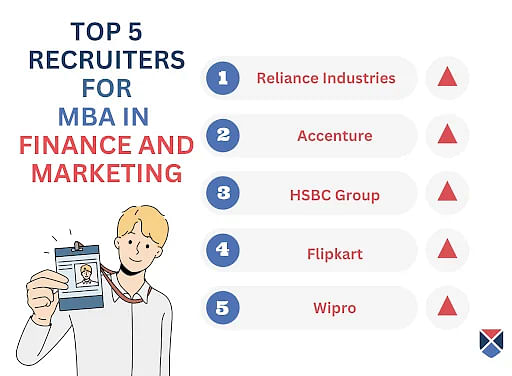
With an MBA in Finance and Marketing, graduates are able to attract top recruiters from banking, consumer goods, technology, consultancy, retail, pharmaceuticals, autos, e-commerce, media, and more. Some of the top recruiters in India are listed in the table below:
Top Recruiter | Average Entry Level Salary |
Reliance Industries | INR 7-9 LPA |
Accenture | INR 8 LPA |
HSBC Group | INR 7-8 LPA |
Flipkart | INR 5-8 LPA |
Wipro | INR 6-9 LPA |
Several types of scholarships are available in India to help families that are struggling to afford their children’s education. These scholarships aim to give deserving students a high-quality education and to encourage them to pursue greater academic goals. Some of the scholarships available to MBA Finance and Marketing students are listed here.
Scholarship | Eligibility | Amount |
| Up to INR 8000 | |
| INR 48,000 | |
| Up to 10,00,000 |
To excel as the best MBA in Marketing and Finance graduate, a combination of skills is essential to thrive in the dynamic business landscape. These skills include:
MBA Finance and Marketing syllabus is divided into four semesters consisting of core and elective subjects focusing on principles of marketing and financial management. The course consists of a capstone or research project where students integrate the concepts of both disciplines and understand their application in the industry.
The MBA Finance and Marketing course helps students develop knowledge of advanced concepts such as valuation techniques, marketing analytics, capital budgeting, brand equity, etc. The concepts help students to get employment in various industries such as e-commerce, retail, financial and banking services, etc.
Table of Contents
The MBA in Finance and Marketing syllabus includes fundamental and advanced concepts related to strategic business planning, financial market challenges, pricing strategies, brand positioning, etc. Below listed is the MBA Finance and Marketing syllabus semester-wise:
The MBA in Finance and Marketing syllabus in the first year deals with the study of business fundamentals, marketing management, financial instruments, etc. The following table contains the MBA Finance Marketing subjects for the first year:
Semester I | Semester II |
Financial Analysis and Reporting | Consumer Research |
Managerial Economics | Indian Financial System |
Business Communication | Financial Markets |
Financial & Management Accounting | Human Resource Management Concepts |
Organizational Behaviour | Business Policy and Strategic Management |
Also, Check: Top Reasons to Pursue an MBA
The MBA in Finance and Marketing second-year syllabus aims at more industry exposure and experiential learning through internship and project work. The following table contains the MBA Finance and Marketing syllabus for the second year:
Semester III | Semester IV |
Summer Internship Program | Behavioural Finance |
Advertising and Sales Promotion | Organization Structure and Design |
Customer Relationship Management | Global Marketing Strategies |
Fundamentals of Operation Research | Services Marketing |
Concepts and Theories of Wealth Management | Open Elective |
Principal of Public Relations | Project Report |
Open Elective | – |
Practical Subjects/ Topics in the Second-Year MBA Marketing and Finance Syllabus
The MBA Marketing and Finance subjects are divided into core and elective subjects with basic and advanced course topics. The subjects are designed with the objective to understand global finance, marketing perspectives, and recent developments in the field. Below listed are MBA Finance and Marketing core and elective subjects:
The MBA Finance and Marketing core subjects aim at understanding different business strategies used in dynamic environments from marketing and finance perspectives. Given below are the core topics of the MBA Finance and Marketing syllabus:
MBA Finance and Marketing elective subjects can be opted by students as per their choice of interest and domain expertise. Given below are the elective topics in the MBA in Finance and Marketing course:
The MBA Marketing and Finance subjects cover aspects of financial markets, effective branding, promotion strategies, and recent trends in the industry. Below listed are a few MBA Finance Marketing subjects in detail and their topics:
MBA Finance and Marketing Subjects | Topics |
Managerial Economics | Demand Analysis and Forecasting, Production Theories, Market Equilibrium, Market Structure, etc. |
Financial Markets | Bond Markets, Types of Financial Markets, Financial Market Regulations, Investment Strategies, etc. |
Wealth Management | Financial Planning, Asset Allocation, Global Wealth Management Theories, Financial Planning, etc. |
B2B Marketing | B2B Buyer Behaviour, Channel Partner Management, Lead Generation Strategies, Pricing Strategies, etc. |
The syllabus for MBA Marketing and Finance course may differ based on different college curriculum structures but the main outcome of the course remains the same to make students understand the effectiveness of marketing and sales strategies in businesses. Below listed are college-wise MBA in Finance and Marketing syllabus:
Sharda University offers an MBA in Marketing and Finance as a dual specialization with a focus on making students equipped with concepts like finance budgeting, analysis, advertising, etc. Below mentioned is the Sharda University MBA Finance and Marketing syllabus:
Semester I | Semester II |
Human Resource Management Concepts | Fundamentals of International Marketing |
Marketing Concepts | Corporate Finance |
Fundamentals of Strategic Management | Managerial Accounting |
Organisational Behaviour | Research Methodology |
Quantitative Techniques Uses in Businesses | Consumer Behaviour |
Fundamentals of Marketing Management | Fundamentals of Production and Operations Management |
Cross-Cultural Management Theories | Operation Research Theories |
Semester III | Semester IV |
Summer Internship Program | Fundamentals of CRM |
Business Legal Aspects | Global Marketing Strategies |
Brand Management Concepts | Financial Derivatives |
Fundamentals of Sales and Distribution Management | Global Financial Management |
Financial Concept Application in Project Management | Elective-II |
Elective-I | Project Report/Viva |
The CMS Business School focuses on providing a practical understanding of finance and marketing strategies, as more than 20% of classes are conducted by industry experts. Below listed is the CMS Business School MBA Finance and Marketing syllabus:
Semester I | Semester II |
Economics for Business | Fundamentals of HRM |
Business Communication | Managerial Finance |
Laws in Business | Indian Policies and Reforms |
Strategic Management | Fundamentals of Financial Markets |
Fundamentals of Marketing Management | Fundamentals of Operation Research |
Financial Reporting and Analysis | Understanding Indian Financial Management System |
Elective-I | Elective-II |
Semester III | Semester IV |
Summer Internship | Concepts of Investment Banking |
Research Methodology | Global Marketing Strategies |
Fundamentals of Wealth Management | Service Marketing |
B2B Marketing Concepts | Portfolio Management |
Concepts of Sales and Distribution Management | Fundamentals of Behavioral Finance |
Skill Enhancement Course | Project Report |
MBA Finance and Marketing subjects cover important projects that are an integral part of the studies to understand the practical application of branding, promotion strategies, portfolio management for investors, etc. Some of the popular research projects are listed below:
Also, Check: MBA Project Topics
The course structure of MBA Finance and Marketing consists of experiential learning, practical projects, corporate capstone projects, etc. The course structure may differ from college to college based on the program objective. Below mentioned is the common course structure followed by colleges for MBA Finance and Marketing courses:
The MBA Finance and Marketing course is a mix of theoretical and practical concepts. The aim of the teaching methodologies is to develop critical thinking learning and encourage active learning through role plays, interactive workshops, etc. Below listed are teaching methodologies and techniques used in the MBA Finance and Marketing course:
MBA in Finance and Marketing subjects books can be used by students as reference materials to understand financial and marketing theories in detail with their evolution. Below listed are a few important books for the MBA Finance and Marketing course:
Books | Topics Covered | Author |
Corporate Finance | Financial Statement and Cash Flow, Discounted Cash Flow Valuation, Risk and Return, etc. | Jonathan Berk and Peter DeMarzo |
Financial Management | Time Value of Money, Cost of Capital, Inventory Management, etc. | Prasanna Chandra |
Global Marketing Management | Global Cultural Environment, Global Marketing Strategies, Global Market Entry Strategies, etc. | Warren J. Keegan and Mark C. Green |
Retail Management | Merchandising, Types of Retail Stores, Retail Marketing Strategies, etc. | Swapna Pradhan |