
- info@wingeducations.com
- +91 (705) 495-5296
- Mon - Sat : 10.00-18.00
DCE is a three-year-long diploma course that deals with the design, development, and construction of a huge range of projects in the built and natural environment. The DCE graduate’s role is central to ensuring the safe, timely, and well-resourced completion of projects in many areas. There are many job opportunities available to the graduates of this role due to the flexibility and diversity of the role. Some of the popular job roles that the graduates start with are Assistant Manager, Assistant Field Inspector, Construction Site Assistant Supervisor, Faculty Member, Executive Engineer, and Project Engineer.
Table of Contents
| Degree | Diploma |
| Full Form | Diploma in Civil Engineering |
| Duration | 3 Years |
| Age | Minimum age limit is 17 years |
| Subjects Required | Biology, Chemistry, Physics, Mathematics, English |
| Minimum Percentage | 50 % in 10th from a recognized board of Education |
| Average Fees | ₹3 – 10 LPA |
| Similar Options of Study | BE Civil Engineering |
| Average Salary | INR 3 – 5 LPA [Source: PayScale] |
| Employment Roles | Assistant Manager, Assistant Field Inspector, Construction Site Assistant Supervisor, Assist. Faculty Member, Executive Engineer, Project Engineer |
| Top Recruiters | Lloyds Ltd, White Young, PCC, Shapoorji and Pallonji, Al Jadeed, Double Crown, Specialized Contracting, Unicon Development Constructions, PAC Constructions, CAS Ventures Pvt. Ltd., etc |
DCE course stands for Diploma in Civil Engineering. DCE focuses on the theoretical and practical application of construction management and mechanism techniques of buildings, sites, etc. as per the dynamic trends and changes in business processes. Diploma in civil engineering syllabus & subject is focused on developing an understanding of civil engineering, engineering drawing, construction management, etc.
A Diploma in civil engineering job scope is vast and offers opportunities in various specializations from quality supervisor to installation and commissioning engineer in both private and government sectors.
Also Read: List of Science Courses after 10th
The Diploma in Civil Engineering course admission is only possible if the students ensure that they meet all the Diploma in Civil Engineering course eligibility criteria. The candidates must qualify 10th class or its equivalent examination with 50% aggregate marks with Science, and Mathematics as the main subjects.
The candidate must have studied English as one of the subjects in the 10th class. Vocational (10+2) pass students or ITI pass students can get admission in the direct second year. There is also a relaxation of 5% in the total aggregate marks in the 10th class i.e 45% marks are enough for the SC/ST category candidates. The Diploma in Civil Engineering course degree age limit is flexible, therefore, everyone can apply for this course.
For obtaining admission to the Diploma in Civil Engineering course, the students are required to meet all the eligibility criteria. Most institutes offering the course admit students based on performance in a relevant entrance test. The admission process includes institutes providing direct admission based on the candidate’s performance at the 10+2 level.
Some institutes admit students through the direct mode of admission, that is, based on marks scored in the 10th board examination. Students should have cleared 10+2 examinations in the Science stream with a minimum aggregate of 50% marks. The admissions can be done through both online and offline methods.
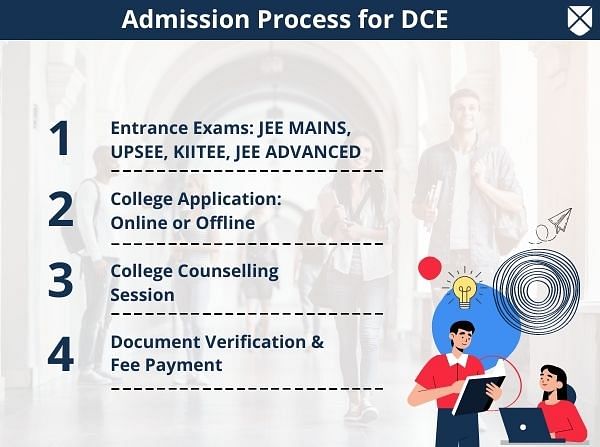
Mentioned below are the details of the admission process in general:
For obtaining admission to the Diploma in Civil Engineering course, students can apply online and offline. The aspirants are expected to register themselves on the official website of the college or provide the filled hard copy of the registration form within the deadline date. For the offline application, the students need to submit the application and paperwork in person by going to the college’s admission office. Admission to the course can happen through an entrance examination and is merit-based.
Most colleges that offer a Diploma in Civil Engineering course, admit students based on their marks in the entrance exams. The outcome of the admission process is determined by the marks cumulative score of Common entrance exam scores, scores obtained in entrance exams and their 10+2 examination percentile. Based on the overall marks obtained by the students, the eligible candidates are offered admission to the program.
Aspirants can pursue the Diploma in Civil Engineering course in the full-time or part-time mode. Below are the types of Diploma in Civil Engineering courses in detail:
The full-time Diploma in Civil Engineering program is typically for 3 years, during which students will have to attend classes in person, submit assignments, and write their exams on campus. The advantage of a full-time Diploma in Civil Engineering course is that students will gain a lot more exposure, experience, and knowledge through direct interaction with their peers and faculty.
The part-time Diploma in Civil Engineering course is designed for students who cannot attend regular classes. Part-time courses either entail weekend or night classes or online classes, depending on the type of course.
The advantage of the part-time Diploma in Civil Engineering course is that students can pursue this course while simultaneously being engaged in employment, research, etc.
Many universities and colleges in India offer the Distance Diploma in Civil Engineering courses. The course is designed keeping the Distance Education methodology in mind. This course is designed for students who cannot afford to attend classes on-campus or those engaged in some form of employment and cannot take time out to pursue a full-time course.
Many entrance exams are conducted by colleges as a means of deciding which students must be given admission. The entrance exams directly test the understanding of the broader subject. These exams can be both national and college level. Listed below are some of the popular entrance exams that are conducted for the admission in Diploma in Civil Engineering course:
When appearing for the Diploma in Civil Engineering entrance exam, is an essential step for the aspirants, as it can ensure that the students know about the pattern of the exam. If the students are aware of the exam pattern, it can help them to ace the exam without any hurdles and therefore, increase their chances of getting admission to a college of their choice.
India is home to some of the Diplomas in Civil Engineering colleges in the world. Aspirants have many options to choose from in terms of the best Diploma in Civil Engineering colleges course as per their preferences.
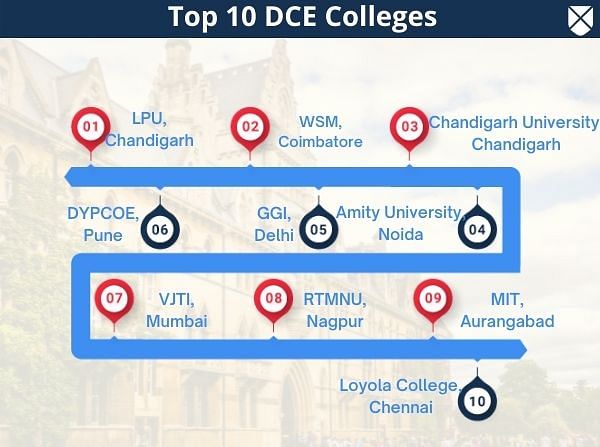
Depending on the type of Diploma in Civil Engineering college programs offered, candidates will have to make the appropriate choice. Below are some of the top colleges in India offering Diploma in Civil Engineering colleges courses.
The Diploma in Civil Engineering course details can be accessed by the students by going to the official website of the colleges providing the course. The Diploma in Civil Engineering course is provided to students in many good colleges around the country. Listed below is a list of the best Diploma in Civil Engineering colleges in India that students can choose from:
Sl. No. | Name of the College | Fees |
| 1 | Lovely Professional University | INR 53,200 PA |
| 2 | Wisdom School of Management | INR 16,000 PA |
| 3 | Chandigarh University | INR 19,400 PA |
| 4 | Dr D.Y. Patil College of Engineering | INR 22,000 PA |
| 5 | Ganga Group of Institutions | INR 33,000 PA |
| 6 | Amity University, Noida | INR 75,000 PA |
| 7 | Veermata Jijabai Technological Institute | INR 12,000 PA |
| 8 | Galgotias University | INR 45,000 PA |
| 9 | Maharashtra Institute of Information Technology | INR 19,000 PA |
| 10 | Sri Venkateswara College of Engineering and Technology | INR 28,000 PA |
India’s capital city is home to some of the best institutions for a Diploma in Civil Engineering in India. Check the table below for the top Diploma in Civil Engineering colleges in New Delhi:
| Sl.No | Institution |
| 1 | DTU |
| 2 | IGNOU |
| 3 | JMI |
| 4 | Aryabhatt Institute of Technology |
| 5 | IIT Delhi |
Pune also has some of the best institutions for a Diploma in Civil Engineering in India. Check the table below for the top Diploma in Civil Engineering colleges in Pune:
| Sl.No | Institution |
| 1 | Shri Chhatrapati Shivajiraje College of Engineering |
| 2 | YB Patil Polytechnic |
| 3 | Gourishankar Polytechnic |
| 4 | Sant Tukaram Polytechnic |
| 5 | Suhas Institute of Technology |
Tamil Nadu’s capital city is home to some of the premier institutions for a Diploma in Civil Engineering in India. Check the table below for the best Diploma in Civil Engineering colleges in Chennai:
| Sl.No | Institution |
| 1 | PT Lee Chengalvaraya Naicker Polytechnic College |
| 2 | GKM College of Engineering and Technology |
| 3 | Central Polytechnic College |
| 4 | Sri Sairam Polytechnic College |
| 5 | Murugappa Polytechnic College |
The capital city of Karnataka is renowned around the country for colleges offering top Diplomas in Civil Engineering programs. Check the table below for the best Diploma in Civil Engineering colleges in India:
| Sl.No | Institution |
| 1 | NMIT Bangalore |
| 2 | MSRIT Bangalore |
| 3 | MEI Polytechnic |
| 4 | The Oxford Polytechnic |
| 5 | SJ Government Polytechnic |
West Bengal’s capital city, Kolkata, has some of the best colleges for Diploma in Civil Engineering courses in India. Check the table below for the best Diploma in Civil Engineering colleges in Kolkata:
| Sl.No | Institution |
| 1 | Techno Main Salt Lake |
| 2 | Techno India University |
| 3 | NIT Kolkata |
| 4 | Brainware University |
| 5 | The George Telegraph Training InstituteB B Ganguly Street |
The Telangana state capital has some premier institutions in the country for Diploma in Civil Engineering courses in India. Check the table below for the top Diploma in Civil Engineering colleges in Hyderabad:
| Sl.No | Institution |
| 1 | MANNU Hyderabad |
| 2 | Arjun College of Technology and Sciences, |
| 3 | NMIMS University |
| 4 | Tudi Ram Reddy Institute of Technology and Science |
| 5 | Princeton Institute of Engineering and Technology for Women |
There are several top Government Colleges offering quality Diplomas in Civil Engineering programs across the country. Check the table below for the top Diploma in Civil Engineering government colleges in India:
| Sl.No | Institution |
| 1 | Government Polytechnic Mumbai |
| 2 | MSU Baroda |
| 3 | JMI New Delhi |
| 4 | Government Polytechnic Pune |
| 5 | Government Ramchandra Khaitan Polytechnic College |
India has seen significant growth in the number of quality Diplomas in Civil Engineering private colleges that offer some of the best programmes in the country. Check the table below for the top Diploma in Civil Engineering in private colleges in India:
| Sl.No | Institution |
| 1 | PT Lee Chengalvaraya Naicker Polytechnic College |
| 2 | Arjun College of Technology and Sciences |
| 3 | Techno Main Salt Lake |
| 4 | The George Telegraph Training Institute |
| 5 | Tudi Ram Reddy Institute of Technology and Science |
The Diploma in Civil Engineering fees may vary based on the facilities and the infrastructure provided by the Colleges. The average course ranges from INR 3 – 10 LPA.
Sl. No. | Name of the Institute | Average Annual Fees |
| 1 | Delhi Technological University, [DTU], New Delhi | INR 6 LPA |
| 2 | SRM, Chennai | INR 10 LPA |
| 3 | Vivekananda Institute of Technology, [VIT] Jaipur | INR 3.8 LPA |
Diploma in Civil Engineering courses is available in many colleges in the country for aspiring engineers. The Diploma in Civil Engineering curriculum is designed to ensure that aspiring students get access to all the relevant information and skills required to be successful in their career paths.
The diploma course is a three-year-long course, consisting of six semesters. The course has both theoretical and practical aspects of teaching. There are core and elective subjects part of the syllabus, making the course very diverse and flexible. Listed below are some of the core subjects taught to the students:
Read More: Diploma in Civil Engineering Syllabus and Subjects
Students often wonder about the Diploma Civil Engineering course details before choosing the course. Before deciding on a career, students come across queries like, “What is Diploma in Civil Engineering course?” and “Why choose a Diploma in Civil Engineering?”. To clearly understand the answers to these questions and know more about the Diploma in Civil Engineering Diploma course, we have framed the following three pointers:
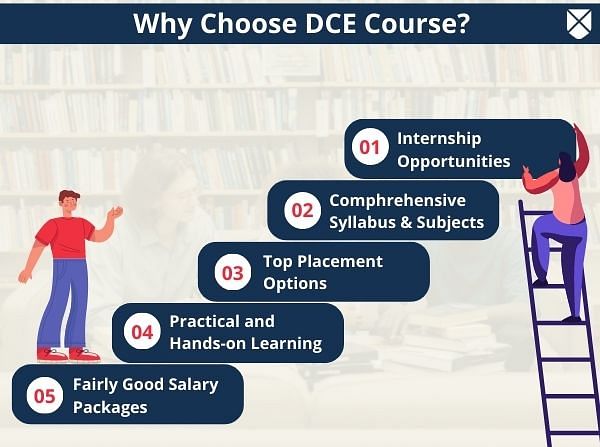
To understand what a Diploma in Civil Engineering is, students must start by knowing the DCE course’s full form. DCE full form translates to Diploma in Civil Engineering. A diploma in Civil Engineering is a 3-year diploma course in Civil Engineering base. Where the students are admitted after the completion of 10th in the first year or after the completion of 10+2 in the second year.
A diploma in civil engineering is a course in which an aspiring student can learn about the design and construction of roads and railways, schools, offices, hospitals, water and power supply, and much more. This course helps the students to get to know more about the engineering concept helps them to achieve good knowledge and solve problems related to construction rigidity and other factors.
A diploma in Civil Engineering is a three-year-long diploma course that enables students to build a career in civil engineering. The course offers students an introduction to the design, construction, and maintenance of infrastructures, which are very much needed in building railway projects, Military and Engineering services, etc.
Some of the popular employers of graduates of this course are Lloyds Ltd, White Young, PCC, Shapoorji and Pallonji, Al Jadeed, Double Crown, Specialized Contracting, Unicon Development Constructions, PAC Constructions, CAS Ventures Pvt. Ltd., etc.
Civil Engineer: A Civil Engineer is responsible for conceiving, designing, supervising, operating, designing, constructing, and maintaining infrastructure projects. They also work on systems that are in the public and private domain such as the road, airports, dams, buildings, tunnels, and systems of water supply and sewage treatments.
This course helps the candidate to grow the supervisory and administrative skills required to construct a building as per the design provided by the architects. As new buildings are built very often, the requirement of these diploma graduates is never-ending. Diploma graduates have more practical knowledge of the subject and hence it is common that they’re hired easily by many civil construction companies.
Diversity And Relevancy Of The Education: After this course, graduates can also further go for a higher degree such as bachelor’s and postgraduate courses, which focuses mainly on imbibing the theoretical knowledge they obtain into the practical experience they get from the diploma course. The candidates can also find staggering job opportunities in many sectors such as PWD, Pvt Other construction companies like MNC, MES, Railways, etc.
Read More: Diploma in Civil Engineering Jobs and Scope
A diploma in Civil Engineering course is made for the students to get both practical and academic clearance. Below is a comparison of the Diploma in Civil Engineering course with other courses:
The table below showcases the differences between Diploma in Civil Engineering and B.Tech in Civil Engineering:
| Degree | Diploma | Bachelors |
| Full-Form | Diploma in Civil Engineering | Bachelor of Technology in Civil Engineering |
| Duration | The course Duration of a Diploma in Civil Engineering is 3 Years. | Course Duration of Bachelor of Technology [B. Tech] (Civil Engineering) is 4 Years. |
| Age | The minimum age limit is 17 years | No specific age limit |
| Minimum Percentage | 50 % in 10th from a recognized board of Education | 50-60% |
| Subjects Required | Biology, Chemistry, Physics, Mathematics, English | Biology, Chemistry, Physics, Mathematics, English |
| Average Fees Incurred | INR 3 – 10 LPA | INR 40K to 2 LPA |
| Average Salary Offered | INR 3 – 5 LPA [Source: PayScale] | INR 2.4 LPA [Source: Payscale] |
| Employment Roles | Assistant Manager, Assistant Field Inspector, Construction Site Assistant Supervisor, Assist. Faculty Member, Executive Engineer, Project Engineer | Civil Engineer, Structural Engineer, Structural Design Engineer, Project Manager, Design Engineer, Construction Manager, Project Engineer, Safety Officer, etc |
Read More: B.Tech in Civil Engineering
If we talk about the Diploma in Civil Engineering and Civil Engineering Degree, both of the courses are Civil Engineering courses but with different time duration, programs, subjects and eligibility criteria. For making it clear, here are some differences between both courses are given in the table below:-
| Course | Diploma in Civil Engineering | Civil Engineering Degree |
| Full-Form | Diploma in Civil Engineering | Civil Engineering |
| Stream | Diploma | Bachelors |
| Course Duration | 3 Years | 4 Years |
| Eligibility | Students should have passed class 10th with a minimum of 50% marks | Students should have passed class 10th with a minimum of 50% marks in Science |
| Entrance Exams | BITSAT, AIEEE | JEE Mains, JEE Advanced, SAAT, SET, BITSET, TANCET |
| Top Colleges | DTU Delhi, IGNOU Delhi, IIT Delhi, JMI Delhi | IIT Bombay, IIT Madras, IIT Kanpur, IIT Patna |
| Fees | INR 3 – 10 LPA | INR 40,000 to 2 LPA |
Read More: BE Civil Engineering
Some of the essential course preparation tips for a candidate who wants to pursue a Diploma in Civil Engineering are:
Start Early: An early start to prepare for the course can be an advantage to the candidate to get to know all the concepts and modules in the course.
Knowledge of the Exam Paper: Preparing for the exams with the reference to previous question papers could make it easy for a candidate to prepare during exams.
Time Management: A timetable should be prepared so that the student can prepare in some of the subjects of the course where he/she is lagging.
After the completion of a Diploma in Civil Engineering, there are plenty of higher education options available for graduates. One of the key reasons why students choose to pursue a higher education degree is because it can help them navigate their career path and build a more satisfying career for themselves. Listed below are some of the popular higher education options available for students:
The average Diploma in Civil Engineering salary ranges between INR 3 – 5 LPA [Source: PayScale]. The salary can depend on many factors like the skill set possessed by the students, the location, and the level of education obtained by the graduates.
Read More: Diploma in Civil Engineering Salary
Job opportunities for Diploma in civil engineering graduates have various opportunities to choose from. Job opportunities are available in both the public and private sectors. Job Opportunities in the field of construction, planning, and design are open for a graduate with Diploma in Civil Engineering. The most common roles the graduates work in are:

There are many skills that Diploma in Civil Engineering graduates need to have to ensure that they succeed in their careers. Some of these skills are listed below:
Diploma in Civil Engineering Syllabus ensures that the students get all the essential skills and knowledge they need to succeed in their careers. The Diploma in Civil Engineering Subjects require both theoretical and practical aspects of teaching. The course structure is given below:
Usually, the Diploma in Civil Engineering subjects and syllabus are divided across 6 semesters, studied over 3 years. The course structure consists of Core, Elective, and Practical subjects, offering students a comprehensive understanding of the principles and practices of civil engineering.
Students willing to pursue this course can find the detailed semester-wise Diploma in Civil Engineering syllabus below:
During the first year of the course, candidates study the following Civil Engineering Diploma Subjects:
| Semester I | Semester II |
| Communication Skills-I | Applied Mathematics- II |
| Applied Chemistry | Engineering Drawing |
| Applied Mechanics | Fundamentals of Electrical Engineering |
| Applied Physics | Communication Skills-II |
| Applied Mathematics- I | Surveying-I |
| Computer Application for Engineering | Understanding Constituents of Mechanical Engineering |
| Workshops | Practicals-I |
Diploma in Civil Engineering First-Year Practicals
Apart from theoretical concepts, the following are the practical subjects available under the Civil Engineering Diploma Subjects for the first year:
The table below contains the Civil Engineering Diploma Subjects covered in the second year of study:
| Semester III | Semester IV |
| Surveying-II | Concrete Technology |
| Basics of Building Construction | Structure Theory |
| Fundamentals of Hydraulics | Fundamentals of Irrigation Engineering |
| Fundamentals of Architectural Drafting and Design | Minor Project Work |
| Practicals-II | Practicals-III |
The following are the practical subjects available under the Civil Engineering Diploma Subjects for the second year:
The table below contains the Civil Engineering Diploma Subjects during the third year:
| Semester V | Semester VI |
| Surveying – III | Estimation of Costing |
| R.C.C. Structure Design-I | R.C.C. Structure Design-II |
| Management of Construction and Safety Engineering | Transportation Engineering |
| Industrial Training | Environmental Engineering |
| Soil Mechanics & Foundation Engineering | Major Project Work |
| Practicals-IV | Practicals-V |
Apart from theoretical concepts, the following are the practical subjects available under the Civil Engineering Diploma Subjects for the third year:
The Diploma in Civil Engineering subjects and syllabus are designed to provide students with knowledge of the fundamentals of civil engineering principles and applications. The course is divided into core, elective, research projects and practical learning disciplines. While core subjects set a foundational understanding of the subject, the elective subjects can be chosen by students. Some of the core & elective topics from the Diploma in Civil Engineering subjects list are given below:
Given below are the core subjects of the Diploma in Civil Engineering:
Given below are the elective subjects for the Diploma in Civil Engineering:
Apart from the core and elective subjects, the Diploma in Civil Engineering Syllabus includes a wide range of subjects such as Applied Physics, Applied Chemistry, and Construction. Some of the Civil Engineering Diploma Subjects are discussed below:
| Diploma in Civil Engineering Subjects | Topics Covered |
| Applied Physics | Electrostatics, D.C. Circuits, Electromagnetism, Expansion of Solids, Heat Transfer, Geometrical Optics, Wave Optics. |
| Applied Chemistry | Problems Based on Volumetric and Gravimetric Analysis, Analysis of Water, Treatment of Water, Corrosion and Lubricants. |
| Building Construction | Foundation, Walls, Partition walls, Arches and Lintels, Doors and Windows, Floors, Scaffolding, Shoring, Underpinning and Formwork. |
| Hydraulics | Properties of Fluids, Hydrostatic Pressure, Measurement of Pressure, Flow Measurements, Hydraulic Machines, Flow Through pipes. |
| Computer Application | Digital Computer Systems, Characteristics, History, Computer Generations, Types of Computers & Their Classifications. |
The teaching methods and strategies used in the Diploma in Civil Engineering Syllabus provide students with a thorough understanding of the concepts in civil engineering. Listed below are the teaching methodologies and strategies used in general: