- info@wingeducations.com
- +91 (705) 495-5296
- Mon - Sat : 10.00-18.00
DCA is a one-year diploma course that focuses on the study of computer applications and technology by understanding database management, web development, and programming languages. After completion of the course, graduates can work as Technical Writer, Web Developer, System Administrator, etc.
Table of Contents
| Degree | Diploma |
| Full Form | Diploma in Computer Applications |
| Duration | 1 Year |
| Age | Minimum age to apply is 17-18 years |
| Minimum Percentage | A minimum of 50% marks in 10+2 (high school degree). |
| Average Fees | ₹10K – 50K |
| Similar Options of Study | B.Sc Computer Science, B.Tech Computer Engineering |
| Average Salary | INR 3.90 LPA (Source: Ambition Box) |
| Employment Roles | Computer Operator, Web Designer, Software Developer, C++ Developer, etc. |
| Top Recruiters | Techno System Pvt Ltd, Benefactor HR Solutions Pvt Ltd, Merit Power Consultants, etc. |
DCA full form is Diploma in Computer Application, which is a diploma course that focuses on providing students a comprehensive understanding of computer systems along with their application in different fields. The DCA course duration is one year.
DCA Admission 2024 requires students to have a minimum of 50% in their high school degree (10+2) from a recognized board. The admission is done on a merit basis. The DCA course includes the study of visuals, programming languages, database management, SQL, operating systems, data structure, algorithms, etc. DCA average fees in India varies from INR 10,000-50,000.
Graduates after completing the DCA course get the opportunity to work in different areas like the IT industry, Education, E-Commerce, Web Development agencies, Telecommunication, etc. The average salary of a DCA graduate is INR 3.90 LPA. (Source: Ambition Box)
Also Read: List of Diploma Courses after 12th
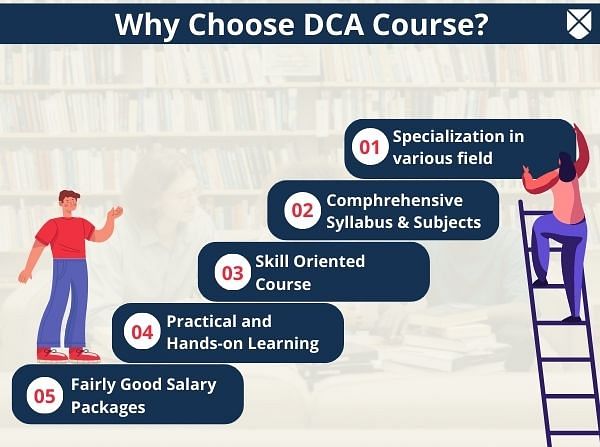
DCA course is one of the highly pursued courses for students seeking knowledge in the field of information technology and computer applications. Below mentioned is a detailed analysis of why one should choose a DCA course:
A diploma in computer application course is ideal for students who are looking to work in the IT Industry in a diverse range of roles. Below mentioned are points regarding who should pursue a DCA course:
Read More: DCA Jobs and Salary
For the DCA admission process, students must ensure they meet the basic eligibility criteria. The standard DCA eligibility criteria is given below:
Students seeking admission to DCA courses can apply directly on the basis of their merit scores. Below mentioned is the process given for admission to the course:
The average DCA course fees is in the range of INR 10,000-50,000 which varies according to the location, infrastructure, and facilities provided by the colleges. Below is the breakdown of fees for respective colleges:
Sl.No | College Name | Tuition Fees | Admission Fees | Miscellaneous Fees |
1 | RIMT University | INR 51,000 | INR 15,000 | – |
2 | RKDF University, Bhopal | INR 10,000 | INR 5,000 | – |
3 | Career Point University, Hamirpur | INR 20,000 | INR 5,000 | INR 36,000 |
Students can pursue DCA courses in various learning modes such as full-time, part-time, or through distance education. Below are the DCA course details consisting of eligibility and course duration:
Type | DCA Eligibility | DCA Duration |
DCA Full Time | Should have cleared 10+2 (high school degree) with a minimum of 50% marks + Entrance Exam | 1 Year |
DCA Part-Time | Should have cleared 10+2 exams with a minimum of 50% marks. | 6 Months-1 Year |
Distance DCA | Should have passed 10+2 exams with a minimum of 45-50% marks. | 1-2 Year |
Below mentioned points highlight the standard distance DCA course details:
A diploma in Computer Application is offered by various government and private institutes based on the merit or entrance exam score secured by the student. Below is a list of top colleges offering a DCA diploma course:
Sl.No | College Name | Average Tuition Fees |
1 | AKS University | INR 9,000 |
2 | Kaushalya-The Skill University | INR 4,000 |
3 | SBBS University | INR 19,750 |
4 | Himalayan Garhwal University | – |
5 | Kalinga University | INR 15,000 |
6 | Sai College | – |
7 | Career Point University, Hamirpur | INR 20,000 |
8 | RIMT University | INR 51,000 |
9 | NILM University | INR 40,000 |
10 | Maharaj Vinayak Global University | INR 35,000 |
Top DCA Colleges by City
DCA Colleges in Mumbai | DCA Colleges in Ahmedabad |
DCA Colleges in Pune | DCA Colleges in Chennai |
DCA Colleges in Indore | DCA Colleges in Nagpur |
DCA Colleges in Jaipur | DCA Colleges in Bangalore |
DCA Colleges in Kolkata | DCA Colleges in Lucknow |
Top DCA Colleges by State
DCA Colleges in Hyderabad | DCA Colleges in Gujarat |
DCA Colleges in Delhi | DCA Colleges in Maharashtra |
DCA Colleges in Karnataka | DCA Colleges in Tamil Nadu |
DCA Colleges in Rajasthan | DCA Colleges in Uttar Pradesh |
DCA Colleges in Chandigarh | DCA Colleges in Punjab |
DCA course syllabus and subjects focus on understanding concepts of web development and designing, C++, software development, visual basics, page designing, and network fundamentals. Listed below are some of the general DCA subjects:
Read More: DCA course Syllabus
DCA course helps students to excel in networking and computer application fields and its application in various industries. There are various other courses that offer similar or advanced knowledge in the domain. Below is a comparison of DCA with other courses.
The table below showcases the differences between DCA and PGDCA:
Course | DCA | PGDCA |
Full Form | Diploma in Computer Application | Postgraduate Diploma in Computer Application |
Course Duration | 1 year | 1 Year |
Eligibility | 10+2 with a minimum of 50-55% aggregate | 10+2+4 or any Bachelor’s degree with a minimum of 50% marks. |
Top Colleges | SBBS University, LPU | AISECT University, Punjab Technical University |
Fees | INR 10,000 – 50,000. | INR 7,000 -1 Lakh |
Average Salary | INR 3.90 LPA | INR 2-6.5 LPA |
Read More: PGDCA
The higher education after the DCA course duration increases the student’s credibility in the field of computer programming and applications. Listed below are some of the higher education options after the DCA diploma course:
DCA computer science/ application graduates have vast career options in both private and public sectors in the IT industry, E-Commerce, Banking and Financial Services, etc. Listed below are a few designations that a graduate can join upon the completion of the course:
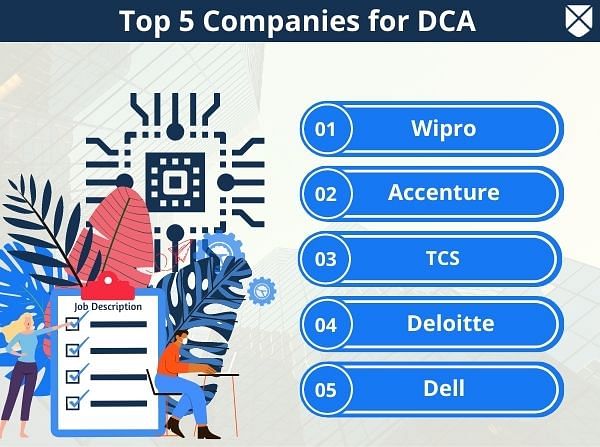
The average salary offered to a DCA graduate in India is INR 3.90 LPA (Source: Ambition Box). The scope of a Diploma in Computer Application is lucrative because of the abundance of opportunities available in the IT sector. The candidate can increase their salary by enrolling in higher studies or professional certification courses.
Read More: DCA Salary
Students pursuing DCA courses should have a certain set of individual skills outside of the academic realm to develop both their aptitude and pragmatic abilities to remain competitive in the market. Listed below are some of the skills that make one a suitable DCA computer science/application graduate:
The DCA course imparts practical and theoretical knowledge in the subject areas to the students, such as basics of computer, management information system, financial accounting system, etc. DCA job scope is expanded into various areas or industries such as information technology, BPOs, KPO, banking, etc. in both private and public sectors.
The computer DCA course syllabus introduces a skill development approach along with the theoretical aspect to ensure students gain a skill set before joining the industry. For instance, the scope of document handling and document formatting along with the windows fundamentals form a crux of the DCA course.
Aspirants of the course should download the DCA course material to get the best possible idea of the demands of the semester wise DCA course syllabus. The computer diploma course syllabus aims to enhance the computer programming and document handling abilities of the individual to provide the best asset upon joining the working industry.
The semester wise DCA syllabus focuses on studying the concepts of computer fundamentals, window settings, document handling, network programming, database management and office automation. The semester wise Diploma in Computer Application Syllabus is mentioned below:
Semester I | Semester II |
Practical on Application Program | Visual Basics |
Operating System and Application Program | Database Management System |
Programming Language | Internet and Web Page Designing |
Fundamentals of Computer | App Development |
– | Project Work |
The DCA subjects introduce the aspirants of the course to foundational concepts of computer fundamentals and their applications. The syllabus of DCA is an amalgamation of academic lectures along with seminars, lab work and project submissions.
Computer course DCA syllabus and its subjects not only provide students with a framework idea of computer operations but also the demands of the industry and their pragmatic scope. Before joining, students should download the DCA syllabus 2021 PDF to understand the various tenets and scope of the Diploma in Computer Application Subjects. The DCA subject list is listed below:
The DCA syllabus is organised chronologically to provide you with a thorough grasp of the fundamentals before facilitating your in-depth study of computer technology. The DCA syllabus is listed below in the tabular format:
Subject Category | Topics Covered in DCA Syllabus |
Financial Accounting System | Storing Financial Data, Basics of Excel and Tally, etc. |
Database Management System | Introduction to SQL |
Basic Networking Concepts | LAN, Networking Devices, WAN, MAN IoT,TCP/IP, Types of Networking, etc |
Internet and its Usage | E-commerce, Social Media, Websites and Webpages, Conferencing, E-governance, Emails, Research, etc. |
Introduction to Windows | Window Setting, Windows, Basics of Operating System, User Interface, and Advanced functions associated with the operating system |
Management Information System | Visualization of Data, Assimilation and Organization |
Principles of Programming | Programing Basics, Introduction to various Programming Languages like JAVA, Python, C, etc |
Multimedia | File Formats, Adobe Suite, Multimedia Compression, Multimedia Components, and Multimedia Sharing |
Microsoft Office 2007 | DTP work, Spreadsheet Package, Workbook, Worksheets and Web PagesPresentations, Basic Animation, and so on are all concepts connected to Word Processing. |
Basics of Computer | Multimedia and Applications, Computer Software and Hardware, Computer System, Central Processing Unit, Secondary Storage Devices, File System Input Devices, Multimedia and Applications, Computer Software and Hardware |
The computer DCA syllabus for the 2-semester duration is structured in a way to provide its students with industrial soft skills along with theoretical knowledge. Questions such as ‘What is the syllabus of DCA?’ should be asked by aspirants before joining to get a better understanding of the syllabus demands.
The DCA course syllabus along with traditional lectures also provides practical classes. Lab classes form the basis of the DCA syllabus. Along with the mentioned features, seminars and project work during the one-year duration provide a dynamic approach to the DCA computer course syllabus. Listed below is the course structure of the syllabus of DCA:
The teaching methodology and techniques of the DCA subjects are more pragmatic than theoretical in comparison to many other courses available. A semester I DCA subject name translates to Practical on C Programming and Application Program which is completely a lab oriented subject. The DCA course subjects ensure the students develop the required skills and aptitude to excel in the job industry.
Since the syllabus of DCA is a foundational course rather than an in-depth approach unlike MCA, there is a balance of both low tech and high tech approaches in the pedagogy to not overburden its students. Listed below are some of the teaching methodology and techniques for the computer DCA syllabus:
The DCA projects ensure students get a real-time experience before jumping the ship to the working sector. DCA course syllabus projects seek to provide the students with a practical scenario for them to hone their computer application skills.
Before the completion of the DCA syllabus duration, students are expected to provide project work showcasing their understanding of the course along with highlighting their skill set. The DCA computer course syllabus projects act as a launching pad for many aspiring candidates in the industry where recruiters hire based upon their pragmatic approach to a problem situation.
Listed below are some of the popular DCA project topics:
A DCA book of any concerned subject in the syllabus is available to the students through both the offline and online modes. Students need to download the DCA study material PDF online to ensure they make purchases with minimal costs. To get the best book for DCA course specialisations, students need to get an idea beforehand through research or consultation about the canonical texts of the course. Listed below are some of the popular DCA syllabus reference books:
Name of the Books | Authors |
Complete Guide to Linux | Peter Norton |
Fundamentals of Information Technology | Alexis and Matthew Leon |
Java- The Complete Reference | Herbert Schildt |
Diploma in Computer Application | Madhur Kumar Telang |
Computer in Application Business | R Parameswaran |
Data and Computer Applications | William Stallings |