- info@wingeducations.com
- +91 (705) 495-5296
- Mon - Sat : 10.00-18.00
The CCNA is a 1.5-year certificate course offered by Cisco Networks to enhance an aspirant’s skills in network fundamentals, IP connectivity, IP services, security fundamentals, automation, and programmability. Certified individuals can work in various roles such as Network Engineer, System Engineer, Network Designer, Network Planner, etc.
Table of Contents
| Degree | Certificate |
| Full Form | Cisco Certified Network Associate |
| Duration | 1 Year6 Months |
| Age | The minimum age limit to enroll in the course is 13 years. |
| Average Fees | ₹22K – 30K |
| Average Salary | INR 5.43 LPA. |
| Employment Roles | Network Engineer, Network Administrator, Network Designer, Network Planner, etc. |
| Top Recruiters | HCL, Wipro, Cisco, TCS, Infosys, etc. |
CCNA full form is Cisco Certified Network Associate. It is a certification course that prepares students to have a fundamental understanding of how to install, design, operate, troubleshoot, and switch systems. The CCNA course duration is 1.5 years.
CCNA Admission 2024 requires students to have a minimum of 55% in their high school degree (10+2). The CCNA course prepare students to gain expertise in networking concepts, technologies, and protocols. The average CCNA course fees is in the range of INR 22,000-30,000.
After completion of the CCNA course, students can pursue careers in the fields of information technology, cloud networking, cybersecurity, etc. The average salary of a certified CCNA is INR 5.43 LPA.
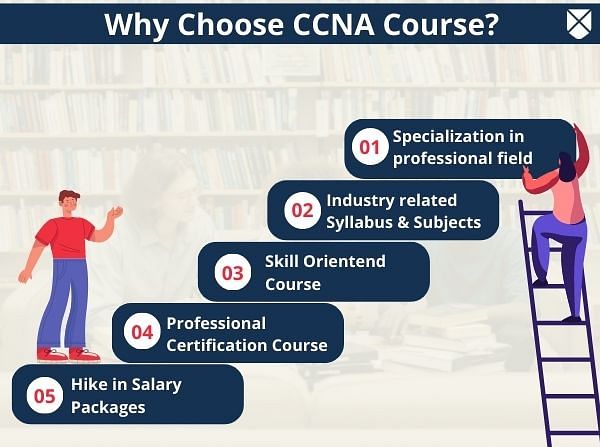
The Cisco Certified Network Associate (CCNA) course provides theoretical knowledge and practical training for students to develop their skills in the networking sector. Below are points regarding why choose a CCNA course:
Below are some points regarding who should pursue a CCNA course:
Also, Check: Scope of CCNA Certification
Cisco offers four levels of certification, which come under the Cisco career certification program. The students learn about networking and informational technology from entry to expert levels. Below are the details relating to the four levels of Cisco certification:
| Level | Certificates Granted | Description |
Entry Level | CCENT | Offers foundational networking knowledge and is often considered the starting point for a career in networking. |
Associate Level | CCNA, CCDA, CCNA Voice, CCNA Wireless, CCNA Security | Covers core networking concepts and skills. |
Professional Level | CCNP, CCDP, CCNP, CCNP Security, CCNP Voice, CCNP Wireless | Test knowledge of multiple technological tracks and advanced networking skills. |
Expert Level | CCIE Routing & Switching, CCDE, CCIE Security, CCIE Voice, CCIE Wireless, CCIE Storage Networking | Imparts knowledge and abilities at the expert level for designing, implementing, and managing intricate network systems. |
For admission to the course, candidates must fulfill the standard CCNA course eligibility criteria, which is given below:
Students interested in Cisco CCNA courses can follow the steps below:
Students who want to study the Cisco CCNA course have to be familiar with the test pattern and syllabus before the exam. The CCNA exam fees in India is approximately in the range of INR 22,000-24,000. Below is the CCNA exam structure:
Below is the list of the ten best institutes that help students prepare well for the CCNA course/exam:
| S.No. | Name of the Institute | Average Fees |
1 | NIIT University | – |
2 | I-Medita Solutions | INR 30,000 |
3 | NetworkBulls | INR 15,000 |
4 | Network Shala | INR 10,000 |
5 | RN Technologies | INR 10,000 |
6 | Net Experts in India | INR 8,000 |
7 | Network Geeks | INR 7,000 |
8 | Networkers Guru | INR 15,000 |
9 | CCNP Voice | INR 8,000 |
10 | Network ACE | INR 10,000 |
The CCNA course can be pursued online through various platforms that collaborate with various universities and offer high-quality education. Below is a detailed overview of the courses:
The courses provided below are mostly free of cost with live projects and discussion boards available. Below are the CCNA course details available on the Coursera learning platform:
| Name of the course | Duration |
Introduction to Networking by Cisco | 3 Hours |
Security Operation Center by Cisco | 11 Hours |
Configure and Verify NAT on Cisco Routers | 2 Hours |
Aruba CX Switching for Cisco Professionals | 7 Hours |
Below are the details regarding the CCNA course duration and fees on the Udemy learning platform:
| Name of the course | Duration | Average Cost |
CISCO 200-301 The complete guide to getting certified | 2 Hour | INR 499 |
CISCO CCNA Packet Tracer Ultimate Labs | 17 Hours | INR 449 |
CISCO CCNA 200-301: Networking Basics | – | INR 490 |
New CCNAx 200-125 Routing and Switching | 31.5 Hours | INR 1200 |
Below are the details regarding the CCNA course available on the Plural Sight learning platform:
| Name of the course | Duration |
Configuring a Cisco Router | 3 Hours |
Introduction to Networking for Cisco CCNA | 2 Hours |
Network Services for Cisco CCNA | 2 Hours |
Building Packet Tracer Labs for CCNA Study | 5 Hours |
CCNA certificate is widely recognized and candidates can renew the certificate to keep up with the latest updates and technologies. The certificate can be renewed as per the CISCO guidelines. Below mentioned are details regarding CCNA recertification:
The CCNA course syllabus and subjects are designed in such a way that candidates have the knowledge and skills necessary to establish, maintain, and troubleshoot any network-related concerns that can also be resolved. Some of the subjects that students get to learn in the CCNA course are:
Read More: CCNA Course Syllabus and Subjects
CCNA offers students opportunities to work for leading IT and networking companies. Graduates can also pursue similar certification courses offering similar career prospects, such as:
Below is the comparison between CCNA and CCIE:
| Course | CCNA | CCIE |
Full Form | Cisco Certified Network Associate | Cisco Certified Internetwork Expert |
Course Duration | 1.5 Years | 1.6 Years |
Eligibility | Should have passed 10+2 (high school degree) with a minimum of 55% marks. | Should have passed 10+2 (high school degree) with a minimum of 55% marks. |
Average Fees | INR 22,000 -30,000. | INR 50,000-1 Lakh |
Average Salary | INR 5.43 LPA | INR 6 LPA |
Read More: CCIE
Candidates, after completion of the CCNA certification course, can go for further certification courses of their interest. Students can also opt for higher education with the same networking sector as the core objective of their study. Listed below are some of the higher education options available to students:
The CCNA course offers students theoretical and practical skills that help them in their career growth. Candidates, after completion of this course, can work in top networking companies such as Juniper Networks, Amazon Web Services, etc. After the CCNA course, students can opt for some of the job roles offered to graduates, including:
The average salary package for CCNA courses in India is INR 5.43 LPA (Source: Payscale). The salary offered to the student varies with the skills and experience the candidate has in the networking sector, and it also varies with the course certification update.
Read More: CCNA Salary
CCNA graduates should develop networking skills and unified communication skills. Listed below are some of the important skills for CCNA graduates:
The syllabus for the CCNA course is divided into major subjects for the 1.5 years certification program. CCNA course mainly concentrates on the core subject and another practical subject which helps students to learn more theoretical and practical experiences in their hands. The CCNA job scope is vast in terms of career opportunities since the course helps to train students with the networking knowledge and skills required for their career development.
CCNA syllabus 2024 offers topics such as IP routing technologies, IP services (FHRP, Syslog, SNMP V2, and V3), LAN switching technologies, and WAN technologies. Some of the major subjects students get to learn in this certification course are Network Fundamentals, Network Access, IP Connectivity, IP Services, Security Fundamentals, Automation and programmability, and many others.
Cisco Certified Network Associate (CCNA) is designed in a way that meets the objectives and needs of the students who are interested in the networking profession. CCNA course mainly concentrates on the networking technologies which are developed in recent days. It also meets the wide range of students’ expectations in networking technologies and gives them the freedom to gain more knowledge and skills by doing this course.
Candidates with no preceding course can opt for the combination course and the examination covering both ICND1 and ICND2. Exam preparation can be done significantly through self-study, various online courses, textbooks and practice exams, on-site classroom programs, or intensive boot camps offered by different venues including Cisco’s approved knowledge partners. All CCNA course certified candidates specialize in one of seven technology paths:
| SI.NO | CCNA Course Specialization |
| 1 | Routing and Switching |
| 2 | Network Security |
| 3 | Design |
| 4 | Service Provider |
| 5 | Storage Networking |
| 6 | Voice |
| 7 | Wireless |
The CCNA course is designed to impart knowledge about computer networks, various protocols used in Communication, Managing configuring Cisco Switches and Routers, and various WAN technologies.CCNA exam syllabus is considered to be one of the most famous course syllabi in networking.CCNA subjects details provide a vast knowledge of networking technologies for the students who opt for this course.
Some of the common topics which are covered in CCNA subjects are OSI models, IP address, WLAN and VLAN, Network security management (ACL included), Routers and routing protocols (EIGRP, OSPF, and RIP), IP Routing, Network Device Security, Troubleshooting, etc.
The course syllabus is designed with core subjects that provide students with a broad range of knowledge about networking. The main objective of the CCNA certification course syllabus is to train students with computer and networking technologies developed in recent days. The course subjects list as follow:
The CCNA certification verifies an Engineer’s understanding of network installation, operation, and troubleshooting. Engineers at the CCNA level are also known as Cisco SMARTHands because they are the boots on the ground who transport and stack physical Cisco equipment as well as perform installations, deployments, and basic upgrades. CCNA specialisation includes:
Each training centre has its timetable for a specific CCNA course. It is, however, contingent on the aspirant’s efforts and abilities. The exam is usually given after 30 days, one month, or six months. The aspirant hopes to score between 810 and 850 points out of a possible 1000. The certification lasts three years. As a result, after three years, one may want to retake the exam to ensure that the certification is still valid.
CCNA course structure is designed in this way for networking professionals.CCNA certification course is further divided into many major subjects.CCNA course syllabus includes basic mitigation of security threats, introduction to wireless networking concepts and terminology, and performance-based skills. Research projects will help the students with more career opportunities. Candidates with a strong interest in networking management can develop their research projects. The course structure is as follows:
CCNA course curriculum takes into account the various teaching techniques followed by the IT field with developing technologies.CCNA certification is a networking-related course, so digital learning techniques are used to teach this course. In addition to the core, subjects students are also encouraged to do their internships and training based on their interesting specializations. Teaching Methodology which is strictly followed by networking professionals is a digital learning method and but it differs from how students want to learn their networking techniques. Listed below are some of the teaching methodologies in general:
CCNA course projects can be done with the students’ interest in networking professionals.CCNA certification can also be done without projects.CCNA projects can be executed with Cisco equipment or using a Cisco packet tracer. The CCNA projects are ideal for students who are pursuing or completed the certification course and would like to have practical experience in the networking profession. The course projects can be designed with real-world experience. Some popular course projects are:
CCNA certification course books are available both online and in many stores with many authors and publications.CCNA’s new syllabus books cover all the major subjects in the course and it also gives students knowledge about different areas of networking.CCNA book online is available free in a pdf format for students’ easy access.
The certification course books differ with the edition according to the year students opt for this course. The best CCNA books to study for the CCNA exam are the latest editions of Cisco’s books are Cisco CCNA ICND1 and CCNA Routing and Switching ICND2. Students who have a strong interest in the networking sector can also invest in books after doing some research about the books. Some of the best reference books are:
| Name of the Books | Authors |
| CCNA Preparation Library (640-801) | Cisco |
| Cisco Certified Network Associate Study Guide (640-802) | Todd Lammle |
| Cisco CCNA Exam Flash Card Practice Library (640-607) | Eric Rivard, Jim Doherty |
| CCNA Exam Certification Guide (640-607) | Wendell Odom |
| CCNA Practical Studies (640-607) | Gray Heap, Lynn Maynes |