
- info@wingeducations.com
- +91 (705) 495-5296
- Mon - Sat : 10.00-18.00
| Degree | Bachelors |
| Full Form | Bachelor of Science in Forensic Science |
| Duration | 3 Years |
| Age | Minimum age limit is 18 years |
| Minimum Percentage | 50% in 10+2 from a recognised board in India |
| Average Fees | ₹30K – 2.5 LPA |
| Similar Options of Study | M.Sc [Forensic Science] |
| Average Salary | INR 3.5 LPA |
| Employment Roles | Clinical Forensic Medicine, Forensic Anthropologist, Forensic Scientist |
BSc Forensic Science is the application of analytical methods and procedures to legal crimes under investigation. The B.Sc Forensic science job scope is vast and the field has changed noticeably over time. Basic elements of Forensic sciences include Forensic pathology, psychiatry, psychology, Forensic medicine, and Forensic dentistry. BSc Forensic Science is a 3-year undergraduate course focusing on law enforcement by examining evidence retrieved from crime scenes. Students who pursue a Forensic science degree learn how to process, store, and analyze various types of evidence. The course falls under the umbrella of B.Sc Courses.
Forensic Sciences is primarily a laboratory-based science that includes B.Sc Forensic science subjects like elements of chemistry, biology, toxicology, ballistics, fingerprinting science, questioned documents, and impressions. The average BSc Forensic Science salary ranges from INR 3.5 LPA.
The admissions into BSc Forensic Science requires the candidate to fulfil certain requirements such as the age limit, subject requirement, merit score, etc. Given below is the BSc Forensic Science eligibility criteria:
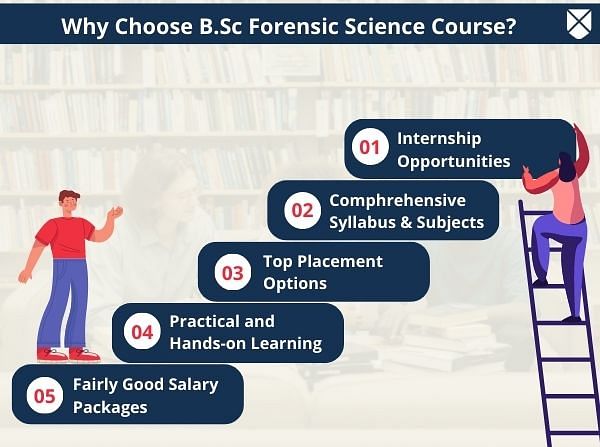
One of the advantages of a career in Forensic science is gaining access to the latest cutting-edge technology, techniques, and methods. In addition, some often contribute to the field by writing journal articles or speaking at industry conferences about their study and findings. Listed below are some of the important points on why choosing BSc in Forensic Science can be the right choice:
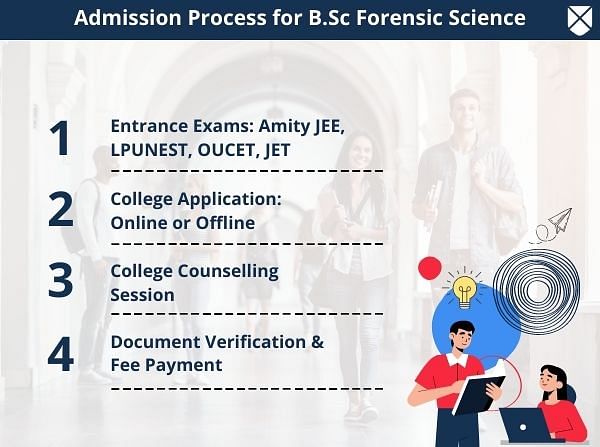
The admission procedure for the B.Sc Forensic Science course is done either through merit-based entry to the program or is based solely on the candidate’s qualifying test score. Entrance-based admission to a course is based on a candidate’s performance in the national, state, or college-level B.Sc Forensic Science entrance exam.
Given below is the step-by-step BSc Forensic Science admission process:
Read More on B.Sc Admission Process
To be admitted to these academic courses, Forensic science candidates must pass such entrance exams. The requisite cut-off marks for the entrance test are determined at the institute’s discretion that administers the test. Those who cut the entrance exam for B.Sc Forensic science will be invited to the final selection process. Some of the most popular B.Sc Forensic science entrance exams are listed below:
| BSc Forensic Science Entrance Exam | Exam Dates | Accepting Colleges |
| Amity JEE | May 15-31, 2024 | Amity University |
| LPUNEST | Jan 20 -Feb 5, 2024 | Lovely Professional University |
| OUCET | Jun 2024 (Tentatively) | Babasaheb Bhimrao Ambedkar University, Banaras Hindu University, Central University |
| JET | Jan 13, 2024 | Aryabhatta Research Institute of Observational Sciences, Bose Institute, Homi Bhabha National Institute |
| IUET | Mar 12, 2024 | Guru Gobind Singh Indraprastha University, Amity University, Manipal University |
| AIFSET | Jan 25, 2024 | Annai Fathima College of Arts and Science, Vivekananda Global University, RR Institutions |
The above-mentioned entrance exam eligibility requirements are entirely dependent on the conducting body and therefore differ. Some of the similarities between the common engineering entrance exams are described below:
The average B.Sc. in Forensic Science fees range from INR 50,000 to 2.5 LPA. The cost of a course can vary depending on the college’s or university’s facilities and infrastructure.The best learning institutes within the country for the B.Sc Forensic Science course are available for the specified aspirants in India. Below is the list of the ten best B.Sc Forensic science colleges in the country:
Name of the College | Average Tuition Fees | Admission Fees | Miscellaneous Fees |
| Dr. Hari Singh Gour University Sagar | INR 900 PA | INR 1,000 | INR 2,000 PA |
| Bundelkhand University | INR 30,000 PA | INR 1,000 | INR 500 PA |
| Galgotias University | INR 50,000 PA | – | INR 10,000 PA |
| Dr. Bhim Rao Ambedkar University | INR 45,000 PA | INR 2,000 | INR 3,500 PA |
| Osmania University | INR 4,000 PA | INR 500 | INR 2,000 PA |
| Gujarat Forensic Sciences University | INR 80,000 PA | INR 1,200 | INR 2,000 PA |
| Panjab University | INR 43,900 PA | INR 1,000 | INR 9,000 PA |
INR 1.2 LPA | INR 15,000 | INR 4,000 PA | |
INR 1.75 LPA | INR 10,000 | INR 8,400 PA | |
INR 57,000 PA | INR 1,000 | INR 500 PA | |
INR 60,000 PA | INR 1,500 | – |
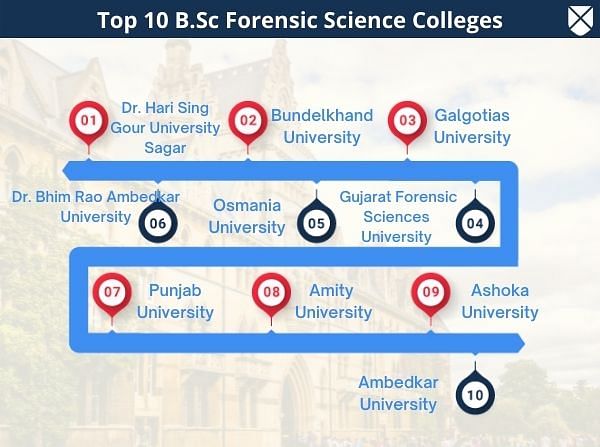
Below listed are the location-wise BSc Forensic Science colleges in India:
| Location | Average Fees |
| Top BSc Forensic Science Colleges in Mumbai | INR 1,50,000 LPA |
| Top BSc Forensic Science Colleges in Coimbatore | INR 1,00,000 LPA |
| Top BSc Forensic Science Colleges in Allahabad | INR 1,30,000 LPA |
| Top BSc Forensic Science Colleges in Jaipur | INR 45,000 PA |
| Top BSc Forensic Science Colleges in Indore | INR 2,50,000 PA |
| Top BSc Forensic Science Colleges in Dehradun | INR 2,75,000 PA |
| Top BSc Forensic Science Colleges in Bangalore | INR 1,60,000 PA |
| Top BSc Forensic Science Colleges in Kolkata | INR 2,80,000 PA |
| Top BSc Forensic Science Colleges in Visakhapatnam | INR 2,40,000 PA |
| Top BSc Forensic Science Colleges in Mysore | INR 1,73,000 PA |
Aspirants can pursue the course in full-time or part-time mode. Below are the types of B.Sc Forensic Science courses in detail:
The full-time B.Sc Forensic Science course lasts around three years. B.Sc Forensic Science requires more practical knowledge than theoretical understanding. The advantage of a full-time course is that students can gain a lot more exposure, experience, and knowledge through direct interaction with their peers and faculty.
The part-time B.Sc Forensic Science course is designed for students who cannot attend regular classes. The advantage of the part-time course is that students can pursue this course while simultaneously being engaged in employment, etc.
Most public colleges provide this course at the undergraduate level on a full-time basis, however, some private universities also offer this course through distance education. In a tremendously diversified group, this distance method creates diversity.
Also, Check: Forensic Science Courses After 12th
B.Sc-M.Sc Forensic Science: B.Sc-M.Sc Forensic Science is an Integrated 5-year course in the field of Forensic Science. The programme aims to offer students a broad perspective and expertise in the field of forensic science in order to promote truth and justice in the country. After completing the course, students will be able to apply their laboratory skills to the Forensic community’s career needs.
The B.Sc Forensic Science program uses a choice-based credit scheme, enabling students to choose their elective subjects. The B.Sc Forensic Science course details follow a set pattern of main, elective, lab, and project subjects. Given below is the list of BSc Forensic subjects and the topics covered:
| BSc Forensic Science Subjects | Topics Covered |
| Introduction to Forensic Science | History of Development of Forensic Science in India, Tools and Techniques in Forensic Science, Organizational Set up of Forensic Science Laboratories in India |
| Crime and Society | Basics of Criminology, Crime, Criminal Justice System, Filing of Criminal Charges, Human rights and criminal justice system in India |
| Criminal Law | Law to Combat Crime, Constitution of India, Acts Pertaining to Socio-economic and Environmental Crimes |
| Forensic Psychology | Basics of Forensic Psychology, Psychology and Criminal Behavior, Detection of Deception |
| Forensic Dermatoglyphics | Basics of Fingerprinting, Development of Fingerprints, Other Impressions |
Read More: B.Sc Forensic Science Syllabus & Subjects
The field of forensic science is primarily concerned with the investigation and resolution of crimes. The table below showcases the differences between B.Sc Forensic Science and B.Tech Biotechnology:
| Course | B.Sc Forensic Science | B.Tech Biotechnology |
| Full-Form | Bachelor of Science in Forensic Science | Bachelor of Technology in Biotechnology |
| Stream | Science | Science |
| Course Duration | 3 years | 4 years |
| Eligibility | Students with a 12th-grade science or a three-year polytechnic diploma | 12th-grade pass in science from a recognised board. |
| Entrance Exams | AIFSET, JET, IUET, | WBJEE, JEE Main, JEE Advanced, KCET |
| Top Colleges | SGT University, DU, Amity University | IIT Kharagpur, IIT Roorkee |
| Fees | INR 30,000 – 2.5 LPA | INR 1.2 – 10.5 LPA |
Read More: B.Tech Biotechnology
Below are some preparation tips made by our experts for aspirants who want to pursue a B.Sc Forensic Science course:
Know the Syllabus: Learning the syllabus ahead of time will help students concentrate on key points during lectures and exams.
Make a Strategy: Students should create a study plan that will allow them to study according to the syllabus and complete it before exams.
Have a sound foundation: If one already knows what area of computer science and wants to specialize in, it’s tempting to hop straight into a highly specialized course.
After earning B.Sc Forensic Science, aspirants can obtain a variety of postgraduate degrees. The postgraduate degrees are two years in duration. The following are the postgraduate degrees available for a career in Forensic science:
PG Diploma in Forensic Science: The Post Graduate Diploma or Degree (PG Diploma or PGD) in Forensic Science is a one-year full-time postgraduate program that focuses on applying science to civil and criminal laws and legislation, emphasizing criminal investigation.
MSc Forensic Science: The Master of Science in Forensic Sciences is a two-year full-time postgraduate program split into four semesters. Forensic science is used to figure out what happened before, during, and after a crime. Students may concentrate on one aspect of Forensics, such as biology or cybersecurity, etc.
PhD in Forensic Science: PhD Forensic Science is a research-based curriculum that can last from two to five years. In India, the course is taught in several prestigious universities. The emphasis of the course is on collecting physical evidence that will reveal the original cause of death.
Freshers’ annual compensation ranges from INR 2.5 to 5 LPA. It increases to more than INR 8 LPA with experience or seniority. The benefits are enormous because the majority are government-sponsored organizations.
| BSc Forensic Science Job Role | Average Salary |
| Fingerprint Technician | INR 4.6 LPA |
| Pathologist Assistant | INR 2.6 LPA |
| Forensic Specialist | INR 3.1 LPA |
| Forensic Scientist | INR 4.9 LPA |
| Forensics Manager | INR 8.0 LPA |
Read More: B.Sc Forensic Science Salary in India
After completing a B.Sc Forensic science, an individual can work both in the public and private sectors depending on their preferences. Some popular areas where Forensic science graduates can work are:
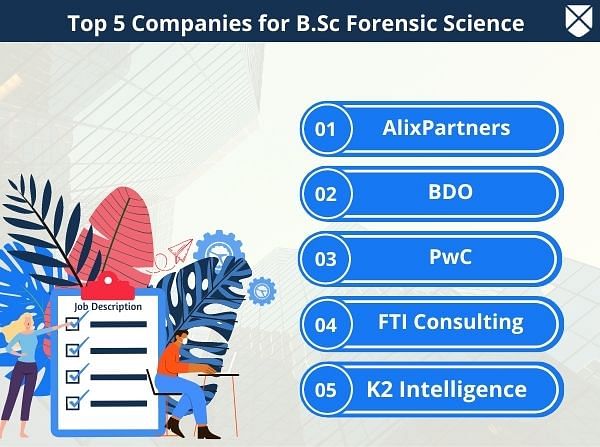
B.Sc. in Forensic Science is a course of study that assists in crime detection. B.Sc Forensic Science covers a broad variety of topics, including thoroughly examining and studying various items found at crime scenes. So Students must possess academic skills and a basic understanding of the field, and a strong desire to learn more about it. A few of the ideal skillsets for a Forensic student are mentioned below:
The three-year course is broken down into six semesters and includes a mix of theory, practical, seminars, assignments, projects, lectures, and class assessments. The B.Sc Forensic Science course teaches about crimes and crime scenes, as well as related procedures and tools for investigating any crime, along with all lab techniques and evidence collection techniques. The semester-by-semester B.Sc Forensic Science subject list is listed below:
The table below contains the list of B.Sc Forensic Science subjects in the first year:
| Semester I | Semester II |
| Introduction to Forensic Science | Chemistry |
| Environmental Science | Law to Combat Crime |
| English | Criminal Law |
| Crime and Society | Physics |
| Digital Forensics | Forensic Psychology |
| Tools and Techniques in Forensic Science | – |
The table below contains the list of B.Sc Forensic Science subjects in the second year:
| Semester III | Semester IV |
| Criminalistics | Forensic Biology |
| Technological Methods in Forensic Science | Computer Science |
| Forensic Dermatoglyphics | Forensic Chemistry |
| Zoology | Anthropology |
| Botany | Questioned Documents |
The table below contains the list of B.Sc Forensic Science subjects in the third year:
| Semester V | Semester VI |
| Psychology | Forensic Science and Society |
| Introduction to Biometry | Forensic Medicine |
| Economics | Computer Forensics Investigations |
| Forensic Ballistics | Forensic Anthropology |
| Forensic Toxicology | Handwriting Identification and Recognition |
B.Sc Forensic Science course is divided into three parts-core subjects, elective subjects, and lab subjects. Subjects in B.Sc Forensic Science followed in the course are mentioned below:
The core B.Sc Forensic Science subjects list of essential subjects that all B.Sc Forensic Science students study irrespective of their optional Subject choices, is as follows:
A B.Sc Forensic Science course is designed as a core subject in general. The course is divided into six semesters, with the first year consisting of a basic introduction to forensics. Forensic Biology, Forensic Physics, and Forensic Serology are the primary topics covered in this course. Each semester includes lab and practical subjects in addition to core subjects. The following is the course structure:
There are various methods for teaching B.Sc Forensic Science. In addition to traditional lecture-based training, Forensic Science Laboratories, community enterprises, and other action-based learning methodologies are used. Students may work in groups to bring out actual answers to a particular case for their final year project.
Apart from this, the B.Sc Forensic Science curriculum is designed to guarantee that students develop numerous communicative and interpersonal skills throughout the course of three years. The following are the various teaching approaches used in the B.Sc Forensic Science syllabus:
Throughout the three-year programme, students are required to learn the application of scientific knowledge in the investigation of crimes. Students submit projects throughout the B.Sc Forensic Science course to demonstrate the skills and methods they have learned through training. This assures various recruiters or organizations that these aspirants have a realistic approach to the B.Sc Forensic Science course subjects when they come to offer job opportunities to them. Some project ideas for B.Sc Forensic Science is listed below:
The purpose of the B.Sc Forensic Science course textbooks is to provide a foundational understanding of the course. The B.Sc Forensic Science books give students an in-depth study of their area of concentration in addition to providing a basic approach. Students can access the textbooks for the course both online and offline. Students should obtain the PDF versions of B.Sc Forensic Science books wherever possible to save money on their purchases.
Students can make an informed decision by thoroughly understanding the course requirements by downloading the course details prior to enrolling in the course. The following are the reference books for the B.Sc Forensic Science syllabus:
| Name of Book | Author |
| Principles of Proteomics | Richard Thyman |
| Inorganic Chemistry | Shriver and Atkins |
| Physical Chemistry | P. Atkins and J de Paula |
| Molecular Diagnostics | George P. Patrinos |
| Mycobacterial Protocols | Tanya Parish and Amanda Claire Brown |
| Environmental Biology | Verma P.S and Agarwal V.K. |
| Physical Evidence in Forensic Science | Henry C. |