- info@wingeducations.com
- +91 (705) 495-5296
- Mon - Sat : 10.00-18.00
BSc Computer Science or BSc CS is a three-year undergraduate program that provides theoretical knowledge and concepts in computer science, computer applications, and related services. BSc Computer Science course can provide job opportunities such as Mobile App Developer, UI/UX Developer, Software Developer, etc.
BSc Computer Science Admission requires students to have a 50% aggregate in Higher Secondary (10+2) with physics, chemistry, and mathematics as core subjects. The candidate also needs to qualify for entrance exams such as CUCET, JEE MAIN, JEE Advance, etc., depending on the college requirement. The BSc Computer Science syllabus equips students with the required knowledge in subjects such as Disk Operating Systems, Advanced Programming using Python, Discrete Mathematics, Java Programming, Database Management systems, etc.
Table of Contents
| Degree | Bachelors |
| Full Form | Bachelor of Science in Computer Science |
| Duration | 3 Years |
| Age | No specific age limit |
| Subjects Required | Physics, Chemistry, Mathematics etc |
| Minimum Percentage | 50-55% |
| Average Fees | ₹10K – 1 LPA |
| Similar Options of Study | BCA, BS, B.Sc+M.Sc |
| Average Salary | INR 4 LPA |
| Employment Roles | Software Engineer / Programmer, Information Technology (IT) Consultant, etc. |
| Top Recruiters | HCL Technologies Ltd., Tata Consultancy Services Limited, Capgemini, etc. |
BSc CS full form is Bachelor of Science in Computer Science, the course focuses on giving students a thorough understanding of computer science’s principles and procedures. The average BSc Computer Science fees are in the range of INR 10,000 – 1 LPA.
The BSc computer science jobs are vast and provide scope in various industries, including IT departments, multinational corporations, universities, and government agencies.
The basic BSc Computer Science eligibility criteria are standard for most colleges. The BSc in Computer Science eligibility criteria are discussed below:
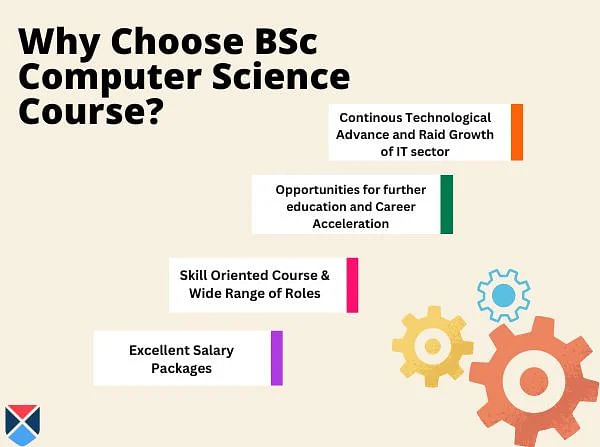
When students decide to pursue a BSc in Computer Science they should research about course details to ensure that they are aware of the course they are enrolled in. Some of the common queries that students encounter are, “What does a BSc Computer Science course graduate do” and “Why choose BSc Computer Science course?”
To get the answers, we have broken them down into the following :
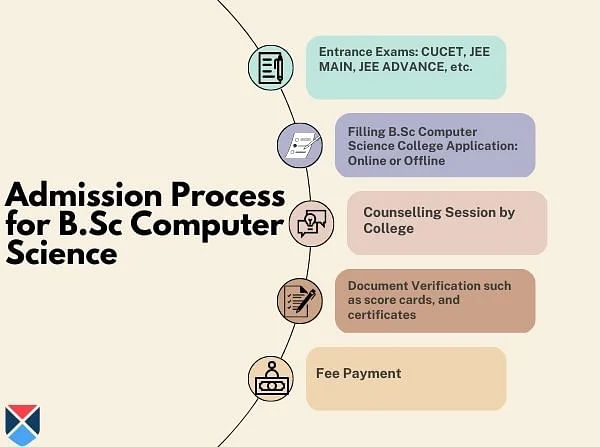
BSc Computer Science admission can be done both online from the website and offline methods by directly visiting the college’s admissions office. Below are some points regarding the details of the BSc CS admission process in general:
Also, Read More on BSc Admission
Admission to most colleges’ BSc Computer Science courses is based on merit. BHU and JNU, on the other hand, accept admission to their BSc Computer Science course through a university-level entrance exam.
Some of the main entrance exams for BSc Computer Science are listed below:
| BSc Computer Science Entrance Exams | Exam Dates | Accepting Colleges |
| JEE Main | Jan 24 – Feb 1, 2024 | Christ University, Sharda University, NIT Trichy |
| CUCET | Sep 18-20, 2024 | Babasaheb Bhimrao Ambedkar University, BHU, Central University of Andhra Pradesh |
| IISER | June 15, 2024 | Indian Institute of Science Education and Research |
Given below are some of the general patterns for the BSc Computer Science entrance exam:
Choosing the right college for a Bachelor of Science in Computer Science (BSc CS) can be a daunting task. There are many factors to consider, such as the program’s reputation, faculty expertise, course offerings, career placement, and campus life.
BSc Computer Science course fees in India range between INR 10,000 to 1 LPA. Factors such as the demand for the college course, the infrastructure provided by the college, the college’s location, etc., can influence the college’s BSc Computer Science fees structure.
Listed below are the top BSc Computer Science colleges with their fee structures in India:
| Name of the Institute | Tuition Fees | Admission Fees | Miscellaneous Fees |
| Christ University | INR 45,000 PA | INR 1000 | INR 59,000 PA |
| Women’s Christian College | INR 41,000 PA | INR 1200 | INR 23,000 PA |
| Bharati Vidyapith College | INR 98,966 PA | INR 1050 | INR 12,745 PA |
| The Oxford College of Science | INR 25,000 PA | – | INR 28,000 PA |
INR 19,000 PA | INR 20,000 | INR 2,500 PA | |
INR 6,000 PA | INR 1,250 | INR 1500 PA | |
INR 14,000 PA | INR 15,000 | – | |
INR 38,600 PA | INR 5,000 | INR 2,500 PA | |
INR 42,000 PA | INR 10,000 | INR 7,500 PA | |
| Loyola College | INR 48,940 PA | INR 10,000 | – |
INR 53,000 PA | INR 15,000 | – | |
INR 70,000 PA | INR 40,000 | – | |
INR 38,000 PA | INR 1,112 | INR 200 PA |
Read More: Top BSc Computer Science Colleges in India
Below listed are the location-wise BSc Computer Science colleges in India:
| Location | Average Fees |
| BSc Computer Science Colleges in Mumbai | INR 5.5 LPA |
| BSc Computer Science Colleges in Delhi | INR 1.2 LPA |
| BSc Computer Science Colleges in Chennai | INR 1.0 LPA |
| BSc Computer Science Colleges in Bangalore | INR 1.2 LPA |
| BSc Computer Science Colleges in Hyderabad | INR 40,000 PA |
| BSc Computer Science Colleges in Kolkata | INR 50,000 PA |
| BSc Computer Science Colleges in Pune | INR 1.5 LPA |
| BSc Computer Science Colleges in Kerala | INR 26,000 PA |
| BSc Computer Science Colleges in Nashik | INR 1.5 LPA |
| BSc Computer Science Colleges in Bhubaneswar | INR 30,000 PA |
With the significant rise of the IT business, as well as huge growth in software and computer-related technology, the number of people interested in pursuing a B.Sc in Computer Science has skyrocketed. Full-time, online, and distance-learning B.Sc Computer Science programs are provided to meet the need.
Full-Time B.Sc Computer Science course would last three years. The usual cost ranges from INR 10,000 – 1 LPA. This is an in-person traditional form of teaching where admission is granted according to a merit list. Some colleges, however, favor entrance exams.
For online education, the B.Sc Computer Science Admission Process is based only on merit. Because it is a certificate program, there are no entry examinations required at the best B.Sc Computer Science colleges that offer B.Sc Computer Science online.
Here are some details about the Online BSc Computer Science course:
Distance education, also known as distance learning, is the education of students who may not always be physically present at a school. Here are some details about the Distance B.Sc Computer Science course:
An integrated BSC degree combines a Bachelor of Science in Computer Science (BSc CS) with a Master of Science in Computer Science (MSc CS). The Integrated BSc Computer Science Course in India is a thorough curriculum that includes undergraduate and postgraduate computer science studies with subjects such as programming languages, algorithms, data structures, computer networks, etc.
Students who have completed a diploma in computer science or a similar discipline are eligible for the BSc Computer Science Lateral Entry program. They can bypass the first-year courses they already took for their diploma and move on to the second year of the BSc Computer Science qualification.
The eligibility for the B.Sc Computer Science Lateral Entry is that the students must have 55% in their 10 + 2 + 1-year Computer Application / 10+3 year Polytechnic Diploma + 6-month Computer Application
The B Sc Computer Science full form is Bachelor of Science in Computer Science, the course curriculum is structured to cover all of the important aspects of training students for a career in the computer science and software industry. Listed below are the BSc Computer Science subjects and the topics covered:
| BSc Computer Science Subjects | Topics Covered |
| Problem-Solving Techniques | Control Structures, prototypes, Arrays, Structures, Pointers, Functions |
| Mathematics | Sets, Relations and Functions, Matematical Connectives, Theory of Equation, Matrices Differentiation |
| Object Oriented Programming using C++ | Introductions to OOPS, Introduction to C++, Functions, Classes and Objects, Inheritance and Polymorphism |
| Data Structures | Stack and Queues, Trees, Searching and Sorting, Graphs |
| Java Programming | Introduction to Java, Object Oriented Concepts, Methods and Classes, Inheritance and Exception Handling, Multithreading, Haplet and String Handling |
| Multimedia and its Application | Multimedia Hardware, Multimedia Software, Authoring Tools and Text, Images and Animation |
Read More: BSc Computer Science Syllabus and Subjects
The BSc Computer Science courses are offered by various private and government colleges with core focus on imparting required skills and knowledge related to computer science. Given below is the comparison of top three colleges offering BSc in Computer Science course in India:
| Parameter | Delhi University | Christ University | Chandigarh University |
| Overview | Delhi University DU has been regarded as one of the finest universities in India. It ranks 18th in the NIRF 2020 overall rankings. It offers a wide array of courses in both UG and PG level | Christ University is one of the top deemed private universities in India. It offers a wide range of courses at the UG, PG, MPhil, and Ph.D. levels. | Chandigarh University is one of the top private universities in India. It has over 13,000 students. It offers courses at all levels of education starting from the diploma to the Ph.D. level. |
| NAAC Rating | A+ | A | A+ |
| Average Fees | INR 60,000 | INR 65,000 PA | INR 2.2 LPA |
| Average Salary | INR 4,50,000 | INR 6,.85 LPA | INR 7 LPA |
| Recruiters | HCL Technologies, American Express, Amazon, etc. | DELL, Amazon, Tech Mahindra, etc. | Cognizant, Wipro, Genpact, PlaySimple, etc |
BSc in Computer Science focuses on developing skills in students to design, create, and maintain computer systems and software applications, whereas BCA courses aim at imparting skills and knowledge related to Data Structures, Database Management Systems, User interfaces, User Experience, etc.
Below mentioned is the difference between BCA and BSc Computer Science:
| Parameters | Bachelor of Science in Computer Science (BSc CS) | Bachelor of Computer Applications (BCA) |
| Degree | Undergraduate (Bachelor of Science) | Undergraduate (Bachelor of Computer Application) |
| Duration | 3 years | 3 years |
| Admission Process | Merit-Based/ Entrance Exam | Entrance Exams or Merit Based |
| Average Fees | INR 20,000-60,000 PA | INR 2 to 3 LPA |
| Top Colleges | Delhi University, Christ University, VIT University, St. Xavier’s College, Fergusson College, etc. | Symbiosis Institute of Computer Studies and Research, Christ University, Stella Maris College, etc |
| Average Salary | INR 4 LPA | INR 4 to 8 LPA |
Read More: BCA
Also, Check:
A bachelor’s degree in computer science can prepare an applicant to work in various computer-related fields, such as hardware or software. Candidates with a BSc in Computer Science will seek higher education opportunities, which would be advantageous to them.
A BSc Computer Science graduate can follow many postgraduate programs:
Read More: Top 10 Courses After BSc Computer Science
In India, a bachelor’s degree in computer science is a successful and promising career choice. After completing a BSc Computer Science qualification, students can work in a variety of fields. In general, the starting salary for a computer programmer is around INR 4 LPA. Given below is the career opportunities for BSc Computer Science graduates along with the salary details:
| Job Role | Average Salary |
| Software Engineer | INR 8.8 LPA |
| Software Developer | INR 9.0 LPA |
| Programmer | INR 5.5 LPA |
| Java Developer | INR 5.6 LPA |
| NET Software Developer | INR 5.9 LPA |
| UI/UX Designer | INR 6.0 LPA |
Read More: BSc Computer Science Salary in India
A graduate with BSc in Computer Science has a broad range of lucrative employability opportunities in a wide variety of industries and areas of employment such as Healthcare, Information Technology, E-Commerce, Logistics, etc.
In India, there are numerous scholarships available for BSc Computer Science students. Here are a few examples:
Also, Check: Computer Science Courses after 12th
The benefits of BSc Computer Science are compiled with having a theoretical understanding of subjects and enhancing the skill sets required for future jobs. Below are a few skills that graduates can work on:
BSc Data Science subjects cover a broad spectrum, providing students with a strong foundation in data science. The BSc CS syllabus explores vital areas like statistics, programming, mathematics, and data analysis, emphasizing key tools like Python and R for data manipulation. Elective courses such as computer graphics, cloud computing, and more offer flexibility, allowing students to align their education with their specific interests and career goals.
By merging theory and practical skills in data handling and visualization, BSc Computer Science course intends to give students a thorough understanding of software development, programming languages, and computer systems. The BSc Computer Science job scope is constantly evolving with the advancements in technology and providing graduates with various range of roles like web developers, database administrators, system analysts, etc.
Table of Contents
A variety of topics pertaining to computer science are covered in the BSc Computer Science course giving a thorough understanding of software engineering concepts, programming languages, algorithms, and computer systems. Below is the BSc Computer Science subjects list for the core and elective subjects:
The core B.Sc Computer Science subjects include the following:
The BSc in Computer Science syllabus also includes practical lab subjects such as:
The elective BSc computer science subjects include the following:
The following are some of the topics and information that will be covered in the BSc Computer Science syllabus. Students will be exposed to basic calculus and other areas of mathematics throughout the BSc Computer Science subjects, which will aid in the theoretical knowledge of computer science.
| Subjects | Topics Covered |
| Introduction to Windows | MS Windows, and its various elements of the Windows title bar, menu bar, maximize and close buttons, borders and corners, scroll bars, deleting unnecessary files, etc. |
| Introduction to Number systems and codes | Different number systems and their conversions (Decimal, Octal, Binary, and Hexadecimal), Coding – BCD, Gray, ASCII, etc. |
| Functions | Definition, function and prototyping, Types of Functions, Type of Arguments, Passing arrays to Functions, Storage class in C-automatic, etc. |
| Introduction to Programming Concepts | Types of Programming Languages, Classification of Software, Application Software and System Software, Structured Programming, and Flowcharts with Examples |
| Disk Operating System | Introduction to DOS Commands, Types of DOS Commands WildCard Character in DOS Directory Related Commands, Filters & Redirection, Batch file. |
The following table shows the structure of the BSc CS syllabus. Certain colleges may use a curriculum that differs slightly from the standard, but the core of the syllabus structure remains the same. The BSc CS subjects list is given below according to semesters:
Below mentioned are the subjects of the BSc CS 1st year syllabus:
Semester Ⅰ | Semester Ⅱ |
Introduction to Digital Electronics | Front Office Management |
Basics of Computer Science | Discrete Mathematics |
Environmental Sciences | Computer Organization |
Foundation course in Mathematics | Fundamental of Open Source Software-LINUX |
Functional English-I | Value and Ethics |
Below mentioned are BSc Computer Science subjects in the 2nd year:
Semester III | Semester IV |
Object-Oriented Programming using C++ | Database Management Systems |
Operating Systems concepts | Introduction to Computer Network |
Introduction to Data Structures | Numerical Analysis |
System Analysis and design | System Programming |
Technical Writing | Report Writing(Yantra) |
Analytical Skill Development-I | Analytical Skill Development-II |
Below mentioned are BSc Computer Science subjects in the 3rd year:
Semester V | Semester VI |
Python Programming | Introduction to Web Technology |
Introduction to Software Engineering | Project Work |
Mobile Application Development | – |
Personality Development Program | – |
Minor Project-I | – |
The six-semester B.Sc Computer Science program at Madras University is meant to provide students with a high level of technical abilities in problem-solving and application development. Given below is the general syllabus for the same:
| Semester I | Semester II |
| Other languages – I | languages – II |
| English – I | English – II |
| Problem-Solving using Python | Computer Organization |
| Problem-Solving using Python Lab | Computer Organization Lab |
| Mathematics I | Mathematics II |
| Soft Skill I | Basic Language |
| III Semester | IV Semester |
| Computer Network | Software Engineering |
| Operating System | Introduction to Data Science |
| Relational Database Management System | Introduction to Cloud Computing |
| Operating System Lab | CASE Tools and Testing Tools Lab |
| PL/SQL Lab | Mini Project |
| V Semester | VI Semester |
| Tamil/ Other languages | Tamil/ Other languages |
| English – III | English – IV |
| Java and Data Structures | Web technology |
| Data Structures using Java Lab | Web Technology Lab |
| Physics I / Statistics I | Physics II / Statistics II |
| Environmental Studies | Soft Skill- II |
For those interested in computer science, Mumbai University provides a three-year B.Sc Computer Science degree. Admission is, however, dependent on entrance exams. The following is Mumbai University’s BSc CS syllabus.
| I Semester | II Semester |
| Computer Organization and Design | Programming with C |
| Programming with Python- I | Programming with Python– II |
| Free and Open Source Software | Linux |
| Database Systems | Data Structures |
| Discrete Mathematics | Calculus |
| Descriptive Statistics and Introduction to Probability | Statistical Methods and Testing of Hypothesis |
| Ability Enhancement Course | Green Technologies |
III Semester | IV Semester |
| Theory of Computation | Physical Computing and IoT Programming |
| JAVA | Skill Enhancement: Web Programming |
| Operating System | Fundamentals of Algorithms |
| Database Management Systems | Advanced JAVA |
| Combinatorics and Graph Theory | Computer Networks |
| V Semester | VI Semester |
| Artificial Intelligence | Architecting of IoT |
| Skill Enhancement: Android Developer Fundamentals | Game Programming |
| Linux Server Administration | Wireless Sensor Networks and Mobile Communication |
| Software Testing and Quality Assurance | Cyber Forensics |
| Information and Network Security | Cloud Computing |
UniPune is a collegiate public state university with 43 academic departments and highly qualified faculty. The following is the syllabus for the B.Sc Computer Science course at Pune University.
| I Semester | II Semester |
| Problem-solving using Computers and C programming | Object-Oriented Concepts using C++ |
| File Organization and Fundamentals of Database | Software Engineering |
| Computer Science Practical | Data Structures Practicals and C++ Practicals |
| Data Structures using ‘C’ | Database Practicals & Mini Project using Software Engineering Techniques |
| Relational Database Management System | System Programmings |
| III Semester | IV Semester |
| Theoretical Computer Science | Data Structures and Algorithms |
| Computer Networks | Computer Networks |
| Internet Programming | Mathematics |
| Programmings in JAVA | Object-Oriented Software Engineering |
| V Semester | VI Semester |
| Constraints | Protection and Security |
| Structure of Relational Databases | Computer Environment |
| Pictorial representation of ER | Client-Server Computing |
| Operating System Services | Special Purpose Systems |
The curriculum for the B.Sc Computer Science is structured to cover all of the important aspects of training students for a career in the computer science and software industry. This course’s curriculum is broken down into six semesters.
Some of the important delivery methods and important training offered to students include classroom lectures, industrial visits, guest lectures, internship training, and project work. The course structure is:
Different teaching approaches are used in the B.Sc Computer Science program. Students are taught by community projects and other action-based learning approaches in addition to conventional lecture-based instruction. Some of the teaching methodologies and techniques are:
B.Sc Computer Science is studying theories and concepts related to computer organization, a network of computers and their types, information sharing through computers, and its protection. This course covers a range of topics evolving object-oriented programming, mobile computing, Computer language, etc.
Below mentioned are BSc Computer Science Project Topics:
It is essential to have proper study material in order to have an in-depth understanding. Below mentioned are some of the reference BSc Computer Science books for students:
| Topics Covered | Name of Books | Author |
Database Management System | Fundamentals of Database Systems | Ramez Elmasri |
Computer Science | Theory of Computer Science | K. L. P. Mishra and N. Chandrasekaran |
Discrete Mathematics | Mathematical Structures for Computer Science | Judith L. Gersting |
Java Programming | Data Structures with Java | J. R Hubbard |