
- info@wingeducations.com
- +91 (705) 495-5296
- Mon - Sat : 10.00-18.00
| Degree | Bachelors |
| Full Form | Bachelor of Science in Chemistry |
| Duration | 3 Years |
| Age | Minimum age limit is 17 years. |
| Minimum Percentage | 50% marks in 10+2 for general category and 45% marks for reserved category. |
| Average Fees | INR 8,000 – 3,00,000 Per Year |
| Similar Options of Study | B.Sc (Biochemistry), B.Sc (Applied Chemistry) |
| Average Salary | INR 3 – 7 LPA |
| Employment Roles | Chemist, Pharma Assist, Clinical Research Specialist. Cytologist, Anesthesiologist, Teacher |
| Top Recruiters | Sun Pharmaceutical, TATA Chemicals, ITC Limited, Nestlé India, Biocon Limited, Apollo Hospitals, etc |
BSc Chemistry course is designed to enable students with required knowledge and skills in areas such as organic chemistry, inorganic chemistry, chemical reactions, and their applications, etc. Graduates with a B.Sc in Chemistry degree are in high demand for job roles such as chemist, chemical engineer, research analyst, etc due to the increase in the use of countless chemical solutions, industrial chemicals, packaged consumer goods, energy technologies, computing, devices, etc.
The average BSc in Chemistry salary ranges from INR 3-7 LPA based on the domain knowledge and expertise. The candidates are recruited by top companies and industries in India such as TATA Chemicals, ONGC, BARC, Innodate, National Lab Institutions, Oriental Carbon and Chemicals, etc. BSc in Chemistry course falls under the umbrella of BSc Courses.
The B.Sc in Chemistry eligibility criteria are standard for most of the colleges and universities in India and require the candidate to fulfil requirements such as merit score, age limit, choice of subjects, etc. Given below are the BSc Chemistry eligibility criteria:
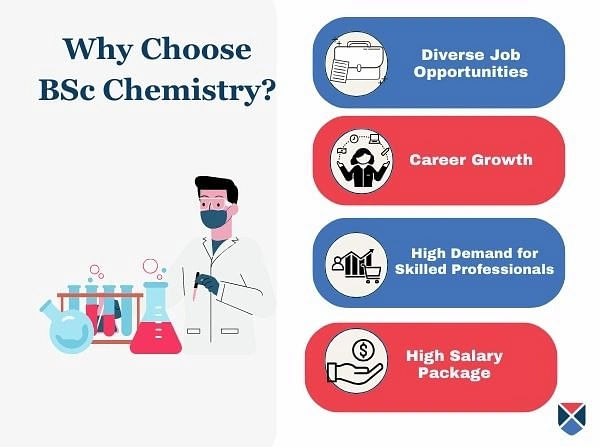
B.Sc Chemistry course enables the students to work in diverse fields and job roles such as Research and Development, Laboratories, Pharmaceutical Industry, Healthcare, etc. Listed below are some of the important pointers on why choosing a B Sc in Chemistry course can be the right choice:
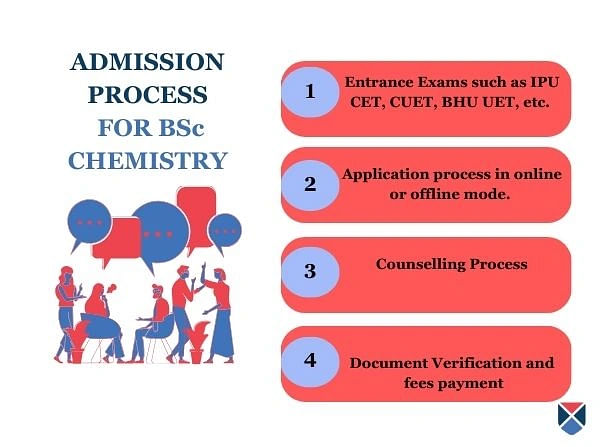
B.Sc Chemistry admission process is done through entrance examinations in colleges such as Delhi University, Christ University, Panjab University, etc., and the admission process is carried through merit scores in colleges such as Miranda House, Madras Christian College, Loyola College, etc.
Listed below is the step-by-step BSc in Chemistry admission process:
BSc Chemistry entrance examination will be conducted on various levels such as state, national, or institutional levels. The candidate must appear for the entrance exam based on their choice of college or university.
Listed below are the BSc in Chemistry entrance exam and the application dates:
BSc Chemistry Entrance Exam | Registration Date | Accepting Colleges |
February 10, 2024 | Christ University, Lovely Professional University, Jawaharlal Nehru University | |
February 1 – March 31, 2024 | Kasturi Ram College of Higher Education, Amity Institute of Education, Guru Nanak College of Education | |
February 2024 | Banaras Hindu University | |
March 2024 | Panjab University |
BSc in Chemistry course is offered by private colleges such as Christ University, Amity University, Miranda House, etc. and government colleges such as Panjab University, Delhi University, Jamia Hamdard University, etc.
The average BSc Chemistry fees ranges from INR 8,000 to 3,00,000 per year and the fee varies depending on the college or university.
Listed below are the top colleges offering BSc Chemistry courses in India as per NIRF ranking 2023 along with their annual fee details::
NIRF Ranking 2023 | Name of the College | BSc Chemistry Tuition Fee (Per Year) | Admission Fees | Miscellaneous Fees |
1 | INR 19,600 | – | – | |
2 | INR 21,000 | – | INR 40,000 | |
5 | INR 3,600 | INR 1,500 | INR 1,13,000 | |
7 | INR 12,950 | INR 10,000 | INR 1,10,000 | |
16 | INR 20,500 | INR 1,000 | INR 1,17,000 | |
25 | INR 73,420 | – | INR 80,000 | |
38 | INR 50,000 | INR 5,000 | INR 45,000 | |
67 | INR 1,10,000 | INR 25,000 | INR 1,25,000 | |
– | INR 12,500 | INR 25,000 | INR 60,000 |
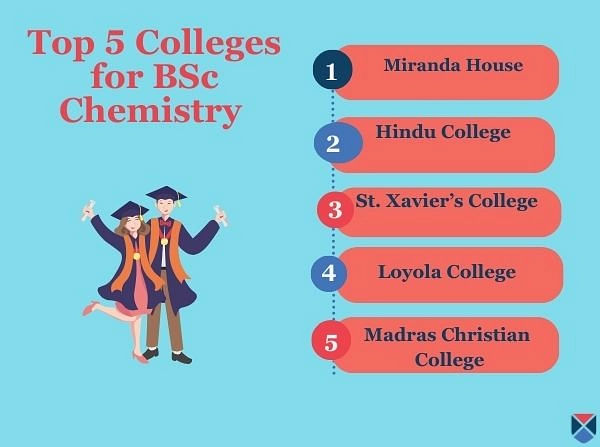
Listed below are the location-wise BSc Chemistry colleges and their annual fee details:
Location | B.Sc Chemistry Fees Per Year |
INR 8,000 – 38,000 | |
INR 7,000 – 1,40,000 | |
INR 8,000 – 70,000 | |
INR 10,000 – 80,000 | |
INR 22,000 – 1,27,000 | |
INR 20,000 – 79,000 | |
INR 40,000- 2,90,000 | |
INR 9,000 – 3,00,000 | |
INR 4,000 – 60,000 | |
INR 11,500 – 30,000 | |
INR 8,000 – 25,000 | |
INR 5.000 – 40,000 | |
INR 7,000 – 30,000 |
The B.Sc Chemistry syllabus is designed to enable students with the knowledge and understanding of the theoretical and practical aspects of chemistry through various subjects such as Advanced inorganic chemistry, Analytical chemistry, Theoretical Aspects of Spectroscopy, Applications of Spectroscopy, etc.
Given below is the semester-wise BSc in Chemistry syllabus:
Semester-I | Semester-II |
Basics of Chemistry | Understanding Biochemical Analysis |
| Concepts of Food Hygiene and Nutrition | Health and Hygiene |
| Concept of General Properties of Matter | Pharmaceutical Basics |
| Chemical Analysis Modern Technique-I | Biostatistics |
| Physical Chemistry Principles | Chemical Analysis Modern Technique-II |
| Understanding Quantitative Analysis | Understanding Renewable Energy Resources |
Semester-III | Semester-IV |
| Coordination of Chemistry and Chemical Dynamics | Analytical Techniques and Quantum Mechanics |
| Chemical Analysis Modern Technique-III | Chemical Analysis Modern Technique-IV |
| Life Science Fundamentals | Environmental Studies and Human Values |
| Concept of Oscillation and Waves | Bioinformatics |
| Concept of Physical Analysis | Concept of Chemistry in Action |
| Physical Education | Instrumental Analysis Concept |
| Coordination of Chemistry and Chemical Dynamics | – |
| Understanding Engineering Materials an Industry Chemistry | – |
Semester-V | Semester-VI |
| Quantitative Analysis Concept | Radiation Chemistry and Chemical Energetics |
| Chemistry Advanced Topics | Analytical Chemistry |
| Organic Synthesis-A | Personality Development and Communication Skills |
| Analytical Ability and Digital Awareness | Understanding Biological Chemistry |
| Reorganizations and Group Elements’ Chemistry | Organic Synthesis |
| Research Project | Research Project |
| Industrial Training | Industrial Training |
| Laboratory/Practical Work | Laboratory/Practical Work |
Read More: BSc Chemistry Syllabus and Subjects
BSc Chemistry is an undergraduate program focusing majorly on equipping students with knowledge related to chemistry, Organic Chemistry, Analytical Chemistry, etc to enable them to work in related industries while BSc Physics course is a three-year undergraduate course that focuses extensively on the concepts and foundation of Physics such as calculus, semiconductors, optics, statistics, etc.
Given below is the comparison between BSc Chemistry vs BSc Physics based on various parameters:
Course | BSc Chemistry | BSc Physics |
Full Form | Bachelor of Science in Chemistry | Bachelor of Science in Physics |
Course Duration | 3 Years | 3 Years |
Course Overview | B.Sc in Chemistry course covers subjects such as Spectroscopy, Analytical Chemistry, General Chemistry, Titrimetry and Thermodynamics | B.Sc in Physics focuses on subjects such as electromagnetism, quantum mechanics, Optics and Statistics |
Eligibility Criteria | 50% in 10+2, with Physics, Chemistry and Mathematics as compulsory subjects | 50% in 10+2, with Physics, Chemistry and Mathematics as compulsory subjects |
Course Fees Per Year | INR 8,000-3,00,000 | INR 5,000 – 50,000 |
Entrance Exam | CUET, BHU UET, IPU CET | CUET, IISAR, GSAT |
Top Colleges | Lovely Professional University, Loyola College, Miranda House | Hindu College, Christ University, St.Stephen’s College |
Job Roles | Lab Chemist, Quality Control Chemist, Research Analyst | Research Associate, Academic Counsellor, Subject Matter Expert |
Average Salary | INR 3 – 7 LPA | INR 3-7 LPA |
Read More: BSc Physics
After graduation, BSc in Chemistry students can opt for higher studies in the field of chemistry and research to enhance their knowledge further and for better career prospects. Listed below are some of the master’s courses BSc Chemistry graduates can pursue:
Read More: Courses After B.Sc Chemistry
BSc Chemistry graduates can get into diverse fields ranging from Healthcare to Logistics in various job roles such as Chemist, Quality Assurance Executive, Chemical Analyst, etc. Listed below are some of the BSc Chemistry job roles along with the job description and top recruiters:
Job Designation | Job Description | Hiring Companies |
Chemist | Chemists are responsible for developing various chemical ingredients, substances, products, etc by conducting numerous tests and research. | Dr Reddy’s, Cipla, Shell, Sun Pharmaceutical Industries |
Junior Research Associate | Responsible for researching and coordinating various research projects and tests in data collection, reporting, analysis and documentation. | Accenture, Microsoft, Baxter, Tata Consultancy Services |
Lab Assistant | Responsible for performing diagnostic tests, generating reports, transporting samples, and documentation in a laboratory setting. | Aston Carter, Amazon, Tata Group, Apollo Hospitals |
Pharmaceutical Sales Executive | Pharmaceutical Sales Executives are responsible for visiting surgeons, and physicians explaining to them the characteristics of different drugs and helping them prescribe them to their patients. | TATA Capital, IndiaMart, Medplus, Cipla |
Analytical Chemist | Responsible for analysing the characteristics of products, drugs, and chemical ingredients using various tools and techniques. | Crisil, Accenture, Dr. Reddy’s, Lenskart |
Forensic Assistant Scientist | Responsible for obtaining evidence in crime scenes, analysing the findings, reporting the findings in front of the law and documentation of the process. | KPMG, Metlife, State Bank of India, IBM |
Listed below are the top recruiters for BSc Chemistry graduates in India and abroad:
Dr.Reddy’s | Cipla | KPMG |
Metlife | Lenskart | Medplus |
TATA Group | Sun Pharmaceutical Industries | Baxter |
IBM | State Bank of India | Abbott |
Apollo Hospitals | Pepsi Foods | Torrent Pharmaceuticals |
Dr Reddy’s Laboratories Ltd | Fortis Healthcare | Johnson & Johnson |
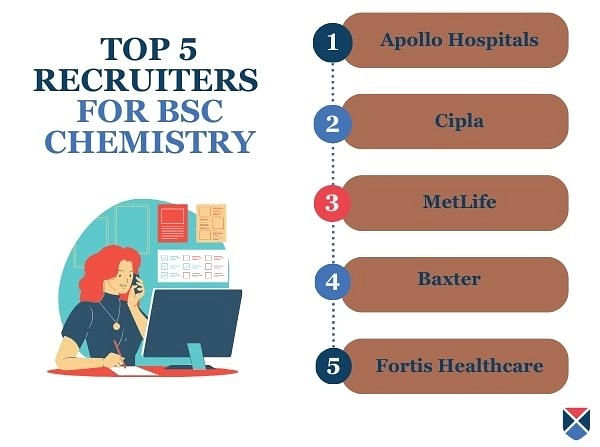
The average BSc Chemistry graduate salary ranges from INR 3-7 LPA based on years of experience and domain knowledge. BSc in Chemistry graduates with 0-1 years of experience can earn in the range of INR 3.0 to 5.5 LPA whereas the candidates with more than 3 years of experience can earn between INR 6.0 to 8.5 LPA or more based on their expertise.
BSc Chemistry Jobs | Entry Level Average Salary | Salary After 3 Years of Experience |
Chemist | INR 3.9 LPA | INR 5.3 LPA |
Junior Research Associate | INR 3.2 LPA | INR 5.0 LPA |
Lab Assistant | INR 3.1 LPA | INR 5.3 LPA |
Pharmaceutical Sales Executive | INR 3.0 LPA | INR 5.0 LPA |
Analytical Chemist | INR 4.0 LPA | INR 6.5 LPA |
Forensic Assistant Scientist | INR 4.5 LPA | INR 8.0 LPA |
Chemical Technician | INR 5.7 LPA | INR 9.0 LPA |
Quality Control Chemist | INR 4.0 LPA | INR 5.5 LPA |
Read More: BSc Chemistry Salary in India
Students can opt to pursue B.Sc Chemistry courses in top cities such as Bangalore, Mumbai, Madras, Hyderabad, etc as it has the most renowned institutions such as Loyola College, Christ University, St.Xavier’s College, etc.
Below listed are the top 5 cities to pursue a B.Chemistry course based on industry exposure, reputation, infrastructure, placement opportunities, affordability, cost of living in the city, etc.
City | Top Colleges Offering BSc Chemistry Courses | Average Living Expense (INR) | Average Starting Salary (INR) | Top Recruiters |
Bangalore | Christ University, Mount Carmel College, St.Joseph’s University | 40,000 – 45,000 Per Month | 20,000-22,000 Per Month | Mk Elite Moon Shine Pvt Ltd, MedPlus |
Mumbai | Doongasree Gangji Ruparel College of Arts, Science and Commerce, University of Mumbai, Amity University | 30,000 – 60,000 Per Month | 20,000-35,000 Per Month | Abbott, Wipro, Cipla |
Hyderabad | Vasundara Group Of Colleges, Maulana Azad National Urdu University, Guru Nanak University | INR 15,000 – 25,000 Per Month | INR 15,000 – 25,000 Per Month | Apollo Hospital, Accenture, Pepsi Foods |
Chennai | Loyola College, Madras Christian College, Ethiraj College for Women | INR 20,000 – 25,000 Per Month | 16,000-25,000 Per Month | Lupin, Apollo Hospitals, Infosys |
Delhi | Jamia Hamdard University, Hindu College, Miranda House | INR 70,000 – 75,000 Per Month | INR 12,000 – 20,000 Per Month | KPMG, Metlife, Ericsson |
BSc Chemistry graduates are offered scholarships by the government of India, NGO and educational institutions based on various criteria such as the merit score, quota, etc. Listed below are some of the BSc Chemistry scholarships students can avail along with their benefits and eligibility criteria:
BSc Chemistry Scholarships | Eligibility Criteria | Amount |
KVPY Scholarship | The candidate must have cleared all the exams in Class 11 and 12 to be eligible for the scholarship | INR 28,000 |
Narotam Sekhsaria Scholarship | Interest-free loan to all the graduates pursuing postgraduate and undergraduate programs and must be under the age of 30. | Up to INR 75,000 |
Dhirubhai Ambani Scholarship Programme | Physically challenged and differently-abled students with a family annual income less than INR 4,50,000 are eligible for the scholarship | INR 41,000 Per Month |
BSc Chemistry graduates must develop strong technical, analytical and interpersonal skills to succeed in their careers and for better career prospects. Listed below are some of the skills the graduates must possess:
The BSc Chemistry syllabus includes a theoretical and practical framework for the fundamental facets of chemistry as well as up-to-date information on the crucial facets of Organic and Inorganic Chemistry and many other topics. Below is the B.Sc Chemistry course syllabus is broken down by semester:
B.Sc Chemistry first-year syllabus focuses on the basics of chemistry subtopics like Atomic Structure, Periodic Table, Chemical Bonding, Hydrocarbons, Alcohols, Ethers, etc. Given below is the 1st year BSc Chemistry syllabus:
Semester 1 | Semester 2 |
Chemistry Fundamentals | Medicinal Chemistry Fundamentals |
Physical Chemistry Principles | Concept of Biochemical Analysis |
Quantitative Analysis | Qualitative Analysis |
Practical/Laboratory Work | Practical/Laboratory Work |
BSc Chemistry 1st year Practical
Below is a list of BSc Chemistry 1st year practical subjects:
B.Sc Chemistry second year syllabus focuses on topics like aromatic compounds, nitrogen-containing compounds, polymers, biomolecules, qualitative and quantitative analysis methods, etc. Given below is the 2nd year BSc Chemistry syllabus:
Semester 3 | Semester 4 |
Understanding Instrumental Analysis | Physical Chemistry-II |
Inorganic Chemistry-I | Organic Chemistry-II |
Organic Chemistry-I | Advanced Materials Concept |
Biostatistics | Quantum Mechanics and Analytical Techniques |
Physical Analysis Concepts | Summer Internship |
Practical/Laboratory Work | Practical/Laboratory Work |
– | Environmental Studies |
BSc Chemistry 2nd year Practical
Below is a list of BSc Chemistry 2nd year practical subjects:
BSc Chemistry third year subjects focus on concepts related to UV-Visible, IR, NMR, and mass spectrometry techniques, statistical thermodynamics and quantum chemistry, etc. The table below highlights the 3rd year BSc Chemistry syllabus:
Semester 5 | Semester 6 |
Organic Chemistry-III | Physical Chemistry-IV |
Physical Chemistry-III | Spectroscopic Methods |
Analytical Chemistry Concept-I | Analytical Chemistry Concept-II |
Elective-I | Elective-III |
Elective-II | Elective-IV |
Understanding Organic Synthesis-A | Understanding Organic Synthesis-B |
Practical/Laboratory Work | Practical/Laboratory Work |
– | Project Work |
BSc Chemistry 3rd year Practical
Below is a list of BSc Chemistry 3rd year practical subjects:
BSc Chemistry subjects are classified as core, lab, and elective subjects. The lab works and workshops are necessary for aspirants to develop their skills for future career scope. Given below are the divided BSc Chemistry subjects:
Below are the core subjects for BSc Chemistry syllabus along with topics covered in each subject:
Core Subjects | Topics Covered |
Chemistry Fundamentals | Atomic structure, chemical bonding, periodic trends, stoichiometry, chemical equations, molecular geometry |
Inorganic Chemistry | Transition metals, coordination compounds, main group elements, periodic trends, non-metals, metal complexes |
Understanding Instrumental Analysis | Spectroscopy, chromatography, electroanalytical methods, mass spectrometry, data analysis, sensors |
Physical Chemistry Principles | Thermodynamics, chemical kinetics, quantum mechanics, molecular structure, statistical mechanics, surface chemistry |
Quantitative and Qualitative Analysis | Analytical techniques, volumetric analysis, gravimetric analysis, qualitative inorganic analysis, instrumental methods |
Medicinal Chemistry Fundamentals | Drug development, pharmacokinetics, pharmacodynamics, structure-activity relationships, bioorganic chemistry |
Concept of Biochemical Analysis | Biomolecules (proteins, nucleic acids, lipids, carbohydrates), enzymatic reactions, metabolic pathways, molecular biology |
Advanced Materials Concept | Nanomaterials, polymers, composite materials, electronic materials, superconductors, materials characterization |
Biostatistics | Statistical methods applied to biological data, data interpretation, experimental design, statistical analysis in life sciences |
Physical Analysis Concepts | Techniques in physical analysis, spectroscopy, chromatography, electrochemical methods, surface analysis |
Quantum Mechanics and Analytical Techniques | Quantum mechanics principles, analytical techniques in chemistry, mathematical methods in quantum chemistry |
Environmental Studies | Environmental issues, sustainability, pollution control, green chemistry principles |
Understanding Organic Synthesis-B | Organic synthesis methods, reaction mechanisms, synthetic strategies |
Understanding Organic Synthesis-A | Organic synthesis methods, retrosynthetic analysis, functional group transformations |
Analytical Chemistry Concept | Principles of analytical chemistry, qualitative and quantitative analysis techniques |
Given below is electives offered in BSc Chemistry syllabus along with topics covered in each:
Elective Subjects | Topics Covered |
Forensic Science | Crime scene reconstruction, forensic toxicology, serology, forensic entomology, forensic anthropology, forensic odontology, digital forensics |
Agriculture Chemistry | Soil fertility management, crop protection chemicals, organic farming practices, agrochemical analysis, greenhouse gas emissions from agriculture, precision agriculture |
Biochemistry | Enzyme kinetics, metabolic pathways (glycolysis, Krebs cycle), protein structure and function, nucleic acid structure, immunochemistry, biochemical assays |
Computational Chemistry | Molecular dynamics simulations, quantum chemical calculations, density functional theory (DFT), molecular docking, cheminformatics, electronic structure methods |
Fuel Chemistry and Batteries | Combustion processes, fossil fuel analysis, alternative fuels, electrochemical reactions in batteries, energy storage technologies, fuel cell technology |
Analysis of Drugs, Foods, Dairy Products & Bio-Chemical Analysis | Pharmaceutical analysis, food safety testing, dairy product composition, chromatographic techniques, spectrophotometry, immunoassays, quality control |
Green Chemistry | Sustainable synthesis methods, renewable energy sources, waste reduction strategies, green solvents, eco-friendly catalysis, life cycle assessment, green nanotechnology |
Chemical Engineering | Unit operations, process optimization, reactor design, mass transfer operations, thermodynamics in chemical processes, fluid mechanics, heat transfer |
Molecular Modelling and Drug Design | Structure-based drug design, molecular docking, pharmacophore modeling, virtual screening, quantitative structure-activity relationships (QSAR), molecular dynamics |
Given below are the lab subjects for BSc Chemistry syllabus:
The BSc Chemistry syllabus differs depending on the structure and aim of the program across institutions. The core subjects remain common in the 1st year syllabus, whereas, the elective subjects in 3rd year can vary depending on the college.
Students can get the BSc Chemistry syllabus pdf from the university website to grasp a better understanding of the BSc Chemistry subjects offered by specific institutions. The following is the BSc Chemistry syllabus of top colleges offering the course:
BSc in Chemistry syllabus at Osmania University helps students in advanced areas like spectroscopy and environmental chemistry. Below listed is the BSc Chemistry subjects list:
Semester I | Semester II |
English-I | English-II |
Second Language | Second Language |
Understanding Chemistry-I | Understanding Chemistry-II |
Optional-I | Optional-I |
Optional-II | Optional-II |
Ability Enhancement Course-I | Ability Enhancement Course-I |
Laboratory/Practical Work (Qualitative Analysis – Semi Micro Analysis of Mixtures) | Laboratory/Practical Work ( Quantitative Analysis – Titrations) |
Semester III | Semester IV |
Chemistry Lab Safety Rules | Material Basics and Application |
Corrective measures for soil fertility, drinking water quality, and pollution | Food Processing and Cosmetics of Chemistry |
English-III | English-IV |
Second Language | Second Language |
Understanding Chemistry-III | Understanding Chemistry-IV |
Optional-I | Optional-I |
Optional-II | Optional-II |
Ability Enhancement Course-III | Ability Enhancement Course-III |
Laboratory/Practical Work (Synthesis of Organic compounds) | Laboratory/Practical Work (Qualitative Analysis of Organic Compounds) |
Semester V | Semester VI |
Advanced Material Concepts and Application-I | Food Processing Advanced Concept |
Pharmaceutical Concepts | Advanced Material Concepts and Application-II |
Chemistry-V | Optional-I |
Optional-I | Optional-II |
Optional-II | Chemistry-VII |
Laboratory/Practical (Organic Synthesis and TLC) | Laboratory/Practical (Qualitative and Spectral Analysis of Organic Compounds) |
Understanding Instrumental Method of Analysis (Chemistry-VI) | Understanding Medicinal Chemistry (Chemistry-VIII) |
Catalysis and Industrial Chemistry (Chemistry-VI) | Fuel and Agriculture Chemistry (Chemistry-VIII) |
Physical Chemistry (Laboratory Course) | Project Work |
The BSc Chemistry syllabus at Sharda University covers topics like coordination compounds and transition elements, thermodynamics, quantum mechanics, etc. Below listed is the BSc Chemistry subjects list for Sharda University:
Semester I | Semester II |
Understanding Quantitative Analysis | Pharmaceutical Basics |
Basics of Chemistry | Understanding Biochemical Analysis |
Concept of General Properties of Matter/Biomolecules/Mathematics | Medicinal Chemistry and Bioorganic Concept |
Concept of Food Hygiene and Nutrition | Health and Hygiene |
Physical Chemistry Principles | Understanding Renewable Energy Resources/Cell Biology/Mathematics |
Chemical Analysis Modern Technique-I (Lab to Industry Training) | Biostatistics/ Life Science Fundamentals/Calculus-I (Minor Elective) |
Laboratory/Practical Work | Chemical Analysis Modern Technique-II (Lab to Industry Training) |
– | Laboratory/Practical Work |
Semester III | Semester IV |
Concept of Physical Analysis | Instrumental Analysis Concept |
Coordination of Chemistry and Chemical Dynamics | Analytical Techniques and Quantum Mechanics |
Understanding Engineering Materials an Industry Chemistry | Concept of Chemistry in Action |
Biostatistics/ Life Science Fundamentals/Calculus-II (Minor Elective) | Chemical Analysis Modern Technique-IV (Lab to Industry Training) |
Concept of Oscillation and Waves/ Molecular Biology-I | Bioinformatics/Laser and its application |
Chemical Analysis Modern Technique-III (Lab to Industry Training) | Environmental Studies and Human Values |
Physical Education | Laboratory/Practical Work |
Laboratory/Practical Work | – |
Summer Internship | – |
Semester V | Semester VI |
Quantitative Analysis Concept | Understanding Biological Chemistry |
Reorganizations and Group Elements’ Chemistry | Radiation Chemistry and Chemical Energetics |
Research Project | Organic Synthesis-B |
Chemistry Advanced Topics | Analytical Chemistry -I |
Organic Synthesis-A | Personality Development and Communication Skill |
Analytical Chemistry -I | Laboratory/Practical Work |
Analytic Ability and Digital Awareness | Research Project |
Industrial Training /Project (Community Connect) | – |
Laboratory/Practical Work | – |
B.Sc Chemistry focuses on candidates gaining various technical skills required in the field of advanced chemistry. The course focuses on candidates gaining knowledge about the latest developments through internships and practical workshops. In short, the BSc Chemistry syllabus structure is given below:
BSc Chemistry syllabus teaching methodologies are not confined to traditional classroom teaching but also include laboratory experiments and industrial visits as part of the course. The teaching and techniques of B.Sc Chemistry are as follows:
BSc Chemistry syllabus has projects that motivate aspirants to develop their lab techniques and gain experience in the field of lab development. Given below are some of the BSc Chemistry project topics: