
- info@wingeducations.com
- +91 (705) 495-5296
- Mon - Sat : 10.00-18.00
| Degree | Bachelors |
| Full Form | Bachelor of Science in Biotechnology |
| Duration | 3 Years |
| Age | No specific Age Limit |
| Minimum Percentage | 50 – 55% |
| Average Fees | INR 3,000-2,00,000 per year |
| Similar Options of Study | B.Sc (Microbiology), B.Sc (Genetics), B.Sc (Biochemistry) |
| Average Salary | INR 2-8 LPA |
| Employment Roles | Marketing Manager, Medical Coder, Quality Control Analyst, Data Analyst, etc. |
B.Sc Biotechnology stands for Bachelor of Science in Biotechnology which is a branch of applied biology that employs living organisms and bioprocesses in engineering, technology, medicine, and other fields that require by-products. The course falls under the umbrella of BSc courses.
The course is focused on developing an understanding of technical skills and knowledge like bioinformatics, cell culture techniques, global health biotechnology, etc., that helps students to get opportunities in both public and private sectors, from roles such as bioprocess engineer, healthcare analyst, clinical research associate, etc. The average BSc Biotechnology salary for a graduate is in the range of INR 2-8 LPA.
The eligibility for BSc Biotechnology may include different components like minimum percentage, entrance exam score, reservation quota, etc. Below listed is the B.Sc Biotechnology eligibility criteria:
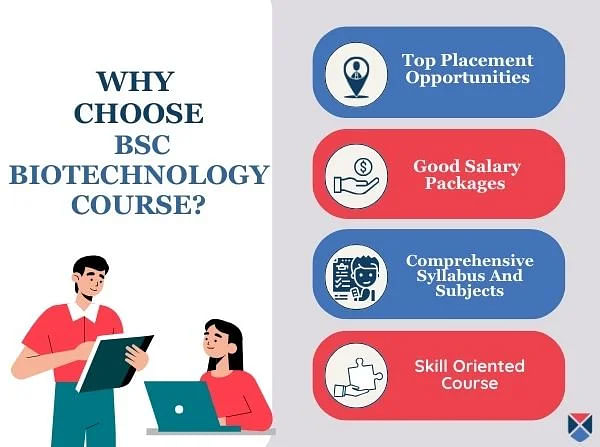
Biotechnology is an increasingly growing industry where many large companies and multinational corporations invest capital, raising the market for B.Sc Biotechnology graduates. Below listed are a few reasons why one should choose BSc in Biotechnology course:
Read More: Compare BSc Biotechnology with BSc Microbiology Course
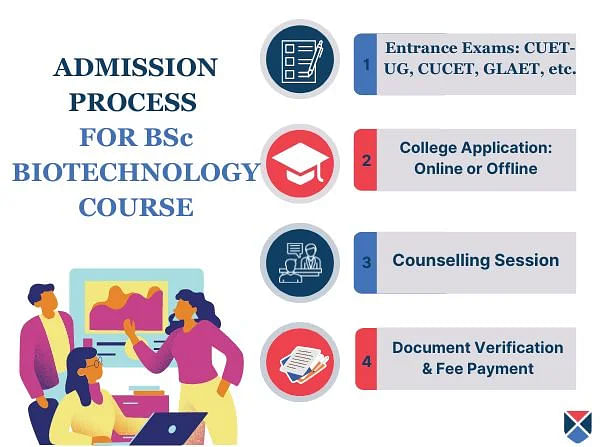
Admission to BSc Biotechnology course is done on a merit basis in colleges like SRM University and colleges like GLA University, Chandigarh University, etc., accept the university entrance exam score for admission. Below is the BSc Biotechnology admission process:
Read More: B.Sc Admission Process
BSc Biotechnology entrance exams are held at both national and institute levels to check student aptitude and subject knowledge. Below listed are a few common entrance exams held for BSc Biotechnology course along with their registration dates and accepting colleges:
| BSc Biotechnology Entrance Exams | Exam Date | Accepting Colleges |
| CUET-UG | May 29, 2024 (Closed) | Madras University, Banasthali University, etc. |
| MAHE OET | Apr 6-Sep 28, 2024 | Manipal University |
| AEEE | Jan-May, 2024 (Closed) | Amrita Vishwa Vidyapeetham |
| GLAET | Dec 1, 2024 | GLA University |
| CUCET | July 2024 (Tentative) | Chandigarh University |
The top private BSc Biotechnology colleges in India include Chandigarh University, Manipal University, Sharda University, etc. The best government colleges offering BSc in Biotechnology course includes the University of Madras, Elphinstone College, etc. The BSc Biotechnology fee is in the range of INR 3,000-2,00,000 per year.
Below listed are the top colleges in India offering BSc Biotechnology course along with the fee bifurcation:
| College Name | Annual Tuition Fees | Admission Fees | Annual Miscellaneous Fees |
| Amrita Vishwa Vidyapeetham | INR 68,600 | INR 5,000 | INR 63,000 |
| Chandigarh University | INR 1,30,000 | INR 2,000 | INR 5,500 |
| Manipal University | INR 1,26,000 | INR 10,000 | INR 41,000 |
| Sharda University | INR 1,25,000 | – | INR 1,65,000 |
| SRM Institute of Science and Technology | INR 1,15,000 | – | INR 50,000-70,000 |
| GITAM | INR 1,05,000 | INR 5,000 | – |
| Elphinstone College | INR 17,000 | – | INR 4,000 |
| University of Madras | INR 3,000 | INR 200 | INR 3,000-4,000 |
| Banasthali University | INR 1,24,000 | INR 5,000 | INR 60,000 |
| Trident School of Biotech Science | INR 72,000 | INR 5,200 | – |
| St. Joseph College | INR 45,000 | INR 10,000 | INR 5,000 |
| Silver Oak University | INR 90,000 | – | INR 21,000 |
| Bharati Vidyapeeth | INR 65,000 | – | INR 37,500 |
| Brainware University | INR 1,00,000 | – | INR 14,000 |
| USTM | INR 80,000 | INR 40,000 | – |
| GLA University | INR 1,00,000 | INR 5,000 | INR 42,000 |
Below listed are the location-wise BSc Biotechnology colleges in India along with their average annual Fees:
| Location | Annual Fees |
| Top BSc Biotechnology Colleges in Mumbai | INR 3,000-2,00,000 |
| Top BSc Biotechnology Colleges in Delhi | INR 70,000-2,00,000 |
| Top BSc Biotechnology Colleges in Chennai | INR 25,000-1,00,000 |
| Top BSc Biotechnology Colleges in Bangalore | INR 50,000-2,00,000 |
| Top BSc Biotechnology Colleges in Hyderabad | INR 15,000-1,50,000 |
| Top BSc Biotechnology Colleges in Kolkata | INR 30,000-2,00,000 |
| Top BSc Biotechnology Colleges in Pune | INR 65,000-2,00,000 |
| Top BSc Biotechnology Colleges in Lucknow | INR 30,000-2,00,000 |
| Top BSc Biotechnology Colleges in Coimbatore | INR 15,000-1,00,000 |
| Top BSc Biotechnology Colleges in Nagpur | INR 35,000-1,50,000 |
BSc Biotechnology course can be pursued full-time, distance, and through integrated education mode. Below listed is BSc Biotechnology course details:
| Type | Basic Eligibility | BSc Biotechnology Duration |
| Full-Time BSc in Biotechnology | 10+2 with a minimum of 50% marks for the general category and 45% marks for the reserved category+ Entrance Exam Score | 3 Years |
| BSc Biotechnology Distance Education | 10+2 with a minimum of 50% marks for the general category and 45% marks for the reserved category | 3-5 Years |
| Integrated BSc Biotechnology | 10+2 with a minimum of 50-55% marks for the general category and 45% marks for the reserved category+ Entrance Exam Score | 5 Years |
BSc Biotechnology distance education is recognized by UGC-DEB in India. Below listed are distance BSc Biotechnology course details:
Students can pursue BSc + MSc Biotechnology as an integrated course after completion of their 10+2 examinations. Below listed are the important pointers regarding integrated BSc Biotechnology courses:
The course combines two broad domains: biology and technology. The first-year syllabus focuses on the fundamentals of chemistry, biotechnology and biology. The second year syllabus covers topics like DNA replication, plant biotechnology, and advanced statistical methods. The third-year syllabus focuses on advanced topics like genetic engineering, nanobiotechnology, stem cell types, etc.
Below listed is the semester-wise BSc Biotechnology subjects:
| Semester I | Semester II |
| English | English |
| Second Language | Second Language |
| Macromolecular Structure & Analysis | Bioinstrumentation |
| Biochemistry | Molecular Biology |
| Cell Structure & Dynamics | Principles of Transmission Genetics |
| Biomathematics | Organic Mechanisms in Biology |
| Semester III | Semester IV |
| English | English |
| Second Language | Second Language |
| Microbial Genetics | Recombinant DNA Technology |
| Principles of Immunology | Biodiversity & Taxonomy |
| Plant Biotechnology | Animal Biotechnology |
| Electives | Electives |
| Semester V | Semester VI |
| English | English |
| Second Language | Second Language |
| Environmental Biotechnology | Medical Biotechnology |
| Plant, Environment & Industrial Biotechnology | Electives |
| Electives | Projects |
Read More: B.Sc Biotechnology Syllabus and Subjects
BSc Biotechnology provides a comprehensive understanding of the fundamental principles and concepts of biotechnology. B.Tech Biotechnology emphasizes the application of biotechnology in various industries. Below is a course comparison between B.Sc Biotechnology and B.Tech Biotechnology:
Parameter | B.Sc Biotechnology | B.Tech Biotechnology |
Full Form | Bachelor of Science in Biotechnology | Bachelor of Technology in Biotechnology |
Course Overview | The course curriculum covers topics like molecular biology, genetics, biochemistry, microbiology, and bioprocess engineering. | The course curriculum covers topics like genetic engineering, bioinformatics, bioprocess technology, etc. |
Duration | 3 Years | 4 Years |
Eligibility | 10+2 with PCBM | 10+2 with PCB/M |
Admission Procedure | Merit/ Entrance-Based | Merit/ Entrance-Based |
Entrance Exam | CUET-UG, GLAET, etc. | BITSAT, WBJEE, MHT CET, etc. |
Job Roles | Clinical Data Manager, Biomedical Technician, Quality Assurance Manager, etc. | Maintenance Engineer, Service Engineer, Biotechnology Expert etc. |
Annual Fees | INR 3,000- 2,00,000 | INR 25,000 – 2,50,000 |
Average Salary | INR 2-8 LPA | INR 3-8 LPA |
Read More: BSc Biotechnology vs BTech Biotechnology
After completing B.Sc Biotechnology, an individual can work both in public and private sectors in fields like health departments, environment agencies, food and beverage industry, genetic counseling, etc.
Below listed are a few jobs for BSc Biotechnology graduates along with top hiring companies:
Job Designations | Job Description | Hiring Companies |
| Biotechnologist | The role involves analyzing biological data and using the statistics for research and development | RG Technosolutions, Axis Technology, Dr. Lal Path Labs, etc. |
| Biomedical Technician | Focuses on equipment maintenance, quality assurance, and offering technical support | Apollo Hospitals, Elexes, Portea, etc. |
| Environmental Analyst | Works on data collection and analysis to form environmental policies and compliances | Nat West Group, SIMA Labs, Shell, etc. |
| Microbiologist | Focuses on microbial research, looking after health and safety application, laboratory experiments, etc. | Cipla, Sun Pharmaceuticals, Dr. Reddy’s Lab, etc. |
The BSc Biotechnology entry-level salary in India for graduates is in the range of INR 2.50-4 LPA. Graduates after having three-plus years of experience can earn upto INR 8 LPA. Below listed are job roles for BSc Biotechnology graduates along with their average entry-level salaries:
BSc Biotechnology Jobs | Entry Level Average Salary | Salary After 3+ Years of Experience |
| Tissue Culture Technician | INR 2.50-3 LPA | INR 4.50-7 LPA |
| Industrial Biotechnologist | INR 3 LPA | INR 4-6.50 LPA |
| Clinical Data Manager | INR 3.50-4 LPA | INR 5-8 LPA |
| Bioinformatics Specialist | INR 3.50 LPA | INR 5.50-7 LPA |
Read More: BSc Biotechnology Salary in India
Below listed are a few top recruiters for BTech CSE graduates:
| Biocon | Dr. Reddy’s Laboratories | Cipla |
| Serum Institute of India | Wockhardt | Bharat Biotech |
| Novozymes | GVK Biosciences | Syngene International |
| Panacea Biotec | Zydus Cadila | Sun Pharmaceutical Industries |
| Reliance Life Sciences | Jubilant Life Sciences | Glenmark Pharmaceuticals |
Students with a B.Sc in Biotechnology have a wide range of career opportunities after graduation. Students can opt for higher advanced education after completing their B.Sc Biotechnology degree course. The higher education options they can pursue are:
Read More: Biotechnology Courses after 12th
The students who want to study BSc Biotechnology can get scholarships from private and government colleges based on merit scores, annual income, and other related factors. Below listed are a few scholarships for BSc in Biotechnology course:
Scholarship | Eligibility Criteria | Amount |
| Chandigarh University Merit-Based Scholarship | The student should have secured 90% or above marks in 10+2 examinations. | Upto 50% of Tuition Fees |
| Post-Matric Scholarship for Students with Disabilities |
| Upto INR 4,000 |
HDFC Bank Parivartan’s ECS Scholarship |
| Upto INR 75,000 |
Below listed are the top 3 cities to pursue a BSc Biotech course based on top colleges, average living expense, top recruiters, and average starting salary:
Cities | Top Colleges Offering BSc Biotechnology Course | Average Living Expense (INR) | Average Starting Salary (INR) | Top Recruiters |
| Delhi | Delhi University, Amity University, etc. | 15,000 – 25,000 | 3,00,000 – 4,50,000 LPA | Biocon, Dr. Reddy’s Laboratories, Cipla, Wockhardt, etc. |
| Hyderabad | Osmania University, University of Hyderabad, GITAM, etc. | 15,000 – 20,000 | 3,50,000 – 5,00,000 LPA | Bharat Biotech, Dr. Reddy’s Laboratories, Novozymes, etc. |
| Bangalore | Christ University, Bangalore University, Jain University, etc. | 20,000 – 30,000 | 3,50,000 – 5,50,000 LPA | Biocon, Syngene International, Jubilant Life Sciences, etc. |
Students interested in biological sciences should have solid problem-solving skills and analytical skills in order to perform their jobs efficiently. Some must-have skills and knowledge for B.Sc Biotechnology aspirants are given below:
BSc Biotechnology subjects impart comprehensive understanding in subject areas such as biological chemistry, microbiology, molecular biology, genetics, analytical techniques, bioinformatics, computer programming, etc. The core & elective subjects under the BSc Biotechnology syllabus are listed below:
The subjects in BSc Biotechnology are divided into core and elective subjects. A list of core subjects covered in the B.Sc Biotech syllabus is as follows:
Elective subjects are optional subjects that make the course more flexible and diversified. The list of elective subjects for the B.Sc Biotechnology curriculum is as follows:
The list of lab subjects for the B.Sc Biotechnology curriculum is as follows:
B.Sc Biotechnology syllabus includes a wide range of subjects encompassing various areas of biotechnology and its application. A detailed view of BSc Biotechnology subjects is given below:
| BSc Biotechnology subjects | Topics Covered |
| Bio-molecules & Analytical Techniques | Carbohydrates, Protein & Lipids, Nucleic acid, Vitamins & Bioenergetics, Centrifugation, Chromatography and Electrophoresis, Spectroscopy, Microscopy and Laser Techniques |
| Microbiology, Cell & Molecular Biology | Microbial Taxonomy and Metabolism, Cell Structure and Functions, Central Dogma of Molecular Biology, DNA Replication, Repair and Regulation of Gene Expression |
| Immunology and rDNA technology | Vaccinology and Clinical Immunology, Bioinformatics, Cloning Strategies and Application of rDNA Technology, Tools and Techniques of rDNA Technology |
| Plant and Animal Biotechnology | Transgenesis and Molecular markers, Bioethics, Biosafety, Transgenic animals & Gene Therapy, Plant tissue culture techniques & secondary metabolites production |
| Biochemistry & Maths | Introduction to Biostatistics, Measures of central tendency, Probability, Binomial Theorem, T-Test & Chi test with biological examples, Sampling & its Techniques |
| Environmental & Industrial Biotechnology | Pollution Types, Biodegradation and Bioremediation, Biofuels, Basic principles of Microbial Technology, Commercial Production of Microbial products |
The BSc Biotechnology syllabus aims to provide theoretical & practical knowledge regarding Medical & Plant Biotechnology, Genetics, Cell Biology, Microbiology, and Biodiversity. The following is a tabulated breakdown of the semester-wise B.Sc Biotechnology course syllabus:
The Biotechnology syllabus for B.Sc 1st year mainly includes the foundational areas of the coursework. The table below represents the B.Sc Biotechnology subjects in 1st year:
| Semester I | Semester II |
| English | English |
| Second Language | Second Language |
| Macromolecular Structure & Analysis | Bioinstrumentation |
| Biochemistry | Molecular Biology |
| Cell Structure & Dynamics | Principles of Transmission Genetics |
| Biomathematics | Organic Mechanisms in Biology |
The B.Sc Biotechnology 1st year syllabus is highly inclined towards practical lab work. A list of practical topics in the 1st year of the BSc Biotechnology syllabus is listed below:
The Biotechnology subjects in B.Sc second year are given below:
| Semester III | Semester IV |
| English | English |
| Second Language | Second Language |
| Microbial Genetics | Recombinant DNA Technology |
| Principles of Immunology | Biodiversity & Taxonomy |
| Plant Biotechnology | Animal Biotechnology |
| Electives | Electives |
The practical topics in the B.Sc Biotechnology 2nd year syllabus are listed below:
The 3rd-year B.Sc Biotechnology syllabus is given below:
| Semester V | Semester VI |
| English | English |
| Second Language | Second Language |
| Environmental Biotechnology | Medical Biotechnology |
| Plant, Environment & Industrial Biotechnology | Electives |
| Electives | Projects |
The practical topics in the 3rd year of the BSc Biotechnology syllabus are listed below:
The coursework under B.Sc Biotechnology syllabus consists of a systematic and multidisciplinary curriculum involving theoretical and practical. Inductive & deductive methods, discovery, scientific method skills, and technical skills are crucial components of the coursework. The general course structure is given below:
B.Sc Biotechnology syllabus includes traditional lecture-based teaching, forensic science labs, group projects, and other action-based learning techniques. The hypothesis-driven laboratory methodology assists students in honing their research abilities. Some techniques are given below:
Most of the projects in the BSc Biotechnology syllabus focus on culturing organisms such as bacterial cells, yeast, and mammalian cells. These projects help to develop the proper skills and industry-relevant expertise. Some of the popular projects in the biotechnology syllabus are given below: