
- info@wingeducations.com
- +91 (705) 495-5296
- Mon - Sat : 10.00-18.00
BSc Agriculture is a four-year undergraduate science program that deals with multiple farming methods and the associated benefits of specific agricultural practices to increase productivity while reducing soil erosion and pollution. After completion of the degree, graduates can work as Agricultural Engineers, Food technologists, and Agriculture Development Officers in both public and private domains.
BSc Agriculture admission requires candidates to have a 50% aggregate in Higher Secondary (10+2) with Science Stream, and qualifying BSc Agriculture entrance exams such as MP PAT, BCECE, etc., based on the college requirements. The BSc Agriculture fee per year is in the range of INR 20,000 – 3,00,000 per year.
Table of Contents
| Degree | Bachelors |
| Full Form | Bachelor of Science in Agriculture |
| Duration | 4 Years |
| Minimum Percentage | 50% in 10+2 from recognized board |
| Average Fees | INR 20,000-3,00,000 Per Year |
| Average Salary | INR 3.5-12 LPA (Source: Glassdoor) |
| Employment Roles | Agriculturalist, Agricultural Research Scientist, Agriculture Development Officer, etc |
BSc Agriculture full form is Bachelor of Science in Agriculture, the course provides students with a comprehensive understanding of the various aspects of agriculture, including crop production, soil science, animal husbandry, and agricultural economics. This course falls under the umbrella of BSc.
The BSc Agriculture course duration is four years. BSc Agriculture syllabus is designed to provide students with a comprehensive understanding of agriculture, its principles, and practices.
BSc Agriculture job scope for graduates is vast, and they can enhance their knowledge and skills by working in varied industries or areas such as research organizations, labs, chemical firms, educational institutions, etc. The average BSc Agriculture graduate salary ranges from INR 3.5-12 LPA.
In order to get admission to BSc in Agriculture certain set of eligibility criteria needs to be met by the student which can differ according to college. Below mentioned are the standard BSc Agriculture eligibility criteria:
Before enrolling in any course it is important to understand the reasons and factors that influence the future scope of the course, like “What job opportunities are available”, ” What is the industry growth rate”, etc.
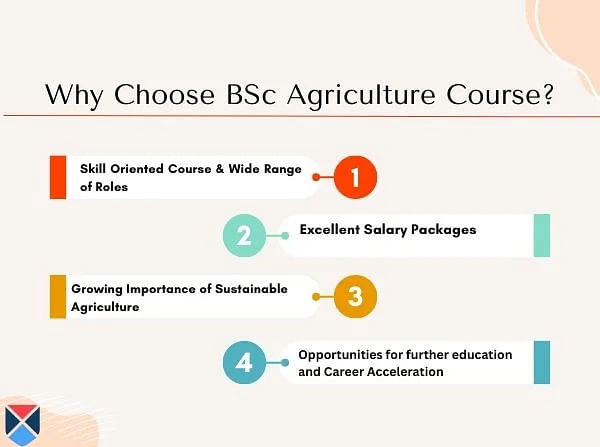
Here are some of the following points to highlight why to choose the BSc Agriculture course:
Getting admission for BSc Agriculture requires an aspirant to go through a fixed procedure, including group discussion, written entrance exams, etc. The BSc Agriculture admission process differs from college to college, but the general guideline is given below:
Read More: BSc Admission Process
The top BSc Agriculture colleges in India select the best candidates based on entrance exams. Some of the most popular BSc Agriculture entrance exams are listed below:
| BSc Agriculture Entrance Exams | Exam Dates | Accepting Colleges |
| BCECE | Jul 13-Jul 15, 2024 | Dr Kalam Krishi College, VKS College of Agriculture, Mandan Bharti Agriculture College |
| MP PAT | Jun 8- Jun 9, 2024 (Closed) | Sagar Institute of Research and Technology, Shri Vaishnav Institute of Management |
| ICAR AIEEA | Jun 29, 2024 (Closed) | Indian Agricultural Research Institute, Punjab Agricultural University, Tamil Nadu Agricultural University |
| AP EAMCET | May 16-May 23, 2024 (Closed) | Ideal Institute of Management and Technology, Andhra University |
BSc Agriculture fees vary from INR 20,000 – 3,00,000 per year, depending on the institute’s facilities and services. Below are the fees for several well-known BSc Agriculture colleges that offer BSc in Agriculture course:
| College | Tuition Fees Per Year | Admission Fees | Miscellaneous Fees Per Year |
| Anbil Dharmalingam Agricultural College and Research Institute | INR 70,800 | INR 2,500 | INR 11,600 |
| Jawaharlal Nehru Krishi Vishwa Vidyalaya | INR 58,000 | – | INR 6,875 |
| TNAU | INR 50,000 | INR 5,000 | INR 9,000 |
| Vivekanand College of Agriculture | INR 65,000 | INR 3,000 | INR 10,000 |
| Dolphin Institute of Biomedical and Natural Sciences | INR 75,000 | INR 15,000 | INR 2,500 |
| Ramkrishna Bajaj College of Agriculture | INR 40,000 | INR 1,000 | – |
| Bharati Vidyapeeth Loknete Mohanrao Kadam College of Agriculture | INR 75,000 | INR 10,000 | INR 4,000 |
| Mewar University | INR 60,000 | INR 20,000 | INR 8,000 |
| Thanthai Roever Institute of Agriculture and Rural Development | INR 40,000 | INR 5,000 | – |
| Sai Nath University | INR 60,000 | INR 5,000 | INR 1,000 |
| RKDF University | INR 75,000 | INR 2,500 | – |
| Rai Technology University | INR 1,50,000 | INR 1,500 | INR 5,000 |
| Junagadh Agricultural University | INR 29,000 | INR 10,000 | – |
Read More: Top BSc Agriculture Colleges in India
Below listed are the state-wise BSc Agriculture colleges in India:
| Location | Fees Per Year |
| Top BSc Agriculture Colleges in TamilNadu | INR 50,000- INR 70,000 |
| Top BSc Agriculture Colleges in Karnataka | INR 40,000-INR 75,000 |
| Top BSc Agriculture Colleges in AP | INR 50,000-INR 1,00,000 |
| Top BSc Agriculture Colleges in Maharashtra | INR 30,000-INR 70,000 |
| Top BSc Agriculture Colleges in Uttar Pradesh | INR 35,000-INR 75,000 |
| Top BSc Agriculture Colleges in Punjab | INR 40,000-INR 2,75,000 |
| Top BSc Agriculture Colleges in Uttarakhand | INR 20,000-INR 40,000 |
| Top BSc Agriculture Colleges in Madhya Pradesh | INR 25,000-INR 75,0000 |
| Top BSc Agriculture Colleges in Rajasthan | INR 30,000-INR 80,000 |
| Top BSc Agriculture Colleges in Kerala | INR 20,000-INR 50,0000 |
The five-year Integrated BSc in Agriculture qualification (BSc Agriculture + MBA in Agri-Business Management) in India combines academic study with hands-on instruction. The coursework is created to give students the abilities and information they need to seek a career in agriculture. Below mentioned are integrated BSc Agriculture course details:
| Eligibility | 10+2 with 50% minimum aggregate marks |
| Integrated BSc Agriculture Duration | 5 Years |
| Average Fees | INR 55,000 PA |
| Top College | VJU Jaipur |
The BSc Agriculture syllabus will ensure a deep understanding of analytical skills, including research involved with information systems and technologies. BSc Agriculture program syllabus is mentioned below:
| Semester 1 | Semester 2 |
| Agronomy | Crop Physiology |
| Plant Biochemistry | Soil and Water Conservation Engineering |
| Soil Science | Agricultural Economics |
| Animal Husbandry | Microbiology |
| Forestry | Agricultural Extension Education |
| Horticulture | Food Science and Nutrition |
| Agricultural Botany | Agro-Meteorology & Climate Change |
| Semester 3 | Semester 4 |
| Plant Pathology | Fundamentals of Plant Genetics |
| Entomology | Plant Disease Management |
| Seed Technology | Crop Production Technology |
| Crop Production Technology | Soil Management |
| Farm Management | Nematology |
| Soil Resource Inventory | Applications of Nanotechnology |
| Farm Machinery and Power | Agricultural Chemistry |
| Semester 5 | Semester 6 |
| Plant Breeding | Agricultural Finance |
| Agricultural Marketing | Agro Informatics |
| Agricultural Microbiology | Organic Farming |
| Horticultural Crops | Plant Biotechnology |
| Post-harvest management | Crop Improvement |
| Soil Fertility Management | Agricultural Extension |
| Agricultural Economics | Electives |
| Semester 7 | Semester 8 |
| Farming System & Precision Farming | Village Attachment |
| Soil Fertility Management | Plant Clinic Attachment |
| Agro-Industrial Attachment | Modules for Skill Development |
| Plant Clinic Attachment | Projects/Reports |
| Unit Attachment | Electives |
| Projects | – |
| Electives | – |
Read More: BSc Agriculture Syllabus & Subjects
BSc Agriculture course is that it makes graduates prepared to make knowledgeable choices about farming methods, land use, and agricultural policy. Diploma in Agriculture focuses on practical skills related to farming and agriculture practices.
Below is a comparison between the BSc in Agriculture and the Diploma in Agriculture:
Course | BSc Agriculture | Diploma in Agriculture |
Full Form | Bachelor of Science in Agriculture | Diploma in Agriculture |
Stream | Science | Science |
Duration | 4 years | 1 -2 years |
Eligibility | 10+2 with PCB as a major combination with 50% as the total aggregate | 10+2 with 50% as the total aggregate |
Entrance Exams | BCECE, PAU CET, JCECE,etc. | AP POLYCET, TS POLYCET,etc. |
Top Colleges | Visvha Bharati, Chandigarh University, Amity University | Agriculture University, Aryans Degree College |
Fees Per Year | INR 20,000 – 3,00,000 | INR 10,000-50,000 |
Job Roles | Agronomist, Agricultural Officer, Plantation Manager, Agricultural Consultant, and more. | Agricultural Assistant, Field Officer, Crop Advisor, and more. |
Average Salary | INR 3.5-12 LPA | INR 1.8-3.5 LPA |
Read More: Diploma in Agriculture
Students who choose BSc Agriculture have a vast scope for higher education. An aspirant can pursue a Ph.D. or take the ARS (Agriculture Research Service) examination after graduation. If an aspirant wants to pursue a career in management, The aspirant can enroll in MBA/PGDM agribusiness programs at IIM A, IIM L, Symbiosis, BHU, and NIAEM.
Listed below are some other courses for higher studies:
Over the last few years, there has been an increase in the demand for skilled professionals in agriculture. Because of technological advancements, there is a modernized revolution in agriculture and such specialists and knowledgeable professionals.
Listed below are some of the career options in this field along with top hiring companies:
Job Designations | Job Description | Hiring Companies |
| Agricultural Consultant | Offer services like farm management and strategies to grow the business through sustainable practices | ITC Limited, DuPont India, Monsanto India |
| Agronomist | Provide advice to farmers and companies regarding crop management and farming practices | ICAR, Mahyco, Syngenta India |
| Agricultural Officer | Looks after compliance practices and ensures the business is conducted within the set rules and regulations | NABARD, IFFCO, State Agriculture Departments |
| Seed Production Manager | Look after the processing, production, and seed distribution | National Seeds Corporation, Kaveri Seed Company |
The average starting salary of a BSc Agriculture graduate is around INR 3.5-12 LPA [Source: Glassdoor]. Many factors like graduation from college, geographic location, academic performance, etc., determine an aspirant’s salary. Given below are the BSc Agriculture graduate salary details for various job roles:
| BSc Agriculture Job Roles | Average Entry Level Salary (INR) | Salary After 5+ Years of Experience (INR) |
| Biochemist | 3,50,000 – 5,00,000 | 8,00,000 – 12,00,000 |
| Food Scientist | 3,00,000 – 4,50,000 | 7,00,000 – 10,00,000 |
| Agricultural Engineer | 4,00,000 – 6,00,000 | 10,00,000 – 15,00,000 |
| Agronomy Sales Manager | 4,50,000 – 6,50,000 | 12,00,000 – 18,00,000 |
Read More: BSc Agriculture Salary
Below listed are a few top recruiters for BSc Agriculture graduates:
| National Seeds Corporation | ICAR (Indian Council of Agricultural Research) | IFFCO (Indian Farmers Fertiliser Cooperative) |
| NABARD (National Bank for Agriculture and Rural Development) | ITC Limited | Monsanto India |
| Mahyco (Maharashtra Hybrid Seeds Company) | Rallis India Limited | Dhanuka Agritech Limited |
| Godrej Agrovet | PepsiCo India | Nestle India |
| Bayer CropScience Ltd. | Syngenta India | DuPont India |
| UPL Limited (formerly United Phosphorus Limited) | Hindustan Unilever Limited (HUL) | Kaveri Seed Company |
For students seeking a BSc in Agriculture degree, there are many scholarships available. These grants can pay for living costs, housing costs, and tuition. Below mentioned are BSc Agriculture Scholarships:
Read More: Best Agriculture Courses after 12th
Below listed are the top 3 cities to pursue a BSc Agriculture course based on top colleges, average living expense, top recruiters, and average starting salary:
Cities | Top Colleges Offering BSc Agriculture Courses | Average Living Expense (INR) | Average Starting Salary (INR) | Top Recruiters |
| Delhi | Indian Agricultural Research Institute, Delhi University, Amity University | 15,000 – 25,000 | 3,00,000 – 4,00,000 LPA | National Seeds Corporation, KRBL Limited |
| Bangalore | University of Agricultural Sciences, Christ University, Bangalore University | 15,000 – 20,000 | 3,50,000 – 4,50,000 LPA | Namdhari Seeds, United Genetics India Pvt. Ltd |
| Hyderabad | Professor Jayashankar Telangana State Agricultural University, Osmania University | 12,000 – 18,000 | 3,00,000 – 4,00,000 LPA | Nuziveedu Seeds, Prabhat Agri Biotech Ltd. |
BSc Agriculture duration is 4 years during the course, students acquire practical, theoretical, and skill-based knowledge. Listed below are some skills that graduates learn throughout the course:
The BSc Agriculture syllabus is designed to provide students with an understanding of agricultural science and modern farming technicalities. BSc Agriculture subjects cover various functionalities of agricultural science and include topics such as Agricultural Economics, Agronomy, Plant Biochemistry, Organic Farming, and more.
BSc Agriculture core subjects include Agronomy, Soil Science, Agricultural Engineering, Plant Pathology, Entomology, Agricultural Economics, etc. Students can also choose elective subjects like Agri-Business Management, Precision Farming and Agri-Informatics, Seed Technology, Post-Harvest Technology, etc., as per their interest area.
BSc Agriculture course is well-structured and prepares students with industry-oriented skills & knowledge in order to obtain adequate job opportunities. Hence, the job scope of B.Sc Agriculture is filled with promising career prospects in the Pharmaceutical Industry, Chemical Firms, Research Centers, and Academic Institutions.
Table of Contents
Read More: BSc Syllabus and Subjects
The B.Sc Agriculture syllabus ensure that the students get a comprehensive understanding of theoretical and practical approaches to agricultural science. However, the syllabus can differ based on diverse academic structures and course curriculums for different institutions.
A generic view of the B.Sc Agriculture syllabus semester wise is given below:
The first year BSc Agriculture syllabus focuses on the foundation of crop science, soil science, horticulture, agriculture engineering, and animal science. B.Sc Agriculture subjects 1st year comprises the following:
| Semester 1 | Semester 2 |
| Agronomy | Crop Physiology |
| Plant Biochemistry | Soil and Water Conservation Engineering |
| Soil Science | Agricultural Economics |
| Animal Husbandry | Microbiology |
| Forestry | Agricultural Extension Education |
| Horticulture | Food Science and Nutrition |
| Agricultural Botany | Agro-Meteorology & Climate Change |
The BSc Agriculture 2nd year syllabus aims at understanding topics like conservation practices, and sustainable agriculture, experimental design in agriculture, rural development, community engagement, and more. Given below is the BSc Agriculture 3rd semester and 4th semester syllabus:
| Semester 3 | Semester 4 |
| Plant Pathology | Fundamentals of Plant Genetics |
| Entomology | Plant Disease Management |
| Seed Technology | Crop Production Technology |
| Crop Production Technology | Soil Management |
| Farm Management | Nematology |
| Soil Resource Inventory | Applications of Nanotechnology |
| Farm Machinery and Power | Agricultural Chemistry |
The 3rd year BSc Ag syllabus focuses deeper into advanced crop science, agriculture biotechnology, agriculture policy and economics, and more. Given below is the B.Sc Agriculture syllabus for the third year:
| Semester 5 | Semester 6 |
| Plant Breeding | Agricultural Finance |
| Agricultural Marketing | Agro Informatics |
| Agricultural Microbiology | Organic Farming |
| Horticultural Crops | Plant Biotechnology |
| Post-harvest management | Crop Improvement |
| Soil Fertility Management | Agricultural Extension |
| Agricultural Economics | Electives |
BSc Agriculture Third Year Practicals
Apart from theoretical concepts, the following are the practical subjects available under the BSc Agriculture program for the third year:
The BSc Agriculture fourth year syllabus aims at understanding advanced techniques in crop production and management, training in modern farming techniques, agribusiness management, and more. Given below is the BSc Agri subjects list for the fourth year:
| Semester 7 | Semester 8 |
| Farming System & Precision Farming | Village Attachment |
| Soil Fertility Management | Plant Clinic Attachment |
| Agro-Industrial Attachment | Modules for Skill Development |
| Plant Clinic Attachment | Projects/Reports |
| Unit Attachment | Electives |
| Projects | – |
| Electives | – |
The BSc Agri is a professional degree comprising core and elective subjects. Any agriculture subject is a mix of Biology, Botany, Biochemistry, and Biotechnology. The subjects provide an in-depth understanding of agricultural science and include topics such as Plant Pathology, Seed Technology, Crop Management, Organic farming, and more.
The following is the BSc Agri subject list consisting of core and elective topics:
The core subjects in B.Sc Agriculture are listed below along with the topics covered:
| BSc Agriculture Core Subjects | Topics Covered |
| Agronomy | Seeds & Sowing, Crop Density, Crop Nutrition, Crop Water Requirement, Water Resources, Quality of Irrigation Water, and more. |
| Crop Production Technology | Origin, Geographical Distribution, Economic Importance, Yield of Rabi & Khariff Crops, Pearl Millet & Finger Millet, and more. |
| Plant Pathology | Importance of Plant Diseases, Study of Plant Pathogenic Organisms, Pathogenesis, Classification of Plant Disease, and more. |
| Plant Biochemistry | Properties of Fatty Acid, Nucleic Acid, Amino Acid, Importance of Proteins, Mechanism of Action, and more. |
| Crop Physiology | Absorption of Water, Photosynthesis, Plant Growth Regulators, Respiration & Glycolysis, and more. |
| Genetics and Plant Breeding | Domestication, Role of Plant Breeding, Acclimatization, Modes of Selection, Breeding Methods, and more. |
| Agricultural Microbiology | Role of Microbes, Biofertilizers, Biopesticides, Biofuel production, Bio Pesticides, Soil Organisms, and more. |
| Soil Science | Soil as a Natural Body, Soil Physical Properties, Soil Color, Soil Organic Matter, Soil Profile, and more. |
| Entomology | History, Morphology, Function of Insect’s Body Parts, Reproduction in Insects, Wing Venation, and more. |
The elective subjects in B.Sc Agriculture are listed below along with topics covered in each subject:
| BSc Agriculture Elective Subjects | Topics Covered |
| Applied Horticulture | Protected Cultivation, Greenhouse Management, Fruit Production, Pomology, Vegetable Production, and more. |
| Agriculture Business Management | Agribusiness Entrepreneurship, Agricultural Finance and Risk Management, Marketing Strategies for Agricultural Products, and more. |
| Commercial Beekeeping | Bee Biology and Behavior, Hive Management Techniques, Bee Diseases, Honey Production and Processing, and more. |
| Seed Technology | Seed Certification, Seed Drying, Seed Treatment, Seed Testing, Seed Packing, GM Crops & Organic Seed Production, and more. |
| Organic Farming | Principles and Practices of Organic Agriculture, Organic Crop Production Methods, Soil Health in Organic Systems, and more. |
| Post-Harvest Technology | Principles of Post-Harvest Handling, Quality Control and Assurance in Post-Harvest Handling, and more. |
| Crop Improvement and Food Safety | Modern Breeding Techniques, Genetic Diversity, Food Safety Regulations and Standards, Quality Assurance in Food Production, and more. |
Also, Check: Best Agriculture Courses after 12th
The BSc Agriculture syllabus varies from college to college based on the curriculum and program objectives. Candidates can visit the college or university’s official website to download the B.Sc Agriculture syllabus PDF 2024 of a particular college. The following is a semester-wise syllabus for BSc Agriculture syllabus for top colleges:
The BSc Agriculture syllabus at Chandigarh University covers an overview of social science, genetics and plant breeding, agriculture engineering, etc. The following tables show the semester-wise syllabus for B.Sc Agriculture at the University of Chandigarh:
BSc Ag 1st Semester Syllabus | BSc Ag 2nd Semester Syllabus |
| English Language-I | Concept of Agriculture Microbiology |
| Horticulture Fundamentals | Agriculture Economics Fundamentals |
| Social Science Basics | Genetics |
| Fundamentals of Mathematics | Concepts of Soil and Water Conservation Engineering |
| Forestry Basics | Plant Pathology |
| Plant Biotechnology and Biochemistry Basics | Basics of Agriculture Economics |
| Waste Management | Entomology |
| Understanding Agriculture Heritage | English Language-II |
| Laboratory Work | Laboratory Work |
BSc Ag 3rd Semester Syllabus | BSc Ag 4th Semester Syllabus |
| Plant Breeding Fundamentals | Understanding Crop Production Technology-II |
| Agriculture-Informatics | Green Technology and Renewable Energy |
| Understanding Crop Production Technology-I | Seed Technology Principles |
| Concept of Livestock and Poultry Management | Basics of Agriculture Marketing |
| Power and Farm Machinery Concepts | Plantation Crop Production Technology |
| Basics of Agriculture Finance | Ornamental Crops Production Technology |
| Vegetables and Species Production Technology | Concept of Sustainable Agriculture |
| Basics Statistics | Climate Change and Agro-Meteorology |
| Elective-I | Elective-II |
| Laboratory Work | Laboratory Work |
BSc Ag 5th Semester Syllabus | BSc Ag 6th Semester Syllabus |
| Crop Improvement-I | Secondary Agriculture and Protected Cultivation |
| Soil Fertility Management and Manure Fertilizers | Watershed Management |
| Disease Management Principles and Pest | Beneficial Inspects Management |
| Business Communication and Entrepreneurship Development | Food Nutrition and Science Principles |
| Crop Management | Horticulture Crop Management and Disease Handling |
| Nano Technology and Precision Farming | Organic Farming Principles |
| Elective-III | Elective-IV |
| Laboratory Work | Laboratory Work |
BSc Ag 7th Semester Syllabus | BSc Ag 8th Semester Syllabus |
| General Orientation | Agriculture Industrial Attachment-I |
| Village and University Attachment | Practical Training in Agriculture and Cottage Industries and Commodities Boards |
| Agriculture Industrial Attachment-I | – |
| Project Report/Viva | – |
The BSc Ag syllabus at Dr. APJ Abdul Kalam University offers various aspects of horticulture fundamentals and integrates subjects like human values and ethics. The following tables show the semester-wise syllabus for BSc Agriculture:
BSc Agriculture 1st Semester Syllabus | BSc Agriculture 2nd Semester Syllabus |
| Horticulture Fundamentals | Concept of Agriculture Microbiology |
| Soil Science Fundamentals | Genetics Fundamentals |
| Plant Biochemistry and Bio-Technology Concepts | Crop Physiology Concept |
| Communication Skills in English | Plant Physiology Fundamentals |
| Forestry Principles | Understanding Agriculture Economics |
| Agronomy | Entomology |
| Agriculture Heritage Concepts | Water and Soil Conservation Engineering |
| Basic Mathematics | Concept of Agriculture Extension Education |
| Understanding Human Values and Ethics | Skill Development Workshop |
| Physical Education and Yoga Practice | – |
BSc Agriculture 3rd Semester Syllabus | BSc Agriculture 4th Semester Syllabus |
| Plant Breeding Fundamentals | Rabi Crop Production Technology |
| Kharif Crop Production Technology | Agriculture Marketing |
| Agriculture Informatics Concepts | Understanding Green Technology and Renewable Energy |
| Statistics Fundamentals | Seed Technology Fundamentals |
| Fundamentals of Farm Machinery and Power | Sustainable Agriculture |
| Agriculture Cooperation and Finance | Plantation Crop and Fruit Production Technology |
| Disaster Management and Environment Science | Management of Problematic Soils |
| Poultry Management and Livestock Concepts | Elective-I |
BSc Agriculture 5th Semester Syllabus | BSc Agriculture 6th Semester Syllabus |
| Intellectual Property Rights | Food Science and Nutrition Principles |
| Kharif Crop Improvement Process | Organic Farming Fundamentals |
| Soil Fertility Management | Secondary Agriculture and Protected Cultivation |
| Geoinformatics Concepts | Rainfed Agriculture |
| Business Communication and Entrepreneurship Development | Beneficial Insects Principles |
| Kharif Crop Improvement- Practical | Farm Production and Resource Economics |
| Elective-II | Rabi Crop Improvement Process |
| – | Rabi Crop Improvement- Practical |
BSc Agriculture 7th Semester Syllabus | BSc Agriculture 8th Semester Syllabus |
| On Campus Training | Agriculture Industrial Attachement-II |
| Agriculture Industrial Attachment-I | Final Viva |
| Project Report and Evaluation | – |
| Village or Unit Attachment | – |
The course structure is a mix of theoretical and practical knowledge and includes group discussions, seminars, and industrial visits. The BSc Ag syllabus includes seminar paper submissions, internships, dissertations, etc. under the curriculum.
A general overview of the course structure is listed below:
The teaching methodology involves a mix of classroom teaching and real-world application through case studies and practicals. Some teaching methodologies and techniques used in the agriculture sector by renowned colleges are listed below:
Projects are a very significant component of the B.Sc Agriculture course curriculum. These projects are industry-oriented and provide a complete understanding of the subject matter in a realistic setting.
Listed below are some of the popular project topics:
BSc Agriculture books help students understand the concepts of crop science, pest management strategies, genetics and plant breeding, agribusiness management, etc. The year-wise BSc Agriculture books followed by colleges across India are detailed in the sections below.
Students are advised to refer to the BSc Agriculture 1st year books listed in the table below:
| Books | Author | Topics Covered |
| Fundamentals of Agronomy | Rajan Chandel | Principles of Agronomy, Crop Ecology, Agricultural Meteorology, Soil-Water-Plant Relationship, and more. |
| Principles of Soil Science | N.C. Brady & R.R. Weil | Soil Formation, Soil Classification, Soil Physical Properties, Soil Chemistry, Soil Biology, and more. |
| Agricultural Economics | R.C. Agrawal & S.K. Singh | Principles of Economics, Agricultural Production Economics, Farm Management, Agricultural Marketing, and more. |
| Plant Pathology | R.S. Mehrotra & Ashok Aggarwal | Introduction to Plant Pathology, Pathogens and Diseases, Disease Cycle, Plant Disease Epidemiology, and more. |
| Principles of Crop Production | C Singh | Crop Growth and Development, Soil Fertility and Fertilizer Use, Water Management, Sustainable Agriculture, and more. |
The B.Sc Agriculture 2nd year books are provided in the table below for students’ reference:
| Books | Author | Topics Covered |
| Irrigation and Water Management | B.C. Punmia & Pande B.B.L. | Soil-Water-Plant Relationship, Irrigation Methods, Water Resources Management, Water Use Efficiency, and more. |
| Principles of Plant Breeding | R.W. Allard | Breeding Methods, Genetic Basis of Plant Breeding, Quantitative Genetics, Plant Genetic Resources, and more. |
| Fundamentals of Plant Physiology | V.K. Jain | Plant Water Relations, Mineral Nutrition, Photosynthesis, Respiration, Plant Growth Regulators, and more. |
| Principles of Organic Farming | P.K. Thampan | Organic Farming Principles, Soil Health Management, Organic Certification, Marketing of Organic Products, and more. |
| Soil Fertility and Fertilizers | J.S. Kanwar & N.P. Gupta | Fertilizer Types, Nutrient Management, Fertilizer Application Methods, Integrated Nutrient Management, and more. |
The B.Sc Agriculture 3rd year books used by most of the institutions in India are provided below:
| Books | Author | Topics Covered |
| Principles of Agribusiness Management | David L. Debertin & P.K. Gupta | Agribusiness Environment, Farm Management, Marketing Strategies, Agribusiness Policy, and more. |
| Post-Harvest Management and Processing | Amalendu Chakraverty | Post-Harvest Physiology, Storage Techniques, Processing Technologies, Quality Control, Food Safety, and more. |
| Livestock Production Management | N.S.R. Sastry & C.K. Thomas | Animal Breeding and Nutrition, Dairy Management, Poultry Farming, Livestock Housing, Waste Management, and more. |
| Principles of Animal Genetics and Breeding | Frank W. Nicholas | Genetic Principles, Breeding Systems, Quantitative Genetics, Molecular Genetics in Breeding, and more. |
The B.Sc Agriculture 4th year books for reference are given below:
| Books | Author | Topics Covered |
| Agricultural Marketing and Price Analysis | Acharya S.S. & Agarwal N.L. | Marketing Functions, Market Structure, Price Determination, International Trade, Agricultural Policies, and more. |
| Climate Change and Agriculture | D.K. Srivastava | Climate Models, Impact on Crop Production, Mitigation Strategies, Climate-Resilient Agriculture, Policy Responses, and more. |
| Agroforestry Systems and Practices | S.S. Negi | Agroforestry Principles, Tree-Crop Interactions, Soil Conservation, Carbon Sequestration, Livelihood Security, and more. |
| Rural Development and Communication | P. Narayanasamy | Rural Development Theories, Communication Strategies, Rural Infrastructure, Microfinance, and more. |
| Integrated Pest Management | Dhawan A.K. | IPM Principles, Pest Monitoring, Biological Control, Chemical Control, Cultural Methods, and more. |