
- info@wingeducations.com
- +91 (705) 495-5296
- Mon - Sat : 10.00-18.00
| Degree | Bachelors |
| Full Form | Bachelor of Education |
| Duration | 2 Years |
| Age | The minimum age limit is 19 years. |
| Minimum Percentage | Graduation with a minimum of 50% marks aggregate. |
| Average Fees | ₹10K – 1 LPA |
| Similar Options of Study | BA B.Ed, B.Sc B.Ed, B.Com B.Ed |
| Average Salary | INR 3.54 LPA |
| Employment Roles | Primary School Teacher, Head Teacher, Education Consultant, etc. |
| Top Recruiters | Oakridge International School, Billabong, Oberoi International School, etc. |
B.Ed full form is a Bachelor of Education, a three-year undergraduate program that aims to provide essential training and knowledge about several areas of educational practices and approaches associated with teaching occupation in primary and high schools. The BEd course duration is two years.
B.Ed job scope for graduates is vast which helps them to pursue careers in educational curriculum development, teachers in government schools, administration, and educational research. The average entry-level salary of a B.Ed graduate is INR 3.54 LPA, which after three-plus years of experience can be more than INR 7 LPA.
In order to be admitted into the course, students are required to fulfill BEd eligibility criteria which are listed below:
Read more: B.Ed after B.Com
BEd course offers students a wide range of opportunities in the field of education and research. Below are a few points that give us in-depth insight into why to choose the B.Ed course:

The admission procedure for the B.Ed course is done on a merit or entrance basis. The admission criteria differ based on different states like Punjab, UP, etc., which include entrance exam requirements, percentage, number of seats, etc.
Listed below is the procedure to get admission for the BEd course:
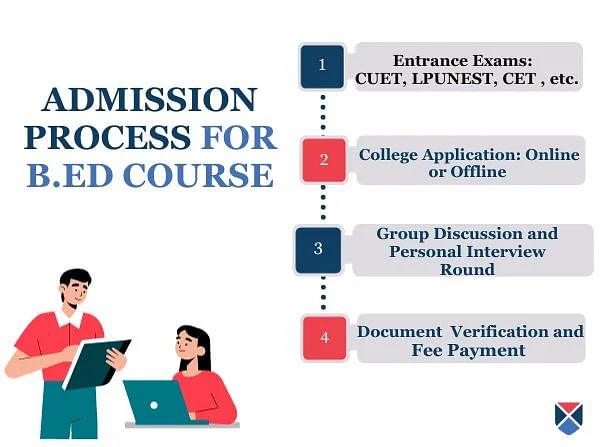
Read More: B.Ed Admission Process
B.Ed admission includes entrance exams at national, state, and institute levels such as LPUNEST, UP B.ED JEE, CUET, GLAET, etc. The popular B.Ed entrance exams are listed below, along with registration dates and colleges accepting the score:
| B.Ed Entrance Exams | Registration Dates (Tentative) | Accepting Colleges |
| CUET | February 2024-April 2024 | Indira Gandhi National Tribal University, JMI, Sanskriti University, etc. |
| RIE CEE | April 2024-June 2024 | RIE Ajmer, RIE Bhubaneswar, RIE Mysore, etc. |
| GLAET | January 2024- May 2024 | GLA University |
| MAHA B.Ed CET | March 2024 | BTTC Mumbai, MIT-WPU, etc. |
| BHU UET | February 2024 | Banaras Hindu University |
| DU B.Ed Entrance Exam | May 2024- June 2024 | Delhi University |
| Bihar CET B.Ed | February 2024- March 2024 | Babasaheb Bhimrao Ambedkar Bihar University, Magadh University, etc. |
| UP B.Ed JEE | February 2024- May 2024 | Lucknow University, Allahabad University, etc. |
| LPU NEST | January 2024 | Lovely Professional University |
| SNDT Women’s University CET | February 2024- March 2024 | SNDT Women’s University |
Read More: B.Ed Entrance Exam Details
B.Ed courses offer various specializations that help the graduates choose or focus on a particular subject they would like to teach when they become teachers. These specializations offer the candidates the requisite skills needed for research, application, and development of children’s understanding of subjects.
Listed below are some of the top Bachelor of Education specializations:
| B.Ed in Psychology | B.Ed in Special Education |
| B.Ed in English | B.Ed in Tamil |
| B.Ed in Commerce | B.Ed in Sanskrit |
| B.Ed in Hindi | B.Ed in Physical Science |
| B.Ed in Physical Education | B.Ed in Computer Science |
B.Ed scope in India is vast as the demand for graduates is ever-increasing and is a professional training program that gets students ready for a teaching career. The B.Ed colleges are located in various parts of India, the top B.Ed colleges in Delhi are Sharda University, JMI, DU, etc., whereas, B.Ed colleges in Mumbai include KJ Somiya College of Education, Bombay Teachers’ Training College – [BTTC], etc.
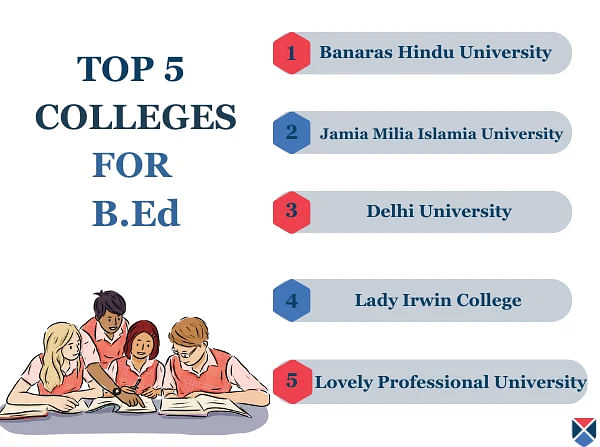
Below listed are the top B.Ed colleges in India with the fee breakdown into admission, tuition, and miscellaneous fees:
Best B.Ed Colleges in India | Average B.Ed Tuition Fees | Admission Fees | Miscellaneous Fees |
INR 17,900 PA | – | INR 19,000 PA | |
INR 6,700 PA | INR 100 | INR 5,000 PA | |
INR 5,742 PA | INR 500 | – | |
INR 34,000 PA | – | INR 18,000 | |
INR 60,000 PA | INR 2,500 | INR 38,000 PA | |
INR 80,000 PA | – | INR 34,500 PA | |
INR 25,000 PA | – | INR 4,500 PA | |
INR 1.40 LPA | – | INR 1.65 LPA | |
INR 53,000 PA | – | INR 55,000 PA | |
INR 1.50 LPA | INR 70,000 | – | |
INR 40,000 PA | – | INR 65,000 PA | |
INR 61,000 PA | INR 15,000 | – | |
INR 35,000 PA | INR 2,000 | – | |
INR 1.50 LPA | – | INR 25,000 PA | |
INR 9,433 PA | INR 1,050 | – |
Below listed are location-wise B.Ed colleges in India with the average annual fees:
| S.No | Location | Average Annual Fees |
1 | INR 9,000-80,000 PA | |
2 | INR 12,000-65,000 PA | |
3 | INR 10,000-50,000 PA | |
4 | INR 10,000-55,000 PA | |
5 | INR 10,000-85,000 PA | |
6 | INR 15,000-1 LPA | |
7 | INR 25,000-1 LPA | |
8 | INR 11,000-75,000 PA | |
| 9 | B.Ed Colleges in Jharkhand | INR 10,000-60,000 PA |
| 10 | B.Ed Colleges in Delhi | INR 6,000-1.40 LPA |
Read More: List of all B.Ed Colleges in India
The course has full-time, integrated, and distance learning options available to students. The following B.Ed course details are provided below:
Type | BEd Eligibility | BEd Duration |
B.Ed Full Time | Should have completed bachelor’s degree with a minimum of 50% aggregate+ Entrance Examinations + PI Performance | 2 Years |
Integrated B.Ed | Should have completed bachelor’s degree with a minimum of 50% aggregate | 4-5 Years |
Distance B.Ed | Should have completed bachelor’s degree with a minimum of 50% aggregate | 2-5 Years |
Below mentioned are the distance BEd course details:
Read More: Distance B.Ed
Integrated B.Ed degree can be pursued by students after 10+2 (high school degree) completion. Below listed is the integrated B.Ed course details:
Read more: Complete List of Education Courses
B.Ed syllabus in first year focuses on psychological foundations of education, historical and political perspectives in education, learning theories, etc. The B.Ed second-year syllabus covers topics like advanced pedagogical courses, assessment strategies, education decision-making, etc. Below is a list of generic subjects covered during the BEd course:
| B.Ed Subjects | Topics Covered |
| Educational Psychology | Learning Theories, Behaviorism, Constructivism, Cognitive Development Theories, Motivation in Learning, etc. |
| Curriculum Design and Development | Principles of Curriculum Design, Curriculum Models and Approaches, Curriculum Evaluation, etc. |
| Classroom Management | Establishing Classroom Rules and Expectations, Strategies for Behavior Management, Conflict Resolution in the Classroom, etc. |
| Assessment and Evaluation | Types of Assessment (Formative, Summative), Assessment Tools and Techniques, Rubrics and Grading, Standardized Testing, etc. |
Read More: B.Ed Syllabus and Subjects
B.Ed is a more general program that prepares teachers for all levels, while D.El.Ed is specifically designed for teaching at the elementary level. Below is a comparison between the B.Ed degree and D.El.Ed:
Course | B.Ed | D.El.Ed |
Full Form | Bachelor of Education | Diploma in Elementary Education |
Stream | Education | Education |
Course Duration | 2 Years | 2 Years |
Eligibility | Bachelor’s degree with a minimum of 50% aggregate | Minimum of 50% aggregate in 10+2 examination |
Course Overview | The course curriculum covers topics like teaching methodologies, educational psychology, curriculum development, and classroom management. | The course curriculum focuses on topics like child development, pedagogy, teaching methods, and assessment techniques. |
Entrance Exams | RIE CEE, AP EDCET, TS EDCET, etc. | Bihar D.El.Ed Entrance exams, Haryana D.El.Ed Entrance exams, etc. |
Top Colleges | DU, MDU, IGNOU | DU, MDU, IGNOU |
Fees | INR 5,000- 1.50 LPA | INR 5,000 – 2 LPA |
Average Salary | INR 3.54 LPA | INR 2-5 LPA |
Job Roles | Primary School Teacher, Head Teacher, Education Consultant, etc. | Primary Teacher, Tutor, Administrator, Assistant Dean, Researcher, Content Reviewer, etc. |
Read More: D.El.Ed
B.Ed degree graduates’ average salary in India is INR 3.54 Lakhs per annum. Candidates willing to become teachers in government schools are advised to pursue a degree in education. The pay is determined by various factors such as domain competence, job profiles, demand in the public and private sectors, etc. As candidates get more practical exposure and experience, the pay scale increases.
B.Ed Jobs | Entry Level Average Salary | Salary After 3 Years of Experience |
| Classroom Teacher | INR 3-3.80 LPA | INR 4.20-5 LPA |
| Education Consultant | INR 3-4.20 LPA | INR 5-7 LPA |
| Special Education Teacher | INR 3-3.50 LPA | INR 5-6 LPA |
| Textbook Author/Editor | INR 3 LPA | INR 4.50-5.50 LPA |
Read More: B.Ed Salary in India
B.Ed is a two-year professional course that can be pursued by students if they wish to pursue teaching as a career option. There are many higher study options available for graduate students after a BEd degree, which can help them better understand the subject. Some of the courses that can be pursued after BEd are listed below:
B.Ed candidates have good prospects and broad employment alternatives in both the private and public sectors. Following are the various job profiles for B.Ed graduate students along with hiring companies and average salary:
B.Ed Job Designations | Hiring Companies | Average Monthly Salary |
| School Counselor | Delhi Public School, Universal Education, etc. | INR 25,000 Per Month |
| Curriculum Developer | K12 Techno Services, Whitehat Jr, Podar International School etc. | INR 22,000-27,000 Per Month |
| School Administrator | Akanksha Foundation, Saint Mira Academy, Sophia High School, etc. | INR 28,000 Per Month |
| Online Educator | Byjus’s, CueMath, Planet Spark, etc. | INR 22,000 Per Month |
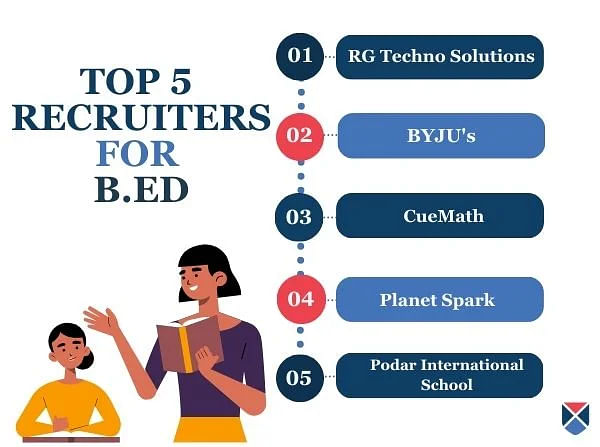
The scope of teacher education in India is vast as graduates are hired by government education departments, textbook publishing, online education platforms, etc. Below listed are a few top recruiters for graduates:
Top Recruiter | Average Entry-Level Salary |
| RG Technosolutions | INR 3.90 LPA |
| BYJU’s | INR 5.50 LPA |
| CueMath | INR 2.60 LPA |
| Planet Spark | INR 3.40 LPA |
| Podar International School | INR 4.10 LPA |
[Sources: Ambition Box]
Students pursuing a Bachelor of Education can apply for various scholarships provided by public and private institutions. A list of scholarships for BEd degree students is provided below:
BEd Scholarship | Eligibility Criteria | Amount |
| Tata Trust Scholarship | Students should have secured a minimum of 60% marks in a bachelor’s degree or any equivalent degree. | Tuition Fee Waiver |
| CARE Rating Scholarship | The student should have completed a graduation degree with a minimum of 50% marks. | Upto INR 25,000 |
| Vidyasaarathi MPCL Scholarship |
| Upto INR 8,000 |
Read More: B.Ed Scholarships
BEd graduate students need a combination of hard and soft abilities to succeed in their careers. Some of the skills required by a B.Ed degree graduate are:
The list of BEd elective subjects has been given below:
Elective Category | Elective Subjects |
Subject Specialisation |
|
Skill-Based Electives |
|
Thematic Areas |
|
There are no specific BEd syllabus specialisations. However, students are provided with the option to specialise in their respective graduation subjects. That means a student can specialise in English if he/ she has completed the qualifying exam with English as the main subject. These BEd syllabus specialisations help candidates enhance their skills in a specified field of study. The list of specialisation subjects included in the BEd syllabus and subjects have been listed below:
The detailed overview of these B.Ed specialisations is given below:
Specialisations | Key Learning Areas |
Social Sciences | Explores the interdisciplinary nature of history, geography, economics, and political science. Focuses on curriculum structure, teaching strategies, textbook analysis, project-based learning, and assessment methods tailored to the Indian school system. |
Biological Sciences | Covers foundational principles of biology education, pedagogical approaches, curriculum design, and effective classroom practices. Emphasizes assessment tools, learner engagement, and professional growth of biology teachers. |
Physical Sciences | Focuses on the aims and methods of teaching physics and chemistry. Includes curriculum planning, teaching aids, assessment techniques, and encouraging lifelong learning. Supports teacher development with practical and theoretical integration. |
Mathematics | Emphasizes logical reasoning, conceptual understanding, and effective teaching strategies for mathematics. Includes curriculum analysis, inclusive teaching methods, resource planning, and strategies for professional enhancement. |
Hindi | Deals with language development, curriculum framing, and understanding language structure and skills. Encourages the integration of cultural, literary, and grammatical elements to enhance Hindi language education. |
English | Focuses on language pedagogy, skill development, literary appreciation, and curriculum design. Includes strategies for teaching language through literature and developing appropriate learning materials. |
Urdu | Addresses the linguistic and cultural significance of Urdu in India, pedagogical strategies, and resource development. Includes literature-based instruction and learner-centric language activities. |
Sanskrit | Highlights the pedagogical principles of teaching classical Sanskrit. Covers lesson planning, literature forms, curriculum analysis, and integrating traditional knowledge with modern methodologies. |
The BEd distance education syllabus course structure is flexible and the outline is similar to the regular B.Ed syllabus. The course structure is divided into foundation courses, core education courses, language proficiency courses, and elective courses. Some of the top colleges offering B.Ed in distance mode include Burdwan University, Bharathiar University, IGNOU, and more. Candidates can check BEd Distance Education Syllabus and Subjects to learn more.
BEd syllabus and subjects can vary from college to college. While the basic structure remains the same, the topics included might vary at some level. The university wise Bachelor of Education (B.Ed) syllabus comparison can be checked below:
Sikkim University’s B.Ed syllabus is thoughtfully structured, starting with learner development, curriculum basics, and teaching methodologies. The Sikkim University B.Ed syllabus is detailed in the table below:
First Year Syllabus:
The first year syllabus with topics included have been given below:
Semester I | Semester II |
Development of Learner | Basics of Knowledge and Curriculum |
Education in Contemporary India | Assessment for Learning |
Learning & Teaching | Pedagogy of disciplinary stream |
Language Across the Curriculum | Understanding Disciplines and Subjects |
Reading and Reflecting on Texts | Developing Creative Skills |
Second Year Syllabus:
The second year syllabus with topics included has been given below:
Semester III | Semester IV |
Pedagogy of a school subject (any two) | School Internship |
Gender, School, and Society | Inclusive Education |
Elective | Understanding the Self |
School Internship | – |
Critical Understanding of ICT | – |
The University of Allahabad’s syllabus covers philosophy, sociology, subject knowledge, pedagogical methods, curriculum development, assessment techniques, psychology of learning, and educational technology. The University of Allahabad B.Ed syllabus is outlined in the table below:
First Year Syllabus:
The first year syllabus with topics included have been given below:
Semester I | Semester II |
Philosophy and Sociology of Education | Subject Knowledge |
Development of Learner | Pedagogy of School Subject I |
School Curriculum Development | Pedagogy of School Subject II |
Principles and Methods of Teaching | School Internship – I (Management of School Activities) |
Personality Development & Yoga | School Internship – I (Learner Assessment) |
Second Year Syllabus:
The second year syllabus with topics included has been given below:
Semester III | Semester IV |
Assessment of Learning | Psychology of Learning |
Educational Technology & ICT | Education in Contemporary Indian Society |
School Internship – II Subject I (20 Lesson Plans + 1 Final lesson plan teaching) | School Management |
School Internship – II Subject II (20 Lesson Plans + 1 Final lesson plan teaching) | Action research |
School Internship – II (Community Work) | Language Across the Curriculum |
Apart from this, some other university’s BEd syllabus can be checked by clicking on the links below:
The B.Ed syllabus has evolved to keep up with the changing times and global education system. The BEd syllabus for 1st-year syllabus focuses on the foundational knowledge related to teaching and learning methodologies. Whereas the Bachelor of Education (B.Ed) 3rd semester starts focusing on the specialization and internship programs. The B.Ed 4th-semester syllabus has a research project that helps students’ understanding of the syllabus.
The BEd Special Education Syllabus and Subjects focuses on equipping students with the required knowledge and skills to effectively teach and support students with special needs. The B.Ed Special Education syllabus is provided in the table below.
First Year Syllabus:
The first year syllabus with topics included have been given below:
Semester I | Semester II |
Human Growth & Development | Learning, Teaching, and Assessment |
Contemporary India and Education | Educational Psychology |
Sensory Disabilities | School Subjects Pedagogy (Mathematics, Science) |
Neurodevelopmental Disabilities | School Subjects Pedagogy 2 (English, Hindi) |
Introduction to Locomotors & Multiple Disabilities | Curriculum Designing |
Assessment and Identification of Needs | Practical |
Second Year Syllabus:
The second year syllabus with topics included has been given below:
Semester III | Semester IV |
Educational Teaching Strategies | Skill-based Optional Course |
Teaching Strategies and Methods | Statistics and Research |
Family Issues and Psychosocial | Inclusive School Creation |
Disabilities and Technology | Project Report/Viva |
Visual and Performing Arts | – |
Field Work/School Internship | – |
The B.Ed Computer Science Syllabus and Subjects aims to provide comprehensive training in both theoretical and practical aspects of computer science, along with pedagogical skills required for teaching. The B.Ed Computer Science syllabus is given in the table below.
First Year Syllabus:
The first year syllabus with topics included have been given below:
Semester I | Semester II |
Childhood Growing up | Learning and Teaching |
Contemporary India and Education | Teacher as a Counsellor |
Pedagogy of School Subject-1 – Part I | Pedagogy of School Subject-(2) |
School Organisation and Management | Pedagogy of Computer Science |
Pedagogy of Computer Science | Knowledge and Curriculum |
Understanding Discipline and Subject | Assessment of Learning |
Second Year Syllabus:
The second year syllabus with topics included has been given below:
Semester III | Semester IV |
Pre Internship | Arts in Education |
Internship | Simulated Teaching |
Engagement with the Field: Tasks and Assignments related to internship | Creating an Inclusive School |
– | Use of Teaching Learning Material in Classroom Discourse ( including teaching aids and reference material ) |
– | Language Across Curriculum |
– | Projects |
The B.Ed English Syllabus and Subjects include a combination of core and elective subjects designed to provide students with a strong foundation in educational theory and pedagogy with a focus on English. The B.Ed English syllabus is provided in the table below.
First Year Syllabus:
The first year syllabus with topics included have been given below:
Semester I | Semester II |
Childhood and Growing | Educational Technology & ICT |
Contemporary India and Education | Pedagogy of School Subject-1 (Part II) |
Philosophical and Sociological Foundations of Education | Intelligent use of ICT |
Psychology of learner, learning & Teaching Core courses | Assessment for Learning |
Pedagogy of School Subject-1 (Part I) | School Organisation and Management |
Understanding Discipline and Subjects | Developing Instructional design including lesson plans and unit plans |
Reading & Reflection | Teacher as a Counsellor |
Second Year Syllabus:
The second year syllabus with topics included has been given below:
Semester III | Semester IV |
Pre-Internships | Language across the Curriculum |
Internships | Gender, School, and Society |
– | Knowledge and Curriculum: Perspectives in Education |
– | Optional Papers |
– | Field Visit |
– | Workshop & Seminar |
The BEd Physical Science Syllabus and Subjects focuses on pedagogical methods, curriculum design, assessment techniques, and educational psychology relevant to teaching science at the secondary school level. The detailed semester-wise Bachelor of Education (B.Ed) Physical Science syllabus is provided in the table below.
First Year Syllabus:
The first year syllabus with topics included have been given below:
Semester I | Semester II |
Childhood & Growing up | Learning & Teaching |
Education in Contemporary India | Assessment for Learning |
Development and Management in School Education | Content & Pedagogy 1 Part I |
Gender, School & Society | Content & Pedagogy 2 Part I |
Second Year Syllabus:
The second year syllabus with topics included has been given below:
Semester III | Semester IV |
Content & Pedagogy 1 Part II | National Concern & Education |
Content & Pedagogy 2 Part II | Creating an Inclusive School |
Observation of demonstration lesson/ video lesson | Knowledge & Curriculum |
A simulated lesson with ICT mediation | Guidance and Counselling |
Internship | Practical Examination |
The B.Ed Psychology Syllabus and Subjects integrates principles of psychology into educational practice. The curriculum may vary across institutions but generally include educational psychology, child development, adolescent psychology, assessment techniques, counselling, and more. The B.Ed Psychology syllabus is provided in the table below.
First Year Syllabus:
The first year syllabus with topics included have been given below:
Semester I | Semester II |
Theory Subject | Teaching And Learning |
Sociological And Philosophical Foundations Of Education | Curriculum And Knowledge |
Childhood And Growing Up | Teacher As A Counsellor |
Pedagogy Of School Subjects | Learning Assessment |
Language Of The Curriculum | Pedagogy Of School Subjects |
Management And School Organisation | Art And Drama In Education |
Practical | Practical |
Second Year Syllabus:
The second year syllabus with topics included has been given below:
Semester III | Semester IV |
Preliminary School Engagement-I | Preliminary School Engagement-II |
Semester III | Semester IV |
Reflecting and Reading On Texts | Society, School, And Gender Theory |
Internship-I | Curriculum And Knowledge |
Practical | Internship-II |
Candidates can check other Important BEd Syllabus and Subjects by clicking on the link below:
Admissions to the BEd are based on merit and entrance exams. The B.Ed entrance exam syllabus is similar to all B.Ed entrance exams. The main sections to cover to get good grades in the B.Ed entrance exams are:
The B.Ed Syllabus for the Entrance examination is mentioned below in detail.
| Main Section | Important Topics | |
| General Knowledge | History | Polity |
| Current Affairs | General Science | |
| Verbal Aptitude | Syllogism | Paragraph Based Puzzles |
| Seating Arrangements | Bar, Pie, and Line chart Data Interpretations | |
| Teaching Aptitude | Nature, Objective, Characteristics, and Basic Requirements of Teaching | Factors Affecting Teaching |
| Teaching Aids | Methods of Teaching | |
| Logical Reasoning | Series Completion | Substitution and Interchanging |
| Tests of Alphabet | Principle of Classification | |
| Quantitative Aptitude | Percentage | Average |
| Ratio & Proportion | Profit & Loss | |
Also Read:
BEd teaching methodologies and techniques consist of both traditional lecture-based training as well as practical forms of teaching methods. The main aim of the practical form of teaching methods is to introduce students to the concepts with real-life problems and scenarios.
The traditional methods, on the other hand, give the students a chance to ask any questions or queries they might have.
During the B.Ed first year, the syllabus focuses on the primary concepts that are essential for the learning of the students. Whereas, in the B.Ed 4th Sem syllabus, the students are expected to work on a research project. These research projects help universities and colleges assess the students’ understanding of the subject.
Students choose the topic of their project based on the specialisation they pursue. Listed below are some of the popular research projects that are undertaken by the students.
Given below is the detailed overview of the career scope after BEd, including subject-wise career outcomes, potential roles, and indicative salary ranges in India:
The specialisation wise career scope after BEd has been given below:
Specialisation | Potential Roles | Average Salary |
Social Sciences |
| INR 3 LPA – INR 6 LPA (TGT), up to INR 8-10 LPA (PGT/Analyst) |
Biological Sciences |
| INR 3 LPA – INR 6 LPA (teacher), INR 6-8 LPA (ed-tech roles) |
Physical Sciences |
| INR 3 LPA – INR 6.5 LPA (school), INR 7-9 LPA (planning roles) |
Mathematics |
| INR 3.5 LPA – INR 7 LPA (school), INR 6-10 LPA (coaching/ed-tech) |
English |
| INR 3 LPA – INR 6 LPA (schools), INR 6-9 LPA (corporate training) |
Hindi/Urdu/Sanskrit |
| INR 2.5 LPA – INR 5.5 LPA (teaching), INR 5-8 LPA (editorial roles) |
The general career paths after pursing BEd course has been given below:
Role | Description | Salary Range |
School Teacher (TGT/PGT) | Teaches specific subjects in middle or high school, based on specialisation. | INR 3 LPA -INR 7 LPA |
School Principal/Vice Principal | Leadership roles in school management (usually after M.Ed and experience). | INR 6 LPA – INR 12 LPA |
Educational Consultant | Advises schools on curriculum, policies, or pedagogy. | INR 5 LPA – INR 10 LPA |
Curriculum Developer | Designs academic content and resources for schools or ed-tech companies. | INR 6 LPA – INR 12 LPA |
Online Tutor/Content Creator | Works with digital platforms to teach or create subject-related content. | INR 4 LPA – INR 10+ LPA (freelance/project-based) |
Competitive Exam Trainer | Trains aspirants for SSC, banking, CTET, and other exams. | INR 4 LPA – INR 8 LPA |
B.Ed syllabus books help students understand the concepts of psychology, pedagogy, assessment, technology integration, inclusive education, curriculum development, etc. Below listed are a few important B.Ed books along with the respective subject and authors:
The B.Ed 1st yearbooks cover topics such as children’s development, education in India, language learning, and more. The books included in the B.Ed 1st year syllabus are given in the table below.
| Books | Authors | Topics Covered |
| Child Growth and Development | E.B. Hurlock | Social Development, Factors Influencing Development, Theories of Development |
| School Education in Emerging Society | J. Mohanty | Role of Education, Educational Policies and Reforms, Curriculum Development |
| The Concept of Knowledge | P. Butchvarov | Philosophical Perspective, Epistemological Theories, Role of Perception |
| Development and Learning | J. Piaget | Cognitive Development, Research Methods, Knowledge Construction |
The B.Ed 2nd year books deal with topics such as teaching perspectives, curriculum development, evaluation, assessment, etc. The books used in the B.Ed 2nd year syllabus are provided in the table below.
| Books | Authors | Topics Covered |
| Methods for Effective Teaching | Paul R. Burden and David M. Byrd | Strategies & Techniques, Instructional Methods, Assessment Techniques |
| Practicing Gender Analysis in Education | Fiona Leach | Gender Issues in Education, Gender Equality & Inclusivity in Educational Settings |
| Index for Inclusion: Developing Learning and Participation in Schools | M. Ainscow and T. Booth | Policies, Practices, and Cultures in School, Enhancing Learning |
| Physiology of Sports and Exercise | Jack H. Wilmore, David L. Costill, W. Larry Kenney | Physiological Response, Anatomy, Exercise Metabolism |