
- info@wingeducations.com
- +91 (705) 495-5296
- Mon - Sat : 10.00-18.00
BCA or Bachelor of Computer Application is a three-year undergraduate degree program that provides students with a solid background in computer science, programming languages, software development, and other related fields. The core BCA subjects include mathematics for computing, computer organization, and architecture, data structures, web technologies, etc.
BCA admission requires students to have a 50% aggregate in Higher Secondary (10+2) with mathematics as a mandatory subject and qualifying entrance exams such as IPU CET, SET, SUAT, CUET-UG, etc., depending on the college requirement.
The BCA course fees are in the range of INR 5,000 – 2,00,000 per year the fees vary depending on the government and private entity, the BCA fees in a private college is between INR 25,000-2,00,000 per year whereas, for government colleges, the fees is between INR 5,000-70,000 per year.
Table of Contents
| Degree | Bachelors |
| Full Form | Bachelor of Computer Application |
| Duration | 3 Years |
| Age | The minimum age limit to enroll in the course is 17 years. |
| Entrance Exam | IPU CET, SET, SUAT, CUET-UG, etc. |
| Minimum Percentage | Minimum of 50% marks in 10+2 examinations |
| Average Fees | INR 5,000 – 2,00,000 per year |
| Average Salary | INR 2 – 8 LPA (Source: Glassdoor) |
| Employment Roles | Software Developer, Technical Analyst, Technical Support, Networking Trainee, Server Administrator etc. |
The BCA full form is Bachelor of Computer Application, the course seeks to develop students’ technical expertise and knowledge in computer science and information technology. The course emphasizes computer networks, business mathematics, and database management systems, enabling students to pursue roles in both public and private sectors, including web development, IT administration, and stack analysis
The BCA job scope for graduates is vast as they can opt for jobs like technical associate, blockchain developer, data manager, etc in both private and public companies like Infosys, Wipro, National Informatics Center, SAIL, etc. The BCA graduate earns around INR 2 – 8 LPA.
Also Read: Complete List of Courses After 12th
The eligibility for BCA may include different components like minimum percentage, entrance exam score, reservation quota, etc. Below listed is the BCA eligibility criteria:
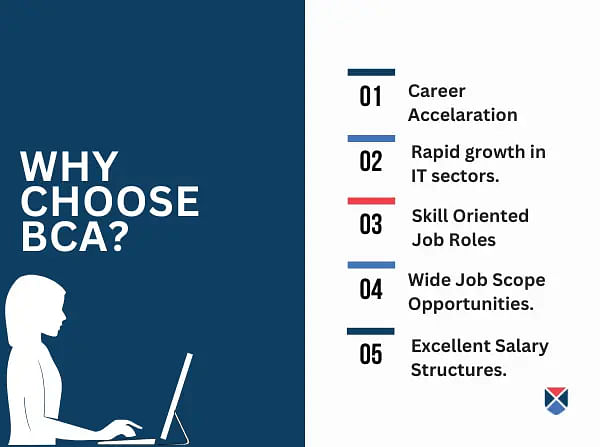
When students decide to pursue a BCA course they should research about course details to ensure that they are aware of the course they are enrolled in. To get the answers to why one should choose BCA, we have broken them down into the following :
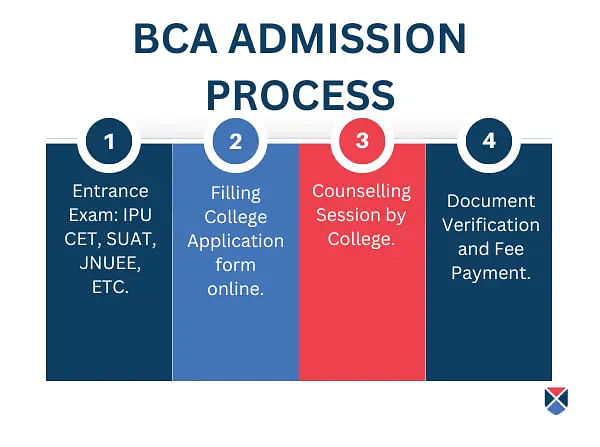
Admission to BCA course is done on a merit basis in colleges like Graphic Era University and colleges like GLA University, Sharda University, etc., and accept the university entrance exam score for admission. Below is the BCA admission process:
Read More: BCA Admission Details
BCA entrance exams are conducted at the national, state, and institute levels. The cut-off for the exam may vary depending on the difficulty level of the exam and the number of seats available. Some popular entrance exams conducted for BCA admission are:
| BCA Entrance Exams | Registration Dates | Accepting Colleges |
| CUET-UG | February 2024-April 2024 ( Tentative) | Shobhit University, Guru Nanak College, Assam Kaziranga University, etc. |
| IPU CET | April 2024-May 2024 (Tentative) | Indraprastha University |
| SET | May 2024 (Tentative) | Symbiosis University |
| SUAT | January 2024- April 2024 ( Tentative) | Sharda University |
| AIMA UGAT | January 2024- April 2024 ( Tentative) | NIIS Bhubnaeshar, UPES |
| MHT CET | April 16- May 2, 2024 | MIT-WPU, MGM University, etc. |
| GLAET | January 2024- May 2024 ( Tentative) | GLA University |
| LPU NEST | January 2024 (Tentative) | Lovely Professional University |
Read More: BCA Entrance Exam Details
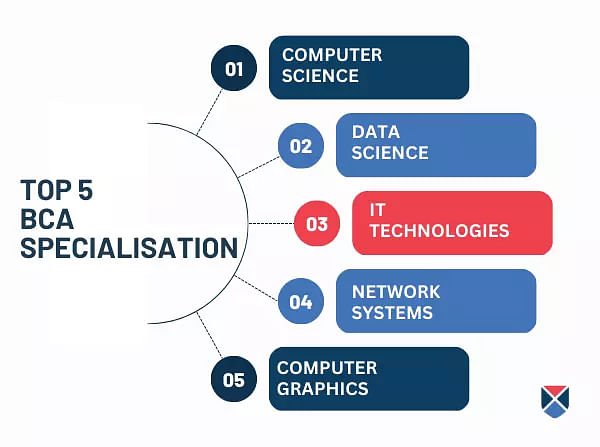
BCA course offers various specializations for candidates in different fields of computer applications. A student can pursue a BCA degree in various areas according to their experience, interest, and future scope.
Here is a list of some of the BCA Specializations:
Read More: BCA Specializations List
BCA Lateral Entry is for students who have already completed their Diploma in Computer Science or Application. Therefore, candidates will get direct admission to the BCA course. BCA Lateral Entry admission is an entrance-based/merit-based admission process. These entrance tests are IPU CET, CUCET, SET, etc, and are conducted by National, State-level, or university education authorities every year.
BCA Lateral Entry eligibility criteria include aspirants must complete their Diploma degree in computer science or application with a minimum of 55% aggregate. The candidates who fall into the reserved category will receive a 5% exemption.
When applying for lateral entry, specific entrance exams are conducted that the students must ensure that they apply for. These entrance exams are essential in the final merit list and selection process. Listed below are the popular entrance exams that are accepted for BCA:
Read More: BCA Lateral Entry
The top private BCA colleges in India include Sharda Univeristy, UPES, and Symbiosis Institute of Computer Studies and Research. The best government colleges offering BCA course includes Dharmshala govt. College, Kannur University, Government Science College, Durg, Lucknow University, etc.
The BCA fee is in the range of INR 5,000-2,00,000 per year. Below listed are the top colleges in India offering BCA course along with the fee bifurcation:
| Name of the College | Tuition Fees Per Year | Admission Fees | Miscellaneous Fees Per Year |
| Symbiosis Institute of Computer Studies and Research | INR 1,93,000 | INR 20,000 | INR 1,01,100 |
| GLA University | INR 1,00,000 | – | INR 55,000 |
| Sharda University | INR 1,50,000 | INR 10,000 | – |
| LPU | INR 64,000 | INR 10,000 | INR 4,000 |
| Chandigarh University | INR 18,125 | INR 1000 | INR 75,000 |
| UPES | INR 2,00,000 | INR 26,000 | INR 1,19,000 |
| Sister Nivedita University | INR 52,333 | INR 30,000 | – |
| JC Bose University of Science and Technology | INR 52,500 | – | INR 12,000 |
| St. Joseph’s College | INR 31,000 | INR 5,000 | – |
| St. Bedes College | INR 22,000 | INR 100 | INR 16,750 |
| Birla Institute of Technology, Mesra | INR 53,000 | INR 32,500 | – |
| VIT Vellore | INR 55,000 | INR 2,000 | INR 57,000 |
| Institute of Business Studies and Research | INR 1,30,000 | – | INR 1,20,000 |
| RIMT | INR 95,000 | INR 15,000 | – |
| Lucknow University | INR 70,160 | INR 36,000 | – |
| University of Mysore | INR 15,900 | INR 2,750 | INR 4,125 |
Also, Check: BCA Course Fees in India
Below listed are location-wise BCA colleges in India with the average annual fees:
| Location | Fees Per Year |
| BCA College in Delhi | INR 14,000 – 1,50,000 |
| BCA College in Mumbai | INR 9,000-1,75,000 |
| BCA College in Pune | INR 15,000-1,00,000 |
| BCA Colleges in Surat | INR 30,000-80,000 |
| BCA Colleges in Lucknow | INR 60,000-1,50,000 |
| BCA College in Patna | INR 20,000-60,000 |
| BCA in Bangalore | INR 25,000-1,25,000 |
| BCA College in Kolkata | INR 20,000-2,00,000 |
| BCA Colleges in Hyderabad | INR 15,000-1,70,000 |
BCA course can be pursued full-time, distance, and through integrated education mode. Below listed is BCA course details:
| Type | Basic Eligibility | BCA Duration |
| Full-Time BCA | 10+2 with a minimum of 50% marks for the general category and 45% marks for the reserved category+ Entrance Exam Score + GD/PI performance | 3 Years |
| BCA Distance Education | 10+2 with a minimum of 50% marks for the general category and 45% marks for the reserved category | 3-5 Years |
| Integrated BCA | 10+2 with a minimum of 50-55% marks for the general category and 45% marks for the reserved category+ Entrance Exam Score | 5 Years |
BCA distance education is recognized by UGC-DEB in India and is considered a valuable degree. Below listed are distance BCA course details:
Students can pursue BCA+MCA as an integrated course course after completion of 12th grade. Below listed are a few details about the BCA integrated course:
Also, Check: Benefits of BCA
The BCA syllabus is divided into 6 semesters. The first year focuses on the basics of computers and IT, programming, system software, etc. The second year subjects cover topics like software testing, operating systems, web designing, data structures, etc. The third year syllabus focuses on advanced and specialized topics like information security, PHP, cloud computing, etc.
Below listed is the semester wise BCA syllabus:
| Semester I | Semester II |
| Basics of Digital Electronics | Advanced Concept in C Programming |
| Business Systems and Application | Computer Architecture and Systems Software |
| Introduction to Programming | System Analysis & Design |
| Mathematics in Computer Applications | Mathematics in Computer Applications |
| Fundamentals of IT | Graph Theory |
| Environmental Studies | English II |
| English I | – |
| Semester III | Semester IV |
| Operating Systems | Web Designing |
| Data Structures | Database Management System |
| Fundamentals of Web Programming | Object-Oriented Programming with C++ |
| Mathematics for Computer Application | Software Engineering |
| Semester V | Semester VI |
| Data Communication & Computer Networks | Introduction to PHP |
| Information Security | Client Server Computing / Intelligent Systems / Image Processing / Introduction to Distributed System |
| Unix & Shell Programming | Data Encoding and Compression / Python Programming / Advanced Database Management / Introduction to Cloud Computing |
| Windows Programming / Human Computer Interaction / Multimedia & E-Commerce / ERP | Major Project |
| Minor Project | Seminar |
| Industrial Training | Viva-Voce |
Read More: BCA Subjects and Syllabus
BCA is a more application-focused program that blends computer science with business management, and BSc CS is a more academic and technical program. The table below shows the differences between BCA and B.Sc Computer Science:
| Course | BCA | BSc CS |
| Full Form | Bachelor of Computer Application | Bachelor of Science in Computer Science |
| Course Duration | 3 years | 3 years |
| Course Overview | The course curriculum covers topics like programming languages, database management, web development, software testing, project management, etc. | The course curriculum covers topics like algorithms, data structures, computer architecture, software engineering, etc. |
| Eligibility | 50% in 10+2, with Computer Applications/ Science as a compulsory subject | 50% in 10+2, with Physics, Chemistry, and Mathematics as compulsory subjects |
| Course Fees Per Year | INR 5,000 to 2,00,000 | INR 10,000 – 1,00,000 |
| Entrance Exam | IPU CET, SET, JNUEE | CUCET,IISER Entrance Exam |
| Top Colleges | Symbiosis Pune, Christ University Bangalore, Loyola College Chennai | St. Stephen’s College Delhi, Presidency College Kolkata, St. Xavier’s College Mumbai |
| Average Salary | INR 2-8 LPA [Source: Payscale] | INR 4 LPA [Source: Ambition Box] |
| Job Roles | Software Developer, Web Developer, Database Administrator, Network Administrator, etc. | Algorithm Developer, Systems Analyst, Research Assistant, etc. |
Read More: B.Sc Computer Science
The BCA salary in India on average is INR 3.7 LPA [Source: Payscale]. Graduates after having three-plus years of experience can earn more than INR 8 LPA. Below listed are job roles for BCA graduates along with their average entry-level salaries:
BCA Jobs | Entry Level Average Salary | Salary After 3 Years of Experience |
| Database Administrator | INR 4 LPA | INR 6.20 LPA |
| System Analyst | INR 3.90 LPA | INR 6.70-8.60 LPA |
| Software Developer | INR 3.10 LPA | INR 7 LPA |
| IT Consultant | INR 2.40-4.50 LPA | INR 6-8 LPA |
Read More: BCA Salary in India
Students can pursue BCA as a prospective career option. Many colleges worldwide provide students with the opportunity to study this course. Additionally, if students are interested, they can decide to pursue a Master’s in Computer application. Some of the master’s courses students can pursue include:
Read More: Courses after BCA
Job opportunities are available in plenty for BCA graduates in both the public and private sectors. Their knowledge and research-based experience qualify them to handle job roles of higher magnitude and multiple domains. Below listed are a few top job roles offered to BCA graduates along with hiring companies:
Job Designations | Hiring Companies | Average Salary |
| System Analyst | UST, TCS, Amdocs, etc. | INR 4-5 LPA |
| Quality Assurance Analyst | Amazon, Infosys, Accenture, etc. | INR 4.70 LPA |
| Web Developer | Cognizant, Infosys, Indegen, etc. | INR 4.70-5.50 LPA |
| UI/UX Designer | Tech Mahindra, Reliance Jio, ABC Ltd, etc. | INR 4-6.50 LPA |
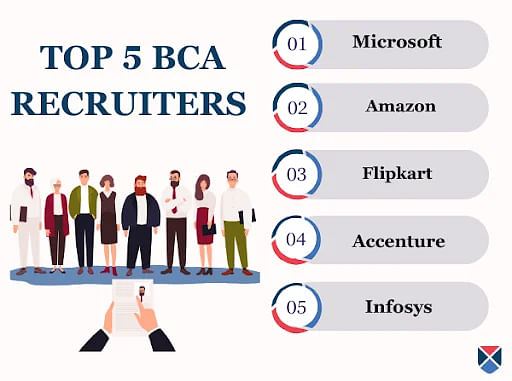
The BCA scope is vast as graduates are hired by various private and government organizations such as the IT Industry, Retail companies, the Healthcare Industry, the Telecommunication Industry, etc. Below listed are a few top recruiters for graduates:
Top Recruiter | Average Entry-Level Salary |
| Microsoft | INR 4-7 LPA |
| Amazon | INR 4.50-6 LPA |
| Flipkart | INR 4-5 LPA |
| Accenture | INR 4-6 LPA |
| Infosys | INR 4.70-6.50 LPA |
[Sources: Payscale & Ambition Box]
Read More: Career Options after BCA
The students who want to study BCA can get scholarships from private and government colleges or schemes based on merit scores, annual income, and other related factors. Below listed are a few scholarships for BCA courses:
Scholarship | Eligibility Criteria | Amount |
| UPES Academic Scholarship | Have passed 10+2 examinations with a minimum of 60% marks | Upto 15% of the Tuition Fees |
| AICTE Pragati Scholarship for Girls | Girls pursuing a technical degree or diploma | Up to INR 50,000 Per Year |
KC Mahindra Scholarship | Students belonging to economically weaker sections and want to pursue BCA or any other technical degree | INR 50,000 |
BCA graduates need to have soft and hard skills that will help them succeed in their professional lives. Some of these skills include:
BCA syllabus is well-designed and helps students build careers in Computer Application, IT, and Software Development. BCA subjects provide exposure to students in various industry-specified functions in database management systems, software engineering, operating systems, etc.
The BCA subjects are divided into core and elective subjects. Each subject in BCA is generally industry-oriented since BCA is a field that is applied in many paths of advancing technology. The BCA syllabus 1st year pdf of the colleges will be available on the websites along with the BCA syllabus for the 2nd and 3rd years.
BCA graduates will have in-depth knowledge in their chosen field which helps the candidate to excel in their career. The scope of BCA expands to various opportunities in public and private sectors with employment roles like Web Designer, Technical Associate, Software Engineer, System Analyst, etc.
Check Detailed Year Wise Syllabus:
Table of Contents
The BCA subjects are focused on providing students with necessary information and knowledge regarding computers, database management, network technologies, and IT among various other fields. Some BCA subjects are given below:
The compulsory subjects of BCA focus on implementing and creating computer applications, software & information technologies, network systems, etc. Below is a BCA subjects list of core topics that develop a fundamental understanding of the course:
The elective subjects in BCA focus on garnering students with extra skill sets to advance their careers and gain more knowledge in their relevant fields. Below is a BCA subjects list for elective topics that students can choose based on their interests:
Students learn the foundational areas of computer application and programming in the initial semesters. Some of the BCA course subjects and the topics covered are as follows:
BCA Subjects | Topics Covered |
Problem-Solving Using C | Introduction to Programming Concepts: Software, Classification of Software, Modular Programming, Structured Programming, Algorithms & Flowcharts |
Data Structures | Elementary data organization, Data Structures, data structures operations, Abstract data types, algorithms complexity |
Data Base Management Systems | Data Modelling Using the Entity-Relationship Model, Functional Dependencies & Normalization for Relational Database, Relational Database Language, Transaction Processing Concepts |
Operating Systems | Process Synchronization and Deadlocks, Memory Management, File management, Protection & Security |
Data Communications & Networks | Transmission Systems, Peer-to-Peer Protocols, Local Area Networks & Medium Access Control Protocols, LAN Standard |
Software Engineering | Software Products and Software Processes, Software Prototyping, Object Oriented& function-oriented design, Software Reliability & Reusability |
Also, Check: BCA Couse Fees in India
The BCA syllabus is spread across three years and includes diverse coursework. The BCA course subjects consist of topics that help students to understand concepts of computer application and to gain strong programming knowledge. The BCA general subjects semester-wise are listed below. However, BCA syllabus subjects will vary slightly from college to college.
BCA subjects 1st year are curated based on the fundamental areas of the computer application field. The BCA subjects 1st year are given in the table below:
| Semester I | Semester II |
| Basics of Digital Electronics | Advanced Concept in C Programming |
| Business Systems and Application | Computer Architecture and Systems Software |
| Introduction to Programming | System Analysis & Design |
| Mathematics in Computer Applications | Mathematics in Computer Applications |
| Fundamentals of IT | Graph Theory |
| Environmental Studies | English II |
| English I | – |
Practical Topics Under the BCA subjects 1st year
Listed Below are some of the practical topics under the BCA subjects 1st year:
BCA 2nd year syllabus comprises two semesters: 3rd and 4th. BCA 3rd sem includes algorithms, data analytics and programming. BCA 4th Sem subjects cover the functional areas of computer programming and analytics. The table below contains the BCA subjects 2nd year:
| Semester III | Semester IV |
| Operating Systems | Web Designing |
| Data Structures | Database Management System |
| Fundamentals of Web Programming | Object-Oriented Programming with C++ |
| Mathematics for Computer Application | Software Engineering |
BCA Second-Year Practical Subjects
The following are some of the practical topics under the BCA 2nd year subjects:
The table below contains the BCA subjects semester wise in the third year:
| Semester V | Semester VI |
| Data Communication & Computer Networks | Introduction to PHP |
| Information Security | Client Server Computing / Intelligent Systems / Image Processing / Introduction to Distributed System |
| Unix & Shell Programming | Data Encoding and Compression / Python Programming / Advanced Database Management / Introduction to Cloud Computing |
| Windows Programming / Human Computer Interaction / Multimedia & E-Commerce / ERP | Major Project |
| Minor Project | Seminar |
| Industrial Training | Viva-Voce |
BCA Third-Year Practical Subjects
The practical topics under the BCA syllabus in the third year are given below:
College-wise BCA syllabus encompasses a broad spectrum of computer science and IT subjects. These programs offer students a well-rounded education in areas like programming, software engineering, computer architecture, and more. The BCA subjects semester-wise syllabus of top BCA colleges is detailed in the sections below:
The University of Allahabad’s BCA syllabus provides a comprehensive education in computer science and information technology, covering programming, digital electronics, communication skills, and software engineering, preparing students for successful IT careers. Listed below are the BCA subjects semester-wise offered by the University of Allahabad:
Semester I | Semester II |
Mathematics-I | Mathematics-II |
Statistics | Basic Electronics |
Basic Circuit Analysis | Digital Electronics & Computer Organization |
Fundamentals of Programming | Data Structures |
Communication Skills | Linux & Shell Programming |
Business Systems | Principles of Programming Languages |
Lab.I: Analog Electronics Lab | Lab.I: Digital Electronics Lab |
Lab.II: Computer Lab | Lab.II: Computer Lab |
Lab.III: Communication Skills Lab | Lab.III: Communication Skills Lab |
Semester III | Semester IV |
Discrete Structures & Graph Theory | Operating Systems |
Design & Analysis of Algorithm | Operation Research |
Introduction to System Software | Data Communications & Networks |
Object Oriented Programming using C++ | Software Engineering |
Database Management System | .Web Programming using JAVA |
Computer Architecture & Microprocessors | Numerical Methods |
Lab. I: Computer Lab | Lab.I: Computer Lab |
Lab.II: Communication Skills Lab | Lab.II: Communication Skills Lab |
Semester V | Semester VI |
.Net Framework & C# | Image Processing |
Embedded System | Multimedia Systems |
Computer Graphics | Main Project |
Secure Computing | – |
Advanced DBMS | – |
Lab.I: Computer Lab | – |
Lab.II: Communication Skills Lab | – |
Lab. III: MINI PROJECT | – |
Maharshi Dayanand University’s BCA syllabus builds a strong foundation in computer science and software development, including computer fundamentals, data structures, operating systems, and database systems, equipping students for IT and software careers. The BCA subjects semester-wise of MDU is detailed in the table below:
Semester I | Semester II |
Computer Fundamentals and Programming | Data and File Structure |
Mathematics-I | Structured Systems Analysis |
Mathematics-II | Mathematical Foundations of Computer Science |
Business Practices | Digital Electronics |
Software Lab | Software Lab |
Semester III | Semester IV |
Computer System Architecture | Operating Systems Organization and UNIX |
Algorithms & Advanced Data Structure | Software Engineering |
Micro-Processors & Assembly Language | Object Oriented Design and Programming |
Database Systems | Financial Accounting |
Practical: Software Lab | Practical: Software Lab |
Semester V | Semester VI |
Data Communication and Networks | Network and Internet Technologies and Applications |
Computer Graphics | Scientific and Statistical Computing |
Principles of Visual and Windows Programming | Multimedia Information Systems |
Java Programming and Internet Applications | Management Information System |
Practical | Practical |
BCA Syllabus offers its candidates various specializations in many fields ranging from network to IT. data science and data analytics are the two major sub-fields among the various BCA specializations. The majority of BCA first-year subjects will be generic, while the specialization topics will be covered from semester 3 onwards. Below is a list of specializations under the BCA Syllabus:
BCA Data Analytics covers the study of Computer Simulation, Decision Analysis, Predictive Modeling, AI, and Information Systems. The following are the subjects included in the BCA Data Analytics syllabus:
The syllabus in BCA Data Science includes the scientific study of Machine Learning, DBMS, Big Data Analysis, R & Python, etc. The following are the subjects included in the syllabus of BCA Data Science:
Read More: BCA Data Science Subjects
BCA Computer Science involves several studies associated with programming languages such as C, C++, HTML, and Java. along with data analytics and other functionalities of computer science. The following are the subjects included in the BCA Computer Science syllabus:
Read More: BCA Computer Science Subjects
In general, a BCA course syllabus consists of computer administration in the core subjects along with various other elective subjects. BCA 6th Sem subjects inclined towards projects, seminars, assignments, industrial visits, etc. BCA is a three-year course with six semesters. The course structure is as follows:
The teaching methods and strategies used in the BCA are created to provide students with a thorough understanding of computer applications. Some of the general teaching methods for BCA course are listed below:
The BCA syllabus includes project work and writing for periodicals. These projects help students to obtain practical insight into the BCA syllabus. Below are examples of some popular research topics:
Students interested in pursuing BCA as further education must invest in some reference books to gauge an idea of the course. Below is a list of books that can help students get started with their BCA course:
Subjects | Books | Author |
Mathematics | Advanced Engineering Mathematics | Erwin Kreyszig |
Statistics | Probability and Statistics for Engineers | Irvrin Miller |
Programming | Programming Languages: Design and Implementation | Terrance W Pratt |
System Software | Introduction to Systems Software | D.M. Dhamdere |
Software Engineering | An Integrated Approach to Software Engineering | Pankaj Jalote |