
- info@wingeducations.com
- +91 (705) 495-5296
- Mon - Sat : 10.00-18.00
BAF is a three-year undergraduate course that deals with the study of core accounting principles, finance, economics, and topics related to various functionalities of the commerce field. A Bachelor of Accounting and Finance is a degree program that combines the study of accounting principles and financial management.
BAF admission requires candidates to have a 50% aggregate in Higher Secondary (10+2) with commerce stream and qualifying entrance exams such as MH-CET, CUET, etc. The BAF course fees per year range between INR 16,000-1,00,000. The core subjects under the BAF syllabus include Financial Accounting, Managerial Accounting, Corporate Finance, Business Law and Ethics, Investment Analysis, etc.
Students receive industry-relevant training and exposure to work in banks, financial institutions, audit firms, and actuarial services as auditors, accountants, export or import managers, tax consultants, etc.
Table of Contents
| Degree | Bachelors |
| Full Form | Bachelor of Accounting and Finance |
| Duration | 3 Years |
| Age | Minimum age limit is 17 years |
| Subjects Required | Accounting, Mathematics, Economics |
| Minimum Percentage | 50% marks in 10+2 examinations. |
| Average Fees | INR 16,000-1,00,000 Per Year |
| Similar Options of Study | B.Com, BBA |
| Average Salary | INR 2-6 LPA (Source: PayScale) |
| Employment Roles | Auditor, Accountant, Export or Import Manager, Tax Consultant, Stockbroker, etc. |
| Top Recruiters | EY, KPMG, Deloitte, PWC, Accenture, Oracle, Gartner, SBI, etc. |
BAF full form is Bachelor of Accounting and Finance, a course designed to impart the necessary knowledge on the core functionalities of commerce, including several topics such as accounting, finance, taxation, auditing, and risk management.
After completion of the BAF course, students can pursue rewarding careers with actuarial firms, banking, business analysis, financial management, actuarial service, e-commerce, financial analysis, etc. The average BAF graduate salary is in the range of INR 2-6 LPA. (Sources: Ambition Box & Glassdoor).
For BAF admission, students must meet the BAF eligibility set by a specific university/college such as minimum percentage, subject required, entrance exam score, etc. The standard eligibility criteria is listed below:
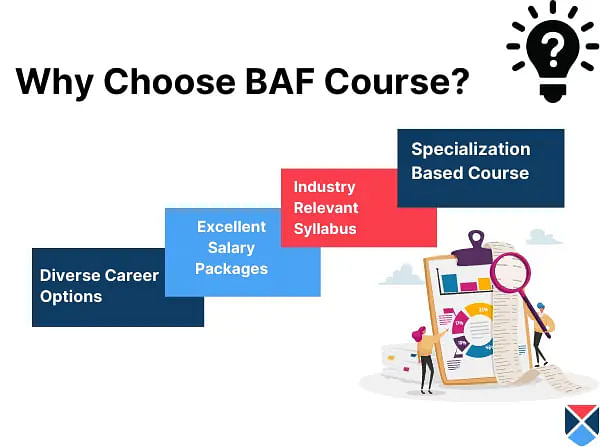
BAF course offers a strong foundation and expertise in the area of financial analysis, auditing, and budgeting required for a successful career. Below mentioned are points regarding why choose the BAF course:
Also, Compare: BBA vs BAF
BAF admission is based on merit basis in colleges like KES, MSG SGKM College of Arts, Science and Commerce. Colleges like Jai Hind may conduct entrance exams for the course based on the requirement. In general, the admission process includes the following components:
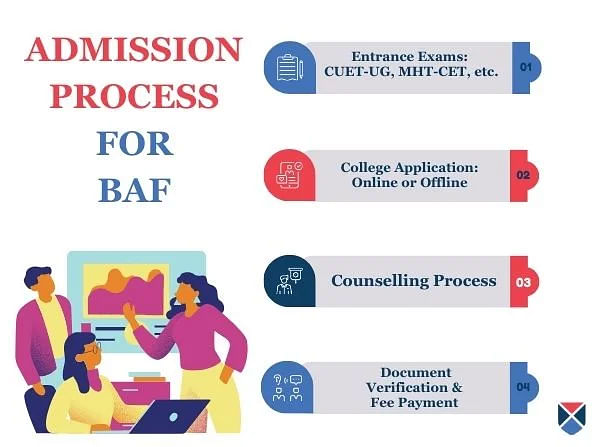
Some colleges and universities offer a Bachelor of Finance and Accounting, through national, state, or college-level entrance exams. There may be differences between university/ college entrance exams and cutoff marks. Here are some of the most popular BAF entrance exams:
Entrance Exam | Registration Dates | Accepting Colleges |
Jan 16-Mar 1, 2024 | Jai Hind College | |
February 2024-April 2024 ( Tentative) | St. Xaviers College |
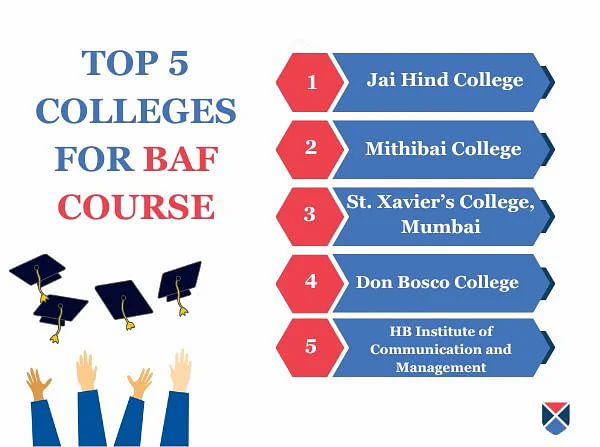
There are various government and private colleges in India offering BAF courses. Top private colleges offering BAF courses include HB Institute of Communication and Management, Jai Hind College, etc. Government colleges like Shankar Narayan College also offer B.A.F courses. The BAF fees per year is in the range of INR 16,000-1,00,000. Below is a list of top BAF colleges in India along with the annual fees:
Institution | Annual BAF Fee |
INR 21,449 | |
INR 16,731 | |
INR 55,000 | |
INR 35,000 | |
INR 70,000 | |
INR 23,000 | |
– | |
– | |
ML Dahanukar College of Commerce | INR 19,079 |
Shri GPM College | INR 17,500 |
Vivek College of Commerce | INR 18,234 |
Anna Leela College of Commerce and Economics | INR 28,400 |
Shankar Narayan College | INR 18,423 |
NM College | INR 38,990 |
BNN College | – |
The course has full-time and distance learning options available to students. The following BAF course details are provided below:
Type | BAF Eligibility | BAF Duration |
BAF Full Time | Should have passed 10+2 with a minimum of 50% marks + Entrance Exam | 3 Years |
Distance BAF | Should have passed 10+2 with a minimum of 45-50% marks. | 3-5 Years |
Below mentioned are details regarding the distance BAF course:
Also, Check:
The BAF syllabus focuses on imparting the necessary knowledge and abilities to evaluate financial figures and efficiently manage financial resources along with recent cost accounting techniques in accounting and current taxation issues. The syllabus for the BAF course is given below:
Semester I | Semester II |
Foundational Cost Accounting-I | Business Communication-II |
Business Environment | Special Accounting Areas- I |
Micro Economics | Financial Accounting-II |
Foundation Course-I (Commercial Environment) | Business Regulatory Framework- I |
Financial Accounting-I | Indirect Taxation-I |
Business Communication-I | Quantitative Methods for Business-I |
Semester III | Semester IV |
Macro Economics | Special Accounting Areas-III |
Methods of Cost Accounting-II | Financial Market Operations |
Techniques of Auditing and Audit Procedures | Information Technology Application in Business |
Special Accounting Areas-II | Indirect Taxation-II |
Business Regulatory Framework-II | Foundation Course -II (Value Education and Soft Skill) |
Introduction to Management | Company Law |
Quantitative Methods for Business-II | Financial Accounting-IV |
Semester V | Semester VI |
Financial Accounting -V | Financial Accounting -VII |
Cost Accounting-III | Cost Accounting – IV |
Financial Statement Analysis | Financial Accounting – VIII |
Direct & Indirect Taxation – III | Direct & Indirect Taxation- IV |
Indian Economy System | Elective-II |
Project Work | Internship/Project Work-II |
Financial Accounting-VI | |
Elective-I | – |
Read More: BAF Subjects and Syllabus
BAF focuses on accounting, finance, and business management, whereas, BCom (Bachelor of Commerce) programs provide students with a strong foundation in financial management, auditing, and taxation. The table below represents the difference between BAF and BCom:
Course | BAF | BCom |
Full-Form | Bachelor of Accounting and Finance | Bachelor of Commerce |
Course Duration | 3 years | 3 years |
Course Overview | The course curriculum covers subjects like financial analysis, financial reporting, taxation, etc. | The course curriculum focuses on subjects like accounting, economics, business law, taxation, and business communication. |
Eligibility | 50% in 10+2, with Commerce | 12th pass in commerce with a minimum of 50% marks. |
Course Fee Per Year | INR 16,000-1,00,000 | INR 7,500-4,00,000 |
Entrance Exam | MHT-CET, CUET | SUAT, BHU UET, AIMA UGAT |
Top Colleges | St. Xaviers College, Mumbai University | Shri Ram College of Commerce, BML Munjal University, St. Xaviers College. |
Average Salary | INR 2-6 LPA | INR 4 LPA |
Job Roles | Financial Analyst, Accountant, Credit Analyst, Investment Analyst, Tax Consultant, etc. | Accountant, Cost Estimator, Financial Analyst, etc. |
Read More: BCom
After completing the BAF course, students can pursue several higher education studies that can improve their understanding of the subjects. Below mentioned are a few courses that can be pursued after BAF:
BAF course allows students to increase their employability by adding to their qualifications. Various colleges provide BAF placement to students and help them shape their careers in the right direction.
Some of the job opportunities that students can get after completing BAF are mentioned below:
BAF Jobs | Job Description | Top Hiring Companies |
Financial Analyst |
| Deloitte, KPMG, EY, PwC, HDFC Bank, ICICI Bank, etc. |
Accountant | Managing financial records, preparing budgets, and ensuring compliance with accounting standards. | Infosys, Accenture, Hindustan Unilever, State Bank of India (SBI), etc. |
Credit Analyst |
| Axis Bank, HDFC Bank, ICICI Bank, Bajaj Finance, etc. |
Investment Analyst |
| Kotak Mahindra Asset Management, Birla Sun Life Mutual Fund, etc. |
Tax Consultant |
| Ernst & Young (EY), Deloitte, KPMG, etc. |
Auditor |
| Ernst & Young (EY), Deloitte, KPMG, PwC, etc. |
Treasury Analyst |
| Reliance Industries, Tata Consultancy Services (TCS), State Bank of India (SBI), etc. |
Financial Planner/Advisor | Guiding people or businesses to reach their financial objectives by offering planning, investment strategies, and financial advice. | Axis Bank, Bajaj Allianz, SBI Life Insurance, Kotak Mahindra Life Insurance, etc. |
Risk Analyst |
| ICICI Bank, HDFC Bank, Axis Bank, Standard Chartered, Kotak Mahindra Bank, etc. |
Corporate Finance Analyst |
| Tata Steel, Aditya Birla Group, Mahindra & Mahindra, Larsen & Toubro, etc. |
Read More: BAF Job Opportunities and Scope
Graduates with a BAF can expect to earn INR 2-6 LPA (Sources: Glassdoor & Ambition Box). Students are paid based on their skills and experience, as well as on the progress they have made. Graduates after a BAF degree are in greater demand due to continuous growth in the financial sector.
BAF Jobs | Entry Level Average Salary (INR) | Salary After 3 Years of Experience (INR) |
Financial Analyst | 3.5 LPA | 6.5 LPA |
Accountant | 2.5 LPA | 5 LPA |
Credit Analyst | 3-4 LPA | 7 LPA |
Investment Analyst | 4-4.5 LPA | 7.5 LPA |
Tax Consultant | 3-4 LPA | 5.5-7 LPA |
Auditor | 3-3.5 LPA | 4-6 LPA |
Treasury Analyst | 3-4 LPA | 5-6.5 LPA |
Financial Planner/Advisor | 2.5-3.5 LPA | 6 LPA |
Risk Analyst | 3.5-4.5 LPA | 7 LPA |
Corporate Finance Analyst | 4-5 LPA | 5.5-7 LPA |
Read More: BAF Salary in India
Below listed are a few top recruiters for BAF graduates:
Deloitte | Cognizant | Concentrix |
Oracle | Hexaware | Birla Sun Life Insurance |
SBI | IBM | Mahindra Finance |
Gartner | HDFC Bank | Muthoot Finance |
TCS | DNS Bank | Serco |
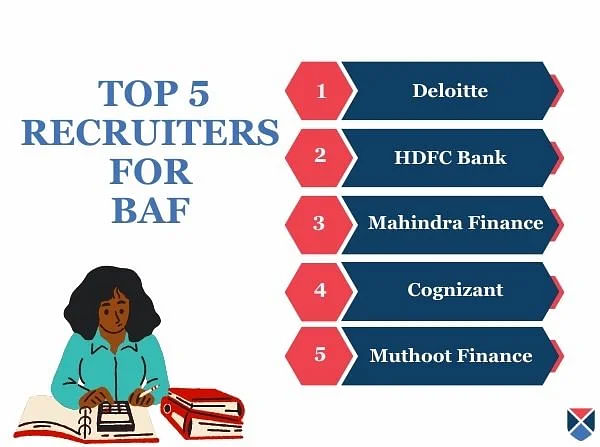
Students can pursue a BAF course from top cities like Mumbai and Bangalore., in prominent colleges like Jai Hind College, St. Xaviers College, etc. Mumbai is considered a home to various top colleges offering BAF course.
Below listed are the top 2 cities to pursue BAF course based on approximate, and actual living expenses, salaries, market conditions, etc.
City | Top Colleges Offering BAF Course | Average Living Monthly Expenses (INR) | Average Starting Salary (INR) | Top Recruiters |
Mumbai | St. Xaviers College, HR College of Commerce and Economics, Mumbai University, etc. | 15,000 – 25,000 | 3-5 LPA | HDFC Bank, Kotak Mahindra Bank, etc. |
Bangalore | CMR National PU College, St. Joseph’s College of Commerce | 12,000 – 20,000 | INR 3.50-4 LPA | Infosys, Wipro, etc. |
There are various scholarships offered to students who want to pursue BAF courses by government and private institutes based on annual income, merit score, quota, etc. Below listed are a few scholarships for BAF course:
BAF Scholarship | Eligibility Criteria | Amount |
Raman Kant Munjal Scholarships |
| Tuition Fee Waiver |
Kotak Junior Scholarship |
| INR 3,000 Per Month |
BAF graduates should possess analytical and critical thinking skills. Learning skills based on their interests can also influence a student’s career. The following skills are expected of Bachelor of Accounting and Finance graduates:
The Bachelor in Accounting and Finance (BAF) is an undergraduate degree of three years that is designed to give students the understanding related to accounting, taxation, and finance. The BAF subjects include accounting, finance, taxation, auditing, and risk management, with the added topics of the Bachelor of Commerce. The BAF syllabus is covered over six semesters, with a focus on projects and internships. The core BAF subject covers topics related to microeconomics, macroeconomics, auditing, financial management, and business regulatory framework.
Students can also elective subjects like international finance, indirect taxes, corporate governance and ethics, etc. The BAF course helps students to learn technical knowledge related to capital budgeting, risk assessment, and time value of money which helps them to work in a range of roles like financial analyst, risk analyst, consultant, etc. The BAF career scope is comparatively promising with top recruiters such as Deloitte, Ernst & Young (EY), and PricewaterhouseCoopers (PwC). Apart from this, several top banks and financial institutions too provide placements. The BAF average salary package ranges between INR 5 LPA to INR 8 LPA.
Some of the important and crucial information related to the BAF subjects and syllabus have been listed in the table below for the candidate’s easy reference.
| Particulars | Details |
| Course Name | Bachelors in Business and Finance (BAF) |
| BAF Course Duration | 3 years |
| BAF Total Semesters | 6 (2 each year) |
| BAF Course Focus | Accounting, Finance, and Business related fields |
The BAF course provides a comprehensive understanding of accounting and finance principles and prepares students for a career in the field. The Bachelor of Accounting and Finance subjects are generally divided into two categories: core and elective subjects. The BAF subjects list consists of the following:
Below listed are the BAF core subjects along with topics covered in each subject:
BAF Core Subject | Topics Covered |
Micro-Economics | Supply and Demand, Market Structures, Consumer Behavior, Elasticity, Production and Cost, Market Failures, Utility, Game Theory |
Direct Tax | Income Tax Act, Tax Deductions, Taxable Income Calculation, Capital Gains Tax, Tax Planning, TDS, Advance Tax, Tax Return Filing |
Business Communication | Written Communication, Oral Communication, Business Correspondence, Presentation Skills, Report Writing, Business Etiquette, Interpersonal Skills, Cross-Cultural Communication |
Cost Accounting | Cost Concepts, Cost Behavior, Cost-Volume-Profit Analysis, Budgeting, Standard Costing, Variance Analysis, Activity-Based Costing |
Financial Accounting | Accounting Principles, Financial Statements, Journal Entries, Ledger, Trial Balance, Financial Ratios, Cash Flow Statements |
Business Statistics and Mathematics | Probability Distributions, Descriptive Statistics, Regression Analysis, Time Series Analysis, Correlation, Mathematics for Business Applications |
Information Technology Application in Business/Accounting | Accounting Software, Database Management, E-commerce, IT Security, ERP Systems, Data Analysis Tools, Information Systems in Accounting |
Management Concept Basics | Planning, Organizing, Directing, Controlling, Decision Making, Organizational Structure, Leadership Styles, Motivation Theories |
Business Law | Contract Law, Company Law, Partnership, Sale of Goods Act, Negotiable Instruments, Consumer Protection, Competition Law |
Macro Economics | National Income, Unemployment, Inflation, Fiscal Policy, Monetary Policy, Economic Growth, International Trade, Economic Indicators |
Auditing | Audit Planning, Internal Control, Audit Reports, Audit Evidence, Audit Sampling, Forensic Audit, Independence and Ethics in Auditing |
Financial Management | Capital Budgeting, Working Capital Management, Capital Structure, Dividend Policy, Risk Management, Time Value of Money, Leverage, Financial Markets |
Business Regulatory Framework | Regulatory Environment, Business Ethics, Corporate Governance, Legal Aspects of Business, Regulatory Compliance, Business and Society |
Below listed are elective subjects in BAF which may vary from college to college:
BAF Elective Subjects | Topics Covered |
Indirect Taxes | Goods and Services Tax (GST), Customs Duty, Excise Duty, Service Tax, VAT, Central Sales Tax, Entertainment Tax, State-specific Taxes |
Portfolio Management and Security Analysis | Asset Allocation, Risk Assessment, Security Valuation, Portfolio Diversification, Fundamental Analysis, Efficient Market Hypothesis, Capital Market Theory, Modern Portfolio Theory |
Corporate and Security Law | Company Law, Securities Regulation, Corporate Governance, Mergers and Acquisitions, Insider Trading, Corporate Compliance, Corporate Ethics, Legal Aspects of Contracts, Corporate Social Responsibility (CSR) |
International Finance | Foreign Exchange Markets, Global Capital Flows, Exchange Rate Mechanisms, International Trade Finance, Cross-Border Investments, Multinational Corporations, Hedging Strategies in Global Markets |
Corporate Governance and Business Ethics | Board Practices, Ethical Decision-Making, Corporate Social Responsibility (CSR), Whistleblowing, Corporate Citizenship, Stakeholder Management |
Operations Research | Optimization, Decision Analysis, Quantitative Techniques, Linear Programming, Game Theory, Queuing Theory, Simulation, Network Analysis, Inventory Management |
Advanced Financial Services | Financial Planning, Wealth Management, Risk Management in Financial Services, Financial Derivatives, Financial Advisory, Financial Regulations, Fintech in Financial Services |
Entrepreneurship Management | Business Start-ups, Innovation and Creativity, Business Model Development, Funding and Financing, Market Research, Risk Management for Entrepreneurs, Social Entrepreneurship |
Investment Analysis | Financial Markets, Equity Research, Derivatives, Technical Analysis, Fundamental Analysis, Investment Strategies, Behavioral Finance, Portfolio Optimization |
Forensic Accounting | Fraud Detection, Investigation Techniques, Forensic Auditing, Financial Crime Prevention, Legal Aspects in Forensic Accounting, Cyber Forensics |
The BAF syllabus is designed to prepare students to learn techniques and methods commonly used in the banking sector. In the curriculum, students study a wide range of financial, accounting, business, taxation, cost accounting, commerce, economics, and risk management.
The following is the semester-wise BAF syllabus along with BAF subjects:
BAF 1st year syllabus focuses on fundamental concepts related to financial accounting, business communication, business economics, business mathematics and statistics, business law, etc. The table below contains the BAF subjects 1st year:
Semester I | Semester II |
Foundational Cost Accounting-I | Business Communication-II |
Business Environment | Special Accounting Areas- I |
Micro Economics | Financial Accounting-II |
Foundation Course-I (Commercial Environment) | Business Regulatory Framework- I |
Financial Accounting-I | Direct Taxation-I |
Business Communication-I | Business Statistics and Mathematics-I |
BAF 2nd year syllabus covers topics like amalgamation, reconstruction, liquidation, and holding company accounts, capital budgeting, working capital management, dividend decisions, etc. The table below contains the BAF semester 3 subjects and BAF semester 4 subjects:
Semester III | Semester IV |
Macro Economics | Special Accounting Areas-III |
Methods of Cost Accounting-II | Financial Market Operations |
Techniques of Auditing and Audit Procedures | Information Technology Application in Business/Accounting |
Special Accounting Areas-II | Direct Taxes-II |
Business Regulatory Framework-II | Foundation Course -II (Value Education and Soft Skill) |
Introduction to Management | Company Law |
Business Statistics and Mathematics-II | Financial Accounting-IV |
BAF 3rd year syllabus focuses on concepts related to complex accounting principles, enhance their skills in financial analysis, and provide comprehensive knowledge of legal and regulatory frameworks governing business practices. The table below contains the BAF subjects in the 3rd year syllabus:
Semester V | Semester VI |
Financial Accounting -V | Financial Accounting -VII |
Cost Accounting-III | Cost Accounting – IV |
Financial Management -I | Financial Accounting – VIII |
Project Work | Financial Management-II |
Financial Accounting-VI | Elective-II |
Elective-I | Internship/Project Work-II |
Direct Taxes-III | – |
The BAF syllabus differs depending on the structure and aim of the program across institutions. Students can get the BAF syllabus pdf from the university website to better grasp a better understanding of the BAF subjects offered by specific institutions. The following is the BAF syllabus of top colleges offering the course:
BAF syllabus at HR College of Commerce and Economics helps students with theoretical foundations and practical applications, honing analytical skills crucial for the accounting and finance sector. Below listed is the BAF subjects list:
Semester 1 | Semester 2 |
Macro Economics | Business Law-II |
Financial Accounting-I | Financial Accounting-II |
Cost Accounting-I | Cost Accounting-II |
Business Law-I | Auditing-I |
Business Statistics and Mathematics-I | Understanding Business Communication |
Information Technology Basics | Business Statistics and Mathematics II |
Indian Society and State: Contemporary Issues | Human Society and Personality |
Semester 3 | Semester 4 |
Financial Accounting-III | Financial Accounting-IV |
Cost Accounting-III | Concept of Corporate Law-II |
Concept of Corporate Law-I | Accounting and Finance Research Methodology |
Accounting IT-I | Cost Accounting-IV |
Auditing-II | Management Concepts |
Direct Taxes-I | Auditing-III |
Financial Management-I | Direct Taxes-II |
Understanding Financial Market and Services | Financial Management-II |
Semester 5 | Semester 6 |
Financial Accounting-V | Financial Accounting-VII |
Financial Accounting-VI | Project Work |
Elective-I | Elective-I |
Elective-II | Elective-II |
Elective-III | Elective-III |
Elective-IV | Elective-IV |
Internship | – |
Mumbai University BAF subjects focus on understanding key concepts related to financial accounting, management accounting, taxation, and business law. Below listed is the BAF subjects semester wise for Mumbai University
Semester 1 | Semester 2 |
Business Environment -I | Foundation to Innovative Financial Services |
Understanding Business Economics-I | Business Law Foundation |
Business Communication-I | Auditing-I |
BAF Foundation Course | Business Communication-II |
Financial Accounting-I | Concept of Business Mathematics |
Cost Accounting-I | Financial Accounting-II |
Financial Management-I | – |
Semester 3 | Semester 4 |
Advanced Business Law | Financial Accounting-IV |
Understanding Business Economics-II | Advanced Direct Tax Concepts |
Direct Taxes Concept | Management Accounting |
Financial Accounting-III | Auditing-III |
Banking Principles and Practices | Understanding Wealth Management |
Skill Enhancement Course | Elective-I |
Ability Enhancement Course | Skill Enhancement Course |
– | Ability Enhancement Course |
Semester 5 | Semester 6 |
Financial Accounting-V | Project Work |
Financial Accounting-VI | Viva |
Elective -II | Research Methodology Basics |
Elective-III | – |
Summer Internship | – |
There are several entrance exams conducted for candidates who wish to tak admission into the BAF course. Some of the commonly conducted BAF entrance exams in India are as follows:
Candidates need to qualify the above listed exams to get into their desired courses. The detailed BAF entrance exam syllabus along with the topics included have been listed below for the candidate’s ease.
| Section | Topics Included |
| Quantitative Ability | Numbers and Operations, Algebra, Profit and Loss, Ratio and Proportion, Time and Work, Speed and Time, Pecentage, Basic Statistics, Data Interpretation |
| English Language | Reading Comprehension, Synonyms, Sentence Correction, Vocabulary, Essay Writing |
| General Awareness | Business Terminologies, Indian and Global Economy, Finance Basics, Current Events, Economic Principles, Basic Science and Technology |
| Logical Reasoning | Analogies, Puzzles, Data Sufficiency, Deductive Reasoning, Syllogisms, Coding and Decoding |
| Accounting and Finance Basics (Optional) | Financial Statements, Journal Entries, Investments, Basic Accounting Principles. Financial Markets, Basic Financial Ratios |
The Bachelor in Accounting and Finance course can also be pursued in distance learning, however, the syllabus is slightly different. The syllabus varies from one institution to other, while only the core subjects remain the same throughout.
The list of core subjects are as follows:
| Accounting | Business Mathematics |
| Cost Accounting | Finance |
| Business Law | Economics |
| Mathematics | — |
The list of optional subjects are as follows:
| Banking and Financial Services | Insurance |
| Risk Management | International Business |
| Human Resource Management | Taxation |
| Operations Management | Research Methodology |
| Investment Analysis | Marketing |
| Entrepreneurship | Infirmation Technology Management |
The BAF course is a mix of theoretical learning and practical application of accounting and financial concepts. It is mandatory to complete a research project by the end of the sixth semester to gain practical and theoretical skills. The following is the course structure:
The BAF syllabus integrates a variety of methods of teaching accounting and finance with new technologies. The students are also exposed to electives from different specializations in addition to lectures and practicals.
In general, the following teaching methods are used:
The BAF curriculum includes research projects that will help students gain experience in managing projects in actuarial firms. BAF course projects will teach students about factors that influence the success of research projects and strategies for implementing them.
The following are some of the most popular BAF project topics:
BAF books help students understand the concepts related to financial accounting, budgeting, financial management, etc. Below listed are a few important BAF books for reference:
BAF Books | Topics Covered | Author |
Financial Accounting | Accounting Principles, Financial Statements, Transactions, etc. | Dr. S. M. Shukla |
Management Accounting | Costing, Budgeting, Decision Making, etc. | Dr. S. M. Shukla |
Business Law | Contract Law, Company Law, Legal Aspects, etc. | M. C. Kuchhal |
Corporate Accounting | Consolidation, Mergers, Amalgamation, etc. | Naseem Ahmed |
Cost Accounting | Cost Concepts, Costing Methods, Cost Analysis, etc. | M. N. Arora |
Business Mathematics | Mathematical Tools, Financial Mathematics, etc. | Dr. A. C. Gupta |