
| Degree | Masters |
| Full Form | Master of Science |
| Duration | 2 Years |
| Age | No age limit |
| Entrance Exam | BHU-UET, OUCET, MGU-CAT, IIT JAM |
| Minimum Percentage | 55% |
| Average Fees | ₹10K – 3 LPA |
| Average Salary | INR 4 – 10 LPA |
| Employment Roles | Chemist, Biology Researcher, Clinical Research Specialist, Geneticist, Lecturer, etc. |
| Top Recruiters | General Electric Co, Biocon, Genpact, Dr. Reddy’s Laboratories Ltd, etc. |
MSc full form stands for Master of Science, a postgraduate course designed to impart theoretical and practical knowledge into the core functionalities of scientific fields. The course offers various specializations in the field like agriculture, mathematics, computer science, botany, life science, etc.
MSc job scope is extensive as students can acquire several job opportunities such as Data Scientist, Chemist, Clinical Research Specialist, Lecturer, etc. The average entry level MSc salary ranges from INR 4 – 10 LPA and after having five-plus years of experience can earn more than INR 15 LPA.
The basic MSc qualification requires fulfillment of various parameters like education background, entrance exam score, SOP, etc. The basic MSc eligibility criteria are given below:
Students who want to pursue the Master of Science should evaluate the MSc course details beforehand to ensure that they are familiar with the course curriculum thoroughly. Students frequently have several questions before enrolling for an MSc degree that includes MSc course benefits and “Who Should Pursue M Sc? ” etc.
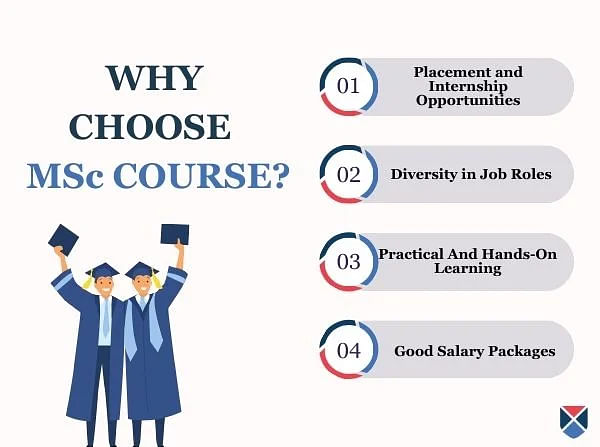
Here are some of the following points to highlight the several benefits of pursuing an MSc course:
Applications for MSc registration may be availed from the college website or by directly visiting the admission office of the institute. Some colleges may have an MSc qualification based on merit like UPES, while other institutes need candidates to clear the MSc entrance exam for MSc admission like IISER, Bhopal.
The details of the MSc admission process are listed below:
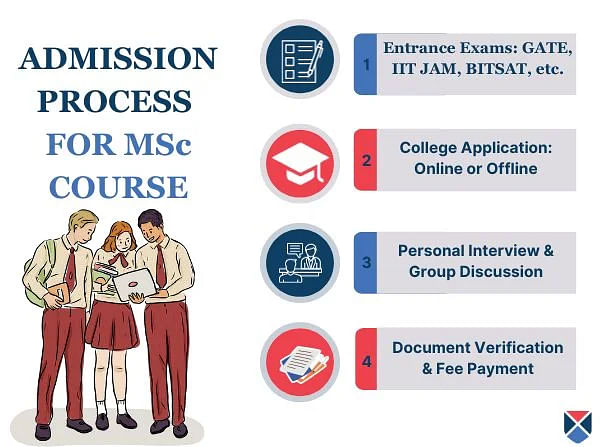
The MSc entrance exams are the most common evaluation process of top MSc colleges in India to select potential candidates for MSc admission. Below are the MSc entrance exam details:
| MSc Entrance Exams | Registration Dates | Accepting Colleges |
| GATE | Nov 19-Nov 24, 2023 | Indian Institute of Science, VIT, Anna University, etc. |
| NEST | February 2024- May 2024 (Tentative) | National Institute of Science Education and Research |
| January 2024- April 2024 (Tentative) | BITS Pilani, BITS Goa, BITS Hyderabad | |
| September 2024- November 2024 (Tentative) | IIT Roorkee, Indian Institute of Science, IISER Bhopal, etc. | |
| February 2024-April 2024 (Tentative) | Central University of Gujarat, BHU, University of Hyderabad, etc. | |
| CUCET | February 2024-April 2024 (Tentative) | Chandigarh University |
| PUCET | April 2024 (Tentative) | Panjab University |
| UPCET | December 2023- January 2024 (Tentative) | IIMT University, AKTU, etc. |
Read More: MSc Entrance Exam
MSc full form in education stands for Master of Science which is a postgraduate program that includes various specializations in science-related subjects. Several MSc course details along with a range of MSc specializations offered in India are provided below
This MSc course list represents the popular MSc specialization available.
The average M Sc course fees in India range from INR 3,000 PA to 5 LPA. The varying range of MSc fees in colleges may depend on the institutional facilities, faculty, prestige, infrastructure, and government quotas. The fees in government colleges is in the range of INR 3,000-60,000 PA, whereas the MSc fee in private colleges is in the range of INR 50,000-3 LPA.
The best MSc colleges in India 2024 are listed below:
| Name of the Institute | Average MSc Fees (Tuition) | Admission Fees | Miscellaneous Fees |
| IISc, Bangalore | INR 16,000 PA | – | INR 90,200 PA |
| IISER, Bhopal | INR 33,400 PA | INR 4,000 | INR 15,400 PA |
| IIT, Jodhpur | INR 54,500 PA | INR 3,800 | – |
| IIT, Kanpur | INR 40,925 PA | INR 2,950 | – |
| BITS, Pilani | INR 4.90 LPA | INR 53,900 | – |
| St Xavier’s College, Kolkata | INR 84,000 PA | – | INR 18,000 PA |
| Presidency College, Kolkata | INR 11,520 PA | – | INR 375 PA |
| UPES | INR 1.46 LPA | – | INR 48,600 PA |
| VIT University | INR 75,000 PA | – | INR 1.19 LPA |
| Fergusson College | INR 1.12 LPA | – | INR 48,035 PA |
| Jawaharlal Nehru Technical University, New Delhi | INR 10,000 PA | INR 1,000 | – |
| Christian Medical College, Vellore | INR 42,830 PA | INR 1,000 | INR 9,000 |
| Miranda House | INR 8,085 PA | INR 200 | – |
| PSG College of Arts and Science | INR 2,456 PA | INR 900 | – |
| University of Hyderabad | INR 6,770 PA | INR 3,200 | INR 2,000 PA |
| St Joseph’s College of Arts and Science, Bangalore | INR 47,250 PA | INR 10,000 | – |
| Chandigarh University, Chandigarh | INR 1 LPA | INR 2,000 | INR 20,000 |
| Jain University, Bangalore | INR 1.2 LPA | INR 2,000 | INR 25,000 |
| Loyola College, Chennai | INR 85,250 PA | INR 1,500 | – |
| CV Raman Global University | INR 80,000 PA | – | INR 1 LPA |
Below listed are location-wise MSc colleges in India with the average annual fees:
| Location | Average Fees |
| MSc Colleges in Chennai | INR 12,000-1 LPA |
| MSc Colleges in Kolkata | INR 10,000-1.20 LPA |
| MSc Colleges in Delhi | INR 40,000-2 LPA |
| MSc Colleges in Mumbai | INR 30,000-1.70 LPA |
| MSc Colleges in Hyderabad | INR 45,000-2.50 LPA |
| MSc Colleges in Pune | INR 40,000-2 LPA |
| MSc Colleges in Bangalore | INR 40,000-3 LPA |
| MSc Colleges in Kerala | INR 4,000-70,000 PA |
| MSc Colleges in Chennai | INR 35,000-2 LPA |
| MSc Colleges in Jaipur | INR 40,000-2.30 LPA |
| MSc Colleges in Indore | INR 50,000-2 LPA |
MSc course can be pursued full-time, distance, and through integrated education mode. Below listed is MSc course details:
| Type | Basic Eligibility | MSc Duration |
| Full-Time MSc | BSc or related degree with a minimum of 55% marks for the general category and 45-50% marks for the reserved category+ Entrance Exam Score + GD/PI performance | 2 Years |
| MSc Distance Education | BSc or related degree with a minimum of 50% marks for the general category and 45% marks for the reserved category | 2-4 Years |
| Integrated MSc | 10+2 with a minimum of 55-60% marks for the general category and 5% relaxation for the reserved category+ Entrance Exam Score | 5 Years |
MSc distance education is recognized by UGC-DEB in India and is considered a valuable degree. Below listed are distance MSc course details:
There are several colleges that provide integrated MSc courses. The MSc course duration for these colleges depends on the academic structure. The integrated MSc course details are given below along with the MSc eligibility criteria for getting admission to the colleges providing this course.
Integrated MSc Course (BSc + MSc)
It is a five-year program that allows students to simultaneously pursue a bachelor’s degree and a master’s degree (BSc for the first three years and MSc for the next two years). Below listed is the BSc+MSc course details:
Read more: BSc + MSc Integrated Course
Integrated MSc Course (MSc + Ph.D.)
It is a five-year program that allows students to simultaneously pursue a master’s and a doctorate (MSc for the first two years and a Ph.D. for the next three years). The Indian Institute of Science (IISc), Bangalore is known for its integrated MSc course.
Candidates can get admission to the integrated M Sc courses through the IIT JAM entrance exam. Below mentioned is the MSc+PhD details:
The syllabus of the MSc degree is structured in such a manner that the students get industry-relevant knowledge and specialized insights into the fundamentals of several scientific studies. The MSc course duration is 2 years. Some of the common subjects for an MSc degree are listed below:
| MSc Subjects | Topics Covered |
| Statistical Analysis | Descriptive Statistics, Inferential Statistics, Regression Analysis, Multivariate Analysis, Hypothesis Testing, etc. |
| Advanced Mathematics | Differential Equations, Real Analysis, Complex Analysis, Numerical Analysis, etc. |
| Analytical Chemistry | Chromatography Techniques, Spectroscopy Methods, Mass Spectrometry, Electroanalytical Techniques, etc. |
| Quantum Mechanics | Schrödinger Equation, Quantum States and Operators, Quantum Entanglement, Quantum Statistical Mechanics, etc. |
Read More: MSc Syllabus and Subjects
MBA degree is focuses on aspects of business and management, whereas, an MSc degree is focused on the advanced study of science, research, and mathematics. Here are some differences between the MSc course and the Master of Business Administration.
| Particulars | MSc | MBA |
| Full-Form | Master of Science | Master of Business Administration |
| Course Overview | The course curriculum focuses on topics like computer science, environmental science, and biomedical engineering. | The course curriculum covers topics like finance, marketing, operations, and strategy. |
| Course Duration | 2 Years | 2 Years |
| Entrance Exam | BHU ET, TISS NET | CAT, MAT |
| Eligibility | 50-60 % in Undergraduate Courses | 50% in Undergraduate courses |
| Specializations | Physics, Mathematics, Chemistry, Biotechnology, etc. | HR, Marketing, Entrepreneurship, Finance, Retail Management, etc. |
| Average Course Fees (INR) | INR 3,000 PA to 5 LPA | INR 3-15 LPA |
| Top Colleges | SXC, Presidency College, Fergusson College | IIM A, IIM B, IIM C |
| Average Salary | INR 4- 10 LPA | INR 4-30 LPA |
| Job Roles | Biostatistician, Clinical Research Associate, Information Security Analyst, etc | Marketing Manager, HR Manager, Financial Analyst, etc. |
Read More: MBA vs MSc
According to Payscale, the average salary offered to an MSc graduate is INR 4-10 LPA. Variation in salary among Master of Science graduates depends on factors such as industry, skill set, dedication, and diligence. The pay range increases as the experience and skill set of graduates enhance over time. Below is a list of a few MSc jobs with their average and experienced salary range:
MSc Jobs | Entry Level Average Salary | Salary After 3 Years of Experience |
| Laboratory Manager | INR 3.30 LPA | INR 6.20-9.20 LPA |
| Clinical Research Associate | INR 4 LPA | INR 5-6 LPA |
| Materials Engineer | INR 3.50-4.60 LPA | INR 6.20-7.80 LPA |
| Quantitative Analyst | INR 4-5 LPA | INR 6-10 LPA |
Read More: MSc Salary in India
MSc, full form in education, stands for Master in Science, which is a master’s degree in the specialized study of scientific fields and also prepares candidates to obtain higher education to get more knowledge and skillsets. Some of the courses after the MSc degree are listed below:
Read more: MBA after MSc
Career opportunities after MSc are available in both the public and the private sectors. The field and the sector in which the graduates can apply for a job depends highly on the specializations in Master of Science courses. Students who want to take up teaching as a profession after an MSc degree can opt for the NET exam and UPSC for civil service. Listed below are some of the popular MSc job roles that are available to students after graduation
Job Designations | Hiring Companies | Average Entry Level Salary |
| Research Scientist | Lupin, Man Kind Pharma, TCG Life Sciences, etc. | INR 5.30 LPA |
| Biostatistician | JSS Medical Research, TCS, Micro Labs, etc. | INR 5.70 LPA |
| Information Security Analyst | IBM, TCS, Accenture, Wells Fargo, etc. | INR 5.40 LPA |
| Health Policy Analyst | NTT Data, Omega Healthcare, Access Healthcare, etc. | INR 4 LPA |
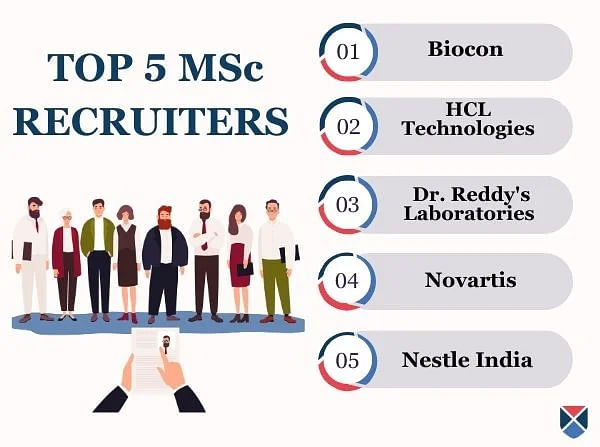
Below listed are a few top recruiters for graduates with average entry-level salaries:
Top Recruiter | Average Entry-Level Salary |
| Biocon | INR 4-6 LPA |
| HCL Technologies | INR 5-8 LPA |
| Dr. Reddy’s Laboratories | INR 4-6.50 LPA |
| Novartis | INR 5-7 LPA |
| Nestle India | INR 4.50-7 LPA |
[Sources: Glassdoor & Ambition Box]
Read more: MSc Job Scope
The Indian government offers several scholarships to students who aspire to pursue MSc courses for financially disabled, members and physically challenged individuals. There are several private and government scholarships available to qualified individuals. The several MSc Scholarships are listed below:
Scholarship | Eligibility Criteria | Amount |
| IISER Tirupati DST-SERB Junior Research Fellowship |
| INR 31,000 Per Month |
| Jawaharlal University, Delhi Scholarship | The student should have completed a bachelor’s degree in Environmental Sciences, Geology, Biochemistry, Physical Sciences, etc. | Tuition Fee Waiver on Monthly Basis |
| Inspire Scholarship for Higher Education |
| Upto INR 80,000 annually |
| Sitaram Jindal Scholarship |
| INR 3,200 Per Month |
Read more: MSc Scholarships
MSc demands a very detailed study of the course. One should possess soft and hard skills to perform better in MSc exams and assessments. Some of these skills are listed below:
The MSc syllabus focuses on studying the concepts of scientific, technical, and numerical research. The MSc subjects list in India emphasizes Electromagnetic Theory, Real Analysis, Cell Biology, Mechanics, Complex Analysis, Algebra, Electronics, etc. Under the MSc course, there are plenty of specializations students can choose from. Therefore, the MSc subjects list over time focuses on specific topics, resulting in an in-depth and comprehensive knowledge base.
The table below contains the semesters from the MSc first-year syllabus:
| Semester I | Semester II |
| Mathematical Physics | Mathematical Statistics |
| Laboratory | Methods in Applied Sciences |
| Analytical Chemistry | Qualitative Analysis Lab |
| Inorganic Semimicro | Numerical Analysis |
| Genes and Genomics | Research Methodology and IPR |
| Cell Biology | Mechanics of Deformable Elastic Solids |
| Complex Analysis | Thermodynamics and Equilibrium |
The table below contains the semesters from the MSc second-year syllabus:
| Semester III | Semester IV |
| Coordination Chemistry | Bioanalytical Chemistry |
| Electrochemistry and Kinetics | Polymer Science |
| Chemistry of Biomolecules | Medicinal Chemistry |
| Spectroscopic Identification of Molecules | Green Chemistry |
| Organic Qualitative Analysis Lab | Nano Chemistry and Technology |
| Elective I | Electives |
| Elective II | Elective IV |
| Organic Quantitative Analysis Lab | Project |
| Bioorganic, Heterocyclic, and Photochemistry | Surface Science and Coating Technology |
MSc subjects provide students with an in-depth knowledge of theoretical, research-oriented, and pragmatic science knowledge. Various MSc subjects come under the purview of each specialization of the MSc syllabus. Each specialization has a wide array of MSc subjects list that enhance the student’s knowledge for a lucrative career in the future. Mentioned below is the subjects list for M Sc:
There are several core subjects in the MSc syllabus. The details for some of the core subjects are discussed below:
| Subject | Subject Details |
| Quantum Mechanics | This teaches different behaviors and properties of light on different scales |
| Classical Mechanics | Motions of macroscopic objects like planets, stars, spacecraft, etc. |
| Optics & Atomic & Molecular Physics | The relation between light and matter is studied in-depth in this subject |
| Condensed Matter Physics | Study of different properties of solids, i.e structural and electromagnetic properties |
| Quantum Computing | Finding new quantum computing ways |
| Biophysics | Biological system: The theories and concepts |
| Astrophysics | The study of the universe and the cosmos at different scales |
| Geophysics | Studying the environment and the earth |
The MSc elective subjects depend on the specialization taken up by the students. Some examples of typical elective subjects are:
| Subject | Subject Detail |
| Bioinformatics Applications for System Analysis | Genetic therapy, preventive medicine, and other uses of bioinformatics are discussed in this article |
| Introduction to Molecular Spectroscopy | This article covers the definition, concept, and application of Molecular Spectroscopy |
| Polymer Synthesis | The definition, nature, and classification of polymer synthesis, i.e., polymerization is discussed in this article |
| Chemistry Engineering | Includes studies surrounding the structure and function of chemical plants |
| Advanced Organic Chemistry | Spectroscopy, medical chemistry, reduction, oxidation, and other concepts are covered in this article |
| Nanoscience | The flexible concepts and principles of nanoscience are described in this article |
| Food Chemistry | Includes chemicals surrounding food storage, processing, and storage |
| Advanced Inorganic Chemistry | The theory and application of the principles of inorganic chemistry |
MSc is a 2-year course that is divided into four semesters. Various subjects such as Chemistry, Physiology, Physics, Anatomy, and Maths are studied and covered thoroughly in these four semesters of the MSc course.
Given below are the important general facts related to MSc that the students must be aware of
Many students might often wonder what specializations are available in the MSc syllabus. MSc subjects in the 2-year duration offer students a scientific, theoretical, and pragmatic view to discerning scientific concepts and applications.
The focus on the specializations in the MSc Subjects begins with the first year itself for most courses. Listed below are the MSc subjects with their specializations semester-wise:
MSc Physics is a 2-year postgraduate course that deals with the concepts of Physics such as Nuclear Physics, Astrophysics, Matter, Geophysics, Classical Mechanics, Electromagnetic Theory, etc.
The program is a collection of lectures, projects, industry-related works, laboratory work, etc. The following are the subjects from the MSc Physics Syllabus:
Read More: MSc Physics Syllabus and Subjects
MSc Chemistry s a 2-year postgraduate course that deals with several areas of study that deal with advanced concepts in chemistry.
Pharmaceutical industries, research facilities, health organizations, and academic institutes are some of the areas where MSc graduates are offered job opportunities. The MSc Chemistry syllabus has the following subjects:
Read More: MSc Chemistry Syllabus and Subjects
MSc Mathematics enables students to get an in-depth knowledge of advanced mathematics through a vast array of subjects to choose from. The subjects from the MSc Mathematics syllabus are mentioned below:
Read More: MSc Mathematics Syllabus and Subjects
MSc Biotechnology introduces students to an interdisciplinary approach with a combination of Biology and Engineering. The subjects from the MSc Biotechnology syllabus are mentioned below:
Read More: MSc Biotechnology Syllabus and Subjects
Other Important MSc Syllabus and Subjects
MSc courses are of 2 years in regular mode, but in distance learning mode, it can be stretched up to 4 years. It is because the students who have enrolled in distance learning programs might not be able to devote as much time to learning as regular students do.
Some of the top colleges that offer distance learning programs for MSc are given below:
The MSc course structure is divided into four semesters. MSc syllabus of various specializations has core subjects across the semesters while some MSc subjects also have electives in the 2-year duration.
The MSc subjects list is well-structured in a manner to provide critical understanding while also enhancing the skills for industry jobs. Certain MSc syllabus also has electives and students can choose them according to their skills and interests.
The 2-year MSc course structure is listed below
The MSc syllabus encompasses various teaching methods. Apart from the traditional lecture-based training, the MSc subjects and their teaching methodology focuses on training in labs, individual projects, group projects, research work, fieldwork, and internships.
Some of the teaching methodology and techniques in the MSc syllabus are listed below
Students pursuing an MSc degree can take up various project topics such as online shopping android applications, the arsenic reduction from water, biomass densification, measuring the size of nanostructures, etc.
The ability to meet deadlines, critical approach, and problem-solving skills are some of the few tenets that students acquire while working on projects of the MSc subjects. Some of the MSc project topics are listed below
MSc books help students in attaining additional knowledge in their field of specialization. A detailed study of specific topics discussed in the MSc books helps in establishing alternative approaches for the aspirants of the course.
Some of the best MSc reference books are listed below
| Name of the Books | Authors |
| Physical Chemistry | Peter Atkins |
| Introduction to Electrodynamics | Capri and Narosa |
| Basic Algebra | Jakobson |
| Essentials of General Chemistry | Raymond Chang |
| Linear Algebra and its applications | David C |
| Classical Mechanics | Narosa H Goldstein |
| Molecular Structure and Spectroscopy | G Aruldhas |
| Power Electronics | PC Sen |
 Wing Educations Assistant