- info@wingeducations.com
- +91 (705) 495-5296
- Mon - Sat : 10.00-18.00
CA or Chartered Accountant course is a five-year professional certification course that focuses on the practice of taxation, accounting, auditing, financial assessment, and budgeting, for an individual, business, or organization. The Chartered Accountant (CA) course in India comprises three levels (Foundation, Intermediate, Final) with challenging exams conducted by the ICAI twice a year. Completing the course and subsequent 3 years of practical training under a CA allows a candidate to become a Chartered Accountant.
CA course registration requires students to have a minimum of 50% in 10+2 (high school degree). The eligibility criteria vary for foundation, intermediate, and final CA exam levels. The CA course syllabus and structure differ as per the level of the course that involves the study of corporate law, accounting, business law, financial management, etc. The course also includes compulsory training programs like Information Technology and Soft Skills (ICITSS and AICITSS).
Table of Contents
| Degree | Certificate |
| Full Form | Chartered Accountancy |
| Duration | 5 Years |
| Age | 17 years |
| Minimum Percentage | A minimum of 50% marks in 10+2 (high school degree) |
| Average Fees | ₹2 – 2.5 LPA |
| Similar Options of Study | ACCA, CMA, CPA, CFA |
| Average Salary | INR 8.5 LPA. |
| Employment Roles | Accountant, Financial Manager, Banker, Taxation Consultant, Consultant and more. |
| Top Recruiters | Deloitte, EY, KPMG, PwC, Infosys, Accenture, State Bank of India (SBI) etc. |
CA full form is Chartered Accountant. The course is divided into three levels: Foundation, Intermediate, and Final. Each level involves clearing an exam conducted by the Institute of Chartered Accountants of India (ICAI). After clearing the Intermediate level, students undergo three years of practical training (Articleship) under a practicing CA. The CA course duration is 4-5 years, including practical training.
The Chartered Accountant (CA) course in India is a prestigious professional qualification for aspirants seeking careers in finance, accounting, auditing, and taxation. CAs are highly sought-after professionals with excellent career prospects and high salaries. CA course enables students to work in various areas like public accounting firms, consulting firms, MNCs, etc. The average salary of a CA graduate is INR 8.5 LPA.
Are You Confused About Pursuing CA Course?
Book a free one-on-one consultation to clear your doubts from our top experts.

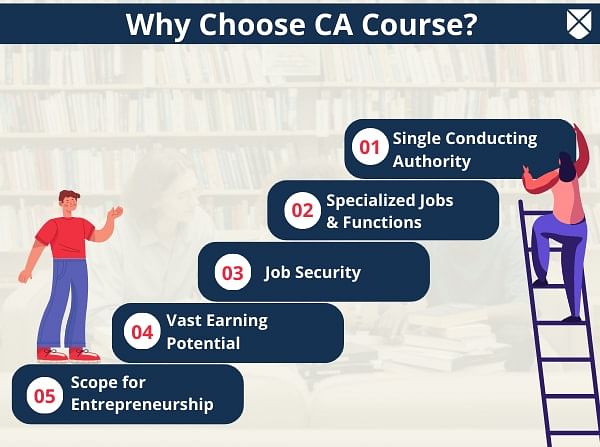
When deciding to pursue Chartered Accountancy as a career path, students must ensure that they do thorough research on the course. Below are points regarding why choose a CA course:
Students who have completed their 10+2 (high school degree) with a minimum of 50% in the commerce stream are eligible to pursue the Chartered Accountancy course. The Eligibility for CA courses differs according to the three different CA levels.
To be eligible for the CA Foundation level, students must meet the following eligibility requirements:
Read More: CA Foundation
To be eligible for the CA Intermediate level, students must meet the following eligibility requirements:
Read More: CA Intermediate
To be eligible for CA final level, students must meet the following eligibility requirements:
Read More: CA Final
The Articleship or training in CA is mandatory for students to complete. CA Articleship training begins once the student has completed one or both CA intermediate groups. To be eligible for the CA Articleship program, here are the following pointers:
Read More: CA Articleship
The process for CA admission in India can seem complex but can be completed by two routes given by ICAI. The following are the two types of approval procedures to earn CA Certification.
Candidates who want to pursue the Chartered Accountancy course after 12th grade must first qualify for the CPT/ CA Foundation exam. The CA exam is held twice a year in May and November, with registration deadlines in April and October, respectively.
Below mentioned are the CPT Route details:
Below mentioned are details regarding the CA certification course through direct entry:
Below is a comparative table highlighting the differences between CPT Route and Direct Entry Scheme in Chartered Accountant Course:
Particulars | CPT Route | Direct Entry Scheme |
Eligibility | After XII | After Graduation or Passed CS Executive or Passed the CMA Intermediate Exam |
Exemptions | No Exemptions | CPT Exempted |
Minimum Duration | 4.5 years | 3 years |
Eligibility to start Articleship | After clearing Group I of the IPCC | Immediately upon joining without clearing the IPCC Group I |
Also, Check: Difference Between CA CPT and CA Foundation
In India, the duration of the CA (Chartered Accountancy) course varies depending on the individual’s progress and the time required to pass each level of test. The following is an approximate breakdown of the duration of each level of the CA course:
S.No | CA Level | Duration |
1. | Foundation Course | A minimum of 4 Months |
2. | Intermediate Course | A minimum of 8 Months |
3. | Articleship Training | 3 Years |
4. | Final Course | A minimum of 4-5 Months |
Also, Read on How to Prepare for CA Foundation without Coaching
The CA course fees vary for foundation, intermediate and final levels. The registration fees are decided by the ICAI. Below mentioned are the estimated registration fees for the Chartered Accountancy (CA) course:
S.No | CA Level | CA Registration Fees |
1 | Foundation Level | INR 9,000 |
2 | Intermediate Level | INR 18,000 |
3 | Articleship Fees | INR 2,000 |
4 | Integrated Course on Information Technology and Soft Skills (ICITSS) | INR 7,000 |
5 | Direct Entry | INR 34,000 |
6 | Final Level | INR 22,000 |
Below is the list of the ten best CA institutes that help students to prepare well for the CA Exam:
S.No. | Name of the Institute | Average Fees |
1 | Aldine CA | INR 19,000 PA |
2 | Academy of Commerce | – |
3 | Resonance | INR 20,000 PA |
4 | Vidya Sagar Career Institute Ltd | INR 45,000 PA |
5 | Chanakya Academy for Management and Professional Studies (CHAMPS) | – |
6 | KSG Square | – |
7 | Northern India Regional Council of ICA | INR 11,000 PA |
8 | Nahata Professional Academy | INR 43.000 PA |
9 | Navkar Institute | INR 60,000 PA |
10 | Mital Commerce Classes | INR 41,000 PA |
The chartered accountancy syllabus differs according to each course level. The syllabus is divided into three parts: CA Foundation, CA Intermediate, and CA Final Level. Below mentioned is the detailed syllabus for each level of the CA course details:
CA Foundation is an entry-level examination for students pursuing a Chartered Accountancy (CA) course. The syllabus for CA Foundation is given by the ICAI. The major 4 subjects or papers are listed below:
CA Intermediate is the second-level examination for students pursuing a Chartered Accountancy course. The syllabus as given by the Institute of Chartered Accountants of India is bifurcated into two groups consisting of 8 subjects.
Group 1 has 4 subjects or papers as given below:
Group 2 has 4 subjects or papers as given below:
CA Final is the last level examination for students pursuing a CA course. The level consists of 2 groups divided into 8 papers/ subjects as given below:
Group 1 consists of 4 subjects or papers as given below:
Group 2 consists of 4 subjects or papers as given below:
Read More: CA Syllabus and Subjects
The Chartered Accountancy course tests certain skills and knowledge of the applicants essential for them to become successful Chartered Accountants. Below are the skill assessments for all 3 levels of the Chartered Accountancy course:
The CA Foundation assessments are based on the comprehension and application skills of the candidates. Below is the marking scheme of the CA Foundation course:
| Paper | Level I: Comprehension and Knowledge | Level II: Application Skills |
| Principles and Practice of Accounting | 5%-20% | 80%-95% |
| Business Laws | 50%-65% | 35%-50% |
| Business Correspondence and Reporting | 100% | – |
| Business Mathematics & Logical Reasoning, Statistics | – | 100% |
| Business Economics | 40%-50% | 50%-60% |
| Business and Commercial Knowledge | 100% | – |
Also, Check: How to Clear CA Foundation on First Attempt?
The CA Intermediate assessment is based on the candidates’ comprehension and application skills. The marking scheme for the CA Intermediate course is as follows:
| Papers | Level I: Comprehension and Knowledge | Level II: Application Skills |
| Accounting | 5%-15% | 85%-95% |
| Paper 1. Company Law | 40%-55% | 45%-60% |
| Paper 2. Other Laws | 35%-55% | 45%-65% |
| Cost and Management Accounting | 20%-30% | 70%-80% |
| Section A: Income Tax Law | 5%-20% | 80%-95% |
| Section B: Indirect Tax Law | 20%-45% | 55%-80% |
| Advance Accounting | 5%-15% | 85%-95% |
| Auditing and Assurance | 30%-55% | 45%-70% |
| Enterprise Information System | 40%-65% | 35%-60% |
| Strategic Management | 50%-70% | 30%-50% |
| Financial Management | 20%-30% | 80%-70% |
| Economics For Finance | 60%-80% | 20%-40% |
The candidate’s comprehension, analysis, application, evaluation, and synthesis skills are assessed in the CA Final. The following is the marking scheme for the CA Final course:
| Papers | Level I: Comprehension and Knowledge | Level II: Analysis and Application Skills | Level II: Evaluation and Synthesis |
| Financial Reporting | 5%-15% | 55%-85% | 15%-25% |
| Strategic Financial Management | 0%-20% | 20%-40% | 50%-60 |
| Advanced Auditing and Professional Ethics | 15%-25% | 40%-70% | 20%-30% |
| Paper 1. Corporate Law | 15%-25% | 40%-55% | 30%-35% |
| Paper 2. Economic Law | 30%-50% | 50%-70% | |
| Strategic Cost Management and Performance Evaluation | 0%-15% | 45%-55% | 35%-40% |
| Direct Tax and International TaxationPart 1. Direct Tax Laws | 5%-10% | 55%-75% | 20%-35% |
| Part 2. International Taxation | 40%-50% | 50%-60% | |
| Indirect TaxPart 1. Goods & Service Tax | 10%-30% | 40%-70% | 20%-30% |
| Part 2. Customer & FTP | 20%-40% | 40%-70% | 10%-20% |
To become a Chartered Accountant, candidates must complete several steps, including meeting eligibility requirements and applying for and completing the required degree. Below are the steps on how to become a chartered accountant:
Read More: How to Become a CA in India?
There are other courses that aspirants can pursue to become Chartered Accountants. However, slight differences make these courses distinct from the Chartered Accountant course. We have provided comparisons of the CA course with other accounting courses for your reference:
CA and ACCA degrees are similar in terms of functionality and opportunities. However, there are a few distinctions, which are listed below:
Full-Form | Chartered Accountant | Association of Chartered Certified Accountants |
Course Duration | 4 to 5 years | 3 – 4 years |
Eligibility | 10+2 with minimum 50% aggregate marks. | 10+2 with Accounting and Maths, with a minimum of 60% aggregate marks. |
Average Total Fees | INR 2 -2.5 Lakhs | INR 1.5 – 3 LPA |
Average Salary | INR 8.5 LPA | INR 6.24 LPA |
Read More: CA vs ACCA
CA and CPA degrees are similar in terms of functionality and opportunities. However, there are a few distinctions, which are listed below:
Full-Form | Chartered Accountant | Certified Public Accountant |
Course Duration | 4 to 5 years | 2 to 4 years |
Eligibility | 10+2 with minimum 50% aggregate marks. | Bachelor’s degree in commerce with economics, mathematics, and accounts as core subjects. |
Average Total Fees | INR 2 -2.5 Lakhs | INR 3.5-4 Lakhs |
Average Salary | INR 8.5 LPA | INR 8 LPA |
Given below are the differences between the CA and CFA courses:
Course | Chartered Financial Analyst | Chartered Accountancy |
Course Duration | 1.5 – 4 years | 4-5 years |
Eligibility | Bachelor’s degree or 4 years of professional work experience | 10+2 with minimum 50% aggregate marks. |
Average Total Fees | INR 1.9 – 3.86 Lakhs | INR 2 -2.5 Lakh. |
Average Salary | INR 6.8 LPA | INR 8.5 LPA |
Read More: CFA vs CA
Given below are the differences between the CA and CMA course:
Course | Cost Management Accounting | Chartered Accountancy |
Course Duration | 3 Years | 4-5 Years |
Eligibility | 10+2 with a minimum of 50% aggregate marks with commerce. | 10+2 with a minimum of 50% aggregate marks. |
Average Total Fees | INR 50,000-2.5 Lakhs | INR 2 -2.5 Lakh. |
Average Salary | INR 2.5 LPA – 7 LPA | INR 8.5 LPA |
Read More: CMA Vs CA
After completion of CA students can pursue various certification courses to enhance knowledge and domain expertise. Below listed are various certification courses that students can enroll in after CA:
The CA course is a very rewarding and promising career path for graduates. CA qualification helps students build a career path that will help them get a good job in both public and private sectors. Some of the job roles for students are mentioned below:
Read More: What Next after Completing CA Final
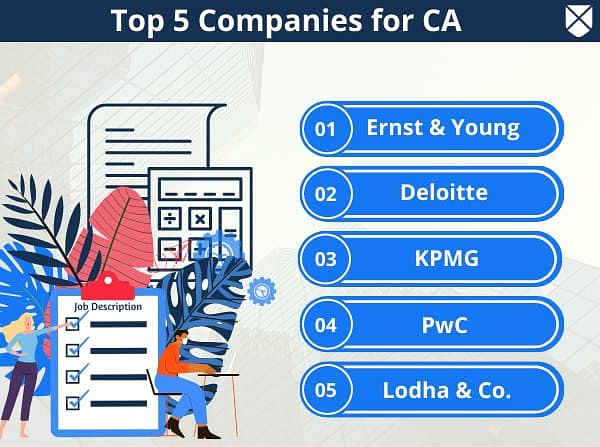
Candidates who have completed the Chartered Accountant course seek employment with the most prestigious chartered accounting firms. Below is a list of the top 20 accounting firms suited for CA graduates.
PWC | SS Kothari | Sir Dinodia & Co. LLP |
KPMG | RSM International | Deewan PN Chopra & Co. |
Ernst & Young SS Kothari | Deloitte | Khanna & Annadhanam |
Sahni Natrajan & Bahl | Suresh Surana & Associate LLP | C.Vasudeva & Co |
BDO International | Grant Thornton International | Lodha & Company |
Luthra & Luthra | Desai Haribhakti | TR Chadha & Company |
SP Chopra & Company | S Aiyar & Company | – |
Read More: Top CA Firms in India
According to Payscale, the average salary is INR 8.5 LPA for a CA in India. However, the salary varies according to different factors such as experience, skills, job designation, industry, organization, location, and more.
Read More: CA Salary in India
As a CA graduate, there are various skills one needs to excel in their career. Some of these skills include:
The CA syllabus is divided into three phases such as Foundation, Intermediate and Final. CA course focuses on the concepts of finances and accounting with in-depth knowledge of cost management, budget analysis, tax accounting, risk management, etc.
CA Syllabus is designed by the Institute of Chartered Accountant of India (ICAI) and the exams are conducted twice a year. The CA job scope has an extensive range of job roles from accountants, auditing experts, and taxation experts to business consultants in both private and public sectors.
Chartered Accountancy as a course aims to introduce students and aspirants to the concepts surrounding the financial sector. There are three levels in the CA course: Foundation syllabus or Common Proficiency course, CA intermediate syllabus or Integrated Professional Competence Course, and the CA Final new syllabus.
CA subjects focuses on imparting required practical knowledge to students in areas such as business law, cost and accounting, taxation, logical reasoning, etc to enable them work with top organisations or to start their own firm as entrepreneurs. Listed below is the detailed CA syllabus and subjects for each paper:
CA Foundation syllabus has 4 papers in total covering topics such as business correspondence, statistics, business mathematics, etc. Below is the list of CA Foundation Subjects along with its papers:
| CA Foundation Paper | CPT Subjects |
| Paper 1 | Principles and Practices of Accounting |
| Paper 2 |
|
| Paper 3 |
|
| Paper 4 |
|
CA Intermediate has 8 papers in total covering topics such as Application of Accounting Standards, Company Accounts, Accounting for Special Transaction, etc. Below is the list of CA Intermediate subjects for each paper:
| CA Intermediate Paper | IPCC Subjects |
| Paper 1 | Accounting |
| Paper 2 |
|
| Paper 3 |
|
| Paper 4 |
|
| Paper 5 | Advanced Accounting |
| Paper 6 | Auditing and Assurance |
| Paper 7 |
|
| Paper 8 |
|
The CA Final subjects and syllabus covers extensive topics such as Risk Management, Financial Management, Financial Reporting, etc. Here is a list of CA Final Subjects:
| CA Intermediate Paper | Subjects |
| Paper 1 | Financial Reporting |
| Paper 2 | Accounting |
| Paper 3 | Advanced Auditing and Professional Ethics |
| Paper 4 |
|
| Paper 5 | Strategic Cost Management and Performance Evaluation |
| Paper 6 |
|
| Paper 7 |
|
| Paper 8 |
|
Chartered Accountancy is divided into three levels, and each step has to be cleared by the candidate to become a CA. CA course duration is usually 3 to 5 years. If students decide to pursue CA after the 12th, the course will be five years long. Whereas, if students decide to pursue CA after completing their undergraduate degree, the course will become shorter for them.
The students gain exposure to different concepts regarding the financial sector, banking and management. Below are some essential concepts taught in the CA foundation subjects, CA intermediate subjects, and CA final subjects:
Chartered Accountancy course syllabus India is designed to ensure that students can pursue their dream to become chartered accountants. The course has core subjects and internships, which help students build a career in their direction. The course structure is as follows:
The CA Core Subjects are as follows:
The CA Articleship is an essential aspect of the CA course where a student will have to enrol in a Certified Accountant Practice for 3 years before being eligible for the CA Final course.
Candidates must meet specific eligibility requirements and apply for and complete the required degree to become a CA. The following are the key points on how to become a chartered accountant:
The Institute of Chartered Accountants of India has approved the Chartered Accountant Basic Level Exam as a common skill exam. Students to need gain eligibility for the second-level entrance exam needed to become a CA.
Passing the CPT exam qualifies candidates for the next level of the Integrated Professional Competency Course. The IPCC comprises seven exams that are divided into two groups (Group 1 + Group 2). To advance to the next level, candidates must qualify for at least one group.
Candidates interested in becoming a CA must enrol in an information technology training programme. The course introduces the skills and knowledge required for a career in accounting. The ITT and orientation registration processes are the only things that need to be paid attention to. As a result, it is critical to apply for ITT and orientation programmes before enrolling in an articleship.
Articleship is an integral part of the certification process because it gives students valuable accounting experience. Those interested in pursuing a career as a Certified Accountant should enrol in a Certified Accountant Practice for three years of articleship support.
Individuals can begin by working for a financial firm or an accounting firm, where they will gain practical experience dealing with clients and managing financial programmes. They are considered eligible to sit for the CA exam after gaining sufficient work experience.
Candidates must take the CA final exam during the last six months of articleship training. This is the last step in the CA process, after which a candidate can work in the industry for a while.
CA teaching methodology and techniques are traditional classroom teaching. The subjects and training are around the concepts tested in the CA exams and aim to prepare students for the final examination. All the institutes around the country follow a very similar structure to ensure that students can get the best education they need to complete the exams.
Below is a list of books according to CA courses:
The list of the CA Foundation Reference Books is as follows:
| Name of the Book | Author |
| Scanner CA Foundation on Principles And Practice Of Accounting | Shuchita Prakashan |
| Scanner CA Foundation on Business Laws And Business Correspondence And Reporting | Shuchita Prakashan |
| Scanner CA Foundation on Business Mathematics, Logical Reasoning And Statistics | Shuchita Prakashan |
| Business Economics And Business And Commercial Knowledge | Bharat Tusian and PC Tulsian |
The list of the CA Foundation Reference Books are as follows:
| Name of the Book | Author |
| First lessons in Accounting Standards | MP Vijay Kumar |
| A Handbook on Corporate and Other Laws | Munish Bhandari |
| Cost Accounting for CA-IPC | PC Tulsian |
| Handbook On Taxation | G. Sekhar |
| Tulsian’s Accountancy: For CA Intermediate Course (Group II) | PC Tulsian and Bharat Tulsian |
| Auditing and Assurance for CA Inter | Surbhi Bansal |
| Padhuka’s Students’ Guide For Enterprise Information Systems & Strategic Management | B. Saravana and Prasath G. Sekar |
The list of CA Final Reference Books is as follows:
| Name of the Book | Author |
| Strategic Cost Management and Performance Evaluation: CA Final New Syllabus | B Saravana Prasath |
| Comprehensive Approach to Advanced Auditing and Professional Ethics | CA Vikas Oswal |
| Padhuka’s A Ready Reference on Advanced Management Accounting | CA Prasath B Saravana |
| Padhuka’s Student Reference On Indirect Taxes: CA Final Old and New Syllabus | G Serkar and B Sarvana Prasath |
| GST Compact Book: Indirect Tax | CA Raj Kumar |
| Conceptual Learning A Handbook on Indirect Tax Law | Yashwant Mangal |