- info@wingeducations.com
- +91 (705) 495-5296
- Mon - Sat : 10.00-18.00
BCom or Bachelor of Commerce, is a 3-year undergraduate degree that focuses on commerce and business. B.Com offers students a fundamental knowledge of Accounting, Corporate Tax, Economics, Company Law, Auditing, Business Management, etc. The B.Com subjects include topics like Financial Accounting, Business Mathematics and Statistics, Business Law, Management Accounting, Marketing Management, Income Tax, etc.
The BCom courses can be pursued in various formats such as classroom, online, and distance learning. It equips the students with the knowledge to apply for jobs in diverse industries like computer science, banking and insurance, taxation, finance, cooperation, accounting and finance, accountancy etc.
B Com Admissions require students to have a minimum of 50% in their high school degree (10+2) with a commerce stream and qualify with the required cut-off marks in B Com entrance exams such as PUCET, CUCET-UG, LPUNEST, etc. The annual BCom fees are in the range of INR 1,000-3 Lakh, the fees vary depending on private and government colleges. The annual fee for BCom at LPU is INR 1.60 Lakh, whereas, the Lucknow University annual BCom fee is INR 9,000.
Table of Contents
| Degree | Bachelors |
| Full Form | Bachelor of Commerce |
| Duration | 3 Years |
| Age | The minimum age limit is 17-18 years. |
| Minimum Percentage | 50% in 10+2 from a recognized board |
| Average Fees | INR 1,000-3,00,000 Per Year |
| Similar Options of Study | BBA, BMS, Bachelor of Economics, Bachelor of Banking and Finance |
| Average Salary | INR 4 LPA |
| Employment Roles | Accountant, Business Analyst, Company Secretary, Financial Analyst, etc |
| Top Recruiters | SBI, Deloitte, TCS, Infosys, Wipro, Reliance Retail, Accenture, ITC Limited, etc. |
BCom stands for Bachelor of Commerce, a 3-year undergraduate degree that emphasizes the theoretical and practical understanding of business, administration of the exchange of goods and services, accounting to sales, and related fields. Candidates with a keen interest in banking, accounting, sales, finance and trade can pursue the BCom course.
BCom course provides good placement opportunities to students in top companies like ICICI, HDFC Bank, Amazon, KPMG, etc., in different roles ranging from Tax Consultant, Cost Estimator, Accountant, Banking Officer, etc. The average salary of a BCom graduate is INR 4 LPA according to Payscale.
BCom admission requires a candidate to fulfil a certain set of parameters like entrance exam score, minimum percentage, additional certifications, etc. Below are the eligibility criteria for BCom courses:
Note: The eligibility criteria for BCom courses vary across colleges, specializations and entrance exams. Candidates must thoroughly check the official website of the respective college and entrance test before applying.
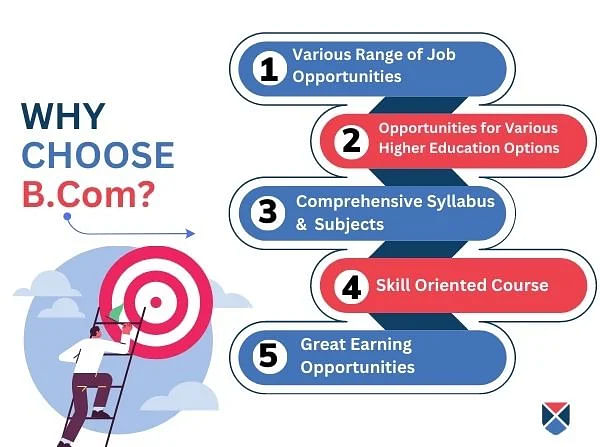
Bachelor of Commerce is one of the more sought-after courses in the field of Commerce, as it teaches topics relevant to financial organizations, banks, businesses, and trading. Below are a few reasons that will provide you with an insight into why to choose BCom subjects:
Also Check: Difference Between BCom and BCA
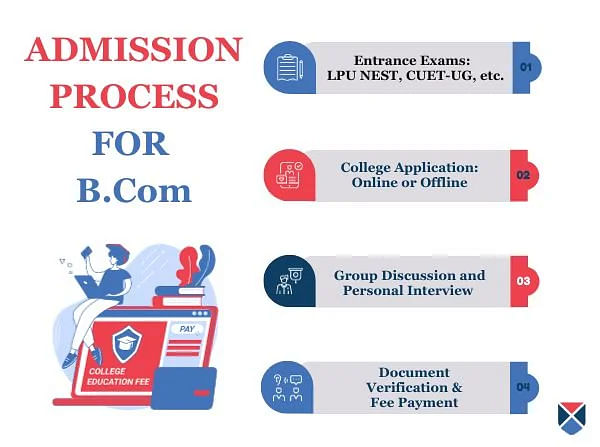
The admission procedure for the Bachelor of Commerce subjects is done on a merit basis in colleges like Invertis University and based on entrance exams in colleges like LPU, Chandigarh University, etc. Listed below is the procedure to get admission for the BCom courses:
Read More: BCom Admission Process
BCom admissions are conducted both based on entrance exam scores and merit basis. The entrance exams are conducted at national, state and institute levels to check student aptitude. The popular BCom entrance exams are listed below, along with application details:
BCom Entrance Exam | Registration Dates 2024 | Accepting College |
| February 27 – April 5, 2024 | UPES, University of Allahabad, etc. | |
| AIMA UGAT | January 4 – June 9, 2024 | KR Mangalam University, IMTS Institute, etc. |
| MIT-WPU CET | May 17 – June 10, 2024 | MIT-WPU |
| LPU NEST | August 1 – August 31, 2024 | Lovely Professional University |
| CUCET | Phase 1: Till July 30, 2024 Phase 2: July 30 – August 31, 2024 | Chandigarh University |
| PUCET | March 27 – April 29, 2024 | Panjab University |
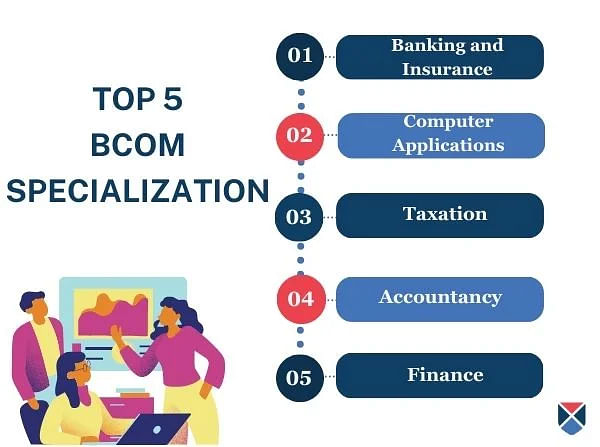
The Bachelor of Commerce is a three-year-long undergraduate program with several specializations. There are many BCom specializations under the degree including Banking, Finance, Taxation and IT, which makes the graduates of this course very employability-oriented. Listed below are some of the top 6 BCom courses:
Other popular BCom Specializations are given below:
Read More: BCom Specializations List
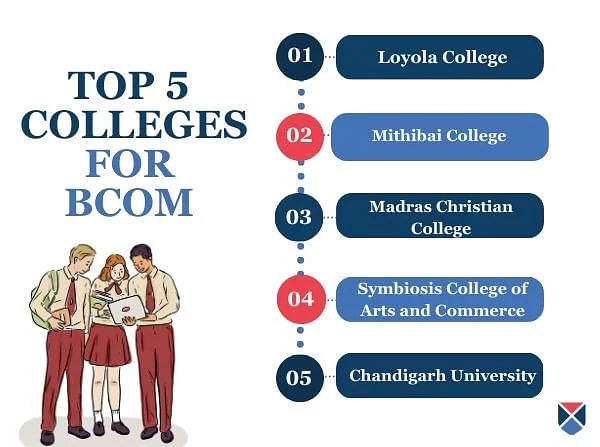
BCom course is offered by various prominent government and private colleges in India such as Symbiosis College of Arts and Commerce, Mumbai University, UPES, Loyola College, etc.
The annual BCom fees in India are between INR 1,000 – 3 Lakh, the government colleges offering BCom courses have an annual fee between INR 1,050-37,000, whereas, the annual fees in BCom private colleges and universities are between INR 1,000-3 Lakh.
The below list contains the top BCom colleges in India with annual fee breakdowns:
The following are some of the top government colleges in India for BCom courses:
Government BCom Colleges | NIRF Ranking | BCom Course Fees (1st Year) |
19 | INR 29350 | |
1 | INR 55000 | |
10 | INR 24000 | |
12 | NIR 23850 | |
21 | INR 50000 | |
89 | INR 23500 | |
9 | INR 38920 – 42230 | |
21 | INR 1290 |
Here’s the list of top private colleges for BCom in India:
Private BCom Colleges | NIRF Ranking 2024 | Tuition Fees Per Year |
8 | INR 37,950 | |
14 | INR 57,000 | |
47 | INR 23,594 | |
20 | INR 1.49 Lakh | |
27 | INR 1.60 Lakh | |
46 | INR 2.46 Lakh | |
INR 20,000 | ||
75 | INR 30,000 |
Below listed are location-wise BCom colleges in India with the annual tuition fees:
Location | BCom Fees Tuition Fees Per Year |
INR 3,000-1 Lakh | |
INR 50,000-3 Lakh | |
INR 50,000-2 Lakh | |
INR 25,000-1.50 lakh | |
INR 15,000-1.00 Lakh | |
INR 12,000-1 Lakh | |
INR 50,000-3 Lakh | |
INR 8,000-60,000 | |
INR 30,000-1 Lakh | |
INR 10,000-80,000 |
Also, Check: BCom Fees in India
The course has full-time, part-time, and distance options available to aspirants. The following BCom course details are provided below:
Type | Bachelor of Commerce Eligibility | BCom Duration |
BCom Full Time | Should have passed 10+2 with Commerce with a minimum of 50% marks for general category and 45% marks for reserved category+ Entrance Exam Score+ GD and PI score. | 3 Years |
BCom Online | Should have passed 10+2 with Commerce with a minimum of 50% marks for the general category and 45% marks for the reserved category | 3 Years |
Distance BCom | Should have passed 10+2 with Commerce with a minimum of 45-50% marks for the general category and 45% marks for the reserved category | 3-5 Years |
Below listed are BCom Distance education course details:
Read More: Distance BCom
Below listed are important pointers regarding online BCom courses:
An integrated course can be two bachelor-level courses combined or undergraduate courses combined with postgraduate courses. These courses provide a joint degree of two courses. Integrated BCom course duration is a five-year UG course that an understudy can seek after the 10+2. Different Colleges/Institutes/Universities in India offer admission to the 5-year Integrated BCom course which can be in the following combinations:
Below listed are the important points regarding the integrated BCom LLB course:
Read More: BCom + LLB
Below listed are the important points regarding the integrated BCom MCom course:
Also Check: M.Com
In BCom course 1st year, students are introduced to the fundamentals of accounting, economics, and business communication. The BCom 2nd year builds upon this foundation with courses in financial management, business law, and taxation. Finally, in the BCom 3rd year, students delve deeper into specialized areas such as auditing, marketing, and entrepreneurship. Some of the subjects of BCom are:
Semester I | Semester II |
Environmental Studies | Business Communication (Language- English/Hindi/MIL) |
Financial Accounting | Corporate Accounting |
Business Law | Corporate Laws |
Micro Economics | Macro Economics |
Semester III | Semester IV |
Human Resource Management | Cost Accounting |
Income-tax Law and Practice | Business Mathematics |
Management Principles and Applications | Computer Applications in Business |
Business Statistics | Business Mathematics |
E-Commerce | Entrepreneurship |
Semester V | Semester VI |
Principles of Marketing | Auditing and Corporate Governance |
Fundamentals of Financial Management | Indirect Tax Law |
Discipline-Specific Elective 1 | Discipline-Specific Elective 3 |
Discipline-Specific Elective 2 | Discipline-Specific Elective 4 |
Read More: BCom Syllabus and Subjects
BCom (Bachelor of Commerce) programs provide students with a strong foundation in financial management, auditing, and taxation whereas, a BBA (Bachelor of Business Administration), focuses on providing students with a comprehensive understanding of various aspects of business management.
Below is a detailed comparison of the two courses:
Full-Form | Bachelor of Commerce | Bachelor of Business Administration |
Course Duration | 3 Years | 3 Years |
Course Overview | The course curriculum focuses on subjects like accounting, economics, business law, taxation, and business communication. | The course curriculum focuses on subjects like finance, marketing, human resources, and operations management. |
Eligibility | 12th pass in commerce with a minimum of 50% marks. | 12th Pass in any stream with a minimum of 50% marks |
Course Fee Per Year | INR 1,000- 3 Lakh | INR 10,000 – 3 Lakh |
Average Salary | INR 4 LPA | INR 2-7 LPA |
Entrance Exam | SUAT, BHU UET, AIMA UGAT/Direct Admission | IPU CET, BHU CET, UPSEE, NPAT, SET |
Top Colleges | Shri Ram College of Commerce, BML Munjal University, St. Xaviers College. | Christ University, Loyola College, Madras University. |
Job Roles | Accountant, Cost Estimator, Financial Analyst, etc. | Business Development Manager, Sales Executive, Marketing Executive, etc. |
Read More: BBA vs BCom
Many job opportunities are opened for the graduates after the course, both in the public and private sectors. The career after BCom is vast, and the jobs can differ according to the industry the graduates work in and the knowledge possessed by the aspirants.
Below is the list of top BCom job roles along with hiring companies and the average salary offered:
BCom Job Designations | Job Description | Hiring Companies |
Budget Analysts |
| IQVIA, SK Finance, CGI Group, E&Y |
Cost Estimators |
| Shell, L&T Power, Tata Motors, KPMG |
Business Operations Manager |
| Accenture, HP, IBM, Cisco |
Tax Consultant |
| E&Y, Deloitte, PWC, Infosys |
Accountant |
| KPMG, Deloitte, Ernst & Young (E&Y), PwC, Infosys |
Auditor |
| Deloitte, E&Y, PwC, KPMG, Infosys |
Financial Risk Manager |
| JPMorgan Chase, Goldman Sachs, Morgan Stanley |
Retail Manager |
| Walmart, Reliance Retail, Future Group |
Public Accountant |
| Grant Thornton, BDO, RSM, Baker Tilly |
Financial Analyst |
| Goldman Sachs, JPMorgan Chase, Accenture, Infosys |
Banking Officer |
| HDFC Bank, ICICI Bank, State Bank of India (SBI) |
Marketing Coordinator |
| Ogilvy & Mather, DDB Worldwide, Leo Burnett |
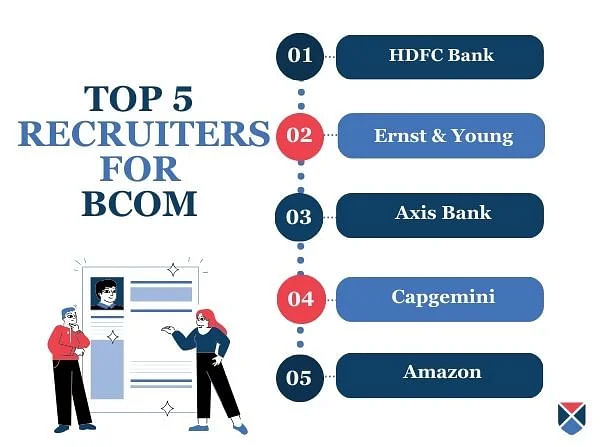
The BCom scope is vast as graduates are hired by various private and government organisations such as BFSI, Retail and E-Commerce, IT and Consulting, Supply Chain and Logistics, Stock Market and Investment, etc. Below listed are a few top recruiters for graduates:
KPMG | Capgemini | Accenture |
SBI | Amazon | Genpact |
HDFC Bank | Flipkart | Infosys |
Deloitte | TCS | Ernst & Young |
Wipro | Cognizant | Reliance Industry |
[Sources: Payscale & Ambition Box]
Read More: Best Career Options After BCom in India
The average BCom course salary in India is INR 4 LPA, according to Payscale. Graduates after having three or more years of experience can earn in the range of INR 6-10 LPA. Below listed are job roles for BCom graduates along with their average entry-level salaries:
BCom Jobs | Entry Level Average Salary | Salary After 3 Years of Experience |
Budget Analysts | INR 3.5 – 4 LPA | INR 6 – 7 LPA |
Cost Estimators | INR 3.2 – 3.8 LPA | INR 5 – 6 LPA |
Business Operations Manager | INR 4 – 4.5 LPA | INR 7 – 10 LPA |
Tax Consultant | INR 3.8 – 4.2 LPA | INR 6 – 7.5 LPA |
Accountant | INR 3 – 3.5 LPA | INR 5 – 6 LPA |
Auditor | INR 3.2 – 3.7 LPA | INR 6 – 7 LPA |
Financial Risk Manager | INR 4.2 – 4.8 LPA | INR 7.5 – 9 LPA |
Retail Manager | INR 3.5 – 4 LPA | INR 6 – 7 LPA |
Public Accountant | INR 3.2 – 3.8 LPA | INR 5 – 6.5 LPA |
Financial Analyst | INR 4.5 LPA | INR 6 – 7.5 LPA |
Banking Officer | INR 3.2 – 3.7 LPA | INR 5.5 – 7 LPA |
Marketing Coordinator | INR 3.2 – 3.7 LPA | INR 5.5 – 6.5 LPA |
Read More: BCom Salary in India
BCom has a lot of scopes both in India and abroad. Graduates willing to enhance their commerce background knowledge can opt for an M.Com degree in India. Some of the higher education after BCom are:
Below listed are the top 5 cities to pursue a BCom course based on top colleges, average living expense, top recruiters and average starting salary:
City | Top Colleges Offering BCom Course | Average Living Expense Per Month (INR) | Average Starting Salary (INR) | Top Recruiters |
Mumbai | St. Xavier’s College | 20,000 – 30,000 | 3 Lakh – 5 Lakh PA | Tata Consultancy Services, HDFC Bank, ICICI Bank, etc. |
Delhi | Ramjas College | 15,000 – 25,000 | 3 Lakh – 4.50 Lakh PA | Ernst & Young, Genpact, etc. |
Bangalore | Christ University | 15,000 – 25,000 | 2.50 Lakh – 4 Lakh PA | Infosys, Goldman Sachs, Wipro, etc. |
Pune | Symbiosis College of Arts and Commerce | 15,000 – 25,000 | 2.50 Lakh – 4 Lakh PA | Bajaj Finance, Tech Mahindra, etc. |
Chennai | Loyola College | 15,000 – 25,000 | 2.50 Lakh – 4 Lakh PA | Cognizant, Sutherland Global Services, etc. |
There are various scholarships provided to BCom students through government and private organizations. Below is a list of scholarships available to BCom students:
BCom Scholarship | Eligibility Criteria | Amount |
CLP India Scholarship Scheme | Students pursuing education from class 12th to the postgraduate level and have a minimum of 50% marks throughout their education. | Up to INR 18,000 |
Sarla Devi Scholarship | Students belonging to economically weaker sections want to pursue education in Arts, Science, Commerce, and Vocational streams. | Up to INR 75,000 |
Azim Premji University Undergraduate Scholarship | Students belonging to economically disadvantaged groups and want to pursue UG and PG degrees in commerce, science, or any stream, with a minimum of 50% marks. | 25-100% Scholarship amount depending on the percentage secured by the student. |
HDFC Ltd’s Badhte Kadam Scholarship | Students who want to pursue degrees like BCom., B.Sc., B.A., BCA, etc. Annual family income is below INR 6 Lakh. | Up to INR 40,000 |
Read More: BCom Scholarships
BCom graduates must possess skills that can help them succeed in their professional careers. The skill sets can help the graduates in academics and help them evolve as the best working professionals. Below listed are a few skills required by BCom graduates:
The BCom syllabus is divided into core and elective subjects. The main topics covered under the BCom syllabus include business, management, economics, banking, finance, trading and accounting. The BCom course is divided into 6 semesters, i.e. the BCom syllabus spans over 3 years, covering practical and theoretical topics to equip the students with fundamental knowledge of business and accounting.
A general BCom syllabus is provided by the University Grants Commission (UGC) on its official website. However, the BCom syllabus may vary across universities. Under the New Education Policy, the Ministry of Education accepts the BCom curriculum designed under the Choice Based Credit System (CBCS). Students willing to gain admission to BCom courses can read ahead in this article.
The BCom syllabus comprises core and elective subjects. The core BCom syllabus includes a range of topics from Accounting, Business Economics, Business Law, Business Mathematics and Statistics, Financial Management, Marketing Management, and more. The syllabus spans 3 years and is strategically divided into six semesters, offering fundamental knowledge of the commerce field. The BCom syllabus pdf of top colleges in India can be accessed from their official websites.
BCom syllabus for the 1st year includes foundational courses in financial accounting, economics, corporate accounting, laws, and economics. Whereas, the 2nd year subjects delve into advanced topics such as income-tax, HR, business statistics-mathematics, economy, etc. BCom subjects in the 3rd year cover topics like marketing, financial management, auditing, tax laws and discipline-specific subjects.
BCom course helps graduates obtain industry-relevant knowledge and career expertise. The course provides them with a variety of career options in both the public and private sectors, with positions like bank manager, accountant, finance specialist, etc.
Table of Contents
BCom syllabus comprises important topics related to commerce, banking, finance and accounting, and all the necessary topics related to commerce and business. BCom syllabus subjects are generally divided into two categories such as core and elective subjects. Let’s have a look at these BCom subjects in detail:
Given below is the core BCom syllabus along with topics covered in each subject:
Core Subjects | Topics Covered |
Financial Accounting | Theoretical Framework, Accounting Process, Computerised Accounting Systems, Business Income, Final Accounts, Accounting for Hire-Purchase and Installment Systems, Consignment, and Joint Venture. |
Business Law | The Indian Contract Act, 1872: General Principles of Contract, The Indian Contract Act, 1872: Specific Contracts, The Sale of Goods Act, 1930, Partnership Laws. |
Business Mathematics and Statistics | Matrices, Differential Calculus, Basic Mathematics of Finance, Uni-variate Analysis, Bi-variate Analysis, Time-based Data: Index Numbers and Time-Series Analysis. |
Company Law | Documents, Management, Dividends, Accounts, Audit, Winding Up, Insider-Trading, Whistle-Blowing. |
Income Tax Law and Practice | Computation of Income under different heads, Computation of Total Income and Tax Liability, Preparation of Return of Income. |
Computer Application in Business | Word Processing, Preparing Presentations, Spreadsheet and its Business Applications, Creating Business Spreadsheet. |
Marketing Principles | Marketing Concepts, Market Research, Consumer Behavior, Product Management, Promotion, Pricing |
Auditing and Corporate Governance | Auditing Standards, Internal Control, Corporate Governance Principles, Audit Reports, Ethics in Auditing |
Management Principles and Application | Planning, Organizing, Leading, Controlling, Decision-Making, Organizational Structure |
Human Resource Management | Recruitment, Training and Development, Performance Appraisal, Employee Relations, HR Policies |
Cost Accounting | Cost Concepts, Costing Methods, Budgeting, Variance Analysis, Cost-Volume-Profit Analysis |
Business Communication | Written and Oral Communication, Business Correspondence, Presentation Skills |
Micro and Macro Economic Principles | Supply and Demand, Market Structures, National Income, Monetary and Fiscal Policy |
Environmental Studies | Environmental Issues, Sustainable Development, Corporate Social Responsibility |
Corporate Accounting | Corporate Financial Statements, Mergers and Acquisitions, Share Capital, Dividends |
Fundamentals of Financial Management | Financial Planning, Capital Budgeting, Working Capital Management, Financial Analysis |
Listed below are some of the elective subjects along with topics covered in each:
Elective Subjects | Topics Covered |
E-Commerce | Online Business Models, E-Marketing, Digital Transactions, Cybersecurity, E-Commerce Regulations, Supply Chain in E-Commerce |
Advanced Entrepreneurship | Business Planning, Start-up Management, Innovation, Funding Strategies, Small Business Operations, Entrepreneurial Marketing |
Advertising | Advertising Strategies, Creative Development, Media Planning, Consumer Behavior, Brand Management, Digital Advertising |
Banking and Insurance | Banking Operations, Risk Management, Insurance Principles, Financial Products, Regulatory Compliance, Investment Banking |
Computerised Accounting Systems | Software Applications, Database Management, Cloud Accounting, Automated Financial Reporting, Security in Accounting Systems |
Indirect Tax Law | Goods and Services Tax (GST), Value Added Tax (VAT), Service Tax, Customs Duty, Indirect Tax Compliance, Tax Planning |
Consumer Protection | Consumer Rights, Legal Framework, Product Liability, Consumer Advocacy, Dispute Resolution, Ethical Marketing |
Indian Economy | Economic Policies, Fiscal and Monetary Policy, Economic Development, Agriculture, Industrialization, Economic Reforms |
Industrial Law | Labor Laws, Employment Contracts, Industrial Disputes, Occupational Health and Safety, Workers’ Rights, Collective Bargaining |
Corporate Tax Planning | Tax Strategies for Corporations, Tax Compliance, Tax Credits and Incentives, Transfer Pricing, Corporate Restructuring |
International Business | Global Business Strategies, Cross-Cultural Management, Export-Import Procedures, International Market Entry, Globalization Impact |
Investment Fundamentals | Portfolio Management, Stock and Bond Markets, Risk Analysis, Investment Strategies, Financial Instruments, Diversification |
Financial Markets, Institutions and Financial Services | Stock Exchanges, Banking Systems, Financial Intermediaries, Mutual Funds, Insurance Services, Regulatory Environment |
Business Tax Procedures and Management | Income Tax Procedures, Business Tax Planning, Tax Compliance, Taxation of Business Entities, Tax Dispute Resolution |
Also, Check: BCom Fees in India
The BCom syllabus is designed to ensure that the students have access to all the vital information they need. The curriculum for the course is divided into three parts: foundation, core and electives, projects. The table below represents the general outline of the BCom general subjects list as semester-wise:
BCom 1st year syllabus focuses on fundamental concepts of commerce and business studies. Students can download BCom syllabus 1st year pdf from the respective university website to know more about the syllabus.
The BCom 1st semester syllabus and the 2nd semester syllabus are detailed in the table below:
Semester I | Semester II |
Environmental Studies | Business Communication (Language- English/Hindi/MIL) |
Financial Accounting | Corporate Accounting |
Business Law | Corporate Laws |
Micro Economics | Macro Economics |
BCom 2nd year syllabus covers aspects related to foundation in financial reporting, measures of central tendency, probability, types of companies and laws, recruitment, selection, and training practices, etc. The table below details the BCom 2nd year subjects:
Semester III | Semester IV |
Human Resource Management | Cost Accounting |
Income-Tax Law and Practice | Computer Applications in Business |
Management Principles and Applications | Business Mathematics |
Business Statistics | Entrepreneurship Fundamentals |
BCom 2nd Year Practical Subjects
The BCom subjects have practicals that are offered in the 2nd year. Below are practical subjects list:
BCom 3rd year syllabus is focused on covering advanced specialization topics related to consolidation of financial statements, activity-based costing, venture capital and business plan, marketing metrics, etc. The table below depicts the BCom 3rd year subjects:
Semester V | Semester VI |
Principles of Marketing | Auditing and Corporate Governance |
Fundamentals of Financial Management | Tax Laws |
Discipline-Specific Elective 1 | Discipline-Specific Elective 3 |
Discipline-Specific Elective 2 | Discipline-Specific Elective 4 |
Summer Internship | Project Work |
Discipline-Specific Elective 1 and 2 | Discipline Specific Elective 3 and 4 |
|
|
BCom course is a three-year-long undergraduate course that helps students to learn about the core areas of commerce and finance and offers several specializations related to the field. Given below is the BCom subject list for various specialization courses.
BCom Specialization | BCom Subjects Covered |
| |
| |
| |
| |
| |
| |
|
Other Important Specialisation wise BCom Subject list:
Read More: BCom Specialization List
College-wise BCom syllabi from institutions across India encompass a broad spectrum of commerce subjects, enabling students to develop a solid understanding of business, finance, law, and economics.
BCom syllabus pdf can be downloaded from the official website of the colleges. However, listed below in the following sections is a semester-wise breakdown of the BCom syllabus for some of the best colleges in India.
Delhi University’s BCom syllabus offers a well-rounded education in commerce, including financial accounting, business laws, economics, and management. Students will explore diverse areas of commerce and gain a comprehensive understanding of business principles and practices. Listed below is the BCom syllabus for Delhi University:
Semester I | Semester II |
Environmental Studies | Language: English/Hindi/Modern Indian Language |
Financial Accounting | Business Laws |
Business Organisation and Management | Business Mathematics and Statistics |
Principles of Microeconomics/New Venture Planning | Principles of Macroeconomics/Economics of Regulation of Domestic and Foreign Exchange Markets |
Semester III | Semester IV |
Company Law | Indirect Tax Laws |
Income Tax Law | Corporate Accounting |
Indian Economy/Financial Markets and Institutions | Human Resource Management/Industrial Laws |
Banking and Insurance/Financial Analysis and Reporting | E-Commerce/Investing in Stock Markets |
Semester V | Semester VI |
Auditing and Corporate Governance | Fundamentals of Financial Management |
Cost Accounting | Business Communication |
Principles of Marketing/Training and Development | Personal Selling and Salesmanship/Cyber Crimes and Laws |
Computer Applications in Business/Advertising | International Business/Consumer Affairs and Customer Care/Entrepreneurship and Small Business/Organizational Behavior/Indian Polity and Governance/Office Management and Secretarial Practice/Corporate Tax Planning/Fundamentals of Investment/Management Accounting |
Read More: Delhi University BCom
Calcutta University’s BCom syllabus focuses on communication, economics, management, and accounting, emphasizing skills and knowledge essential for success in the business world. The semester-wise syllabus of BCom offered at Calcutta University is detailed in the table below:
Semester I | Semester II |
Communicative English and Indian Language | E-Commerce & Business Communication |
Microeconomics I & Statistics | Company Law |
Business Laws | Marketing Management and Human Resource Management |
Principles of Management | Cost and Management Accounting – I |
Financial Accounting – I |
Semester III | Semester IV |
Information Technology & Its Application in Business | Microeconomics II & Indian Economy |
Business Mathematics & Statistics | Entrepreneurship Development and Business Ethics |
Financial Accounting II | Taxation I |
Indian Financial System | Cost and Management Accounting -II |
Semester V | Semester VI |
Auditing & Assurance | Environmental Studies |
Taxation II | Computerised Accounting and e-filing of Tax Returns |
Economics II and Advanced Business Mathematics/Consumer Behaviour and Sales Management/Public Finance and Taxation/Fundamentals of Computer | Project Work |
Corporate Accounting/Product & Pricing Management and Marketing Communication/Direct Tax: Laws and Practice/DBMS and System Analysis & Design | Financial Reporting and Financial Statement Analysis/Retail Management and Marketing of Services/Indirect Tax: Laws and Practices/Internet & WWW and Functional e-Business System |
– | Financial Management/Rural Marketing and International Marketing/Tax Procedures and Planning/Computer Applications and e-Business Applications – Practical |
The University Grants Commission has provided a comprehensive BCom syllabus on its official website for all the universities across India to follow. Candidates can find the direct link for the BCom syllabus from the table provided below:
| BCom Syllabus | Download PDF |
BCom course subjects are well-structured and include core and elective BCom subjects. The aspirants can choose electives based on their specialisations and the research-based projects at the end of the last year. The following points represent the important components of the BCom course structure:
BCom degree encompasses different teaching methods. Besides traditional lecture-based training, the students are trained to aid in various labs, group projects, and other action-based learning methods.
Students can work as a team for the final year project to provide practical solutions to various challenges. Some of the learning methodologies are:
Students pursuing a BCom degree can take up projects on different topics related to portfolio analysis and management, working capital management, the stock market, mutual fund, etc. These projects motivate the students to develop skills in designing and developing various commerce-based domains.
The popular project topics BCom students are:
The reference books for BCom help the students to get additional knowledge about the course they are pursuing. The BCom books help students understand concepts related to financial accounting, business mathematics, income tax law, corporate accounting, etc.
The PDF versions of several BCom books are also available on the internet, and the students can access them whenever and wherever they want. Some of the best BCom books are:
BCom Subjects | Books | Topics Covered | Authors |
Financial Accounting | Introduction to Financial Accounting | Accounting Principles, Financial Statements, Accounting Standards, Journal Entries | Charles T. Horngren and Donna Philbrick |
Business Mathematics | Mathematics for Business Studies | Algebraic Equations, Statistics, Calculus, Financial Mathematics | J.K. Thukral |
Income Tax Law and Practice | Students’ Guide to Income Tax | Income Tax Basics, Tax Planning, Tax Deductions, Filing Procedures | Vinod K. Singhania and Monica Singhania |
Corporate Accounting | Fundamentals of Corporate Accounting | Corporate Financial Statements, Mergers and Acquisitions, Share Capital, Dividends | J.R. Monga |
Cost Accounting | Fundamentals of Cost Accounting | Cost Concepts, Costing Methods, Budgeting, Variance Analysis | H.V. Jhamb |